Have you ever typed “accross” and then paused, wondering if that extra “c” belongs there? You are not alone. This is one of the most searched spelling questions in the English language — and the answer is cleaner and simpler than you might think. In this guide, you will get the full picture: the correct spelling, the meaning, the grammar rules, real examples, and a practice session to lock it all in for good.
The Correct Spelling Explained
Let us get straight to it.
“Across” is the only correct spelling. “Accross” is always wrong — in every context, every dialect, and every standard form of English.
There is no debate here, no regional variation, and no exception. Every major dictionary — Oxford, Merriam-Webster, Cambridge, Collins — lists only “across.” If you type “accross” into Google Docs, Microsoft Word, or Grammarly, the red underline appears immediately. It is classified as a misspelling, full stop.
| Spelling | Correct? | Used In |
| Across | ✅ Yes | All standard English |
| ~~Accross~~ | ❌ No | Nowhere — it is a misspelling |
What Does Across Mean in English?
“Across” is a versatile word that functions as both a preposition and an adverb in English sentences. Its core meaning is simple: movement or position from one side to the other, or on the opposite side of something.
As a preposition, it connects a subject to a place, direction, or surface:
- She walked across the street.
- The bridge stretches across the river.
- The news spread across the entire country.
As an adverb, it describes a state or action without directly modifying a noun:
- The lake is two miles across.
- He swam across and reached the shore.
As an adjective (less common but valid), it appears in compound forms:
- The company announced an across-the-board pay increase.
The earliest recorded use of “across” dates to the 13th century, when it functioned as an adverb meaning “in a position reaching from one side to the other.” As a preposition, it appeared around 1528. As an adjective, it surfaced by 1576.
Accross vs Across — Meaning Explained
Some people wonder: do “accross” and “across” mean different things? Perhaps “accross” has a slightly different use?
No. There is no meaning to “accross” because it is not a word.
The difference between “accross” and “across” is not about nuance, register, or regional preference. It is the difference between a real word and a misspelling. Only “across” carries meaning. Only “across” exists in the English language. Any sentence written with “accross” contains a spelling error — nothing more, nothing less.
Why Is Across Spelled With One “C”?

This question reveals how logical English spelling actually is once you know the word’s origin.
“Across” is built from two parts:
a (prefix meaning “on” or “in”) + cross (verb/noun meaning “to go through” or “an intersection”) = across
The word “cross” has one “c.” Adding the prefix “a-” does not change that. There is no grammatical reason, no phonetic rule, and no historical precedent for doubling the “c.” The math is simple:
a + cross = across — one “c,” clean and correct.
The word traces back to Middle English acrosse, which derived from Old French a croix and en croix, meaning “in the form of a cross.” Latin crux (meaning cross) is the deeper root. Throughout its evolution across centuries, the single “c” was never doubled.
Once you see the word “cross” hiding inside “across,” you will never misspell it again.
Why Do People Spell Across Wrong?
Understanding why a mistake happens is the fastest way to stop making it. Here are the real reasons “accross” is such a common error:
- Phonetic confusion — When spoken quickly, “across” can sound like it has a stressed double consonant, similar to words like account, accident, or accuse. Writers unconsciously mirror that sound.
- Double-consonant patterns in English — English is full of double letters: butter, occasion, accommodate, recommend. Writers apply this pattern broadly, even where it does not belong.
- Infrequent reading — Writers who rely on sound rather than visual memory are more prone to phonetic spelling errors.
- Fast typing — In digital communication, fingers sometimes hit a key twice without the writer noticing.
- Seeing it misspelled online — Once you see “accross” written somewhere without correction, your brain may store it as plausible.
None of these reasons make the spelling correct. They simply explain the psychology behind the mistake.
Accross vs Across — Grammar Rules Explained
To use “across” correctly every time, it helps to understand its grammatical roles.
Across as a Preposition
As a preposition, “across” indicates direction or position relative to a surface or area. It always connects to a noun phrase.
- The dog ran across the garden.
- She lives across the road from the school.
- The message was broadcast across all channels.
Across as an Adverb
As an adverb, “across” describes movement or extent without attaching to a specific noun.
- He swam across and climbed out.
- The river is three kilometres across.
Across as an Adjective
In compound adjective form, “across” modifies a noun when hyphenated:
- They made an across-the-board decision to reduce costs.
Quick Grammar Checklist
✅ Use “across” when describing movement over a flat surface or open area
✅ Use “across” when indicating the opposite side of something
✅ Use “across” when showing something spans a wide area
❌ Never double the “c” under any circumstances
How to Use Across in a Sentence Correctly
Here are natural, real-world examples of “across” used correctly — as a preposition, adverb, and in idiomatic expressions:
Basic movement:
- The children ran across the field after school.
- She drove across three states to attend the wedding.
Position or location:
- The pharmacy is just across from the hospital.
- My neighbour lives directly across the street.
Figurative or wide-reaching use:
- The new policy affected employees across all departments.
- The idea spread rapidly across social media.
Common idiomatic uses:
- Come across — to find or encounter something unexpectedly: I came across an old diary in the attic.
- Put across — to communicate effectively: She put her argument across very clearly.
- Get across — to make something understood: The teacher struggled to get the concept across.
Across vs Through vs Over: Key Differences
These three prepositions are closely related but not interchangeable. Using the wrong one can make your English sound unnatural.
| Preposition | Core Idea | Best Used For | Example |
| Across | From one side to the other on a surface | Open, flat, or two-dimensional spaces | She walked across the bridge. |
| Through | In one end and out the other, enclosed | Three-dimensional spaces with things on all sides | He drove through the tunnel. |
| Over | Above and to the other side | Height, elevation, or something high | The bird flew over the roof. |
The simplest rule:
- “Across” = movement on a flat surface (across the road, across the ocean)
- “Through” = movement inside something (through the forest, through the crowd)
- “Over” = movement above something (over the wall, over the mountain)
Think of it this way: if you were on the ice, you walked across it. If you were inside the wood, you walked through it. If you jumped a fence, you went over it.
Synonyms and Similar Words to Across
Sometimes a different word fits better depending on context. Here are natural alternatives to “across”:
| Synonym | When to Use It |
| Over | When height or elevation is involved |
| Beyond | When referring to something further away |
| Opposite | When describing a facing position |
| Throughout | When covering a wide area or range |
| Spanning | When something extends from side to side |
| Crosswise | When describing a diagonal or crossing direction |
Note: None of these are perfect substitutes in every sentence. Context always matters. “She walked beyond the river” and “she walked across the river” carry slightly different meanings.
Across Spelling UK vs US: Any Difference?
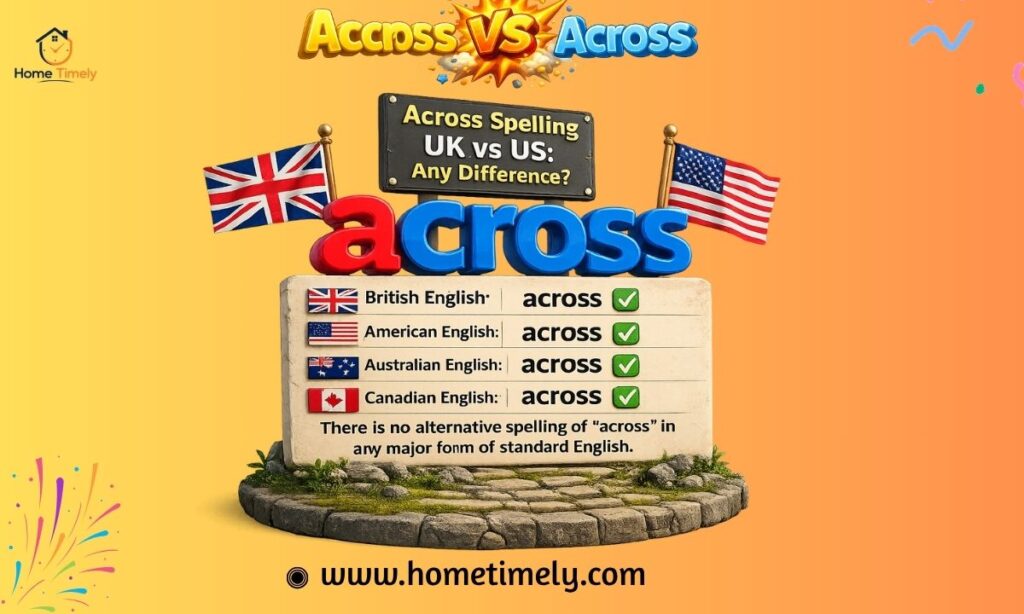
This is a fair question since British and American English do differ on several spellings — colour/color, organise/organize, centre/center, and so on.
However, “across” is identical in both dialects.
- British English: across ✅
- American English: across ✅
- Australian English: across ✅
- Canadian English: across ✅
There is no alternative spelling of “across” in any major form of standard English. Whether you are writing for a UK audience, a US audience, or an international one, the spelling is always and only across.
Is Accross Ever Correct to Use?
No. “Accross” is never correct — not in formal writing, not in casual writing, not as a variant, not as an archaic form, and not in any regional dialect.
It is not an older spelling that fell out of fashion. It is not a creative alternative. It is simply a mistake. Spell-check tools across all major platforms — Google Docs, Microsoft Word, Grammarly, Apple’s autocorrect — flag it immediately as wrong.
The only reason “accross” exists in written text is human error. Once corrected, there is no reason to ever use it again.
The Impact of Spelling Errors on Writing
You might think one misspelled word is trivial. In casual messages between friends, perhaps it is. But in professional, academic, or published writing, spelling mistakes carry real consequences.
Credibility — Readers judge writing quality quickly. A spelling error early in a piece signals carelessness and can cause readers to dismiss the content, even if the ideas are strong.
SEO performance — Search engines use natural language processing to evaluate content quality. Repeated spelling errors can signal low-quality content, which affects search rankings. A blogger who published multiple articles with “accross” and later corrected them reported improved rankings and reduced reader complaints after the audit.
Trust — In academic writing, legal documents, business proposals, and medical information, spelling errors erode trust. The reader begins to question whether other details in the document are equally careless.
Readability scores — Tools like Hemingway App and readability calculators consider spelling accuracy as part of overall writing quality.
The fix is always simple. When in doubt, remember: a + cross = across.
Practice Session
Fill in the Blanks
Complete each sentence by writing the correct spelling of the word in the blank.
- She walked __________ the bridge to reach the market on the other side.
- The news spread __________ the entire city within hours.
- He came __________ an old photograph while cleaning the attic.
- The police chased the suspect __________ three districts before making an arrest.
- The teacher struggled to get her point __________ to the distracted students.
Answers: All five blanks require across.
Multiple Choice Questions
1. Which sentence uses the correct spelling?
- a) She ran accross the park to catch the bus.
- b) She ran across the park to catch the bus. ✅
- c) She ran acros the park to catch the bus.
2. What does “across” mean in the sentence: “The shop is across the road”?
- a) Far away from the road
- b) On the opposite side of the road ✅
- c) Along the road
3. Which word correctly completes this sentence: “The company introduced an _____-the-board salary freeze”?
- a) accross-the-board
- b) across-the-board ✅
- c) a cross-the-board
4. “Across” functions as which part of speech in: “The river is half a mile across”?
- a) Preposition
- b) Adjective
- c) Adverb ✅
Common Mistakes Related to Across
1. Doubling the “C” — accross
The most common error. Writers type two c’s under the influence of phonetics or double-consonant patterns from other words. Fix: Remember a + cross = across. The word “cross” has one “c,” and adding “a-” changes nothing.
2. Confusing With “Cross”
Some writers use “cross” when they mean “across” — or vice versa.
- ❌ She cross the road carefully.
- ✅ She crossed the road carefully. (verb form of cross)
- ✅ She walked across the road carefully. (preposition)
“Cross” is a verb or noun. “Across” is a preposition or adverb. They are related in origin but different in function.
3. Misplacing Across in a Sentence
“Across” must refer to a surface or space. Placing it in a sentence where no surface or span exists creates awkward or incorrect phrasing.
- ❌ He was angry across his decision.
- ✅ He was angry about his decision. (no surface involved — use “about”)
- ✅ His anger was felt across the room. (a space is involved — “across” works)
Frequently Asked Questions (FAQs)
Q: Is “accross” ever acceptable in informal writing?
A: No. It is always a spelling error, regardless of context or formality.
Q: Where does the word “across” come from?
A: It comes from Middle English acrosse, combining the prefix a- with the word cross, rooted in Old French and Latin crux.
Q: Can “across” be used as an adjective?
A: Yes, in the hyphenated compound form, such as across-the-board.
Q: Is the spelling different in British and American English?
A: No. “Across” is spelled identically in all major varieties of English.
Q: What is the easiest way to remember the correct spelling?
A: Find the word cross inside across. One “c” in cross, one “c” in across.
Q: Can I use “across” and “through” interchangeably?
A: No. “Across” suits open, flat surfaces; “through” is for enclosed, three-dimensional spaces.
Q: Does spell-check catch “accross”?
A: Yes. Every major spell-checker — Grammarly, Word, Google Docs — flags it immediately.
Q: What are good synonyms for “across”?
A: Depending on context: over, throughout, spanning, opposite, or beyond.
Conclusion
The answer to accross vs across has never been ambiguous. “Across” is right. “Accross” is wrong. It has always been that way, and it will remain that way across every style guide, every dictionary, and every standard form of English ever written.
The word is simple to understand once you see its origin: a + cross = across. One prefix, one familiar word, one “c.” No doubling, no variation, no exception.
Correct spelling is not just about following rules — it is about communicating with precision and being taken seriously by your readers. Whether you are writing a professional email, an academic essay, a blog post, or a social media caption, the word you need is “across” — and now you will never second-guess it again.
Keep this guide bookmarked, share it with anyone who needs it, and the next time your fingers type that extra “c,” you will catch it immediately.

Michael Brook is the creator and author behind Healthy Leeks, a platform focused on grammar, writing skills, and English language learning. Passionate about clear communication and effective writing, Michael Brook shares practical grammar tips, easy-to-follow language guides, and educational content to help readers improve their English with confidence.