Have you ever typed “meating” in a professional email and hit send — only to cringe a second later? You are not alone. The confusion between meating vs meeting is one of the most searched grammar questions online, and it trips up both native and non-native English speakers every single day. One wrong letter can make your writing look careless, reduce your credibility, and even cause unintentional humor in a workplace context.
This guide breaks down everything you need to know — the origins, meanings, correct spellings, usage rules, and clever memory tricks — so you never make this mistake again.
Origins and Meanings of Meeting and Meating
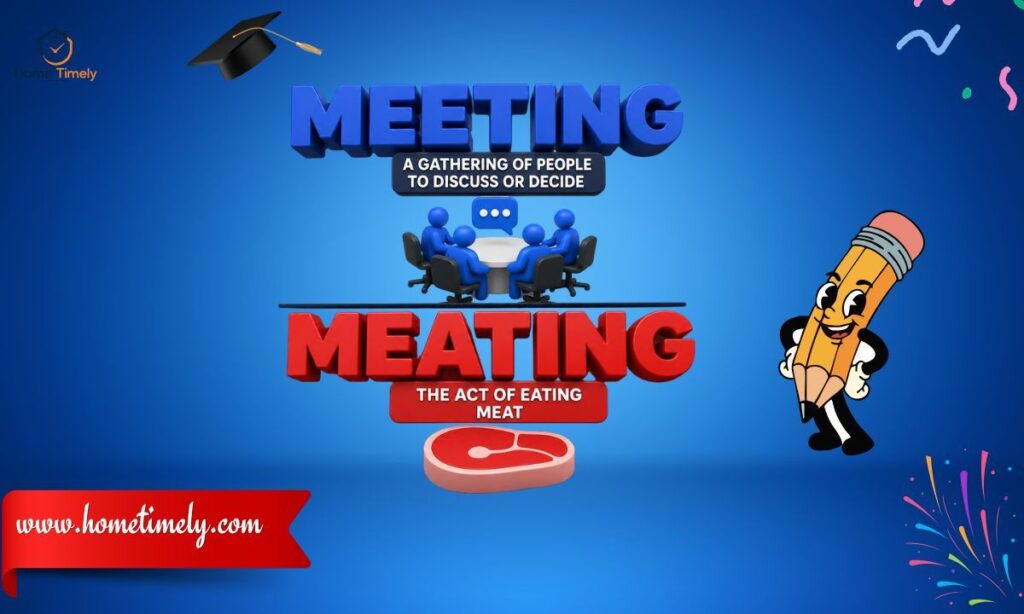
Meeting Meaning in English
The word meeting has deep roots in Old English. It derives from the verb “mētan,” which meant “to come upon” or “to encounter.” Over centuries, it evolved into the modern word meet, and with the addition of the suffix -ing, it became meeting — describing the act or event of people coming together.
Today, meeting is a noun that refers to any gathering of two or more people for a specific purpose. It appears in business, education, government, sports, and everyday social life.
Common definitions of “meeting” include:
- A formally arranged gathering of people to discuss topics or make decisions
- A casual or informal social get-together
- An unexpected or accidental encounter between people
- A place or point where two things come together (e.g., the meeting of two rivers)
- In Quaker tradition, an administrative unit of worship
Synonyms for meeting: assembly, conference, gathering, session, convention, huddle, congress, rendezvous, summit, conclave, encounter
Meating Meaning
Here is the honest answer: “meating” is not a recognized word in standard English. You will not find it in Merriam-Webster, Oxford, or Cambridge dictionaries as a valid term for modern use.
In extremely rare historical or archaic contexts, “meating” referred to feeding or eating arrangements — essentially, the action of providing or consuming meat. Some older texts used it in this niche sense, but this usage is virtually extinct in contemporary English.
For all practical purposes — emails, essays, presentations, workplace communication, or everyday conversation — meating is a spelling mistake.
Quick Rule: If your sentence is about people gathering, talking, or deciding something together, the correct word is always meeting.
Meting Meaning
Here is where things get a little more interesting. Unlike meating, the word meting is a real English word — and people often confuse it with meeting because they sound nearly identical when spoken.
Meting is the present participle of the verb “to mete,” which means to distribute, assign, or dispense something — most commonly punishment, justice, or rewards.
Examples:
- The judge was meting out sentences to the defendants.
- The coach meted out consequences for breaking team rules.
- The organization was criticized for meting out unfair penalties.
The key difference: meting is about distributing or assigning something; meeting is about people coming together.
Correct Spelling and Pronunciation
| Word | Correct Spelling | Pronunciation | Part of Speech |
| Meeting | M-E-E-T-I-N-G | /ˈmiːtɪŋ/ | Noun / Verb (present participle) |
| Meating | ❌ Incorrect spelling | — | Not a standard word |
| Meting | M-E-T-I-N-G | /ˈmiːtɪŋ/ | Verb (present participle of “mete”) |
Notice something important: meeting and meting are pronounced identically. That is exactly why writers get confused. The difference only shows up in spelling and context.
Spelling tip: Think of it as meet + ing. You meet people at a meeting. Double the “e” and you are always correct.
How to Use ‘Meeting’ in Sentences
The word meeting is versatile. It works as both a noun (a standalone thing) and as the present participle of the verb “meet.”
As a Noun:
- The board meeting starts at 9 a.m. sharp.
- She was nervous before her first meeting with the new clients.
- Can you send me the minutes from last week’s meeting?
- The town hall meeting drew over 200 residents.
- Our weekly team meeting covers project updates and blockers.
As a Present Participle (Verb Form):
- Meeting new people is one of the best parts of traveling.
- I enjoy meeting old friends for coffee.
- Meeting the deadline required everyone’s full effort.
In Compound Phrases:
- Meeting room, meeting agenda, meeting notes, meeting request, Google Meet meeting, parent-teacher meeting, annual general meeting (AGM)
Why ‘Meating’ is Usually Incorrect
Writers type “meating” for a few very understandable reasons:
- Pronunciation confusion — Both meat and meet sound like /miːt/, so adding -ing to either produces the same spoken sound.
- Autocorrect errors — Predictive text sometimes substitutes the wrong word, especially on mobile devices.
- Spelling by sound — English learners (and sometimes native speakers) spell what they hear rather than what is correct.
- Speed typing — Rushing through emails or messages makes it easy to hit an extra “a” without noticing.
The result? “I have a meating with the client tomorrow” — which sounds fine when read aloud but looks deeply unprofessional in writing.
Bottom line: Unless you are writing about archaic eating arrangements (which almost no one is), meating is always a typo. Replace it with meeting every single time.
Common Confusions and Mistakes
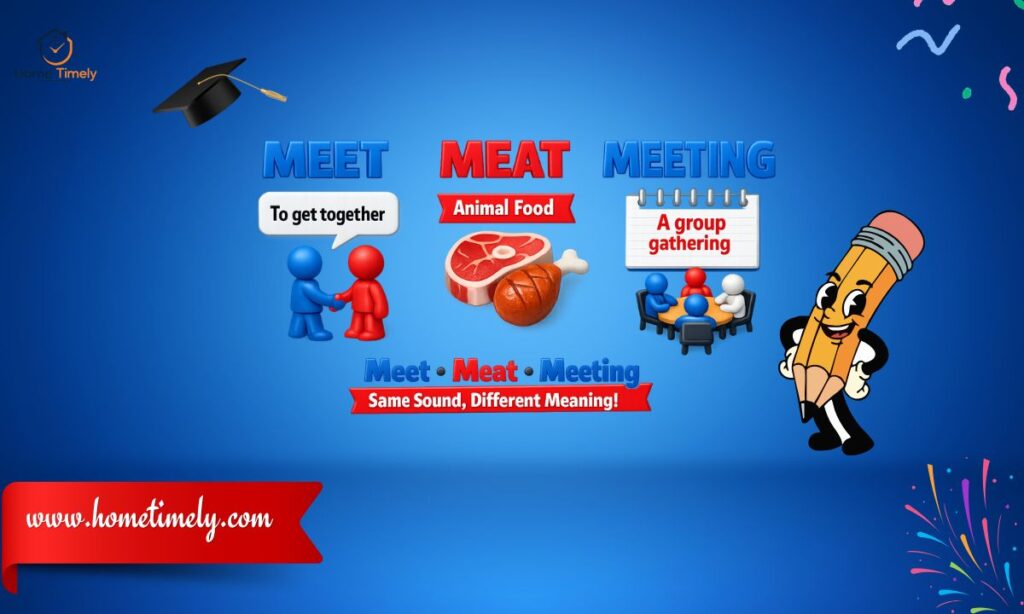
Meet vs Meat vs Meeting
These three words are among the most commonly confused in English, especially by learners. Here is a clear breakdown:
| Word | Type | Meaning | Example |
| Meet | Verb | To come together with someone | Let’s meet for lunch tomorrow. |
| Meat | Noun | Animal flesh used as food | The chef seasoned the meat carefully. |
| Meeting | Noun / Verb (present participle) | A gathering of people; the act of meeting | The meeting has been rescheduled. |
Why it is confusing: All three share the same /miːt/ sound. Context is everything. Ask yourself: Am I talking about food, an action, or a gathering?
Meeting vs Meting
| Word | Root Verb | Meaning | Typical Context |
| Meeting | Meet | A gathering of people | Business, school, social, virtual |
| Meting | Mete | Distributing or assigning something | Legal, formal, disciplinary contexts |
Mnemonic device: “In a meeting, we greet. When meting, we treat.”
The word meting is most common in legal or formal writing. You will rarely encounter it in everyday conversation, which makes meeting the far safer and more common choice.
Spelling Mistakes in English: Why They Happen
English spelling is notoriously inconsistent. Words that sound identical (homophones) but are spelled differently — like meet/meat, to/too/two, their/there/they’re — create countless opportunities for error. Add the pressure of fast communication, autocorrect, and second-language learning, and it is no surprise that meating shows up regularly in written English.
Common spelling mistakes related to this topic:
- Writing meating instead of meeting
- Confusing meting with meeting
- Spelling meet as meat in phrases like “nice to meat you” (a common pun, but an error in serious writing)
- Omitting one “e” to write meting when meeting is intended
Professional communication — emails, reports, proposals, assignments — demands accurate spelling. A single error like meating can undermine the credibility of an otherwise excellent document.
Scenarios
Real-Life Scenarios Where the Mistake Happens
Scenario 1 — The Office Email
❌ “Please confirm your availability for the project meating on Friday.” ✅ “Please confirm your availability for the project meeting on Friday.”
Scenario 2 — The School Notice
❌ “Parent-teacher meating is scheduled for next Tuesday evening.” ✅ “Parent-teacher meeting is scheduled for next Tuesday evening.”
Scenario 3 — The Calendar Invite
❌ “Join the meating link below for the weekly sync.” ✅ “Join the meeting link below for the weekly sync.”
Scenario 4 — The Legal Document
❌ “The committee was meeting out penalties to rule violators.” ✅ “The committee was meting out penalties to rule violators.”
Examples for Clarity
Correct Usage of “Meeting”
- The annual general meeting drew shareholders from around the country.
- She is responsible for scheduling the team’s weekly meeting.
- It was a chance meeting — they ran into each other at the airport.
- The merger was finalized at a boardroom meeting last Thursday.
- Meeting deadlines consistently is what sets great professionals apart.
Correct Usage of “Meting”
- The principal was firm about meting out fair consequences.
- The court was slow in meting out justice to the accused.
Incorrect Usage (Common Errors to Avoid)
- ❌ “We have a meating with investors at noon.” → ✅ “We have a meeting with investors at noon.”
- ❌ “The new manager is known for meeting out punishments quickly.” → ✅ “The new manager is known for meting out punishments quickly.”
Practice Session: Meating vs Meeting
Test your understanding with these quick exercises.
Fill in the Blank
Fill each blank with the correct word: meeting, meting, or meat.
- The HR team called an emergency ________ to address the policy changes.
- The butcher carefully wrapped the ________ before refrigerating it.
- The judge was known for ________ out unusually strict sentences.
- Our next project ________ is on Wednesday at 3 p.m.
- She has been ________ new colleagues at every department event.
Correct the Sentences
Identify and fix the error in each sentence:
- “I’ll be in a client meating all morning.”
- “He is meeting out rewards to top performers.”
- “Please share the meating agenda before Thursday.”
- “Nice to meat you at the conference!”
- “The committee is responsible for meeting out disciplinary action.”
Scenarios
Scenario A: Your manager sends a message: “Can we schedule a meating for tomorrow?” — Is this correct? What should it say?
Scenario B: A news headline reads: “Court meting out strict sentences to fraud suspects.” — Is this correct?
Scenario C: A party invitation says: “Join us for a casual meating at the park on Saturday.” — What is wrong here?
Answers
Fill in the Blank:
- meeting | 2. meat | 3. meting | 4. meeting | 5. meeting
Correct the Sentences:
- ✅ “I’ll be in a client meeting all morning.”
- ✅ “He is meting out rewards to top performers.”
- ✅ “Please share the meeting agenda before Thursday.”
- ✅ “Nice to meet you at the conference!” (acceptable as a pun but wrong in formal writing)
- ✅ “The committee is responsible for meting out disciplinary action.”
Scenarios:
- A: No, it is incorrect. It should read: “Can we schedule a meeting for tomorrow?”
- B: Yes, this is correct. Meting out is the right phrase here.
- C: Meating should be meeting — it is a spelling error
Tips to Avoid Mistakes
Simple Tips to Never Make This Mistake Again
- Always proofread before sending. Even a two-second scan catches errors that autocorrect misses.
- Use spell-check, but do not rely on it alone. Spell-checkers sometimes miss homophones.
- Ask: What am I describing? If it is a gathering of people → meeting. If it is dispensing justice or punishment → meting. If it is food → meat.
- Type slowly for important documents. Speed is the enemy of accuracy in professional writing.
- Read your text aloud. Your brain often catches errors when you hear them spoken.
Easy Memory Hacks
Hack 1 — The “meet + ing” trick Break the word down: MEET (verb) + ING (suffix) = MEETING. You meet people, so you are going to a meeting. Never “meating.”
Hack 2 — Double E = People Whenever two or more people are involved, you need the double “E.” Two E’s, two (or more) people. MEETING.
Hack 3 — The Food Test If your sentence could involve a kitchen or a plate of food, you might mean meat. If it involves a conference room, a Zoom link, or a school hall, you definitely mean meeting.
Hack 4 — The Justice Rhyme “Meting is for treating (distributing justice). Meeting is for greeting (gathering together).”
Hack 5 — Autocorrect Is Not Your Editor Never trust autocorrect with professional writing. Always do a final manual review before hitting send.
Frequently Asked Questions (FAQs)
Q: Is “meating” ever a correct word?
A: Rarely. It appears in some archaic texts to describe eating or feeding arrangements, but it is not accepted in modern standard English.
Q: What is the correct spelling — meeting or meating?
A: Meeting is always correct for describing a gathering or assembly of people.
Q: Why do people write “meating” instead of “meeting”?
A: Usually because of typing speed, pronunciation similarity, or autocorrect errors on mobile devices.
Q: What does “meting” mean?
A: Meting means distributing or assigning something — most often used in phrases like “meting out justice or punishment.”
Q: Can spelling errors like “meating” affect my professional image?
A: Yes. Frequent spelling mistakes reduce readability and can undermine your credibility in emails, reports, and formal documents.
Q: Are “meeting” and “meting” pronounced the same way?
A: Yes, both are pronounced /ˈmiːtɪŋ/ — the difference only appears in written form and context.
Q: How do I remember when to use “meting” vs “meeting”?
A: Use this rhyme: “Meting is for treating; meeting is for greeting.”
Conclusion
The difference between meating vs meeting comes down to one simple fact: meating is almost always a spelling error, while meeting is the correct, universally accepted word for any gathering of people — whether it is a boardroom session, a school assembly, or a casual catch-up with friends.
And when you see meting — know that it is a completely different word, rooted in the verb mete, used specifically for distributing or assigning things like justice, punishment, or rewards.
Master these three straightforward rules:
- Meeting = people coming together for a purpose ✅
- Meating = almost always a typo ❌
- Meting = distributing or assigning something ✅
With the memory hacks, practice exercises, and examples in this guide, you now have everything you need to write with confidence and never mix these words up again. Proofread once, remember the “meet + ing” rule, and your professional writing will always be on point.

Michael Brook is the creator and author behind Healthy Leeks, a platform focused on grammar, writing skills, and English language learning. Passionate about clear communication and effective writing, Michael Brook shares practical grammar tips, easy-to-follow language guides, and educational content to help readers improve their English with confidence.


