
Ever typed a word and then stared at it, wondering if it looked right? That’s exactly what happens with dought vs doubt. These two words sound almost identical, yet only one belongs in modern English writing. If you’ve ever second-guessed your spelling mid-sentence, you’re in very good company — thousands of learners make this mistake every single day.
This guide cuts straight to the truth: what each word means, why the confusion happens, how to spell and pronounce “doubt” correctly, and how to use it with full confidence going forward.
Quick Answer: Dought vs Doubt
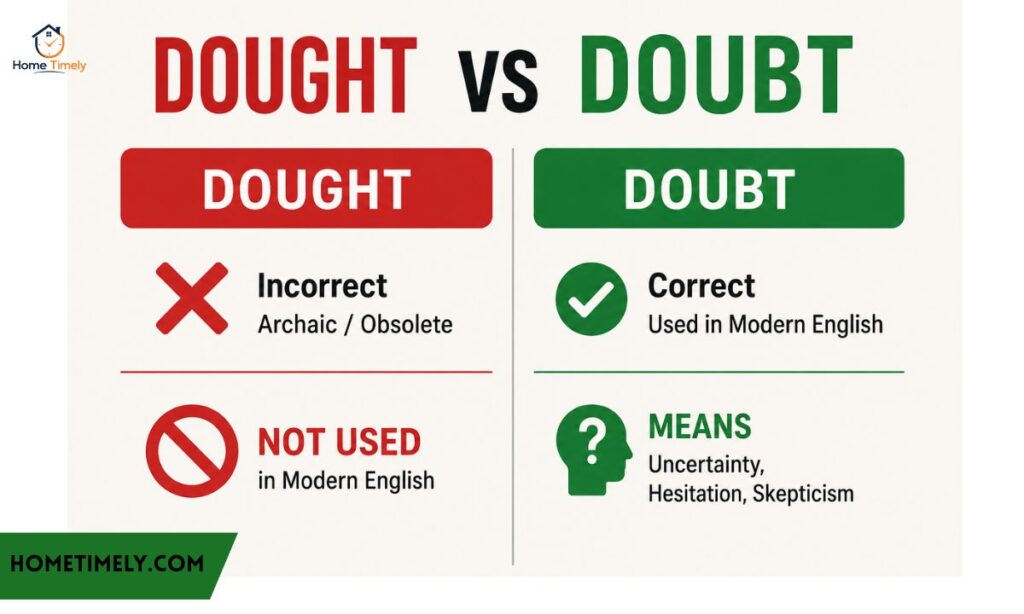
| Feature | Doubt | Dought |
| Correct in Modern English? | ✅ Yes | ❌ No (archaic/obsolete) |
| Pronunciation | /daʊt/ (rhymes with “out”) | Same sound — but incorrect spelling |
| Part of Speech | Noun and Verb | N/A in modern usage |
| Meaning | Uncertainty, hesitation, skepticism | Archaic; historical or dialect use only |
| Used in Formal Writing? | ✅ Always | ❌ Never |
Bottom line: In all modern writing — academic, professional, or casual — use doubt. “Dought” is not a standard word and will be flagged as an error by every grammar tool and dictionary.
Why This Confusion Occurs
The dought vs doubt mix-up is not a carelessness problem. It’s a brain pattern problem — and once you understand it, the mistake becomes almost impossible to repeat.
Here’s what’s happening in your head:
- You hear the word “doubt” spoken aloud — it sounds exactly like “dowt.”
- Your brain searches for similar-sounding words it already knows: thought, bought, fought, brought.
- All of those words end in -ought, so your brain guesses: “maybe it’s spelled dought?”
- You write “dought” — and it feels right, because it fits the pattern.
This is a completely logical mistake. The problem is that English doesn’t always follow logic. “Doubt” contains a silent “b” that disappears in speech but must stay in writing. That invisible letter is the source of almost all the confusion.
Difference Between Doubt and Dought
Let’s be direct about the distinction here.
Doubt is the correct, widely accepted spelling in all forms of modern English. It functions as both a noun and a verb, and it expresses uncertainty, hesitation, or lack of conviction.
Dought is an archaic word with roots in Middle English and Old Scottish dialects. Depending on the historical context, it could mean courage or bravery, or it appeared as an alternative past-tense form of the verb “dare.” In some older texts, it was also loosely connected to dough (as in bread dough). None of these meanings overlap with “doubt,” and the word has no place in contemporary writing.
Key distinction: These words don’t just differ in spelling — they have entirely different meanings. Writing “dought” when you mean uncertainty isn’t just a typo; it’s technically a different (and obsolete) word entirely.
Doubt Meaning in English
The word doubt refers to a mental state of uncertainty — when the mind is suspended between two possibilities and cannot commit to either. It carries a sense of hesitation, skepticism, or lack of full belief.
Merriam-Webster defines it as: “uncertainty of belief or opinion” and “to be uncertain about something.”
Doubt can be:
- Mild — a small hesitation before making a decision
- Strong — a deep disbelief in something’s truth or reliability
- Philosophical — as in Descartes’ famous method of radical doubt, questioning everything to find certainty
The word covers a wide emotional and intellectual range, from everyday second-guessing to serious skepticism.
Doubt as a Noun and Verb
One of the things that makes “doubt” especially useful is its flexibility. It works as both a noun and a verb without any change in spelling.
Doubt as a Noun
When used as a noun, “doubt” refers to a feeling or state of uncertainty.
- She had serious doubts about the investment.
- There is no doubt that he is the right person for the job.
- His doubt grew stronger as the evidence unraveled.
Doubt as a Verb
When used as a verb, “doubt” means to question, distrust, or feel uncertain about something.
- I doubt he will arrive on time.
- She doubted the accuracy of the report.
- We doubted whether the plan would succeed.
Tip: When “doubt” is a verb, it is often followed by “that,” “whether,” or “if” — for example, “I doubt that this will work” or “She doubted whether the results were real.”
Doubt Pronunciation and the Silent “B”
The correct pronunciation of “doubt” is /daʊt/ — it rhymes perfectly with words like out, shout, and clout.
The “b” is completely silent. You do not say “dowbt.” You say “dowt.”
Pronunciation Breakdown
| Letter(s) | Sound |
| D | /d/ |
| ou | /aʊ/ (like “ow” in “cow”) |
| b | Silent — not pronounced |
| t | /t/ |
Full word: /daʊt/
Why Is the “B” Silent in Doubt?
This is one of the most fascinating corners of English history — and knowing it makes “doubt” much easier to remember.
The word “doubt” traces back through Old French (doute, douter) to the Latin root “dubitare” — meaning to waver, hesitate, or be uncertain. In Latin, the “b” was fully pronounced. But when the word passed through Old French into early Middle English, the pronunciation softened and the “b” sound disappeared entirely. In fact, for a period in early Middle English, the word was simply spelled “doute” — no “b” at all.
Here’s the twist: during the 15th and 16th centuries, Renaissance scholars in England wanted to reconnect English words to their classical Latin ancestors. They deliberately reinserted the “b” into “doubt” — along with the “b” in debt (from Latin debitum) and subtle (from Latin subtilis) — to honor the Latin etymology. By then, nobody was pronouncing that “b” anymore, but it stayed in the spelling permanently.
As linguist Gina Cooke points out, this actually makes beautiful sense: the root of “doubt” is connected to the root of the word “double” — and having a doubt is literally having two takes on something at once. The “b” silently ties those two ideas together.
Memory trick: Think of the “b” in “doubt” as the word’s quiet history — present but not heard, just like uncertainty itself.
What Is Dought Meaning?
To be thorough: “dought” does carry some meaning in very old and specialized contexts.
- In Middle English and Scottish dialects, “dought” appeared as a past-tense form of the verb “dow” or “dare,” conveying the idea of being able or having courage.
- In some historical texts, it was connected loosely to dough (unbaked bread).
- In extremely rare literary or historical writing, it expressed bravery or valor.
However, none of these meanings intersect with the modern word “doubt.” A reader today encountering “dought” would likely assume it’s a typo. It does not appear in any standard modern English dictionary as an active word.
Why People Write “Dought” Instead of “Doubt”
Understanding the psychology behind this mistake makes it much easier to avoid. Here are the core reasons:
- Phonetic spelling habit — Writers spell what they hear. “Doubt” sounds like “dowt,” so they reach for a spelling that matches familiar sound patterns.
- The -ought analogy — Words like thought, bought, fought, brought, and sought all end in -ought. The brain borrows this pattern for “doubt.”
- Silent letter confusion — English has many silent letters (knife, kneel, wrong, wrap), and they don’t follow simple rules. The silent “b” in “doubt” trips up even confident writers.
- ESL learner patterns — For speakers of phonetic languages, English’s inconsistent spelling is especially challenging.
- Autocorrect dependency — Many writers rely on tools to catch errors, so they never deeply learn the rule themselves.
How to Spell Doubt Correctly
Here are four reliable strategies to lock in the correct spelling forever:
- Use the word “double” as your anchor. Doubt and double share the same Latin root. Both have a “b.” When in doubt (pun intended), think: double → doubt.
- Remember the phrase “beyond a doubt.” Repeat it, write it, say it. The “b” in “beyond” primes you to remember the “b” in “doubt.”
- Visualize the word. Picture D-O-U-B-T in your mind. The “b” is sitting quietly between the “u” and the “t” — present but silent.
- Associate it with debt and subtle. All three words have a silent “b” added by Renaissance scholars. Learn all three together, and the pattern sticks.
How to Use Doubt in a Sentence Correctly
Using “doubt” correctly depends on whether you’re using it as a noun or a verb. Here are clear guidelines with examples:
As a Verb:
- Follow “doubt” with “that” when you lean toward disbelief: I doubt that she will call.
- Follow “doubt” with “whether” or “if” when the outcome is genuinely uncertain: I doubt whether this plan is realistic.
As a Noun:
- Use with “no,” “some,” “any,” or “little”: There is no doubt about his talent.
- Use in the plural when referring to multiple uncertainties: She had her doubts before signing the contract.
Common Structures:
- “There is no doubt that…” — expresses certainty
- “I have my doubts about…” — expresses mild skepticism
- “Beyond a shadow of a doubt” — means with absolute certainty
- “Cast doubt on…” — means to cause uncertainty about something
- “Give someone the benefit of the doubt” — means to trust someone despite uncertainty
Dought vs Doubt Examples
These side-by-side examples show exactly what to write — and what not to write:
| ❌ Incorrect (Dought) | ✅ Correct (Doubt) |
| I dought he will finish on time. | I doubt he will finish on time. |
| She had doughts about the deal. | She had doubts about the deal. |
| There is no dought about it. | There is no doubt about it. |
| He doughted her explanation. | He doubted her explanation. |
| I dought it will work. | I doubt it will work. |
| Without a dought, she’s the best. | Without a doubt, she’s the best. |
The pattern is clear. Every single time you feel uncertainty in a sentence, “doubt” is the word. “Dought” never fits.
Doubt Synonym and Related Vocabulary
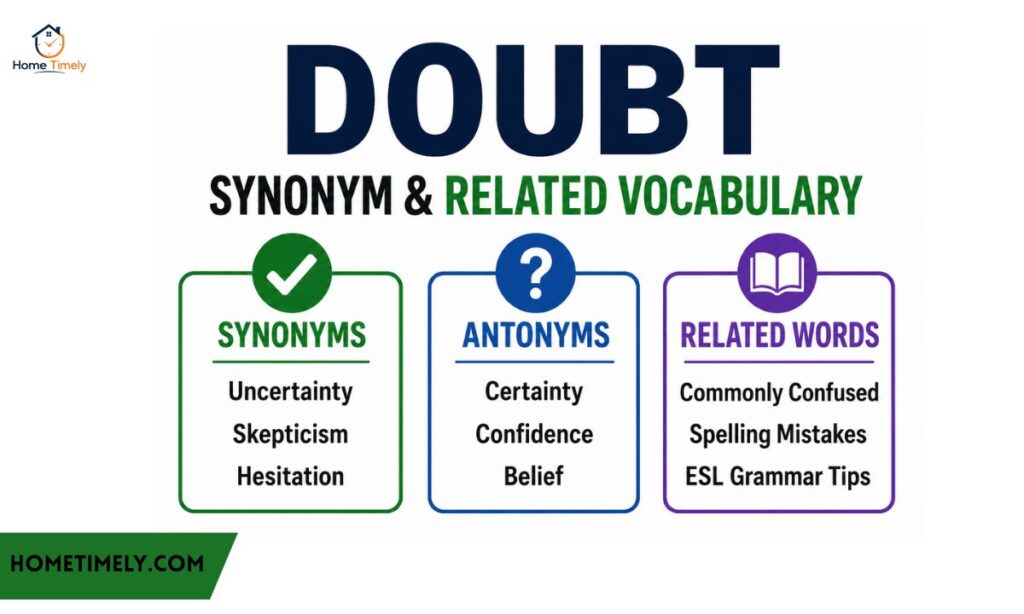
Expanding your vocabulary around “doubt” helps you write with variety and precision.
Synonyms for doubt (noun):
- Uncertainty
- Skepticism
- Hesitation
- Misgiving
- Reservation
- Suspicion
- Qualm
- Distrust
Synonyms for doubt (verb):
- Question
- Distrust
- Disbelieve
- Query
- Challenge
- Second-guess
- Harbor reservations about
Antonyms of doubt:
- Certainty
- Confidence
- Belief
- Trust
- Conviction
- Assurance
Related vocabulary (LSI keywords):
- Silent letters in English
- Commonly confused words
- Spelling mistakes in English
- Homophones in English
- ESL grammar tips
- Word origins and etymology
- English spelling rules
Context and Proper Usage
The right word always depends on context. Here’s how “doubt” fits naturally across different registers:
Everyday conversation: “I doubt we’ll get a table without a reservation.”
Academic writing: “Researchers expressed doubt regarding the validity of the preliminary results.”
Professional communication: “There is little doubt that the merger will reshape the competitive landscape.”
Literary or creative writing: “A quiet doubt lingered in her mind long after the conversation ended.”
Legal context: “The jury must convict only if guilt is proven beyond a reasonable doubt.”
In every case above, “dought” would be incorrect, confusing, and unprofessional.
The Impact of a Minor Error
It might feel like a small thing — one wrong letter in one word. But spelling errors, especially in formal writing, carry real consequences.
- In academic settings, consistent spelling errors can affect grades and credibility.
- In professional emails and reports, they create an impression of carelessness.
- In published content, they erode trust with readers.
- In job applications, they can eliminate a candidate before an interview.
The good news: this is one of the easiest fixes in English. Once you know the rule, you will never write “dought” again.
Common Spelling Mistakes in English
The dought/doubt confusion belongs to a well-known family of silent letter errors. Here are other common ones worth knowing:
| Word | Incorrect Version | Silent Letter |
| Doubt | Dought / Dowt | B |
| Debt | Det / Dett | B |
| Subtle | Suttle / Sutle | B |
| Knife | Nife | K |
| Knight | Nite | Kn |
| Wrap | Rap (as spelling) | W |
| Psychology | Sychology | P |
| Wednesday | Wendsday | D |
Recognizing this pattern across multiple words makes your spelling sharper overall.
Practice Session
Test yourself with these exercises to solidify your understanding.
Fill in the Blank
(Answer: doubt in each case)
- I ______ that the report was completed on time.
- There is no ______ she is the most qualified candidate.
- He had serious ______s before accepting the offer.
- Without a ______, this is the best solution available.
- She ______ed whether the information was accurate.
Sentence Correction
Find and fix the error:
- ❌ “I have a dought about this decision.” → ✅ “I have a doubt about this decision.”
- ❌ “She doughted his loyalty.” → ✅ “She doubted his loyalty.”
- ❌ “There is no dought he passed the exam.” → ✅ “There is no doubt he passed the exam.”
- ❌ “He expressed dought about the findings.” → ✅ “He expressed doubt about the findings.”
Pronunciation Practice
Say each of these aloud. Notice that all rhyme with “doubt” (/daʊt/):
- Out
- Shout
- Clout
- Scout
- Stout
- Doubt ✅
Context Challenge
Which sentence uses “doubt” correctly?
A. The baker kneaded the doubt for ten minutes. B. I doubt she received the message in time. C. He was dought about the outcome.
Answer: B — “doubt” is used correctly as a verb expressing uncertainty.
Synonym Replacement
Replace the underlined word with the correct form of “doubt”:
- She questioned the doctor’s diagnosis. → She doubted the doctor’s diagnosis.
- He had misgivings about the partnership. → He had doubts about the partnership.
- I distrust that version of events. → I doubt that version of events.
Key Takeaways
- ✅ Doubt is the only correct spelling in modern English for expressing uncertainty or hesitation.
- ❌ Dought is an archaic, obsolete word with no place in contemporary writing.
- The silent “b” in “doubt” was reinserted by Renaissance scholars to honor its Latin root dubitare.
- The word is pronounced /daʊt/ — the “b” makes no sound.
- “Doubt” works as both a noun (“I have doubts”) and a verb (“I doubt it”).
- Connect “doubt” to “double” — they share the same Latin root, and both have a silent “b.”
- Spelling errors like this one can quietly damage your professional and academic credibility.
Frequently Asked Questions
Is “dought” a real word? It exists as an archaic term in historical and dialectal English, but it has no use in modern writing.
How do you pronounce “doubt”? It’s pronounced /daʊt/ — rhymes with “out.” The “b” is completely silent.
Why does “doubt” have a silent “b”? Renaissance scholars in the 1500s reinserted the “b” to reflect its Latin ancestor dubitare, even though the sound had long since disappeared.
Can I use “dought” instead of “doubt”? No. In any modern context — formal, casual, academic, or professional — only “doubt” is correct.
What is the opposite of doubt? The primary antonyms are certainty, confidence, conviction, and trust.
Is “doubt” a noun or a verb? Both. It functions as a noun (“she had her doubts”) and a verb (“I doubt it will work”).
What does “benefit of the doubt” mean? It means trusting someone or assuming good intent despite lacking full proof.
Can “dought” appear in a recipe? No — the correct culinary term is “dough,” not “dought.”
Is “I doubt it” a grammatically correct phrase? Yes. It means “I don’t think that’s true” and is perfectly correct in both formal and informal English.
What is “beyond a reasonable doubt”? It’s a legal standard meaning the evidence is so strong that no sensible person would question a defendant’s guilt.
Conclusion
The dought vs doubt confusion is a perfect example of how English spelling and English pronunciation go their separate ways — and how a single silent letter can create so much trouble. The word is doubt, always spelled with a quiet “b” that traces back centuries to Latin scholarship. Once you understand why that “b” is there, the spelling clicks into place permanently.
From this point forward, whenever you feel uncertain about something, reach for the word that perfectly captures that feeling: doubt — with its hidden “b,” its rich history, and its clear, confident place in the English language.
Write with doubt about nothing.

Michael Brook is the creator and author behind Healthy Leeks, a platform focused on grammar, writing skills, and English language learning. Passionate about clear communication and effective writing, Michael Brook shares practical grammar tips, easy-to-follow language guides, and educational content to help readers improve their English with confidence.


