If you have ever typed the word “submittion” and paused to wonder whether it looked right — you are not alone. This is one of the most common English spelling mistakes made by students, professionals, and non-native speakers alike. The short answer? “Submittion” is not a word. The correct spelling is always “submission.”
But knowing what is correct is only half the battle. Understanding why — and learning how to use “submission” confidently in academic, legal, and professional writing — is what this guide is all about. By the end, you will never second-guess this word again.
Which One Is Correct? Submission vs Submittion
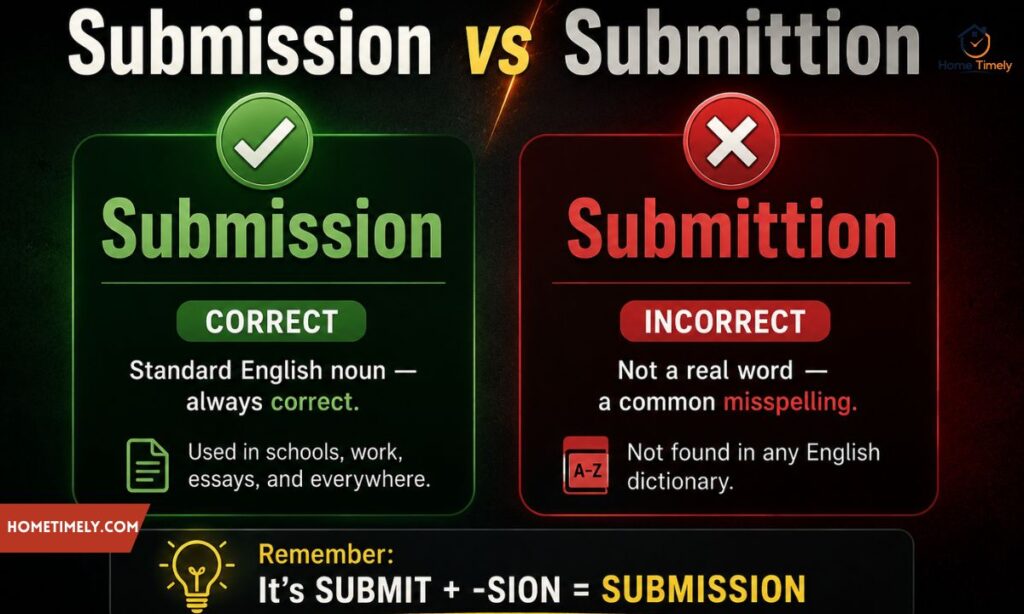
| Word | Correct? | Usage |
| Submission | ✅ Yes | Standard English noun — always correct |
| Submittion | ❌ No | Not a real word — a common misspelling |
The answer is clear: submission is the only correct spelling. “Submittion” does not appear in any English dictionary — not Merriam-Webster, Oxford, or Cambridge. It is a misspelling, plain and simple.
Meaning of Submission
Submission is a noun with several related meanings depending on the context:
- The act of presenting something for review or consideration — handing in a document, form, essay, or proposal.
- The act of yielding to authority or a superior force — accepting someone else’s control or power.
- A document or piece of work that has been submitted — the submission itself as an object.
Examples:
- Her submission for the short story contest was selected as the winner.
- The rebels’ submission came after weeks of negotiation.
- Online form submission is usually confirmed by email within minutes.
The word traces back to Latin — submissio — meaning “a lowering” or “a yielding,” derived from submittere (to let down, to yield). This Latin root is exactly why the spelling is “submission,” not “submittion.”
Why “Submittion” Is Incorrect
People write “submittion” because English is full of verbs that turn into nouns ending in “-tion.” Words like permission, admission, commission, and omission seem to suggest that “submittion” should work the same way.
However, English spelling — especially for words with Latin roots — does not always follow a simple sound-based pattern. When a verb ending in -mit becomes a noun, the transformation follows a specific rule:
-mit → -mission (not -mittion)
This happens because the Latin root submittere transforms through a process called assimilation, where the double “t” becomes “ss” before the “-ion” suffix is added. Think of these parallel examples:
| Verb | Noun Form |
| submit | submission |
| permit | permission |
| admit | admission |
| commit | commission |
| omit | omission |
The pattern is consistent. Every verb ending in “-mit” produces a noun ending in “-mission.” There is no “-mittion” in English — not for submit, permit, or any other word in this family.
How to Spell Submission Correctly
Break it down into syllables: sub – mis – sion
- sub- = the prefix meaning “under” or “below”
- -mis- = from the Latin mittere (to send)
- -sion = the noun suffix
A helpful memory trick: think of it as “sub + mission.” You are sending something on a mission — a sub-mission. This visual cue makes the correct spelling stick immediately.
Correct spelling: S – U – B – M – I – S – S – I – O – N
Pronunciation: /səbˈmɪʃ.ən/ (suh-MISH-un)
Common Spelling Mistakes of Submission
Writers make several errors with this word beyond the “submittion” mistake. Here are the most common ones to watch for:
| Misspelling | Error Type |
| submittion | Added extra “t” |
| submition | Missing one “s” |
| submision | Missing one “s” |
| submissoin | Transposed letters |
| submisson | Missing “i” |
Each of these falls under the category of common English spelling errors. The safest habit is to always run a spell check and understand the word’s structure — because autocorrect does not always catch every variation.
Submission: Grammar Usage and Word Forms
Submission is a noun. It does not change form the way verbs do, but the related verb submit has several forms you should know:
| Form | Word | Example Sentence |
| Base verb | submit | I will submit the form today. |
| Past tense | submitted | She submitted her essay yesterday. |
| Present participle | submitting | He is submitting the documents now. |
| Noun (completed act) | submission | The submission was received on time. |
| Plural noun | submissions | All submissions must follow the guidelines. |
Submission vs Submitting: These are not interchangeable. Submitting describes the ongoing action (“I am submitting”), while submission refers to the completed act or the submitted item itself (“My submission is ready”).
Submission vs Submittal
Both “submission” and “submittal” are real English words — but they are not always interchangeable.
| Feature | Submission | Submittal |
| Recognized in dictionaries | ✅ Yes | ✅ Yes |
| Common usage | General — academia, law, business | Technical — construction, engineering |
| British English preference | ✅ More common | Less common |
| American English preference | Common | Also used in specific industries |
| Can refer to the document itself | ✅ Yes | Less commonly |
| Connotation | Broad (yielding + presenting) | Narrowly tied to the act of sending |
According to language experts, submission is clearer and more traditional in almost all contexts. Submittal has a specialized niche in construction management and engineering, where it refers specifically to shop drawings, material data, and samples submitted to an architect for approval.
In everyday writing, academic work, and legal contexts — always use “submission.”
Submission of a Document in Real Life
When someone refers to “submission of a document,” they mean the formal act of delivering that document to the relevant party for review, processing, or judgment. Here are real-life examples:
- Job application: Your résumé and cover letter become a submission once they are sent.
- Academic paper: A student’s essay handed in to a professor is a submission.
- Legal filing: Evidence or arguments presented to a court are submissions.
- Creative writing: A manuscript sent to a publisher is a submission.
- Online forms: Clicking “Send” on a web form completes the submission.
In each case, the word “submission” captures both the act and the item — making it a versatile and powerful noun.
Submission Date Meaning and Importance
A submission date is the deadline by which something must be submitted to be considered valid or accepted. Missing a submission date can have real consequences:
- In academics, late submissions often result in grade penalties or rejection.
- In business, missing a proposal submission date can mean losing a contract.
- In legal settings, submissions filed after the deadline may be dismissed entirely.
- In publishing, submission windows are strict — editors will not review late entries.
Always treat the submission date as a hard deadline, not a guideline.
Submission in Academic and Legal Contexts
Submission in Education
In academic settings, “submission” is one of the most frequently used words. It refers to:
- Submitting assignments, essays, or research papers to instructors
- The process of turning in a thesis or dissertation
- Sending academic manuscripts to journals for peer review
- Uploading coursework through online learning management systems (LMS)
Academic institutions often have formal submission portals, submission guidelines, and strict submission deadlines. Understanding this vocabulary is essential for students at every level.
Submission in Legal or Formal Contexts
In law and formal settings, “submission” carries significant weight:
- Lawyers make submissions to the court — presenting arguments or evidence for a judge’s consideration.
- Written submissions are formal documents filed as part of a legal proceeding.
- A voluntary submission to jurisdiction means a party has agreed to be bound by a court’s authority.
- Arbitration submissions refer to disputes formally referred to an arbitrator.
In these contexts, precision in language matters enormously. Using “submittion” in a legal document would immediately signal a lack of care and professionalism.
Submission in Business
In professional environments, submissions arise in many forms:
- Proposal submissions for new projects or contracts
- Budget submissions for approval by senior management
- Report submissions at the end of a quarter or fiscal year
- Content submissions for company blogs, newsletters, or publications
A well-timed, well-formatted submission can be the difference between winning and losing a business opportunity.
Submission vs Application
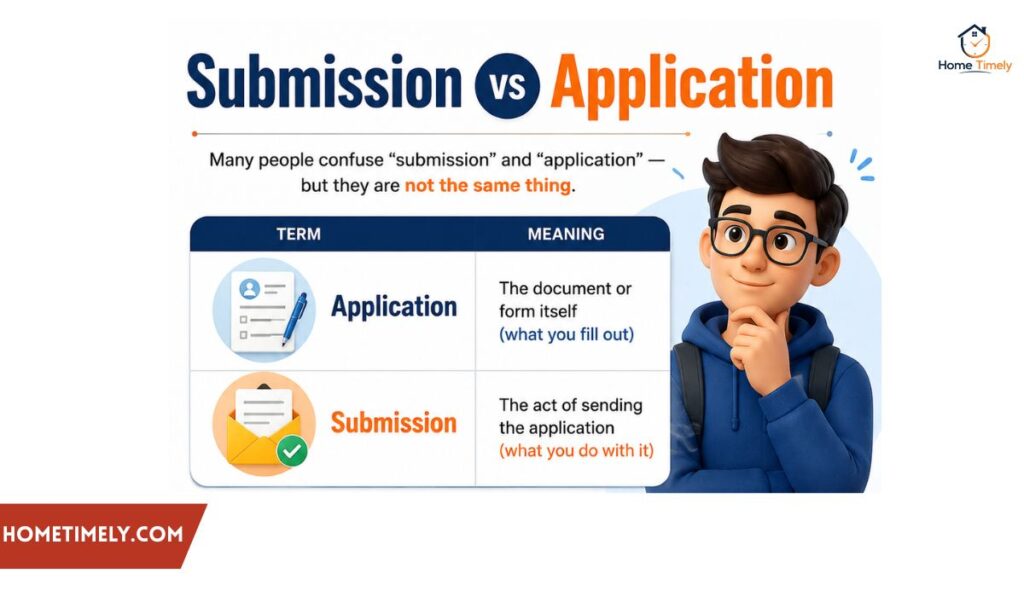
Many people confuse “submission” and “application” — but they are not the same thing.
| Term | Meaning |
| Application | The document or form itself (what you fill out) |
| Submission | The act of sending the application (what you do with it) |
Think of it this way: you submit an application. Once it has been sent, the application is now a submission. The application is the content; the submission is the act and record of delivering it.
Example:
- She completed her application for the scholarship. (filling it out)
- Her submission was received before the deadline. (after sending it)
Common Mistakes to Avoid
Here is a quick reference list of errors writers make related to this word:
- ❌ Writing “submittion” instead of “submission”
- ❌ Using “submition” (missing one “s”)
- ❌ Confusing “submitting” (verb) with “submission” (noun)
- ❌ Using “submittal” in general writing where “submission” is more appropriate
- ❌ Treating “application” and “submission” as the same thing
- ❌ Forgetting the double “s” in the middle: sub-ss-ion
Practice Session
Fill in the Blank
Choose submission or submittion to complete each sentence. (Remember: only one is a real word.)
- The professor reminded the class that the final _______ of essays is due Friday.
- I made a late _______ of my tax documents and received a penalty.
- Your _______ will be reviewed by the admissions committee next week.
- Online form _______ is usually confirmed by email.
- He accidentally typed “submittion” instead of the correct word — _______.
(Answers: All five blanks = submission)
Correct the Mistakes
Rewrite the following sentences correctly:
- I completed my submittion for the scholarship on time. ✅ I completed my submission for the scholarship on time.
- The document submittion was accepted by the HR department. ✅ The document submission was accepted by the HR department.
- Please make sure your submittion date is before the deadline. ✅ Please make sure your submission date is before the deadline.
Identify the Verb vs Noun
Circle the noun form (submission) and identify the verb form (submit/submitting/submitted):
- She is submitting her report before the deadline. → verb
- His submission impressed the judges. → noun
- I will submit the form later today. → verb
- Late submissions are not accepted. → noun
Application Practice
Write one original sentence using “submission” in each of these contexts:
- Academic setting
- Business setting
- Legal setting
Trick Test
Which sentence is correct?
A) I made my submittion before the deadline. B) I made my submission before the deadline.
Answer: B — “Submittion” is not a word in English.
Why People Confuse Submission and Submittion
Double “T” Confusion in English
English has many words that double a consonant before a suffix — submitted, beginning, occurring. When the verb form “submitted” has a double “t,” it is natural for writers to carry that “tt” into the noun form, producing “submittion.” But the noun-forming rule for “-mit” words works differently: the “t” transforms into “ss” before “-ion.”
Pronunciation Makes It Harder
When you say “submission” out loud, the “ss” sound in the middle (/ˈmɪʃ/) does not call attention to itself. Learners hearing the word may not realize there are two s’s, especially if they are spelling by ear. This is why understanding the rule — not just the sound — is critical.
Typing and Autocorrect Errors
Fast typists often produce “submittion” through simple muscle memory, especially if they have just typed “submitted” moments before. Autocorrect does not always catch this error because the system may not recognize “submittion” as needing correction on all platforms. Proofreading manually remains the safest approach.
Understanding the Word Submission: A Summary
| Category | Detail |
| Part of speech | Noun |
| Correct spelling | Submission |
| Incorrect spelling | Submittion, submition, submision |
| Pronunciation | /səbˈmɪʃ.ən/ |
| Origin | Latin submissio (a lowering, yielding) |
| Plural | Submissions |
| Related verb | Submit |
| Common collocations | Submission deadline, final submission, written submission, formal submission, peer review submission |
Frequently Asked Questions (FAQs)
Q: Is “submittion” ever correct in any form of English?
No. “Submittion” is incorrect in all forms of English — British, American, or otherwise. There is no context in which it is accepted.
Q: What is the correct noun form of “submit”?
The correct noun form of “submit” is submission.
Q: What is the difference between submission and submittal?
“Submission” is the broad, widely used term. “Submittal” is a narrower term used primarily in construction and engineering contexts in American English.
Q: Can “submission” refer to a physical document?
Yes. “Submission” can refer both to the act of submitting and to the document or item itself that has been submitted.
Q: How do I remember the correct spelling of submission?
Think of it as “sub + mission.” You are sending something on a mission — a sub-mission.
Q: What is a submission date?
A submission date is the final deadline by which something must be submitted to be considered valid or accepted.
Q: Is “submitting” the same as “submission”?
No. “Submitting” is the present participle verb form (describing the ongoing action), while “submission” is the noun (referring to the completed act or the submitted item).
Q: Can I use “submission” in a legal document?
Yes. “Submission” is the standard, preferred term in legal writing for presenting arguments, evidence, or documents to a court or authority.
Conclusion
The debate between submission vs submittion has a clear winner: submission is always correct, and submittion does not exist in any recognized dictionary or style guide. The confusion is understandable — English spelling rules are not always intuitive — but once you understand that -mit verbs become -mission nouns, the correct form becomes second nature.
Whether you are a student handing in coursework, a professional filing a business proposal, or a writer submitting a manuscript, using the word correctly signals attention to detail and command of the language. Small spelling errors like “submittion” can quietly undermine your credibility in ways you may not notice until it is too late.
The rule is simple: submit the work, make the submission — and never write “submittion” again.

Michael Brook is the creator and author behind Healthy Leeks, a platform focused on grammar, writing skills, and English language learning. Passionate about clear communication and effective writing, Michael Brook shares practical grammar tips, easy-to-follow language guides, and educational content to help readers improve their English with confidence.


