
You’re scrolling through your messages, or maybe a BookTok comment section, and there it is: IICYIFY. Seven letters that make you stop, squint, and wonder if you missed a memo. You’re not alone. This acronym has quietly spread from niche online book communities into mainstream texting culture, and it carries more weight — and more meanings — than most people realize.
Whether someone sent it to you flirtatiously, a friend dropped it as a joke, or you spotted it under a dark romance post with 2 million likes, this guide breaks down every layer of the IICYIFY meaning in text, where it came from, how to use it, and when to think twice before you do.
What Does IICYIFY Stand For?
IICYIFY is an initialism — each letter represents the first word of a phrase. Unlike most texting shorthand, this one doesn’t have a single fixed meaning. It shifts depending on the conversation, the relationship, and the platform you’re on.
The two most widely recognized expansions are:
| Interpretation | Full Phrase | Typical Tone |
| Romantic / Supportive | If I Could, I Would For You | Warm, caring, devoted |
| Flirty / Provocative | If I Catch You, I Fu*k You | Playful, bold, adult |
| Fandom / BookTok | If I Catch You, I’ll Find You | Dramatic, fictional reference |
| Empathetic | If I Could, I’d Fix You | Emotional support, vulnerability |
Simple translation
At its most basic, IICYIFY is a compressed way of expressing intense emotion. It’s either saying “I care about you so much I’d do anything” or it’s leaning into a flirty, chase-driven dynamic made famous by dark romance fiction. The right interpretation almost always depends on context — and knowing your audience.
IICYIFY Meaning in Text vs Real Life
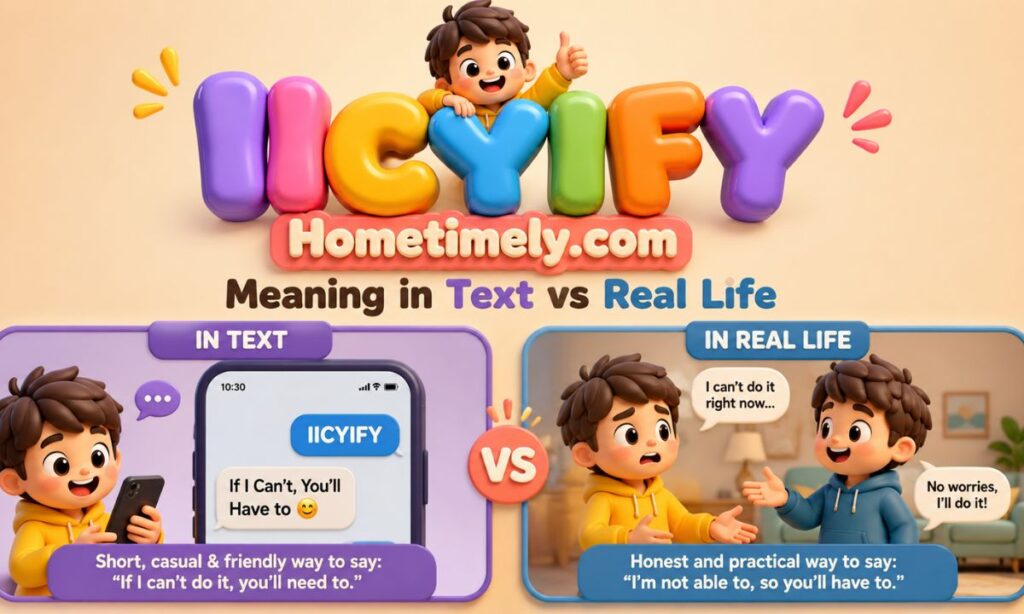
Here’s where things get interesting. The same four letters can land completely differently depending on the medium.
In a text message, IICYIFY reads as intimate and intentional. Someone typed it, looked at it, and hit send. That’s a deliberate choice. In real life, no one walks up to someone and says the acronym out loud — it exists entirely within digital communication culture.
Same words. Different reactions.
- In a flirty DM: It feels exciting, bold, a little dangerous — the thrill of being chased.
- In a group chat between friends: It becomes a punchline. Someone’s being dramatic on purpose, and everyone laughs.
- In a BookTok comment: It’s community shorthand — a nod to dark romance readers who all understand the reference.
- From a stranger: It can feel confusing, unsettling, or even alarming — context collapses when you don’t share it with someone.
The text version of IICYIFY benefits from the invisible armor of fiction and internet culture. Remove that armor, and the weight of the phrase changes fast.
Where Did the IICYIFY Slang Come From?
The origin story of IICYIFY isn’t a mystery. It traces almost directly back to one book and one fictional character who captured the internet’s imagination.
Haunting Adeline by H.D. Carlton is a dark romance novel centered on Adeline Reilly and Zade Meadows — an obsessive, possessive stalker who becomes her love interest. The novel leans hard into morally gray territory, featuring intense power dynamics, chase scenes, and the kind of fictional “dangerous man” energy that the BookTok community went wild for.
The phrase “If I Catch You, I F*ck You” captures the predatory, pursuit-driven tension at the book’s core. Fans began using it as shorthand in comments, edits, and captions. Within months, the hashtag #IICYIFY was stacking up millions of views on TikTok.
Why it exploded
Three things fueled the spread:
- Dark romance was already having a cultural moment. Books like Haunting Adeline were pulling enormous audiences who wanted emotionally extreme fiction.
- BookTok made it visual. Video editors turned moody clips, aesthetic shots, and dramatic audio into content branded with IICYIFY. Engagement was instant.
- Acronym culture thrives on ambiguity. Once people realized the phrase had a “safe” interpretation — If I Could, I Would For You — it crossed from adult content spaces into everyday texting without needing any explanation.
Full Form and Origin of IICYIFY
To be precise about the terminology: IICYIFY is an initialism (pronounced letter by letter, not as a word). Its full form is fluid, but the two most established versions are:
- If I Could, I Would For You — the emotionally supportive reading, often used in caring, romantic, or empathetic contexts.
- If I Catch You, I F*ck You — the provocative reading, rooted in Haunting Adeline fandom and used in flirty or adult-themed conversations.
By 2026, both interpretations coexist. Users choose one based on the emotional register they want to strike. The abbreviation itself gained organic traction starting in 2024 on TikTok and has since spread to Instagram, Snapchat, Reddit threads, and casual text conversations.
IICYIFY Meaning in Dark Romance
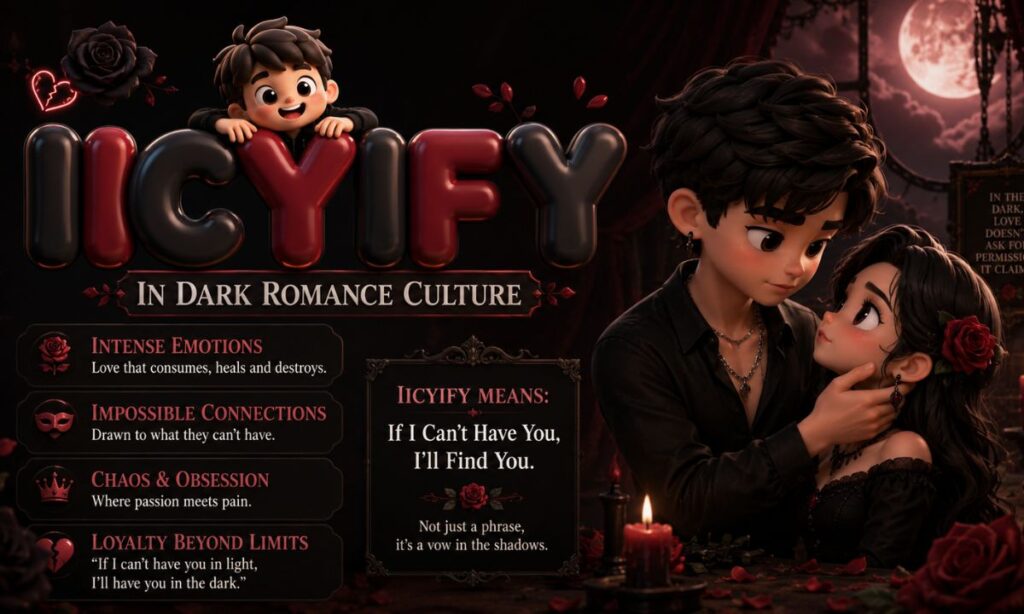
Dark romance as a genre deliberately plays in the space between discomfort and desire. It features morally gray characters, non-traditional power dynamics, obsession, and intensity that mainstream romance avoids. IICYIFY fits this genre like a glove.
Within dark romance reading communities, the phrase isn’t meant to be taken literally. It’s theatrical shorthand — a way of expressing that a character (or a fictional ideal) embodies that possessive, all-consuming energy. Readers use it to:
- Signal that a book boyfriend has “unhinged” energy in the best possible way
- React to a plot moment that was shocking or intensely romantic
- Express connection with a character’s obsessive devotion
The phrase carries none of the real-world concern when it stays inside fiction. That’s what makes it so popular among readers who know exactly what they signed up for when they opened the book.
IICYIFY Explained for Beginners
If you’re new to this term, here’s the fastest way to understand it:
Think of IICYIFY as a mood in seven letters. It expresses:
- Extreme devotion (I’d do anything for you)
- Playful threat (try to run, see what happens)
- Fandom in-joke (you know what book this is from)
- Emotional support (I wish I could take your pain away)
Which of those four a sender means depends entirely on tone, context, and how well you two already communicate. If you’re unsure which version someone meant, look at the rest of their message for emotional cues. Emoji usage, capitalization, and conversation history all help decode it.
Why People Say IICYIFY Online
Digital communication rewards brevity. The shorter the expression, the faster it spreads — and IICYIFY packs the emotional payload of an entire sentence into one compact acronym.
People use it online because:
- It creates instant intimacy or intrigue without spelling everything out
- It functions as a cultural signal — using it shows you’re plugged into BookTok or internet slang culture
- It’s deniable — if the other person doesn’t get it, you can default to the supportive interpretation
- It travels well across platforms — the hashtag works on TikTok, the acronym works in DMs, and the vibe translates to comment sections everywhere
There’s also a performative quality to internet slang. Saying IICYIFY is a bit like wearing a specific band’s shirt — it tells others something about you without explaining it outright.
IICYIFY in Chat: How People Drop It in Messages
The way IICYIFY gets used in actual chat conversations follows some recognizable patterns. It’s rarely a standalone opening. More often, it appears as a punchline, a closer, or a dramatic mid-text drop.
Typical examples
Romantic / devotional:
“You had a terrible day and I’m an hour away — IICYIFY, I promise.”
Flirty / teasing:
“You think you’re faster than me? IICYIFY and that’s not a threat, that’s a promise 😏”
BookTok fan moment:
“Just finished chapter 34 of Haunting Adeline and all I have to say is… IICYIFY Zade energy is real.”
Friend group humor:
“You ate the last slice without telling me?? IICYIFY when I get home 😭”
Notice how different each of those feels. Same acronym, completely different emotional register.
Tone Guide: Romantic, Playful, or Too Much?
Not every use of IICYIFY lands well. Understanding the tone you’re projecting — and the tone the other person will receive — is the difference between a cute message and an awkward moment.
| Scenario | Tone It Sends | Will It Land? |
| Long-term partner who reads dark romance | Flirty, playful, intimate | Almost certainly yes |
| Close friend who knows the meme | Humorous, dramatic, in-joke | Yes |
| New romantic interest | Intense, potentially alarming | Risky — read the room |
| Coworker or acquaintance | Confusing, inappropriate | No |
| Comment under a dark romance post | Expected, community language | Yes |
The phrase sits naturally in spaces where theatrical emotion is the norm. Take it somewhere formal or unfamiliar, and it loses its footing entirely.
IICYIFY in Dark Romance Culture
Within dark romance communities specifically, IICYIFY has evolved into something bigger than an acronym. It’s a cultural marker — a signal that you understand and enjoy the genre’s aesthetic of obsession, possession, and emotionally dangerous love.
Fans use IICYIFY to:
- Tag edits of morally gray book characters
- Caption aesthetically dark couple photos or moodboards
- Describe their fictional “book boyfriend” energy
- React to scenes in books or adaptations that hit the right dramatic notes
Merchandise with the phrase — shirts, stickers, bookmarks — appeared in online shops. This commercialization signals how deeply it embedded itself in reader culture, not just as slang but as a fandom identity badge.
IICYIFY on BookTok vs Normal Texting
The same phrase operates on two very different frequencies depending on where it appears.
| Context | Primary Meaning | Audience | Tone |
| BookTok | Fandom shorthand for possessive book energy | Dark romance readers | Theatrical, celebratory |
| Regular texting | Flirty, devotional, or playful depending on pair | Friends, partners | Personal, context-driven |
| Instagram captions | Aesthetic mood marker | General followers | Dramatic, aspirational |
| Reddit threads | Explaining the reference or debating its meaning | Mixed | Analytical, casual |
Why?
BookTok gave IICYIFY its launch pad, but regular texting gave it staying power. Once an acronym migrates out of a fandom and into everyday conversation, it takes on a life that doesn’t depend on knowing the source material. Most people texting IICYIFY in 2026 may never have opened Haunting Adeline — and that’s completely fine. The phrase works on its own emotional logic.
What Someone Usually Means When They Say IICYIFY
If someone sent you IICYIFY and you’re trying to figure out what they actually meant, here’s a quick decoder:
- They used a heart emoji with it → Probably the supportive version (If I Could, I Would For You). They’re expressing care.
- They used a smirk or 😈 → Almost certainly the flirty/provocative version. They’re teasing or being playfully intense.
- You were just talking about a book → It’s a fandom reference. No personal meaning beyond shared enthusiasm.
- It appeared out of nowhere in a serious conversation → Pause and ask. Context matters too much to assume here.
When Not to Use IICYIFY
For all its versatility, IICYIFY has clear no-go zones:
- Professional settings — emails, Slack messages, work group chats, job applications. Never.
- Early-stage conversations — sending it to someone you’ve just started talking to can feel intensely forward or confusing.
- Texts with family members — unless you have an unusually meme-fluent family dynamic, skip it.
- Any context where the flirty meaning could be misconstrued as threatening — the “catch you” framing needs a very specific relationship to land right.
- Serious emotional conversations — if someone is going through something heavy, this is not the moment for dramatic internet slang.
The general rule: if you’d hesitate to explain what it stands for to the person you’re sending it to, don’t send it.
How to Use IICYIFY Without Creating Chaos
Timing and context are everything. Follow these guidelines to use it smoothly:
- Establish the vibe first. If the conversation is already playful or flirty, IICYIFY fits naturally. Don’t use it to start a serious conversation.
- Know your audience. People familiar with BookTok or dark romance will recognize it immediately. Others may need a beat to look it up — factor that in.
- Match the energy. If someone’s being earnest and emotional, respond in kind. Don’t break the mood with a dramatic acronym.
- Have the explanation ready. If someone asks what it means, explain it without making them feel out of the loop. Keep it light.
- Use emoji as tone markers. A 💛 after IICYIFY reads very differently than a 😈. These small signals do heavy lifting.
How to Respond When Someone Says IICYIFY
Being on the receiving end of IICYIFY can feel a little like being handed a puzzle. Here are a few response directions depending on how you feel:
If you enjoy it
Lean into the energy they’re offering. Match the playfulness or the warmth, depending on which meaning they clearly intended.
“Oh yeah? You’d have to catch me first 😏”
Or, if it was sweet and supportive:
“That genuinely means a lot to me. Thank you 💛”
If you want to stay playful
Play it like a game. Dark romance energy thrives on dramatic back-and-forth.
“Bold claim. Prove it.”
If it makes you uneasy
Be straightforward. Internet slang shouldn’t override your comfort.
“Hey, I’m not totally sure what you mean by that — can you explain?”
Asking for clarity is always valid. The phrase’s ambiguity is real, and no one should feel obligated to decode a message that makes them uncomfortable.
IICYIFY Reply Meaning: What Your Answer Tells Them
Your reply to IICYIFY sends its own signal. A quick decoder:
| Your Reply | What It Signals |
| “Try me 😈” | You’re in, you’re flirty, game on |
| “Aww, same honestly 💛” | You received the supportive version and mirrored it |
| “lmaoo okay Zade” | You recognized the BookTok reference |
| “Haha what does that even mean” | You’re unfamiliar with the term — invites explanation |
| Nothing / left on read | You’re unsure, or it didn’t land |
| “Please don’t say that” | The tone was off and you’re setting a boundary |
IICYIFY vs Other Slang
How does IICYIFY compare to other acronyms in the texting lexicon?
| Acronym | Stands For | Vibe |
| IICYIFY | If I Catch You, I F*k You / If I Could, I Would For You | Intense, dual-meaning |
| IYKYK | If You Know, You Know | Exclusive, cryptic |
| ILY | I Love You | Warm, universal |
| NGL | Not Gonna Lie | Casual, honest |
| ISTG | I Swear to God | Emphatic, dramatic |
| IJBOL | I Just Burst Out Laughing | Humor, reaction |
IICYIFY stands out because it’s context-dependent in a way most acronyms aren’t. Most texting shorthand has one stable meaning. IICYIFY has at least four, which makes it both more interesting and more risky to deploy.
Is IICYIFY Formal or Informal?
Completely and unambiguously informal. IICYIFY belongs to the world of digital communication shorthand — the same casual register as LOL, BRB, or NGL.
It has no place in:
- Academic writing
- Business communication
- Formal letters or emails
- Professional social media profiles
This isn’t a borderline case. The phrase is internet slang in its purest form — expressive, contextual, and community-specific. It evolved in chat apps and TikTok comment sections, and that’s where it belongs.
IICYIFY in Social Media Comments
Comment sections are one of the most natural habitats for IICYIFY. You’ll see it most frequently under:
- Dark romance book posts and edits (its home territory)
- Couple content where someone is being protective or possessive in a cute way
- Thirst trap content where the energy is playful and everyone’s in on the joke
- Reaction content — someone does something impressive or chaotic, and the top comment is simply: IICYIFY
In these contexts, IICYIFY functions as a reaction word — the internet equivalent of a wolf whistle or a dramatic gasp. It signals appreciation, attraction, or theatrical awe without requiring a full sentence.
IICYIFY Used by Friends
Among close friends, IICYIFY sheds most of its romantic or provocative edge and becomes pure comedic drama. Friends use it to:
- Threaten revenge for something petty (“you ate my leftovers? IICYIFY”)
- Exaggerate excitement about seeing someone (“IICYIFY, I haven’t seen you in weeks”)
- Tease someone who’s being avoidant or evasive
This friendships-use-case is one of the reasons the phrase spread so far beyond its original fandom context. Comedy travels. Theatricality travels. And among friends who communicate in memes and hyperbole anyway, IICYIFY fit right in.
IICYIFY in Gaming
The gaming community — particularly in voice chats, Discord servers, and in-game text — has absorbed IICYIFY into its vocabulary too. The chase-and-catch dynamic of the phrase translates neatly to PvP (player vs player) settings.
You might see it:
- When someone’s hunting another player in a survival game
- As trash talk between friends competing online
- In Discord banter after someone escapes a near-death moment in a game
The playful threat aspect of IICYIFY maps naturally onto competitive gaming dynamics, where chasing someone down is literally a mechanic.
Why the IICYIFY Trend Took Off
The success of IICYIFY wasn’t accidental. Several cultural forces aligned perfectly:
- Dark romance had a mainstream breakout moment — books that were once considered niche became bestsellers, and TikTok drove millions of new readers to the genre.
- Acronym culture rewards ambiguity — slang that means one thing in one community and another thing in a different community gets discussed, debated, and shared extensively.
- BookTok has a massive content creation machine — editors, readers, and influencers turned the phrase into aesthetic content that reached people who had never touched the source material.
- Dual meaning gave it cover — the existence of a “safe” interpretation (If I Could, I Would For You) allowed the phrase to spread onto platforms and into conversations where the provocative meaning would’ve been filtered out.
Will the Phrase Stay Popular?
Internet slang has a famously short shelf life. But IICYIFY has a few things working in its favor for long-term stickiness:
- It’s tied to a book series with an ongoing fan community, not just a single viral moment
- It has genuine dual utility — both the supportive and the flirty meanings are useful in real conversations
- It’s already embedded in merchandise, fan art, and fandom identity — those roots run deeper than most trends
The phrase may not stay at peak virality forever, but it’s likely to remain recognizable in dark romance circles and used selectively in mainstream texting for years ahead.
IICYIFY Example Sentence Collection
Romantic
- “I know you’re exhausted and I’m miles away, but IICYIFY — I’d drive through the night if you asked.”
- “You deserve every single thing you’ve been working for. IICYIFY, no question.”
- “IICYIFY, I’d skip sleep a thousand times just to be there when you need me.”
Funny
- “You walked past the dishwasher without unloading it AGAIN?? IICYIFY when you get home 😭”
- “My cat knocked my drink off the table and honestly, IICYIFY, you little menace.”
- “You canceled plans for the third time. IICYIFY and that’s on you.”
Dramatic
- “You think distance changes anything? IICYIFY. There’s nowhere you could go.”
- “Running? Cute. IICYIFY and we both know it 😈”
- “I’ve been patient. I’ve been kind. IICYIFY — this is your final warning.”
Case Study: Context Changes Everything
Consider this exact message: “IICYIFY 😏”
Sent by a long-term partner after a teasing argument? Flirty. Heart-rate-raising in the best way.
Sent by a close friend after you stole their fries? Hilarious. An inside joke.
Sent by someone you matched with yesterday on a dating app? Uncomfortable. Possibly a dealbreaker.
Sent under a BookTok video about Zade Meadows? Completely expected. Everyone in the comments agrees.
The phrase didn’t change. The relationship, platform, and history did. That’s the lesson: IICYIFY is only as safe or as exciting as the context you put it in.
Also Read About This : What Does “Bricked Up” Mean? A Clear and Honest Guide
Is There a Supportive Version of IICYIFY?
Yes — and it’s arguably just as popular as the flirty one. The interpretation If I Could, I Would For You (or If I Could, I’d Fix You) carries genuine emotional warmth.
People use this version when:
- A friend is going through a hard time and they wish they could carry some of the burden
- They want to express deep care without it sounding romantic
- They’re responding to someone’s vulnerability with an earnest, shorthand show of support
In this reading, IICYIFY becomes an act of emotional solidarity — concise but meaningful. It’s the digital equivalent of putting your arm around someone.
Phrases Similar to IICYIFY
If you like the vibe IICYIFY creates, you might recognize these related terms:
| Phrase / Acronym | Meaning | Tone |
| IYKYK | If You Know, You Know | In-the-know, exclusive |
| OOMF | One of My Followers | Social media reference |
| Unhinged (used affectionately) | Wildly intense in a good way | Fandom / humor |
| Obsessed | Extreme admiration or attachment | Casual, positive |
| “Touch her and you die” | Protective threat (fictional) | Dark romance staple |
| Catch me if you can | Chase dynamic | Playful, flirty |
Quick Look at Where It Fits Among Texting Acronyms
Texting acronyms generally fall into a few categories. Here’s where IICYIFY sits:
- Reaction words (LOL, OMG, LMAO) → Single emotional beat, universal
- Informational shortcuts (BRB, AFK, IMO) → Functional, neutral
- Affectionate shorthand (ILY, ILYSM, HMU) → Warm, relational
- Dramatic / fandom slang (IICYIFY, IYKYK, NPC) → Contextual, community-driven
IICYIFY belongs firmly in that last category. It’s not a universal shorthand — it’s a community signal that carries different weight in different circles.
Common Myths About IICYIFY
Myth 1: It always means something sexual. Not true. The supportive interpretation is just as common in many circles. Context determines which version applies.
Myth 2: Only dark romance fans use it. IICYIFY has spread well beyond its BookTok origins. Friends use it humorously, couples use it flirtatiously, and gamers use it competitively.
Myth 3: It’s a new word invented in 2024. The phrase pre-dates its viral moment. What happened in 2024 was amplification, not invention.
Myth 4: Using it is always appropriate between romantic partners. Even in established relationships, springing IICYIFY without context can land oddly. Tone still matters.
Myth 5: It’s just a trend that’s already dying. Its connection to an ongoing literary fandom, combined with genuine conversational utility, has given it more staying power than most viral slang.
Why Understanding Digital Communication Shorthand Helps
It’s easy to dismiss internet slang as trivial. But understanding phrases like IICYIFY has real practical value:
- Avoid misreading tone. An acronym that seems aggressive might just be playful — and vice versa.
- Communicate more fluently. Digital spaces have their own vocabulary. Knowing the language helps you navigate it.
- Set appropriate boundaries. When you understand what something means, you’re better equipped to say whether you’re comfortable with it.
- Bridge generational gaps. If you’re a parent, teacher, or employer trying to understand how younger people communicate, learning current slang matters.
As the Cambridge Dictionary notes in its expanded coverage of informal language, words evolve based on social context — and digital shorthand is no different from the slang of any previous generation.
Quick Recap of the IICYIFY Meaning in Text
Here’s everything distilled into one clear summary:
- IICYIFY is an initialism with multiple meanings depending on context
- The two dominant interpretations are If I Could, I Would For You (supportive) and If I Catch You, I F*k You (flirty/provocative)
- It originated in Haunting Adeline fandom on BookTok and spread rapidly to mainstream texting
- Tone, relationship, and platform determine which meaning applies
- It’s entirely informal — never appropriate in professional or formal communication
- Used well, it can be warm, funny, or thrillingly dramatic; used poorly, it can confuse or unsettle
Reference: Cambridge Dictionary Definitions
To ground some of these ideas in established language frameworks:
- Slang (Cambridge Dictionary): “very informal language that is usually spoken rather than written, used especially by particular groups of people.” IICYIFY fits this definition precisely — it lives in digital speech, not formal writing.
- Initialism: An abbreviation formed from the first letters of a string of words, spoken as individual letters. Unlike acronyms (which are pronounced as words), initialisms like IICYIFY are spelled out.
- Context: Cambridge defines it as “the situation within which something exists or happens, and that can help explain it.” With IICYIFY, context isn’t optional — it’s the entire key to understanding what someone means.
Conclusion
IICYIFY is one of the more interesting examples of how internet culture generates language. It started as a coded reference in a fictional world, got amplified by millions of book-loving content creators, and eventually settled into the everyday vocabulary of texting — where it now carries everything from genuine devotion to comedic drama to playful threat.
The most important thing to take away? There is no single IICYIFY. There’s the version your partner might send with a 😈, and the version a close friend sends after you stole their snack, and the version a BookTok fan types under a moody edit of a fictional stalker. All of them are real. All of them are valid. And all of them require you to read the room before you respond.
Now that you know what IICYIFY means in text — in all its interpretations — you’re equipped to send it, receive it, and decode it without a second of confusion.

Michael Brook is the creator and author behind Healthy Leeks, a platform focused on grammar, writing skills, and English language learning. Passionate about clear communication and effective writing, Michael Brook shares practical grammar tips, easy-to-follow language guides, and educational content to help readers improve their English with confidence.