If you’ve ever paused mid-email wondering whether to type “enquiries” or “inquiries,” you’re not alone. This is one of the most common spelling dilemmas in professional English, and it trips up native speakers just as often as learners.
The short version: both spellings are correct. The word you should use depends on where your reader lives, what kind of writing you’re doing, and sometimes, what industry you’re in. This guide breaks down the meaning, history, regional rules, and real-world usage of “enquiries” and “inquiries” so you never have to second-guess yourself again.
Enquiries or Inquiries: Quick Answer
Here’s the fast version if you’re in a hurry:
- Inquiries is the standard spelling in American English, used for both general questions and formal investigations.
- Enquiries is common in British English for everyday questions, while inquiries is often reserved for formal or official investigations.
- Both words mean the same thing: a request for information.
- Neither spelling is “wrong” the correct choice depends entirely on your audience and writing context.
If you’re writing for a US audience, default to “inquiries.” If you’re writing for a UK, Australian, or Commonwealth audience, “enquiries” usually reads more naturally for everyday questions, while “inquiries” fits official or legal contexts.
Enquiries vs Inquiries: Meaning, Usage, and Common Confusion
At their core, “enquiries” and “inquiries” both describe the act of asking for information or looking into something. They come from the same root idea, and in casual conversation, most people would never notice if you swapped one for the other.
The confusion comes from the fact that English has two major standardized forms British English and American English and each has developed its own preference over the last century or so.
In practice:
- Inquiry/Inquiries tends to lean toward formal investigation, official review, or a structured request for information.
- Enquiry/Enquiries tends to lean toward a general, everyday question, particularly in British and Commonwealth English.
That said, this distinction is a tendency, not a strict grammar rule. Many British organizations use “enquiries” for customer service and “inquiries” for legal or governmental matters, while American writers rarely use “enquiries” at all.
Common Real Life Phrases
You’ll spot both words constantly in daily communication. Some frequently used examples include:
- “For sales enquiries, please contact our office.” (British business usage)
- “Thank you for your inquiry. We’ll respond within 24 hours.” (American customer service)
- “The government launched a public inquiry into the incident.” (Formal investigation, both regions)
- “Please direct all customer enquiries to our support team.” (UK company website)
- “We welcome inquiries from prospective students.” (American university)
Notice how the formal-investigation meaning of “inquiry” stays consistent across both regions, while the everyday-question meaning shifts spelling depending on where the writer is based.
The Origin of Enquiries or Inquiries
Both words trace back to the Latin verb inquirere, meaning “to seek into” or “to search for,” which passed into Old French before entering English. Historically, English writers used “enquire” and “inquire” almost interchangeably, and spelling wasn’t standardized the way it is today.
Over time, American English style guides and dictionaries settled firmly on “inquire” and “inquiry” as the preferred forms, dropping “enquire” almost entirely from common use. British publishing houses, however, kept both spellings alive, gradually assigning a soft distinction: “enquire” for general questions, and “inquire” for formal investigations, though this rule has always been loosely applied rather than strictly enforced.
This is why, even today, you’ll see British newspapers and government reports use “inquiry” for a formal investigation, while a hotel front desk in London might have an “Enquiries” sign for guest questions.
British English vs American English Spelling
The clearest way to understand the difference is to look at how each English variant treats the word.
- American English treats “inquiry” and “inquiries” as the only standard spelling. “Enquiry” is rarely used and can look like a typo to American readers.
- British English treats both spellings as valid but assigns them slightly different roles. “Enquiry” fits general, everyday requests, while “inquiry” fits formal or official matters.
- Australian, New Zealand, and Indian English, which largely follow British conventions, tend to mirror this same pattern.
- Canadian English is a mixed case, often blending American and British habits depending on the organization or publication.
Comparison Table
| Region | Preferred General Spelling | Preferred Formal/Investigation Spelling | Notes |
| United States | Inquiries | Inquiries | “Enquiries” is rarely used and may look incorrect |
| United Kingdom | Enquiries | Inquiries | Common split: enquiries for questions, inquiries for investigations |
| Australia | Enquiries | Inquiries | Follows British pattern closely |
| New Zealand | Enquiries | Inquiries | Follows British pattern closely |
| Canada | Mixed (often Inquiries) | Inquiries | Style varies by publication or organization |
| India | Enquiries | Inquiries | Commonwealth spelling conventions apply |
| Global/International Content | Inquiries | Inquiries | Favored for broader clarity and search consistency |
Which Spelling Should You Use?
The right spelling comes down to a simple question: who is going to read this?
If your audience is American
Use “inquiries” for everything whether you’re writing a customer service email, a business report, a news article, or a formal legal document. American readers generally consider “enquiries” a spelling mistake, so sticking with “inquiries” keeps your writing polished and professional.
If your audience is British or Commonwealth
Use “enquiries” for general questions, everyday customer communication, and casual business correspondence. Reserve “inquiries” for formal investigations, legal proceedings, or government-related content. This split isn’t mandatory, but it matches what most readers expect and signals attention to detail.
If your audience is global
When your readers span multiple countries, consistency matters more than picking the “perfect” regional word. Many international brands and websites default to “inquiries” since it’s understood everywhere and avoids looking out of place to American readers, who make up a large share of global English-speaking internet traffic.
When to Use “Enquiries” in British English
British writers still reach for “enquiries” in several common situations:
- Customer service pages (“Contact us for general enquiries”)
- Hotel, retail, and hospitality signage (“Enquiries Desk”)
- Everyday business correspondence (“I’m writing to make an enquiry about your services”)
- School and university admissions communication for general questions
- Casual or conversational writing where the tone isn’t strictly formal
Meanwhile, “inquiry” still shows up in British English for:
- Government or public inquiries into major incidents
- Police and legal investigations
- Corporate investigations or internal reviews
- News reporting on official proceedings
So even within British English, the word you choose can shift depending on whether you’re asking a simple question or referring to a structured, formal investigation.
Also Read This : Incorporate or Encorporate: Which Spelling Is Correct?
Common Mistakes with Enquiries or Inquiries
Even experienced writers slip up with this pair. Here are the mistakes to watch for.
1. Mixing spellings in one document
Switching between “enquiries” and “inquiries” within the same email, page, or report looks inconsistent and unpolished. Pick one spelling based on your audience and stick with it throughout.
2. Thinking they have different meanings
Some writers assume “enquiry” and “inquiry” refer to fundamentally different concepts. In reality, they’re spelling variants of the same core meaning: a request for information or an investigation.
3. Spelling errors
A frequent mistake is writing “inquires” instead of “inquiries,” or dropping letters entirely (like “enquries” or “inquries”). Double-check the plural form, especially in headings and contact page copy where errors are highly visible.
4. Using regional spelling for the wrong audience
Using “enquiries” on a website aimed at American customers, or “inquiries” throughout formal British legal writing where “enquiries” would fit better, can look slightly off to native readers, even if they can’t always explain why.
5. Overthinking the choice
Because both spellings are technically correct, there’s no need to agonize over every instance. Choose based on your primary audience, apply it consistently, and move on.
How to Spell Enquiries or Inquiries + When to Use Each
Spelling Guide
- Enquiries: E-N-Q-U-I-R-I-E-S
- Inquiries: I-N-Q-U-I-R-I-E-S
The only difference is the first two letters: “en” versus “in.” An easy memory trick is that “enquire” and “enquiries” share the same British “en” pattern, while “inquire” and “inquiries” share the American “in” pattern.
When to Use Each Form
| Situation | Recommended Spelling |
| Writing for American readers | Inquiries |
| Writing for British/Commonwealth readers (general questions) | Enquiries |
| Writing about formal investigations (any region) | Inquiries |
| International or global content | Inquiries |
| Customer service page for a UK business | Enquiries |
| Legal or government documentation | Inquiries |
Common Usage Examples
- “Please send all press inquiries to our media team.” (American)
- “For booking enquiries, contact our reservations desk.” (British)
- “The committee opened an inquiry into the funding decision.” (Both regions)
- “We received a high volume of customer enquiries this week.” (British)
- “Thank you for your inquiry regarding our services.” (American)
Small but Important Grammar Notes
- The singular forms follow the same pattern: “enquiry” and “inquiry.”
- The plural of both is formed by changing “y” to “ies”: enquiries, inquiries.
- The related verbs are “enquire” and “inquire,” and their present participles are “enquiring” and “inquiring.”
- Avoid writing “inquires” when you mean the plural noun “inquiries” — “inquires” is a verb form (as in “he inquires about pricing”), not a noun.
Enquiries or Inquiries in Everyday Examples
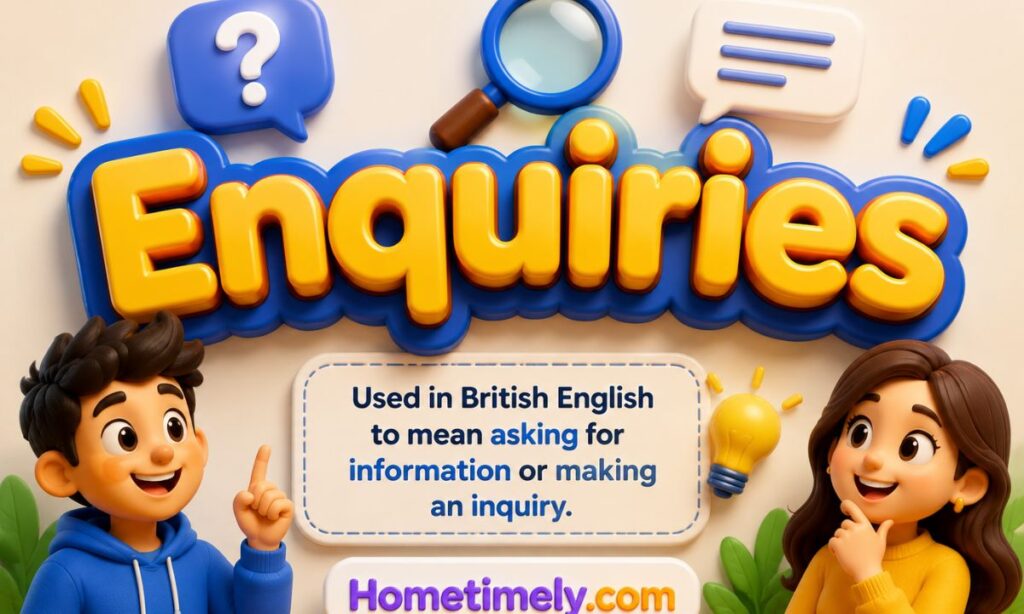
Seeing both words in context makes the distinction easier to remember. Here’s how they typically appear across different types of writing.
Emails
American: “Thank you for your inquiry. A member of our team will follow up shortly.” British: “Thank you for your enquiry. We’ll be in touch within one business day.”
Business Writing
American businesses typically write: “We welcome inquiries from potential partners.” British businesses often write: “We welcome enquiries from potential clients,” reserving “inquiry” for internal audits or investigations.
News Writing
News outlets in both regions often use “inquiry” when reporting on official investigations, government reviews, or legal proceedings, since this usage is largely consistent across English variants.
Social Media
Social captions tend to follow whichever regional spelling the brand’s home audience expects. A US-based company might post, “DM us with any inquiries!” while a UK-based brand might write, “Drop your enquiries in the comments.”
Academic Writing
Academic and research writing generally favors formality and consistency. American academic writing uses “inquiry” throughout, while British academic writing may use “enquiry” for general research questions and “inquiry” for formal reviews or investigative studies.
Customer Service Pages
This is where the spelling choice matters most for branding. A “Contact Us” or “Enquiries” page should match the primary spelling convention of the country the business operates in, since this is often the first place readers notice inconsistency.
Common Mistakes to Avoid
To keep your writing polished, watch for these recurring issues:
- Don’t mix “enquiries” and “inquiries” across the same website or document.
- Don’t assume the words carry different meanings they don’t.
- Don’t misspell the plural form as “inquires” or “enquires.”
- Don’t use “enquiries” for an exclusively American audience unless there’s a specific stylistic reason.
- Don’t overanalyze single instances; consistency across your content matters more than perfection in any one sentence.
Enquiries or Inquiries: Google Trends & Usage Data
Search and usage patterns closely mirror regional spelling habits, which is a useful signal for writers and marketers deciding which word to use in content, ads, or web copy.
United States
American search behavior overwhelmingly favors “inquiries.” Content, business pages, and news sources in the US rarely feature “enquiries” at all, and when they do, it’s often flagged as an error by readers and editors alike.
United Kingdom
UK search and usage data show a more balanced split. “Enquiries” remains dominant for everyday business and customer service language, while “inquiries” appears more often in news coverage of official investigations and legal matters.
Australia and New Zealand
Both countries closely follow British spelling conventions, with “enquiries” common in business and consumer-facing content, and “inquiries” reserved for formal proceedings.
Canada
Canadian usage is mixed. Government and formal documents often lean toward “inquiries,” while some businesses and regional publications use “enquiries,” reflecting Canada’s blend of British and American English influences.
Global Online Content
Across international websites, blogs, and SEO-driven content, “inquiries” tends to perform more consistently, largely because American English dominates global online search volume and content production.
Comparison Table: Keyword Variations Side by Side
| Keyword Variation | Common Region | Typical Use Case |
| Inquiries | United States, global content | General questions and formal investigations |
| Enquiries | United Kingdom, Australia, NZ, India | General, everyday questions |
| Inquiry | All regions | Singular form, often formal investigations |
| Enquiry | UK/Commonwealth | Singular form, general questions |
| Inquire | American English | Verb form, asking or investigating |
| Enquire | British English | Verb form, asking casually |
| Public Inquiry | UK, Canada | Formal government or legal investigation |
| Customer Enquiries | UK, Australia | General customer service questions |
| Sales Inquiries | United States | Business or product-related questions |
Conclusion
“Enquiries” and “inquiries” are two correct spellings of the same idea: asking a question or requesting information. Neither one is a mistake, and neither one is universally “more correct” than the other. What matters is matching your spelling to your audience and staying consistent throughout your writing.
If you’re writing for American readers, use “inquiries” across the board. If you’re writing for a British or Commonwealth audience, “enquiries” works well for everyday questions, while “inquiries” suits formal investigations. And if you’re writing for a global audience, “inquiries” is usually the safer, more universally recognized choice.
Once you understand this simple regional split, you’ll never have to hesitate over which spelling to use again you’ll just write with confidence, knowing your words match your reader’s expectations.

Michael Brook is the creator and author behind Healthy Leeks, a platform focused on grammar, writing skills, and English language learning. Passionate about clear communication and effective writing, Michael Brook shares practical grammar tips, easy-to-follow language guides, and educational content to help readers improve their English with confidence.


