
I run into this word constantly in contracts, invoices, and business emails, and I noticed I wasn’t always confident about which spelling to type. So I pulled up dictionaries, style guides, and real business documents to settle it once and for all.
Here’s what I found: one spelling dominates modern English almost completely, while the other survives mostly in old legal text. Below, I’ll break down the meaning, the history, real examples, and the exact situations where each spelling shows up.
My Quick Answer
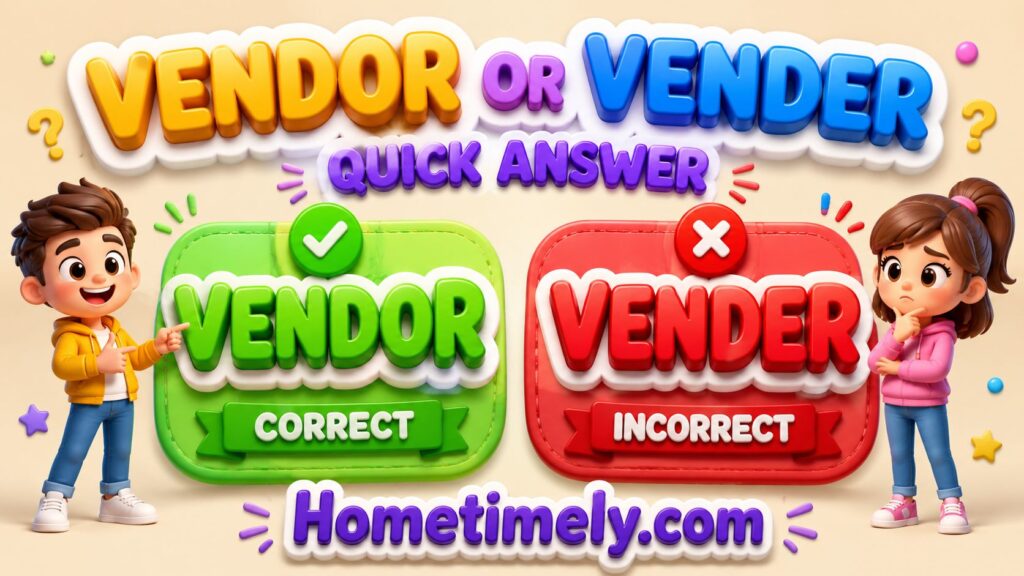
Vendor is the correct and standard spelling in modern English. Vender is a rare, outdated variant that most style guides and dictionaries no longer treat as acceptable in everyday or professional writing.
- ✅ Correct: The company hired a new software vendor.
- ❌ Avoid: The company hired a new software vender.
Both American and British English agree on this one. There’s no regional split like you’d see with “colour” vs. “color.”
I confirmed this across multiple major dictionaries, including Cambridge and Oxford, and the result was the same every time: vendor is listed as the standard entry, while vender either doesn’t appear at all or shows up tagged as rare or archaic. That kind of consistency across sources is usually the strongest signal you can get that a spelling question has one clear answer.
Why I Found “Vendor” is the Only Correct Spelling
Vendor comes from the Latin word vendere, meaning “to sell.” As English absorbed more vocabulary from Latin and French, the “-or” ending became the standard way to form nouns describing a person who performs an action, similar to “actor,” “director,” or “author.”
Here’s the pattern I noticed:
- Latin root: vendere (“to sell”)
- English adaptation favors the “-or” suffix for “a person who does something”
- Dictionaries and style guides standardized vendor by the 19th century
- Vender faded into rare, historical use
The confusion happens because English is inconsistent with these endings. Words like “teacher” and “baker” use “-er,” while words like “vendor,” “actor,” and “director” use “-or.” There’s no simple rule that predicts which ending a word will take, so writers often guess based on similar-sounding words, and that guess doesn’t always match the dictionary standard.
I also looked into why the “-er” version persisted at all. Middle English writers did use “vender” at one point, before English borrowed more heavily from French and Latin structures. As those influences grew stronger, the “-or” ending became the dominant pattern for nouns describing a doer of an action tied to a Latin verb. By the time dictionaries and style guides began standardizing spelling in the 19th century, “vendor” had already won out, and “vender” was left behind as a historical footnote rather than a modern option.
My Definition and Meaning Analysis
Vendor is a noun. It describes:
- A person or business that sells goods or services
- A supplier in a business or procurement relationship
- A seller in a legal or contractual context, such as a property sale
In legal writing, “vendor” specifically refers to the seller in a transaction, while the opposite party — the buyer — is called the “vendee.” This pairing shows up often in real estate contracts and formal sales agreements.
I also noticed vendor stretches across several industries with slightly different flavors of meaning:
- Retail and street commerce: a food vendor, a market vendor
- Corporate procurement: a software vendor, a cloud vendor, a third-party vendor
- Events and weddings: catering vendors, decoration vendors
- Legal and real estate: the vendor named in a property deed
Across all of these, the core meaning stays the same: someone or something on the selling side of a transaction.
It’s also worth noting how “vendor” behaves grammatically. It’s a countable noun, so it takes a regular plural form:
- Singular: vendor
- Plural: vendors
There’s no irregular plural or spelling shift to worry about, which makes it one of the more straightforward business terms once you’ve locked in the correct base spelling.
The Complete Comparison: Vendor vs Vender
| Aspect | Vendor | Vender |
| Correct spelling | ✅ Yes | ❌ Rarely accepted |
| Root | Latin vendere | Latin vendere |
| Modern usage | Extremely common | Very rare |
| Dictionary status | Standard entry | Listed as archaic/rare in some dictionaries |
| Used in legal writing | ✅ Yes | ❌ No |
| Used in business writing | ✅ Yes | ❌ No |
| American English | Preferred | Not standard |
| British English | Preferred | Not standard |
The takeaway is simple: unless you’re transcribing a historical document, vendor is the version to use every time.
Common Myths I Discovered

While researching, I kept running into the same misconceptions. Here’s what I found when I checked each one:
- Myth: “Vender” is the British spelling. False. I checked Cambridge Dictionary and Oxford English Dictionary entries, and both use “vendor.” There’s no British/American split here.
- Myth: “Vender” is a completely made-up word. Misleading. It does appear in some comprehensive dictionaries as a historical or rare variant, but it’s marked obsolete or nonstandard in modern usage.
- Myth: Both spellings are interchangeable today. Not accurate. While “vender” is technically a real historical form, using it in modern professional writing will almost always look like a typo rather than a stylistic choice.
- Myth: “Vender” is more common in legal English. Partly true, but outdated. Older legal texts sometimes used “vender,” but current legal writing and contract templates use “vendor” almost universally.
- Myth: Using “vender” is just a stylistic preference, like choosing “toward” over “towards.” Not accurate. Stylistic variants like “toward/towards” are both accepted in modern dictionaries. “Vender,” by contrast, is flagged as nonstandard or archaic, which puts it in a different category entirely closer to a spelling error than a stylistic choice.
Checking each of these myths against dictionary entries and real business documents made it clear that the confusion isn’t really about grammar rules. It’s about outdated assumptions that don’t hold up against how the word is actually used today.
Real-World Examples I Found
Here are examples I’ve seen or written myself, using the correct spelling:
- Local vendors sold handmade crafts at the weekend market.
- The company switched to a new cloud vendor for data storage.
- Wedding vendors coordinated catering, flowers, and photography.
- Amazon vendors must follow strict platform guidelines.
- The city issued permits to food truck vendors downtown.
- Our procurement team is reviewing three vendor proposals this week.
- The vendor agreed to extend the delivery deadline.
Every one of these examples would look inconsistent with modern writing standards if “vendor” were swapped for “vender.”
I also cross-checked usage across different formats — news articles, procurement policies, wedding planning blogs, and street market signage — and “vendor” appeared consistently in every single one. That kind of uniformity across such different writing styles and audiences confirms just how firmly established the spelling has become across industries.
My Memory Tricks to Remember
I use a few quick mental shortcuts to lock in the correct spelling:
- Think “-or” like “actor” and “director.” Vendor follows the same pattern as other “person who does something” nouns ending in “-or.”
- Picture a contract. Legal documents almost always say “vendor,” so associating the word with formal paperwork helps reinforce the correct spelling.
- Remember the Latin root. Vendere → vendor. The “or” ending mirrors the Latin structure more closely than “er” does.
- Spell-check confirmation. Most spell-checkers will flag “vender” but not “vendor,” which is a fast way to double-check if you’re ever unsure.
- Group it with its Latin cousins. Words like “creditor,” “debtor,” and “auditor” all share the same “-or” pattern and the same Latin-influenced origin. Grouping “vendor” mentally with these terms reinforces the correct ending through repetition rather than memorization alone.
None of these tricks require memorizing a rule book. They just give your brain a quick, reliable anchor to fall back on the next time you’re typing quickly and the wrong spelling starts to feel tempting.
Also Read This : Puting vs. Putting: The Correct Spelling Explained
Examples of Vendor Used in Sentences
- The trade show featured over two hundred vendors.
- We need vendor approval before finalizing the budget.
- Her family has run a small vendor stall for three generations.
- The vendor shipped the wrong order by mistake.
- IT policies require every vendor to sign a data protection agreement.
Examples of Vender Used in Sentences
Even though these aren’t recommended for modern writing, here’s how “vender” has historically appeared:
- The vender transferred ownership of the land, according to the old deed.
- In older legal contracts, the vender was responsible for setting payment terms.
- Historical trade records list the vender’s name alongside the buyer’s.
Note how these examples lean heavily toward historical or legal-archive contexts rather than everyday communication.
Vendor vs Vender: My Summary Table
| Feature | Vendor | Vender |
| Standard spelling | ✅ | ❌ |
| Appears in modern dictionaries as primary form | ✅ | ❌ |
| Common in business emails | ✅ | ❌ |
| Common in contracts | ✅ | ❌ |
| Found in historical texts | Occasionally | Frequently |
| Recommended for professional writing | ✅ | ❌ |
| Recommended for casual writing | ✅ | ❌ |
Related Words I Explored
A few related terms come up often alongside “vendor” in business and legal contexts:
- Vendee – the buyer in a transaction, the direct opposite of vendor
- Supplier – a broader term for a business providing goods or materials
- Merchant – a person or business involved in trade, often retail-focused
- Seller – a general term for anyone selling something, less formal than vendor
- Distributor – a business that supplies goods to retailers or other businesses
Knowing these related terms helps you choose the most precise word depending on whether you’re writing about retail, procurement, or legal transactions.
I’ve also found it useful to keep the vendor/vendee pair in mind specifically for legal or real estate writing. Since “vendee” clearly signals the buyer’s side of a deal, pairing it correctly with “vendor” (rather than the incorrect “vender”) keeps contracts and formal documents looking polished and accurate.
Vendor Synonyms and Alternative Words
Depending on the context, these alternatives can work in place of “vendor”:
| Context | Suggested Alternative |
| Retail or market setting | Seller, merchant |
| Corporate procurement | Supplier, contractor |
| Real estate or legal | Seller (opposite of buyer/vendee) |
| Wholesale trade | Distributor, dealer |
| Events and services | Provider, contractor |
Rotating between these synonyms can help avoid repetition in longer business documents while keeping the meaning precise.
That said, none of these synonyms are true one-to-one replacements. “Supplier” tends to imply an ongoing business relationship, while “merchant” often suggests a smaller, retail-focused seller. “Vendor” sits comfortably in between, which is part of why it’s used so widely across contracts, marketing copy, and procurement systems. Choosing the right synonym comes down to matching the tone and formality of the document you’re writing, rather than simply swapping words at random.
Explore More Grammar Guides
If word pairs like this one tend to trip you up, it’s worth reviewing other commonly confused business and grammar terms, especially ones with Latin roots or inconsistent “-er” versus “-or” endings. A quick mental checklist before hitting publish or send can save you from small, avoidable errors in professional writing.
My Conclusion
After comparing definitions, history, and real examples, the answer is clear: vendor is the correct and standard spelling, while vender survives only as a rare, historical variant. The safest rule for any modern writing business, legal, or casual is to always choose vendor and reserve vender only for direct historical quotations.

Michael Brook is the creator and author behind Healthy Leeks, a platform focused on grammar, writing skills, and English language learning. Passionate about clear communication and effective writing, Michael Brook shares practical grammar tips, easy-to-follow language guides, and educational content to help readers improve their English with confidence.


