
Few grammar pairs trip up writers as often as “hasn’t” and “haven’t.” They look almost identical, sound similar in fast speech, and both point to something that didn’t happen. Yet mixing them up is one of the fastest ways to make a sentence feel off, even to readers who can’t explain why.
This guide breaks the rule down in plain language, walks through real examples, and gives you memory tricks that stick. By the end, you’ll be able to pick the right word instantly, without pausing mid-sentence to second-guess yourself.
Why “Hasn’t vs Haven’t” Confuses So Many Writers
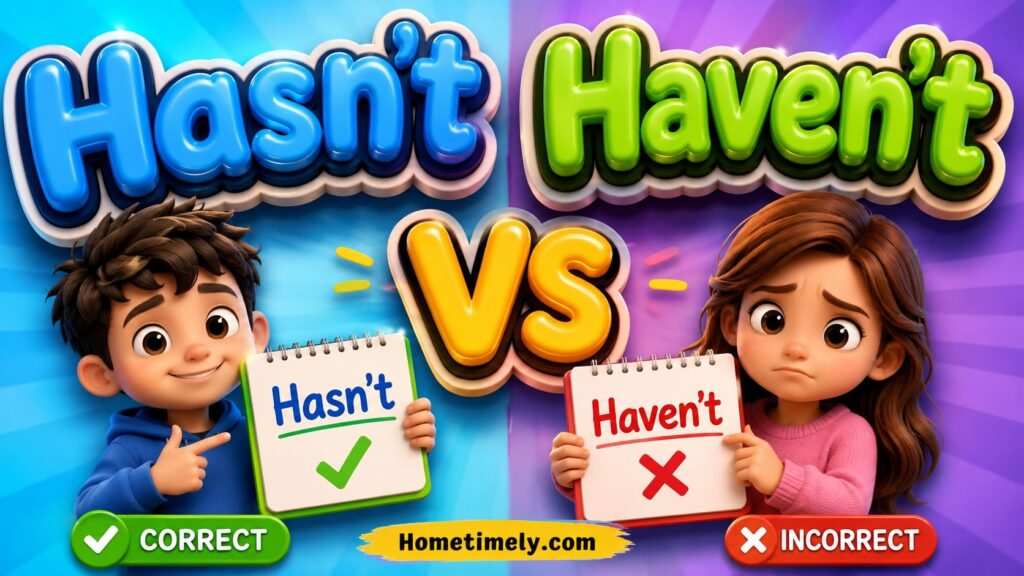
The confusion isn’t really about vocabulary. Both words mean the same thing at their core — something has not happened. The trouble comes from grammar, specifically subject-verb agreement, which is a concept many people learned once in school and never revisited.
A few reasons this pair causes so much trouble:
- They sound nearly identical when spoken quickly, so ears don’t always catch the difference.
- English speakers often learn contractions by ear before they learn the rule behind them.
- The exception involving “I” breaks the pattern learners expect, which throws people off.
- Autocorrect and casual texting habits blur the line between formal and informal usage.
- Non-native speakers translating from languages without this kind of agreement system find the rule unintuitive.
Once you see the logic behind the choice, though, the confusion disappears for good.
What “Hasn’t” and “Haven’t” Actually Mean
Both words are contractions used to form negative statements in the present perfect tense.
- Hasn’t is short for “has not.”
- Haven’t is short for “have not.”
Both describe an action that didn’t happen, either up to this point in time or at any point so far. Consider these two sentences:
- She hasn’t called yet. → She has not called up to now.
- We haven’t eaten lunch. → We have not eaten lunch yet.
Notice that the meaning is nearly the same in both cases. The real difference isn’t about timing or intensity — it’s entirely about which subject you’re pairing the word with.
The Grammar Rule That Decides Everything (Subject-Verb Agreement)

Here’s the one rule that governs everything in this guide: the verb must agree with its subject in person and number.
English mostly hides this rule inside contractions, so it’s easy to miss. But “has” and “have” follow the exact same agreement pattern as any other present-tense verb.
| Subject Type | Verb Form | Contraction |
| Third-person singular (he, she, it, a singular noun) | has not | hasn’t |
| First-person singular (I) | have not | haven’t |
| All plural subjects (we, you, they, plural nouns) | have not | haven’t |
Once you memorize that single table, you can build any sentence correctly, in any context.
When to Use “Hasn’t” (With Clear, Real Examples)
Use hasn’t only when your subject is singular and in the third person. That means the subject is he, she, it, or a singular noun standing in for one of those pronouns.
Examples:
- He hasn’t finished his homework.
- She hasn’t called me back yet.
- The dog hasn’t eaten its food.
- The company hasn’t announced its results.
- It hasn’t stopped raining all day.
A quick way to check yourself: if you can swap the subject for “he,” “she,” or “it” without changing the sentence’s structure, “hasn’t” is correct.
Sentences Where “Hasn’t” Fits Naturally
- My brother hasn’t gone to the gym today.
- The package hasn’t arrived yet.
- Nobody hasn’t handed in their assignment. (Incorrect — double negative; the correct form is “Nobody has handed in their assignment.”)
That last example is a useful warning. Words like “nobody,” “everybody,” and “someone” are grammatically singular, so they pair with “hasn’t” only in a straightforward negative sentence, not alongside another negative word.
When to Use “Haven’t” (And Why It’s More Common)
Use haven’t with I, you, we, they, and any plural subject. This group covers far more pronouns than “hasn’t” does, which is part of why “haven’t” shows up more often in everyday speech and writing.
Examples:
- I haven’t seen that movie.
- You haven’t called me back yet.
- They haven’t arrived at the party.
- We haven’t started the project.
- My parents haven’t decided where to travel this year.
Because “you,” “we,” “they,” and “I” cover so much everyday conversation, “haven’t” naturally appears more frequently in casual English than “hasn’t” does.
Why Do We Say “I Haven’t” but Not “I Hasn’t”?
This is where most learners get stuck. Logically, “I” is singular, so it seems like it should pair with “hasn’t.” But English treats first-person singular differently from third-person singular.
The verb “have” behaves irregularly across persons:
- I have → I haven’t
- You have → You haven’t
- He/She/It has → He/She/It hasn’t
- We have → We haven’t
- They have → They haven’t
Only the third-person singular form changes to “has.” Every other subject, including “I,” keeps the base form “have.” This is simply a fixed feature of English grammar, similar to how “I am” doesn’t follow the same pattern as “he is,” even though both are present-tense statements.
The Special Case: Why “I Haven’t” Is Correct But “I Hasn’t” Is Always Wrong
There’s no scenario, formal or informal, where “I hasn’t” is acceptable in standard English. It’s one of the few absolute rules in this topic.
- Correct: I haven’t finished the report.
- Incorrect: I hasn’t finished the report.
If you remember nothing else from this guide, remember this: “hasn’t” never follows “I,” ever. Treat it as a fixed pairing you memorize once and never question again.
Sentence Structures That Affect “Hasn’t vs Haven’t”
The core rule stays the same across sentence types, but a few structures are worth calling out because they trip people up.
Negative Questions
Questions flip the word order, but the subject-verb agreement rule doesn’t change.
- Hasn’t she called yet?
- Haven’t they arrived yet?
- Haven’t you finished your homework?
Sentences With Compound Subjects
When two singular subjects are joined by “and,” the combined subject becomes plural, so it takes “haven’t.”
- Correct: Tom and Sarah haven’t submitted their forms.
- Incorrect: Tom and Sarah hasn’t submitted their forms.
Collective Nouns
Words like “team,” “family,” “government,” and “committee” can be tricky. In American English, these are usually treated as singular, so “hasn’t” is standard. In British English, they’re sometimes treated as plural, especially when emphasizing the individuals within the group.
- American English: The team hasn’t won a game this season.
- British English (informal): The team haven’t won a game this season.
Neither version is “wrong” exactly — it depends on the variety of English and the style guide you’re following. For consistency, most formal writing should stick to one approach throughout a document.
Indefinite Pronouns
Words like “everyone,” “someone,” “nobody,” and “anybody” are grammatically singular, even though they refer to multiple people in a general sense.
- Everyone hasn’t finished the test yet. (Awkward; better rewritten as “Not everyone has finished the test yet.”)
- Nobody has left the building. (Nobody pairs with “has,” not “have,” in positive statements.)
Common Mistakes Native and Non-Native Speakers Make
Even fluent speakers slip up occasionally, usually in casual conversation. Here are the errors that show up most often:
- Using “hasn’t” with “I.” This is the single most common mistake among learners, since “I” feels singular.
- Mismatching plural subjects with “hasn’t.” For example, “They hasn’t arrived” instead of “They haven’t arrived.”
- Forgetting past participle form. After “hasn’t” or “haven’t,” the main verb must stay in its past participle form: “hasn’t gone,” not “hasn’t went.”
- Double negatives. Combining “hasn’t” or “haven’t” with another negative word, like “nobody” or “nothing,” creates confusing or incorrect sentences.
- Overcorrecting collective nouns. Applying British rules in American writing (or vice versa) can look inconsistent if it isn’t intentional.
- Autocorrect substitutions. Phones sometimes swap “hasn’t” and “haven’t” automatically, especially after voice typing, so proofreading matters.
Each of these mistakes breaks the same underlying rule: subject-verb agreement. Once you fix the match between subject and verb, the sentence works.
Quick Comparison Table: Hasn’t vs Haven’t
This table gives you a snapshot you can bookmark, print, or screenshot for quick reference.
| Feature | Hasn’t | Haven’t |
| Full form | has not | have not |
| Subjects used with | he, she, it, singular nouns | I, you, we, they, plural nouns |
| Person | Third-person singular | First person, second person, all plural |
| Tense | Present perfect (negative) | Present perfect (negative) |
| Example | She hasn’t left yet. | They haven’t left yet. |
| Common error | Pairing with “I” or plural subjects | Pairing with singular third-person subjects |
Easy Memory Tricks That Actually Work
Grammar rules stick better when they’re tied to a simple image or phrase. Try one of these:
- The “S” trick: Hasn’t has an extra hidden “s” feel to it, matching singular subjects — he, she, it.
- The group trick: Haven’t works with groups — we, you, they — and the lone exception, I.
- The phone charger trick: Hasn’t fits only one model (singular subjects). Haven’t works across multiple devices (plural subjects and I).
- Say it out loud: Replace the contraction with “has not” or “have not” and read the sentence aloud. If it sounds natural, you’ve chosen correctly.
- The pronoun swap test: Mentally replace the subject with “he” or “they.” If “he” fits, use “hasn’t.” If “they” fits, use “haven’t.”
Practicing with real sentences, rather than just memorizing rules, is what makes the choice automatic over time.
Real-World Usage: Formal Writing vs Everyday Speech
Both “hasn’t” and “haven’t” are grammatically correct in formal writing, but contractions in general tend to sound more casual than their full forms.
- Formal writing (reports, academic papers, official emails): Favor the full forms “has not” and “have not” for a more polished, professional tone.
- Everyday speech and casual writing (texts, blogs, conversations): Contractions like “hasn’t” and “haven’t” sound natural and are widely accepted, even in professional emails and business communication today.
Notice how much more natural “She hasn’t told me yet” sounds compared to the stiffer “She has not told me yet.” Neither is incorrect — the choice depends on tone and context.
Also Read This : Height vs Hight: Which Spelling Is Correct? (Meaning & Usage Explained)
Case Study: Everyday Errors and How to Fix Them
Below are common real-world sentences with the mistake corrected, showing how small subject-verb mismatches change the entire sentence.
| Incorrect Sentence | Why It’s Wrong | Corrected Sentence |
| I hasn’t finished my homework. | “I” never pairs with “hasn’t.” | I haven’t finished my homework. |
| They hasn’t replied to the email. | “They” is plural, requiring “haven’t.” | They haven’t replied to the email. |
| The manager haven’t approved the request. | “The manager” is singular, requiring “hasn’t.” | The manager hasn’t approved the request. |
| We hasn’t decided on a venue yet. | “We” is plural, requiring “haven’t.” | We haven’t decided on a venue yet. |
| Nobody haven’t seen the results. | “Nobody” is singular and shouldn’t create a double negative. | Nobody has seen the results. |
Working through examples like these, one sentence at a time, is the fastest way to internalize the pattern permanently.
Easy Ways to Remember Hasn’t vs. Haven’t
If the earlier tricks didn’t click, here are a few additional approaches that work well for visual and auditory learners alike:
- Write the rule on a sticky note: He/She/It = hasn’t. Everyone else = haven’t.
- Create flashcards: Put a pronoun on one side and the correct contraction on the other, then quiz yourself.
- Read your sentence backward: Isolating the subject and verb from the rest of the sentence makes mismatches easier to spot.
- Practice with your own life: Write five true sentences about your day using “hasn’t” and five using “haven’t.” Personal relevance helps memory stick.
- Teach it to someone else: Explaining the rule out loud reinforces it far more than passive reading does.
Final Takeaway: How to Choose Instantly Without Overthinking
When you’re unsure which word to use, ask yourself one question: Who is doing the action?
- If the answer is he, she, it, or a singular noun, use hasn’t.
- If the answer is I, you, we, they, or a plural noun, use haven’t.
That’s the entire rule. Everything else in this guide — the exceptions, the collective nouns, the negative questions — builds on that single foundation. With a bit of practice, you’ll stop thinking about the rule altogether and simply hear which word sounds right.
Useful Cheatsheet You Can Print or Screenshot
Keep this shortlist handy for fast reference whenever you’re writing or editing:
- He, She, It → hasn’t
- I, You, We, They → haven’t
- Singular nouns → hasn’t (the phone hasn’t rung)
- Plural nouns → haven’t (the phones haven’t rung)
- Compound subjects joined by “and” → haven’t
- Collective nouns (team, family) → hasn’t in American English; either form possible in British English
- Never pair “I” with “hasn’t,” under any circumstance
- In formal writing, consider using “has not” and “have not” instead of contractions
Conclusion
The difference between “hasn’t” and “haven’t” comes down to one simple idea: matching the verb to its subject. Singular third-person subjects — he, she, it — take “hasn’t,” while everyone else, including the sometimes-confusing “I,” takes “haven’t.” Once that pattern is locked in, the rest becomes second nature, whether you’re writing a formal report or texting a friend.
Grammar rules like this one aren’t meant to be memorized forever from a textbook — they’re meant to become instinct. Practice with real sentences, read them aloud, and revisit the cheatsheet above whenever you hesitate. Over time, choosing between “hasn’t” and “haven’t” will stop feeling like a rule you’re following and start feeling like something you simply know.

Michael Brook is the creator and author behind Healthy Leeks, a platform focused on grammar, writing skills, and English language learning. Passionate about clear communication and effective writing, Michael Brook shares practical grammar tips, easy-to-follow language guides, and educational content to help readers improve their English with confidence.


