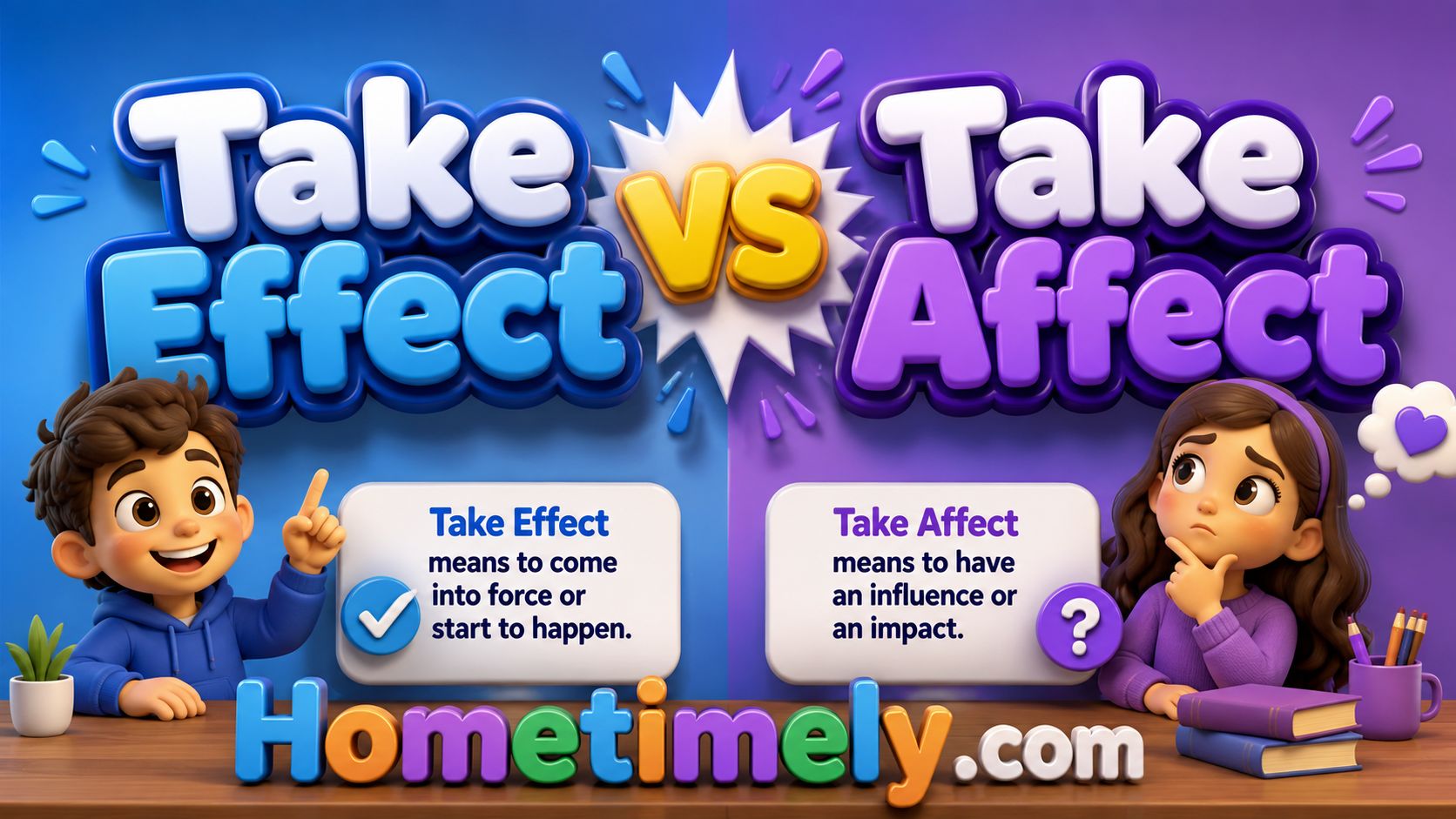
I spent hours pulling apart this exact phrase after catching myself typing “take affect” in a work email. If you’ve ever paused mid-sentence wondering which one is right, this guide settles it for good, with the grammar logic, real examples, and memory tricks that finally made it stick for me.
My Quick Answer
The correct phrase is always “take effect.”
“Take affect” is grammatically incorrect and should never appear in your writing, formal or casual. Here’s the one-line reason:
- Effect is a noun (a result), so it fits after the verb “take.”
- Affect is a verb (to influence), so it cannot logically follow another verb like “take.”
| Phrase | Correct? |
| Take effect | ✅ Yes |
| Take affect | ❌ No |
That’s the whole rule. Everything below explains the reasoning, shows you real examples, and gives you tricks so you never mix them up again.
Why I Found “Take Effect” Is the Only Correct Choice
When I first researched this, I expected some exception buried somewhere. There isn’t one. The answer comes down to basic sentence structure.
“Take” is a verb, and verbs need an object. In English, the object of a verb is typically a noun, not another verb. Look at the pattern:
- Take a break (noun)
- Take a seat (noun)
- Take effect (noun)
Now compare that to what “take affect” would require:
- Take a run (verb used as noun — works because “run” can be a noun)
- Take affect (verb) — this doesn’t work, because “affect” functions almost exclusively as a verb, not a noun
Since “affect” isn’t behaving as a noun in this context, it simply cannot slot into the “take + noun” structure the way “effect” does. This is the entire grammatical explanation, and once you see it, the confusion usually disappears for good.
The Core Grammar Rule
- Effect = noun (a result or outcome).
- Affect = verb (to influence or change something).
- “Take” needs a noun after it, so “effect” is the only word that fits.
- This rule stays consistent across British English and American English. There’s no regional variation here.
I also traced the origin of both words, since etymology often explains why English settles on one form over another. “Effect” comes from the Latin effectus, meaning “a result” or “a completion,” and it entered English in the 14th century primarily as a noun. “Affect” comes from the Latin afficere, meaning “to influence” or “to act upon,” and it entered English around the same period, but almost exclusively as a verb.
That historical split matters. Because “effect” has functioned as a noun for roughly seven centuries, it naturally slots into noun positions in sentences, including right after action verbs like “take,” “put,” “have,” and “go into.” “Affect,” on the other hand, has spent that same seven centuries functioning as a verb, describing an action rather than naming a result. Trying to force it into a noun’s position, as “take affect” does, goes against how the word has behaved in English since it was first adopted.
My Definition and Meaning Analysis
Understanding what each word actually means makes the grammar rule click even faster.
Effect (Noun)
“Effect” refers to a result, outcome, or consequence of something. It’s the thing that happens because of an action or event.
- The medicine had an immediate effect.
- The new policy had a positive effect on morale.
- Pollution has damaging effects on the environment.
Occasionally, “effect” can function as a verb meaning “to bring about” or “to cause” (as in “effect change”), but this usage is rare and mostly appears in formal or academic writing.
Affect (Verb)
“Affect” means to influence, change, or have an impact on something.
- The weather can affect your mood.
- Lack of sleep affects concentration.
- Stress may affect productivity.
In rare psychological and clinical contexts, “affect” can be used as a noun meaning a person’s outward emotional expression (as in “the patient displayed a flat affect”). But this is a specialized, technical usage, not something you’ll encounter in everyday writing.
Quick Definition Table
| Word | Part of Speech | Meaning | Example |
| Effect | Noun (usually) | A result or outcome | “The effect was immediate.” |
| Affect | Verb (usually) | To influence or change | “Noise can affect sleep.” |
| Effect | Verb (rare) | To bring about or cause | “The manager effected real change.” |
| Affect | Noun (rare, clinical) | Emotional expression | “The patient showed a blunted affect.” |
Because “take” is always paired with a noun in this specific phrase, “effect” wins every single time.
Why “Take Affect” Is Always Wrong
“Take affect” isn’t a regional variant, a stylistic choice, or an accepted informal version. It’s simply incorrect.
Here’s why it fails grammatically:
- Verbs don’t follow verbs directly in this structure. “Take” demands a noun object, and “affect” almost never functions as one.
- No dictionary lists “take affect” as a valid phrase. Every major English dictionary and style guide recognizes only “take effect.”
- Spell-checkers and grammar tools flag it. Programs like Grammarly, Microsoft Editor, and Google Docs consistently mark “take affect” as an error.
- Style guides are unanimous. From AP Style to Chicago Manual of Style, none recognize “take affect” as acceptable in professional or academic writing.
The mistake almost always comes from one of these situations:
- Autocorrect swapping the words without the writer noticing.
- Confusing the pronunciation, since “affect” and “effect” sound nearly identical when spoken quickly.
- Genuine uncertainty about which word functions as the noun and which as the verb.
None of these reasons make “take affect” correct. It remains an error every time it appears, regardless of context or intent.
What Happens If You Use “Take Affect” Anyway
If you write “take affect” in a professional or academic setting, a few things tend to happen:
- Readers notice, even if they can’t explain why. A native English speaker will often sense that something is off, even without knowing the exact grammar rule.
- It undermines credibility. In legal contracts, business emails, or academic papers, a mistake like this can make the entire document look less carefully written, even if the rest of the content is solid.
- Editors will always correct it. Any professional editor, proofreader, or grammar-checking tool will flag and fix this error without exception.
- It can create genuine confusion. In legal or medical writing especially, precision matters. A reader briefly pausing to figure out what you meant is a distraction you want to avoid entirely.
None of this means the mistake is unforgivable. It’s an extremely common slip, largely because the words sound alike. But once you know the rule, there’s no reason to keep making it.
50+ Real-World Examples I Collected
I gathered examples across different fields to show exactly how “take effect” is used in real writing. Notice how the structure stays identical no matter the topic.
Legal and Government Examples
- The new law will take effect on January 1st.
- This agreement shall take effect upon signature by both parties.
- The court ruling takes effect immediately.
- The updated tax policy takes effect next fiscal year.
- The ban on plastic bags takes effect this summer.
- The amendment will take effect once ratified by the state legislature.
- The contract’s terms take effect the day it is signed.
- The new immigration rules take effect at midnight.
- The court order takes effect as soon as it is filed.
- The revised regulation takes effect after a 30-day notice period.
Medical and Health Examples
- The medicine should take effect within 30 minutes.
- Painkillers usually take effect faster on an empty stomach.
- The anesthesia will take effect before the surgery begins.
- The vaccine takes effect two weeks after the second dose.
- This treatment takes effect gradually over several weeks.
- The sedative took effect almost instantly.
- The new dosage should take effect by tomorrow morning.
- Antibiotics typically take effect within 48 hours.
- The allergy medication takes effect in under an hour.
- The therapy’s benefits take effect after consistent use.
Business and Workplace Examples
- The new work-from-home policy takes effect next Monday.
- Salary adjustments take effect at the start of the quarter.
- The updated dress code takes effect immediately.
- Your promotion takes effect on the first of next month.
- The company’s new return policy takes effect this week.
- The merger takes effect once both boards approve it.
- The revised employee handbook takes effect January 1st.
- This price change takes effect at checkout.
- The new safety protocol takes effect across all branches.
- The updated commission structure takes effect next pay cycle.
Technology and Software Examples
- The software update takes effect after you restart your device.
- The new privacy settings take effect immediately.
- Changes to your account take effect within 24 hours.
- The security patch takes effect once installed.
- The password reset takes effect right away.
- The new algorithm takes effect after the next server update.
- The subscription change takes effect at the next billing cycle.
- The firewall rule takes effect as soon as it’s saved.
- The app’s dark mode takes effect after you restart it.
- The system update takes effect during the next reboot.
Everyday and Personal Examples
- The diet changes should take effect within a few weeks.
- My new workout routine will take effect starting Monday.
- The rule change takes effect for the next school semester.
- Her new schedule takes effect after the holidays.
- The gym’s updated hours take effect this weekend.
- The curfew takes effect at 10 p.m. sharp.
- The discount takes effect automatically at checkout.
- The new house rules take effect immediately.
- His resignation takes effect two weeks from today.
- The weather advisory takes effect this afternoon.
- The travel restriction takes effect at midnight tonight.
- The membership benefits take effect once payment clears.
Every single one of these examples follows the same structure: “take” plus the noun “effect,” describing something starting, activating, or becoming operational.
Take Effect vs. Take Affect: My Complete Comparison
| Feature | Take Effect ✅ | Take Affect ❌ |
| Grammatical correctness | Correct | Incorrect |
| Word functioning as noun | Effect | None (affect is a verb) |
| Dictionary recognition | Yes | No |
| Meaning | To begin, activate, or become operational | Not a recognized meaning |
| Used in legal writing | Always | Never |
| Used in medical writing | Always | Never |
| Used in business writing | Always | Never |
| Accepted by style guides | Yes (AP, Chicago, APA) | No |
| Common cause of error | N/A | Homophone confusion, autocorrect |
| Regional variation | None (same in US/UK English) | None (always wrong) |
If you remember nothing else from this guide, remember this table. Every context that requires this phrase uses “effect,” without exception.
My Memory Tricks and Tips
Here are the tricks that helped this rule stick permanently for me.
- RAVEN Rule: Remember Affect = Verb, Effect = Noun. It’s a simple acronym that covers the vast majority of cases.
- “A” for Action: Affect starts with A, and so does Action. Affect is the action of influencing something.
- “E” for End Result: Effect starts with E, and so does End result. Effect is the outcome after something happens.
- Ask what comes after “take.” Since “take” always needs a noun, and effect is the noun, effect is your default answer.
- Test with a synonym. Replace the word with “result.” If “result” fits the sentence, use “effect.” (“The law will take result” doesn’t quite work grammatically, but it confirms you’re looking for a noun, which points you to “effect.”)
- Trust your spell-checker, but understand why. Don’t just accept the correction blindly; know that “affect” as a verb can never follow “take” in standard grammar.
Special Cases I Discovered
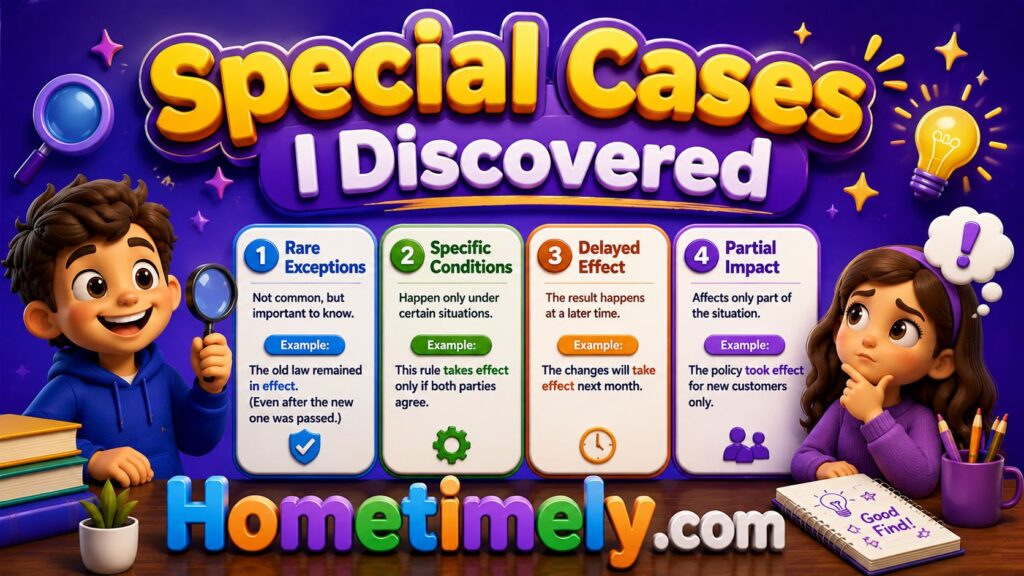
While “take effect” is the only correct form of this specific idiom, I found a few related situations worth knowing about, since they sometimes add to the confusion.
When “Effect” Is Used as a Verb
In rare, formal writing, “effect” can function as a verb meaning “to cause” or “to bring about”:
- The new CEO effected major changes within the company.
- The committee hopes to effect real reform this year.
This is different from “take effect.” Here, “effect” itself is the action verb, not paired with “take.”
When “Affect” Is Used as a Noun
In psychology and clinical settings, “affect” can be a noun describing someone’s visible emotional state:
- The therapist noted the patient’s flat affect.
- His affect seemed unusually cheerful during the session.
This specialized usage doesn’t apply to “take affect.” Even in psychology, you would never say “take affect” to mean something is starting or becoming active.
“Go Into Effect” as an Alternative
Some writers use “go into effect” instead of “take effect.” Both are grammatically correct and interchangeable in most contexts:
- The new rule will go into effect next week.
- The new rule will take effect next week.
The Word “Effective” as a Related Adjective
Many of the same contexts that use “take effect” also use the adjective “effective” to describe when something begins:
- The new policy is effective January 1st.
- Changes to your subscription are effective immediately.
This isn’t interchangeable with “take effect” grammatically (one is a verb phrase, the other is an adjective describing a date), but they’re often used side by side in the same document, especially in legal and HR writing. Knowing both forms helps you vary your sentence structure without ever reaching for “take affect.”
Why Context Never Changes the Rule
I also checked whether “take affect” might be acceptable in any specialized field, such as psychology, where “affect” does function as a noun. Even there, the answer is no. Clinicians describe a patient’s “affect” as a state or observation (“her affect was flat”), but they still never say something “takes affect.” The phrase “take effect” always refers to something beginning or becoming active, and that meaning has no clinical equivalent involving “affect” as a noun. The specialized noun use of “affect” and the idiomatic phrase “take effect” simply don’t intersect.
Synonyms for “Take Effect”
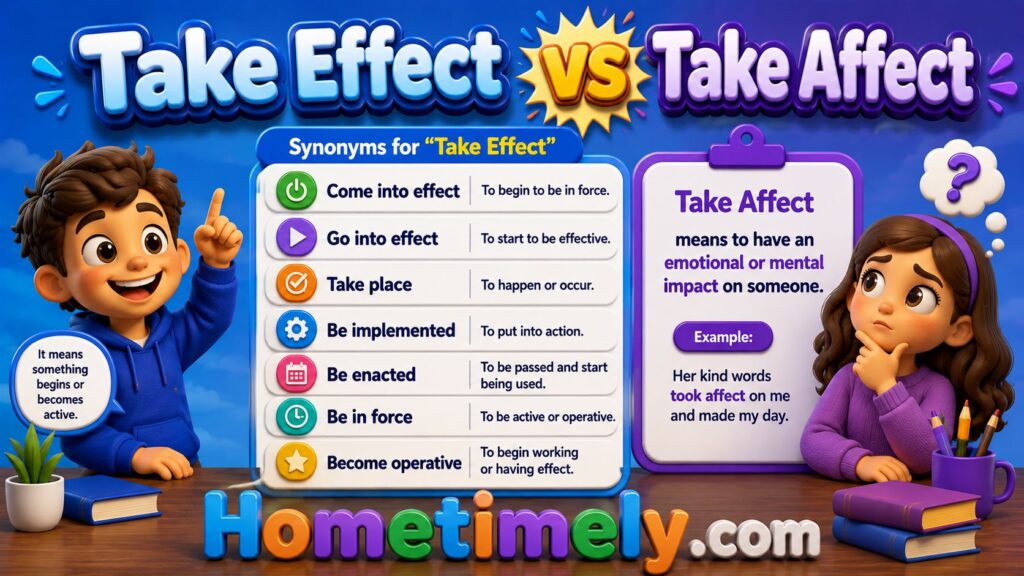
If you want to vary your writing or avoid repeating the same phrase, here are reliable alternatives:
- Come into force
- Go into effect
- Become active
- Begin operating
- Kick in (informal)
- Become law
- Start applying
- Become operational
- Enter into force (common in legal and international contexts)
- Become effective
Example usage:
- “The new tax rate will come into force next quarter.”
- “The medication should kick in within the hour.”
- “The treaty will enter into force once all nations sign.”
Common Phrases I Found with “Effect”
Beyond “take effect,” the word “effect” appears in several other fixed expressions worth knowing:
| Phrase | Meaning |
| In effect | Currently active or in force |
| Put into effect | To implement or activate something |
| To that effect | With that general meaning or purpose |
| Side effect | An unintended secondary result |
| Cause and effect | The relationship between an action and its result |
| For effect | Done to create a particular impression |
| Come into effect | To begin operating or applying |
| No effect | No noticeable result or impact |
Notice that “effect” consistently functions as a noun across nearly all of these expressions, reinforcing why it’s the correct choice in “take effect.”
Why This Mistake Is So Common
I wanted to understand why so many people, including confident writers, still mix these words up. A few clear reasons stood out:
- They’re homophones in casual speech. When spoken quickly, “affect” and “effect” sound nearly identical, especially in fast conversation.
- They share a common root. Both words come from Latin roots related to “doing” or “making,” which adds to the semantic overlap.
- Autocorrect doesn’t always catch it. Since both are real words, some spell-checkers won’t flag the phrase unless grammar-checking is specifically enabled.
- Limited exposure to formal writing. Native speakers who rely mostly on spoken English may never see the written distinction clearly enough to internalize it.
- Both words relate to change. Since “affect” means to influence and “effect” refers to the resulting change, the conceptual overlap makes the mix-up feel almost logical, even though it’s grammatically wrong.
Recognizing why the mistake happens makes it much easier to catch yourself before making it.
Also Read This : Puting vs. Putting: The Correct Spelling Explained
Professional Context Examples
Getting this phrase right matters most in professional and formal writing, where small errors can affect how credible you appear.
- Legal documents: “This clause shall take effect upon execution of the agreement.” Legal writing relies heavily on precise, standardized phrasing, and “take effect” is the industry-standard term for when a clause, contract, or law becomes enforceable.
- HR communications: “Your new benefits package takes effect at the start of next month.” Human resources teams use this phrase constantly when communicating policy changes, salary adjustments, and benefit updates to employees.
- Corporate announcements: “The updated leadership structure takes effect immediately.” Press releases and internal memos favor this phrasing because it clearly signals a definitive start date without ambiguity.
- Academic writing: “The policy change takes effect for the upcoming academic year.” Universities and research papers use this construction when describing institutional changes, funding shifts, or new academic requirements.
- Journalism: “The new trade tariffs take effect at midnight, according to officials.” News writing depends on precise timing language, and “take effect” is the standard way to communicate exactly when a law or policy becomes active.
- Customer notices: “These updated terms of service take effect on the date listed above.” Companies use this phrase in terms-of-service updates, privacy policy changes, and subscription notices sent to millions of users.
- Government communications: “This executive order takes effect immediately upon signing.” Official government language relies on this exact phrase to establish enforceability and timing with legal precision.
Using “take effect” correctly in these settings signals attention to detail and reinforces professionalism, exactly the kind of small grammar choice that builds trust with readers. In fields like law, healthcare, and finance, where a single misplaced word can create real ambiguity, using the correct phrase isn’t just a style preference. It’s part of writing clearly enough that nobody has to guess what you meant.
Explore More Grammar Guides
If word pairs like this trip you up, you’re not alone, and there are several similar mix-ups worth reviewing:
- Affect vs Effect: The complete difference explained
- Then vs Than: When to use each correctly
- Its vs It’s: A simple guide to possessives and contractions
- Complement vs Compliment: Correct usage and examples
- Advice vs Advise: Noun or verb, which one do you need?
Wrapping It Up
“Take effect” is the only grammatically correct version of this phrase, and now you know exactly why: “take” needs a noun, and “effect” is that noun. “Take affect” simply doesn’t hold up under English’s basic sentence structure. Keep the memory tricks above handy, and you’ll never second-guess this pair again.

Michael Brook is the creator and author behind Healthy Leeks, a platform focused on grammar, writing skills, and English language learning. Passionate about clear communication and effective writing, Michael Brook shares practical grammar tips, easy-to-follow language guides, and educational content to help readers improve their English with confidence.