A single apostrophe. Placed before or after a single letter “s.” That is all that separates parent’s from parents’ — and yet the difference in meaning is significant enough to change the entire intent of a sentence, a school letter, a legal form, or a consent document.
If you have ever stared at a sentence and genuinely could not decide between “parent’s meeting” and “parents’ meeting,” you are not alone. This is one of the most searched grammar questions among students, teachers, office administrators, and parents themselves. The confusion is understandable because all three forms — parents, parent’s, and parents’ — sound identical when spoken aloud. Only in writing does the difference emerge, and only when you understand the underlying grammar rule does the right choice become obvious every time.
This guide explains both forms completely — what they mean, when to use each one, how they appear in school contexts and official documents, and why apostrophe placement is far more important than most people realize.
Quick Answer: Parents’ vs Parent’s
Here is the clearest possible summary before diving deeper:
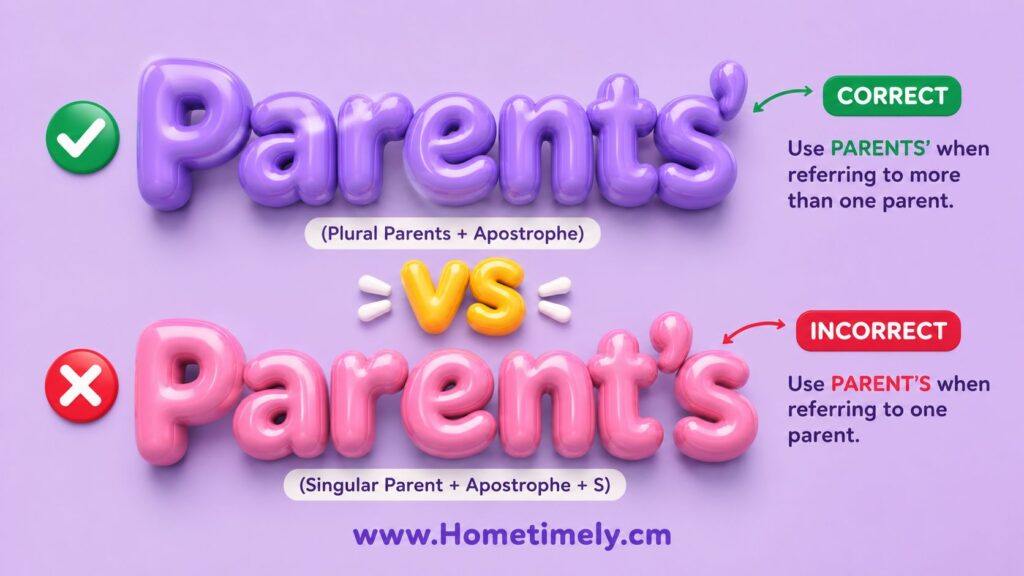
- Parent’s = one parent owns or is associated with something
- Parents’ = two or more parents own or are associated with something
- Parents = simply more than one parent, no ownership involved
The apostrophe does not change pronunciation. It changes meaning. Its position — before or after the “s” — tells the reader exactly how many parents you are referring to and whether possession is involved.
Quick Example
- “My parent’s car is red.” → One parent’s car. (Could be just mom or just dad.)
- “My parents’ car is red.” → Both parents share the car.
- “My parents are coming to visit.” → Just stating there are two parents. No ownership.
Quick Reference Table
| Form | Type | Meaning | Example |
| Parents | Plural noun | More than one parent, no possession | “Both parents attended the event.” |
| Parent’s | Singular possessive | One parent owns or is linked to something | “The parent’s signature is missing.” |
| Parents’ | Plural possessive | Two or more parents own or are linked to something | “The parents’ meeting starts at 6 PM.” |
What Do Parent’s and Parents’ Actually Mean?
Both parent’s and parents’ are possessive forms of the word “parent.” The difference between them is purely about number — singular vs plural. The apostrophe in both cases signals ownership or association, but where it sits determines whether you are talking about one parent or more than one.
Parent’s uses an apostrophe before the “s.” This is the standard way English forms the possessive of any singular noun. The structure is: singular noun + apostrophe + s. So “parent” becomes “parent’s.”
Parents’ uses an apostrophe after the “s.” When a noun is already plural and ends in “s” — as “parents” does — you simply add an apostrophe at the end to show possession. You do not add another “s.” So “parents” becomes “parents’.”
This rule is consistent across English grammar. It applies to all regular plural nouns that end in “s” — teachers’, students’, employees’, neighbors’, and so on. Understanding the parent/parents pairing gives you a template you can apply to dozens of similar words.
Meaning Table
| Form | Number of Parents | Shows Possession? | Pronunciation |
| Parents | Two or more | No | PAIR-ents |
| Parent’s | One | Yes | PAIR-ents |
| Parents’ | Two or more | Yes | PAIR-ents |
All three forms are pronounced identically. Context and apostrophe placement are the only tools that distinguish them in writing.
The Core Grammar Rule Behind Apostrophes
To use parent’s and parents’ correctly every time, you only need to understand one foundational rule of English grammar: apostrophes show possession, and their position depends on whether the owner is singular or plural.
The rule works in two steps:
- Singular noun (one owner) → Add apostrophe + s after the noun
- Parent → Parent**’s**
- Teacher → Teacher**’s**
- Child → Child**’s**
- Plural noun ending in “s” (multiple owners) → Add apostrophe only after the final “s”
- Parents → Parents**’**
- Teachers → Teachers**’**
- Students → Students**’**
There is a third rule worth knowing for completeness: plural nouns that do not end in “s” (like children or women) follow the singular rule and take apostrophe + s — children’s, women’s. But this does not apply to “parents,” which ends in “s” in its plural form.
One more critical point: apostrophes are never used simply to make a word plural. Writing “parent’s” when you only mean “more than one parent” — with no possession involved — is an error. If you are just referring to multiple parents without any ownership, write parents with no apostrophe at all.
Grammar Rule Table
| Situation | Rule | Result |
| One parent owns something | Singular noun + ‘s | parent’s |
| Two or more parents own something | Plural noun + ‘ | parents’ |
| Just referring to more than one parent | Plural noun, no apostrophe | parents |
| Never correct | Plural noun + ‘s | parents’s ❌ |
The form parents’s is always wrong. No standard grammar rule produces this form. If you see it, treat it as an error.
Parents’ vs Parent’s vs Parents in Real Life
Knowing the rules is one thing. Seeing them in real sentences makes them automatic. Here is how all three forms appear in the kinds of sentences you actually encounter:
Using parents (plural, no possession):
- “Both parents are expected to attend the ceremony.”
- “The school sent a notice to all parents.”
- “Many parents struggle to balance work and family responsibilities.”
Using parent’s (singular possessive):
- “The parent’s decision was respected by the school board.”
- “A parent’s love is one of the most consistent forces in a child’s life.”
- “The form requires a parent’s signature — one is sufficient.”
- “It was entirely the parent’s responsibility to arrange transport.”
Using parents’ (plural possessive):
- “The parents’ concerns were addressed at the meeting.”
- “All families received the parents’ handbook before the school year began.”
- “The parents’ joint consent is required before the trip.”
- “Their parents’ house has been in the family for three generations.”
Comparison Table
| Sentence | Correct Form | Why |
| “The ___ car is in the driveway.” (both parents) | parents’ | Plural possession |
| “The ___ signature is needed.” (one parent) | parent’s | Singular possession |
| “___ are invited to the annual gala.” (general group) | Parents | Plural, no possession |
| “The ___ role in education is vital.” (one parent) | parent’s | Singular |
| “The ___ handbook was updated.” (for all parents) | parents’ | Plural possession |
Parents Meeting or Parents’ Meeting (School Context Explained)
This is one of the most commonly searched variations of this topic — and for good reason. School letters, event notices, classroom bulletins, and email invitations get this wrong with surprising frequency.
The correct form is parents’ meeting — with an apostrophe after the “s.”
Here is why. A parents’ meeting is a meeting that belongs to, or is organized for, multiple parents. The word “parents'” functions as a plural possessive modifier, describing ownership or association. Because multiple parents are involved, the apostrophe goes after the “s.”
“Parent’s meeting” would technically suggest that one specific parent owns or called the meeting — which is almost never the intended meaning in a school context.
“Parents meeting” — without any apostrophe — reads as incomplete in formal writing. It may pass in casual signage or group texts, but in any official school communication, the apostrophe matters.
The same logic applies to related school phrases. A parents’ evening (more on this below), a parents’ committee, a parents’ association, and a parents’ handbook all follow the same plural possessive rule.
Usage Table
| Phrase | Correct? | Notes |
| Parents’ meeting | ✅ Yes | Correct plural possessive |
| Parent’s meeting | ⚠️ Context-dependent | Only if one specific parent is hosting |
| Parents meeting | ❌ Informal only | Missing apostrophe; avoid in formal writing |
| Parents’ committee | ✅ Yes | Plural possessive |
| Parents’ association | ✅ Yes | Group belonging to multiple parents |
| Parents’ handbook | ✅ Yes | Handbook for all parents |
Parents’ Name, Parent’s Name, and Signature Usage
Official forms — school enrollment documents, medical consent forms, permission slips, and legal paperwork — frequently ask for a parent’s name or signature. The correct choice depends entirely on how many signatures or names are required.
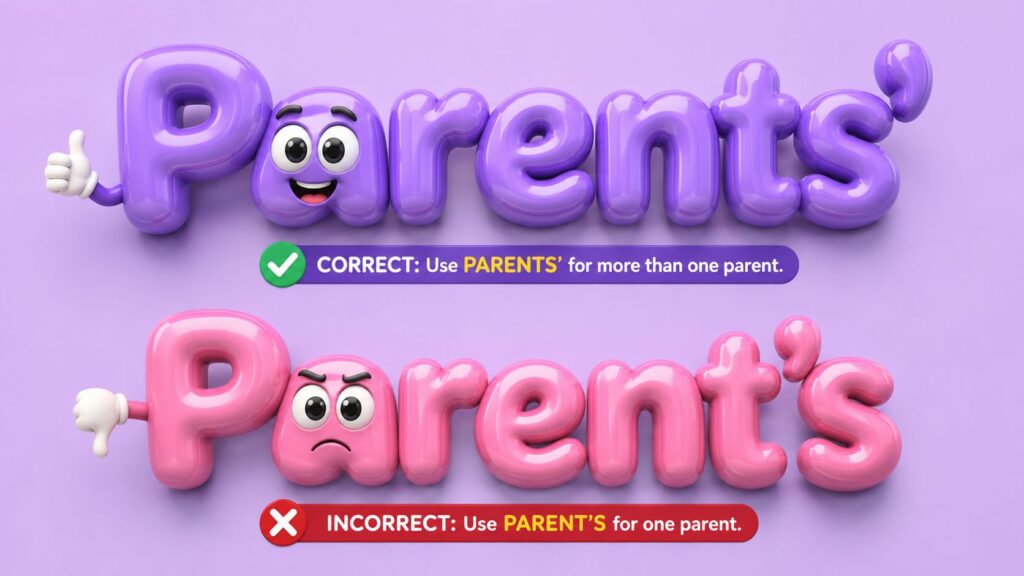
- If the form requires one signature, the correct phrase is parent’s signature or parent’s name. The document is asking for a single person’s authorization.
- If the form requires both parents to sign, the correct phrase is parents’ signatures or parents’ names. Both guardians are owners of the action.
- If you are simply referring to parents’ names in general — as a field label — parents’ names is typically more appropriate in formal or institutional documents, since most families involve two guardians.
In everyday writing, you might also see:
- “Please write your parent’s name in the box below.” (One name required.)
- “Both parents’ names must appear on the registration form.” (Two names required.)
- “The application must include a parent’s signature from the custodial guardian.” (One specific parent.)
Signature Table
| Phrase | Correct Use | Context |
| Parent’s signature | One parent signs | Permission slips, single-guardian forms |
| Parents’ signatures | Both parents sign | Joint legal documents, dual-consent forms |
| Parent’s name | One name required | Single-entry fields on forms |
| Parents’ names | Both names required | Joint enrollment or legal documents |
| Parents’ consent | Consent from both | Medical, travel, legal forms |
Parents’ House vs Parent’s House (Ownership Clarity)
This specific phrase comes up constantly in everyday conversation and writing, and the correct choice depends on a single question: who owns the house?
- If both parents own the house together, write parents’ house.
- “We spent every summer at our parents’ house in the countryside.”
- If only one parent owns the house — for example, after a divorce, or when referring specifically to your mother’s or father’s property — write parent’s house.
- “She stayed at her parent’s house while her apartment was being renovated.” (One parent’s home.)
In most everyday usage, when people refer to the family home where both parents live, parents’ house is the appropriate form. It reflects shared ownership or shared association with the property.
The same rule applies to related phrases: parents’ garden, parents’ bedroom, parents’ anniversary, parents’ decision. If both parents are involved or share ownership, the apostrophe goes after the “s.”
Ownership Table
| Phrase | Owner | Correct Form |
| The family home shared by both parents | Both parents | parents’ house |
| A house owned by one parent alone | One parent | parent’s house |
| The bedroom belonging to both parents | Both | parents’ bedroom |
| The decision made by one parent | One | parent’s decision |
| The anniversary of both parents | Both | parents’ anniversary |
Plural vs Possessive Nouns (Why Errors Happen)
One of the most persistent sources of apostrophe errors in English writing is a confusion between two completely different grammatical functions: making a word plural and showing possession.
These are not the same thing, and apostrophes are used for possession — not for plurals. Yet many writers automatically reach for an apostrophe whenever they add an “s” to a noun. This error is so common it even has a nickname among editors and grammar teachers: the greengrocer’s apostrophe, named after the handwritten signs that used to read “apple’s” and “orange’s” on market stalls.
Here is the fundamental distinction:
- Plural means more than one. No apostrophe needed. → parents, teachers, students, employees
- Possessive means belonging to or associated with. Apostrophe required. → parent’s, teacher’s, student’s, employee’s
- Plural possessive means belonging to more than one. Apostrophe after the “s.” → parents’, teachers’, students’, employees’
When people write “parent’s” and they simply mean “more than one parent” — no ownership involved — that is the greengrocer’s apostrophe in action. The correct form in that case is simply parents, no punctuation.
Function Table
| Form | Grammatical Function | Apostrophe? | Example |
| parents | Plural only | No | “Both parents came to school.” |
| parent’s | Singular possessive | Yes — before s | “The parent’s car needs repair.” |
| parents’ | Plural possessive | Yes — after s | “The parents’ car is in the lot.” |
| parents’s | No valid function | N/A — always wrong | ❌ Never use |
Common Mistakes with Parents’ vs Parent’s
Awareness of recurring errors is one of the fastest ways to permanently fix your own writing habits. These are the mistakes that appear most often in school communications, business emails, social media posts, and formal documents.
Mistake 1: Using “parent’s” when you mean all parents Writing “I spoke to my parent’s teacher” when both parents are involved. The correct form is “parents’ teacher” or simply “my parents’ teacher.”
Mistake 2: Writing “parents” with no apostrophe when possession is involved “The parents meeting is at 7 PM” is grammatically incomplete in formal writing. The meeting belongs to the parents — it should be “parents’ meeting.”
Mistake 3: Writing “parents’s” This form is never correct. Once a word ends in “s,” you do not add another “s” after the apostrophe. “Parents'” is the correct plural possessive — nothing more.
Mistake 4: Adding an apostrophe to a simple plural “All parent’s are welcome” — here, no possession is intended. The apostrophe is wrong. Write “All parents are welcome.”
Mistake 5: Treating “parent’s” as interchangeable with “parents'” These are not stylistic alternatives. They refer to different numbers of people. One is singular, one is plural. Using the wrong one genuinely changes the meaning of your sentence.
Mistake Table
| Incorrect | Error Type | Correct |
| The parents’s decision | Double possessive | The parents’ decision |
| All parent’s must attend | False possessive plural | All parents must attend |
| The parent’s meeting (for all) | Wrong number | The parents’ meeting |
| Both parents’ signature needed | Mismatched number | Both parents’ signatures needed |
| The parents home | Missing apostrophe | The parents’ home |
Is It Parent’s or Parents’ Evening?
The correct form is parents’ evening — and this matters particularly in British and Irish English, where the term is used widely by schools to describe the event at which parents meet teachers to discuss their child’s academic progress.
The logic is straightforward. A parents’ evening is an evening organized for multiple parents. The event is collectively associated with all attending parents — not just one. Since multiple parents are involved and there is a possessive relationship between the parents and the evening, the apostrophe goes after the “s”: parents’ evening.
“Parent’s evening” would technically suggest the evening belongs to one specific parent. While this might theoretically apply in a very narrow context, it is almost never the intended meaning.
Interestingly, many schools and official bodies in the UK drop the apostrophe entirely in informal signage — “parents evening” — but this is considered grammatically incomplete. In any formal school communication, letter, or official document, the full form parents’ evening is the correct and expected standard.
In the United States, the equivalent event is more commonly called a parent-teacher conference or parent-teacher night — but when “parents’ evening” is used in American English, the same apostrophe rule applies.
Event Table
| Phrase | Correct? | Notes |
| parents’ evening | ✅ Yes | Standard formal form |
| parent’s evening | ⚠️ Narrow use | Only if referring to one parent’s specific event |
| parents evening | ❌ Informal only | Missing apostrophe; avoid in official writing |
| parents’ night | ✅ Yes | American variant, same rule |
| parent-teacher conference | ✅ Yes | Common US equivalent term |
Why Apostrophe Placement Matters
It might seem like a tiny detail — one small curved mark moved a single letter to the left or right. But apostrophe placement is one of those grammatical choices that professionals, teachers, and careful readers notice immediately. And its impact goes beyond appearance.
Clarity of meaning. “The parent’s decision” tells you one person made a call. “The parents’ decision” tells you it was a joint one. In family law, medical contexts, and educational records, that distinction is legally and practically significant.
Professional credibility. In business emails, school communications, cover letters, and formal documents, apostrophe errors signal carelessness. A letter to a school board that reads “Parents meeting on Thursday” instead of “Parents’ meeting on Thursday” subtly undermines the authority of the message.
Avoiding ambiguity. When apostrophes are omitted or misplaced, readers must guess at the intended meaning. Clear apostrophe use removes that guesswork entirely.
Clarity Table
| Sentence | With Correct Apostrophe | Without Apostrophe |
| “The ___ role is significant.” | parent’s role (one person) | Ambiguous |
| “___ concerns were noted.” | Parents’ concerns (group) | Unclear |
| “The ___ house is sold.” | parents’ house (both) | Could mean either |
| “___ evening starts at 6.” | Parents’ evening | Reads as incomplete |
English Writing Tips for Possessives
Applying apostrophe rules correctly is a learnable habit, not a talent. The following process works reliably for any possessive noun — not just “parents.”
Step 1: Identify the owner. Ask yourself: who or what owns the thing being described?
Step 2: Count the owners. Is it one person or more than one?
Step 3: Apply the rule.
- One owner → noun + ‘s (e.g., parent’s)
- Multiple owners, noun ends in “s” → noun + ‘ (e.g., parents’)
- Multiple owners, noun does NOT end in “s” → noun + ‘s (e.g., children’s)
Step 4: Check for false possessives. If you are not describing ownership — just referring to multiple people — no apostrophe is needed.
Step 5: Read the sentence aloud. Even though all three forms of “parent/parents/parent’s/parents'” sound the same, the act of reading aloud forces you to clarify meaning in your head, which often exposes the wrong choice.
Process Table
| Step | Question to Ask | Action |
| 1 | Who owns it? | Identify the owner |
| 2 | One or more than one? | Count the owners |
| 3 | Does the plural end in “s”? | Choose apostrophe placement |
| 4 | Is this really a possessive? | Remove apostrophe if no ownership |
| 5 | Does the sentence read clearly? | Final check |
School Communication Errors
Schools produce an enormous volume of written communication — letters, newsletters, notice boards, permission slips, event invitations, and online announcements. And school communications are among the most common places where “parents'” and “parent’s” are misused.
Common real-world examples that appear incorrectly on school materials:
- ❌ “Parent’s evening on Wednesday” → ✅ “Parents’ evening on Wednesday”
- ❌ “All parents are asked to fill in the parent consent form” → ✅ “All parents are asked to fill in the parents’ consent form” (if applying to all)
- ❌ “The school requires a parents signature” → ✅ “The school requires a parent’s signature” (one signature per child)
- ❌ “Please bring your parents’s ID” → ✅ “Please bring your parents’ ID”
- ❌ “The parents voice matters” → ✅ “The parents’ voice matters”
One of the most common errors in school signage is simply omitting the apostrophe entirely — “Parents Evening” instead of “Parents’ Evening.” While readers generally understand the intent, in formal communication it signals a lack of attention to grammatical detail.
Table
| Incorrect School Phrase | Corrected Version | Error Type |
| Parents Evening | Parents’ Evening | Missing apostrophe |
| Parent’s Meeting (for all) | Parents’ Meeting | Wrong number |
| Parents Handbook | Parents’ Handbook | Missing apostrophe |
| Parents’s Committee | Parents’ Committee | Double possessive |
| The parents voice | The parents’ voice | Missing apostrophe |
Also Read This : Stich vs Stitch: Difference, Meaning, and Correct Usage (Complete Guide)
Practice Section
Test your understanding with these exercises. Focus on whether possession is involved and how many parents are being discussed.
Fill in the Blanks
Complete each sentence using the correct form: parents, parent’s, or parents’
- “The _______ meeting has been rescheduled to next Thursday.”
- “She followed her _______ advice and chose the safer route.” (one parent’s advice)
- “Both _______ signed the permission form before the trip.”
- “The _______ house has been in the family for over forty years.” (both parents own it)
- “He needed his _______ signature on the consent document.” (one parent signing)
- “The school invited all _______ to the annual open day.”
- “The _______ decision to move cities affected the whole family.” (both parents decided)
- “A _______ role in early childhood development cannot be overstated.” (one parent’s role)
Multiple Choice Questions
Choose the correct option for each sentence.
Question 1: “The _______ evening is scheduled for next Friday.”
- a) parent’s
- b) parents’
- c) parents
Question 2: “She borrowed her _______ car for the weekend.” (only her mother’s)
- a) parents’
- b) parent’s
- c) parents
Question 3: “All _______ are encouraged to attend the orientation.”
- a) parent’s
- b) parents’
- c) parents
Question 4: “The _______ joint consent is required for the medical procedure.”
- a) parents’
- b) parent’s
- c) parents
Question 5: “The school will notify _______ about any timetable changes.”
- a) parent’s
- b) parents’
- c) parents
Question 6: “It was entirely the _______ choice to enroll her in the advanced program.” (one parent)
- a) parents’
- b) parents
- c) parent’s
Question 7: “The _______ handbook explains all school policies.”
- a) parent’s
- b) parents’
- c) parents
Question 8: “He grew up in his _______ house in rural Wales.” (both parents’ home)
- a) parent’s
- b) parents
- c) parents’
Answers
Fill in the Blanks
- parents’ — The meeting belongs to multiple parents. Plural possessive.
- parent’s — One parent gave advice. Singular possessive.
- parents — Simply referring to both parents. No possession indicated.
- parents’ — Both parents own the house. Plural possessive.
- parent’s — One parent’s signature is needed. Singular possessive.
- parents — Referring to all parents as a group. No possession.
- parents’ — Both parents made the decision together. Plural possessive.
- parent’s — One parent’s role. Singular possessive.
Multiple Choice
| Question | Answer | Reason |
| 1 | b) parents’ | The evening is for multiple parents. Plural possessive. |
| 2 | b) parent’s | One parent (mother) owns the car. Singular possessive. |
| 3 | c) parents | No ownership — just referring to multiple parents. Plural only. |
| 4 | a) parents’ | Both parents consent together. Plural possessive. |
| 5 | c) parents | No possession — the school notifies them. Plural only. |
| 6 | c) parent’s | One parent made the choice. Singular possessive. |
| 7 | b) parents’ | The handbook is for all parents collectively. Plural possessive. |
| 8 | c) parents’ | Both parents own the house. Plural possessive. |
Bringing It All Together
The difference between parent’s and parents’ is not about spelling — both words look almost identical. It is not about pronunciation — all three forms sound exactly the same. The only thing that separates them is apostrophe placement, and that placement carries real grammatical weight.
Parent’s tells your reader: one parent. Parents’ tells your reader: more than one parent. Parents with no apostrophe tells your reader: a group of people, no ownership involved.
Once you internalize those three distinctions, the choice becomes automatic. Before you write, pause for just a second and ask yourself two questions: Is there possession? And how many parents are involved? Those two answers tell you everything you need to know about where to place the apostrophe — or whether to use one at all.
Correct apostrophe use in possessives like parents’ and parent’s is one of those quiet grammar skills that builds reader trust without anyone consciously noticing. And that is exactly how good writing works — clearly, correctly, and without distraction.

Michael Brook is the creator and author behind Healthy Leeks, a platform focused on grammar, writing skills, and English language learning. Passionate about clear communication and effective writing, Michael Brook shares practical grammar tips, easy-to-follow language guides, and educational content to help readers improve their English with confidence.