
Have you ever typed “stear” and paused, wondering if it was right? You are not alone. Thousands of writers, students, bloggers, and even professionals search this exact question every single day. The words look almost identical. They sound completely the same. But only one of them belongs in the English language — and knowing which one can quietly protect your credibility every time you write.
This guide breaks down everything you need to know about “steer” vs “stear” — the correct spelling, the full meaning, how to use it in different contexts, why the mistake happens, and simple memory tricks so you never get tripped up again. Whether you write emails, essays, news articles, or social media posts, this is the clarity you have been looking for.
The Quick Answer
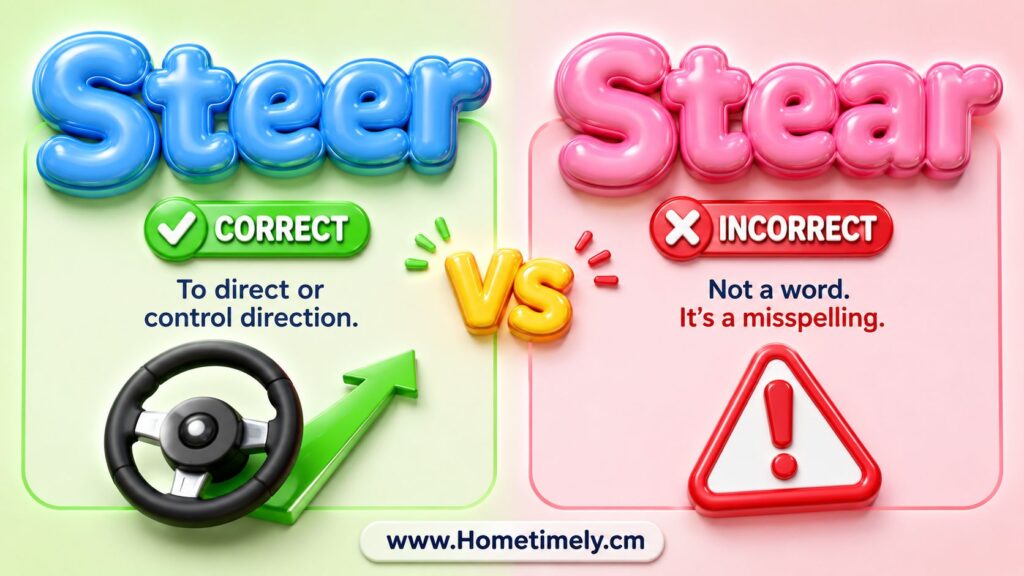
Steer is the correct spelling. It is a real, standard English word recognized by every major dictionary, including Merriam-Webster, Oxford, Collins, and Cambridge.
Stear is not a real word. It does not appear in any standard English dictionary as an independent entry. It is a misspelling — nothing more.
| Word | Correct? | Meaning |
| Steer | ✅ Yes | To guide or control direction; a young male bovine |
| Stear | ❌ No | Not a real word — a common spelling error |
If you ever find yourself typing “stear,” stop and replace the “ea” with “ee.” That single correction — from “stear” to “steer” — is all it takes.
Definition and Core Usage
The word steer functions as both a verb and a noun in standard English, and both uses are equally well established.
As a verb, steer means to control or guide the direction of something — a vehicle, a vessel, a conversation, a decision, or even a person’s behavior. It implies deliberate, purposeful guidance.
As a noun, steer refers to a young castrated male bovine animal, typically raised for beef. In the United States, the term is used more broadly for male beef cattle of any age.
As slang (informal noun), steer also means a tip or piece of useful advice — for example, “He gave me a good steer on where to invest.”
The word traces its roots to Old English stēoran, meaning “to guide a vessel,” and is connected to Proto-Germanic stiurijaną. The agricultural noun “steer” comes from Old English stēor, meaning “bullock,” and shares Germanic ancestry with Dutch stier and German Stier. The word has been in continuous use for over a thousand years across navigation, agriculture, and everyday communication.
What Does Steer Mean in Different Contexts
The meaning of steer shifts slightly depending on where you use it, but the core idea — guidance and control — runs through every context.
Driving and vehicles: When you steer a car, truck, or bicycle, you control its direction using the wheel, handlebars, or rudder. This is the most common modern use of the word.
Navigation and sailing: Sailors and ship captains steer their vessels through waterways. The word has a deep nautical history, going back to before the 10th century in Old English literature.
Leadership and management: In business and organizational writing, you often steer a team, a project, or a company toward a goal. This metaphorical use is extremely common in professional communication.
Conversations and behavior: You can also steer a conversation — meaning you subtly guide it toward or away from a topic. Similarly, you might steer someone away from a bad decision.
Agriculture: In farming contexts, a steer is a specific type of livestock — a castrated male bovine raised primarily for beef production.
Informal advice: In informal American English, a “steer” can mean a useful tip or suggestion, as in “Thanks for the steer — that restaurant was excellent.”
Is “Stear” a Real Word?
No. Stear is not a real word in standard English.
It does not appear as an independent entry in:
- Merriam-Webster Dictionary
- Oxford English Dictionary
- Cambridge Dictionary
- Collins English Dictionary
- Dictionary.com
When people search for “what does stear mean” or “what animal is a stear,” they are almost always looking for information about the correctly spelled word — steer.
There is one narrow technical exception worth knowing: the letter combination “stear” appears inside scientific terms like stearic acid — a saturated fatty acid found in animal and vegetable fats. Words like stearate, stearyl, and stearin are real chemical terms derived from the Greek stéar, meaning “fat.” However, these are prefix-based scientific terms, not the everyday word people are trying to spell. You would never write “please stear the car” and justify it by referencing stearic acid.
Outside chemistry, “stear” is a misspelling, plain and simple.
Steer vs Stear Meaning Difference
Since “stear” has no definition of its own, there is no true meaning difference between the two. The comparison is really between a correct word and an incorrect one.
| Feature | Steer | Stear |
| Dictionary listed | Yes | No |
| Correct spelling | Yes | No |
| Verb usage | ✅ Guide, control | ❌ Not valid |
| Noun usage | ✅ Young male bovine; informal tip | ❌ Not valid |
| British English | steer | Not applicable |
| American English | steer | Not applicable |
| Professional writing | ✅ Use freely | ❌ Avoid entirely |
One thing worth noting: unlike words such as colour/color or organisation/organization, “steer” has no British vs American spelling variation. Both dialects use exactly the same spelling. There is no situation — formal or informal, American or British — where “stear” is considered acceptable.
How to Use Steer Correctly in a Sentence
Using “steer” correctly is straightforward once you understand its two main grammatical roles.
As a verb, steer follows standard English verb conjugation patterns:
- Present: I steer, you steer, he/she steers
- Present continuous: I am steering, she is steering
- Past: I steered, they steered
- Past participle: I have steered
When using steer as a verb, you typically pair it with a direction, a destination, or an object:
- Steer toward (a goal, a place)
- Steer away from (danger, a topic)
- Steer through (traffic, a crisis)
- Steer clear of (a common idiom meaning “avoid”)
As a noun, steer is simply used to refer to the animal or, informally, a piece of advice. It is countable, so you can say “a steer,” “the steer,” or “several steers.”
Steer in a Sentence (Real Examples)
Seeing the word in natural context is one of the best ways to lock in the correct spelling and usage. Here are authentic examples across different contexts:
Driving and navigation:
- “She carefully steered the car through the narrow mountain pass.”
- “The captain steered the ship through a fierce storm without losing control.”
- “He learned to steer a bicycle before he was five years old.”
Leadership and business:
- “The new CEO promised to steer the company toward more sustainable practices.”
- “It was her job to steer the project back on schedule after a series of delays.”
- “They worked together to steer the organization through a difficult transition.”
Conversations and social situations:
- “He tried to steer the conversation away from politics at the dinner table.”
- “She gently steered her friend toward a more positive outlook.”
- “The moderator had to steer the discussion back to the original topic.”
Agriculture:
- “The rancher sold three steers at the county livestock auction.”
- “A well-fed steer can weigh over 1,000 pounds by the time it is sold.”
Idiom — steer clear of:
- “The doctor advised him to steer clear of processed foods.”
- “She steered clear of the argument and let others sort it out.”
Informal tip:
- “Thanks for the steer — that turned out to be exactly the advice I needed.”
Steer Synonyms and Related Words
Depending on the context, several synonyms can replace “steer” without changing the meaning significantly. However, each carries a slightly different tone or level of formality.
| Synonym | Best Used When |
| Guide | General direction, mentoring someone |
| Direct | Formal instructions or management |
| Navigate | Complex routes or situations |
| Control | Emphasizing authority or power |
| Pilot | Vehicles, aircraft, or leadership metaphors |
| Lead | People or groups toward a goal |
| Maneuver | Careful movement in tight situations |
| Channel | Focusing energy or attention |
| Drive | Active, forceful direction |
| Govern | Formal or policy-related contexts |
Related words and word family:
- Steering (noun/present participle) — “The steering wheel is broken.”
- Steered (past tense) — “She steered them to safety.”
- Steers (third-person singular) — “He steers the boat expertly.”
- Steerable (adjective) — “The drone is fully steerable from a phone.”
- Steersman / Steersman (noun) — A person who steers a boat.
Steer vs Stir vs Stear Common Confusions
Writers sometimes mix up three similar-looking or similar-sounding words: steer, stir, and stear. Here is how they break down clearly:
| Word | Real Word? | Meaning | Example |
| Steer | ✅ Yes | To guide or control; a male bovine | “Steer the car left at the junction.” |
| Stir | ✅ Yes | To mix a liquid; to provoke emotion or reaction | “Stir the soup before serving.” |
| Stear | ❌ No | Not a real word — misspelling of steer | Should not be used |
Steer and stir are completely different words with different meanings. One is about direction and control; the other is about mixing or provoking. They only share the letters “st” at the beginning, which is enough to confuse some writers, especially when typing quickly.
The sentence “She stirred the soup before she steered the car out of the driveway” uses both correctly — and shows just how different they really are.
Past Tense and Forms of Steer
One of the most common related mistakes is writing “steared” as the past tense of steer. This is incorrect.
The correct conjugation follows a completely regular verb pattern:
| Tense | Correct Form | Common Error |
| Base form | steer | stear |
| Third person singular | steers | stears |
| Present participle | steering | stearing |
| Simple past | steered | steared |
| Past participle | steered | steared |
Examples of correct past tense usage:
- ✅ “The driver steered the bus through heavy rain.”
- ❌ “The driver steared the bus through heavy rain.”
- ✅ “She has always steered her team with confidence.”
- ❌ “She has always steared her team with confidence.”
- ✅ “They were steering toward a compromise.”
- ❌ “They were stearing toward a compromise.”
Notice the pattern: wherever “stear” appears in any form, it is wrong. The double-E spelling stays consistent across every tense and every form — steer, steers, steering, steered.
Common Mistakes Writers Make with Steer vs Stear
Understanding the errors others commonly make helps you avoid them yourself. Here are the most frequent mistakes seen in emails, blog posts, and social media writing:
Mistake 1: Writing “stear” instead of “steer” The most obvious error. Caused by phonetic spelling — the word sounds like it could end in “-ear” because of words like “bear,” “wear,” and “tear.”
Mistake 2: Writing “stearing” instead of “steering” The incorrect present participle. Often appears in casual writing and digital messages.
Mistake 3: Writing “steared” instead of “steered” The incorrect past tense. This error is particularly common in informal writing and first drafts.
Mistake 4: Confusing a steer (the animal) with other cattle terms A steer is specifically a castrated male bovine. It is not the same as a bull (uncleaned male), a cow (female), or a heifer (young female).
Mistake 5: Over-relying on autocorrect Autocorrect tools sometimes let “stear” slip through undetected — especially in messaging apps. Never rely on autocorrect alone for proofreading.
Steer in Everyday and Professional Use
The word steer shows up consistently across virtually every writing environment:
Emails: “Can you steer this project toward the Friday deadline?”
News and journalism: “The new policy aims to steer investors away from high-risk assets.”
Academic writing: “The study sought to steer participants toward more informed decision-making.”
Business reports: “Leadership successfully steered the organization through a period of significant change.”
Social media: “Just trying to steer clear of drama this week.”
Literature and fiction: “He steered his horse across the dry, cracked riverbed.”
Sports commentary: “The coach steered his team to a third consecutive championship.”
In professional writing, spelling “stear” instead of “steer” signals inattention to detail — and that signal travels further than most writers realize. A single spelling error in an otherwise polished business proposal or formal letter can quietly undermine trust. Getting “steer” right every single time is a small habit with a measurable payoff.
Quick Tips to Remember the Correct Spelling
You do not need to memorize a grammar rule. A few simple mental anchors are all it takes:
- Double-E visual trick: Think of a steering wheel — it has two sides, just like the two E’s in stEEr. The wheel is round and symmetrical. So is the double-E.
- Eye-based memory: You stEEr with your EEyes (eyes). Both the word and the act of steering require two eyes — and two E’s.
- The “-ear” trap: Words like bear, wear, tear, and fear all use “-ear.” But “steer” does not follow that pattern. It uses “-eer,” like deer, beer, and cheer. Think: “I grab a beer and watch the deer while I steer.”
- Rhyme method: Steer rhymes with deer, beer, cheer, and clear — all spelled with double-E. Stear rhymes with nothing real.
- Quick self-check: Before you hit send or publish, ask yourself: “Does it mean to guide or control?” If yes, make sure you have two E’s.
Steer vs Stear Made Simple
If you want the cleanest possible summary before moving on, here it is:
- Steer = the correct English word. It means to guide, control, or direct. It also refers to a young male bovine and, informally, a useful tip.
- Stear = not a real word. It is a misspelling caused by the way the word sounds. It does not appear in any standard English dictionary.
- Both American English and British English use steer — no variation, no exception.
- The past tense is steered, not “steared.”
- The present participle is steering, not “stearing.”
- The only time you might see “stear” in legitimate writing is inside chemical terms like stearic acid — and that does not affect everyday usage at all.
Why People Confuse Steer and Stear
This is where things get genuinely interesting. The confusion is not random — there are real, identifiable reasons why so many people reach for “stear” when they mean “steer.”
Similar Sound Patterns
English pronunciation is notoriously inconsistent. The “-eer” sound in “steer” appears in words like deer, beer, career, and engineer — all spelled with “-eer.” But the same sound also appears in pier, here, and sphere. Meanwhile, the “-ear” ending shows up in bear, wear, pear, and swear — all with a very similar sound.
When someone hears or mentally “sounds out” the word steer, the brain scans its library of similar sounds and patterns. The “-ear” pattern (bear, fear, hear) is extremely common — and it fires first for many people. The result: “stear” instead of “steer.”
Typing Habits
Modern typing, especially on touchscreens, is fast and largely automatic. Most people do not spell out each letter consciously — their fingers move on muscle memory. When the brain signals “that word that sounds like bear but means guide,” the fingers sometimes type “stear” before the conscious mind catches it.
This is especially common when switching between tasks quickly, typing while distracted, or messaging informally when proofreading feels unnecessary.
Word Association
Certain familiar words create a kind of gravitational pull. Words like fear, near, clear, hear, and year — all ending in “-ear” — are used far more frequently than “steer” in most people’s daily vocabulary. The brain has trained itself to default to that ending, and “stear” slips out.
Real-Life Example
Imagine you are writing an email quickly: “Please stear the discussion toward action items.” Your finger finds the “a” before the second “e” — not because you do not know better, but because your brain fired the wrong pattern at speed. Without a careful proofread, that typo goes straight to the recipient’s inbox.
Memory Hack
Here is the one mental anchor most writers find stickiest: think of a steering wheel. It is perfectly round, symmetrical, and has two sides. Now picture the word: st-EE-r. Two identical letters, side by side — just like the two sides of a wheel. Every time you picture a steering wheel, the double-E snaps into place.
Another Simple Trick
Steer rhymes with beer and deer — both spelled with double-E. Stear rhymes with nothing real in modern English. If the rhyme sounds right with a word you know is spelled “-eer,” your spelling is correct. If you cannot find a real rhyming partner, something is off.
Quick Reinforcement
Run through this check once every time you are unsure:
- Does the word mean “guide” or “control”?
- Does it rhyme with deer, beer, or cheer?
- Is there a steering wheel involved (literally or metaphorically)?
If the answer to all three is yes, write steer — two E’s, no exceptions.
Also Read This : Half Day vs Half-Day: Which Is Correct and How to Use Each Form
Practice Exercises
The best way to cement correct spelling is through active use. Work through these exercises to test and reinforce what you have learned.
Fill in the Blanks
Complete each sentence with the correct word or form of “steer”:
- “She _______ the conversation away from sensitive topics.” (steered)
- “The captain is _______ the ship through the fog.” (steering)
- “The rancher sold two _______ at the county fair.” (steers)
- “He tried to _______ clear of the construction zone.” (steer)
- “The consultant gave the board a useful _______ on hiring strategy.” (steer)
Multiple Choice Questions
Choose the correct option:
1. Which sentence is correct?
- a) She steared the car into the garage.
- b) She steered the car into the garage. ✅
- c) She stear the car into the garage.
2. What is the present participle of “steer”?
- a) stearing
- b) steering ✅
- c) stearring
3. Which word is NOT a synonym for “steer”?
- a) guide
- b) pilot
- c) stir ✅
4. Which spelling is correct?
- a) stear ❌
- b) steer ✅
- c) Both are equally valid
Context Exercise
Rewrite each incorrect sentence correctly:
- ❌ “The manager steared the team toward a new strategy.” ✅ “The manager steered the team toward a new strategy.”
- ❌ “Can you stear me to the nearest pharmacy?” ✅ “Can you steer me to the nearest pharmacy?”
- ❌ “He was stearing his bike through the park.” ✅ “He was steering his bike through the park.”
- ❌ “She bought a young stear at the livestock auction.” ✅ “She bought a young steer at the livestock auction.”
Quick Rule Check
Answer true or false:
| Statement | Answer |
| “Stear” is an acceptable alternative spelling of “steer” | False |
| The past tense of steer is “steered” | True |
| “Stear” is used in chemistry as a prefix | True (but not as an independent word) |
| “Steering” is the correct present participle | True |
| Both British and American English use “steer” | True |
Putting It All Together
Spelling matters more than people often realize — especially in a world where writing happens constantly, publicly, and at speed. The difference between “steer” and “stear” is small on the page but meaningful in practice. One is a word with over a thousand years of history, appearing in Merriam-Webster, Oxford, and Collins with a rich set of meanings. The other is a phonetic accident that has no definition, no history, and no place in any dictionary.
The good news is that once you understand why the confusion happens — the “-ear” sound trap, fast typing, familiar word patterns — the fix is almost automatic. Steer rhymes with deer. Steering looks like a steering wheel with its two matching E’s. Steered ends in “-eed,” just like succeeded and proceeded.
You already know the right word. Now you know why it is right, how to use it in every context, and how to make sure “stear” never slips through again. Steer your writing in the right direction — every time.

Michael Brook is the creator and author behind Healthy Leeks, a platform focused on grammar, writing skills, and English language learning. Passionate about clear communication and effective writing, Michael Brook shares practical grammar tips, easy-to-follow language guides, and educational content to help readers improve their English with confidence.