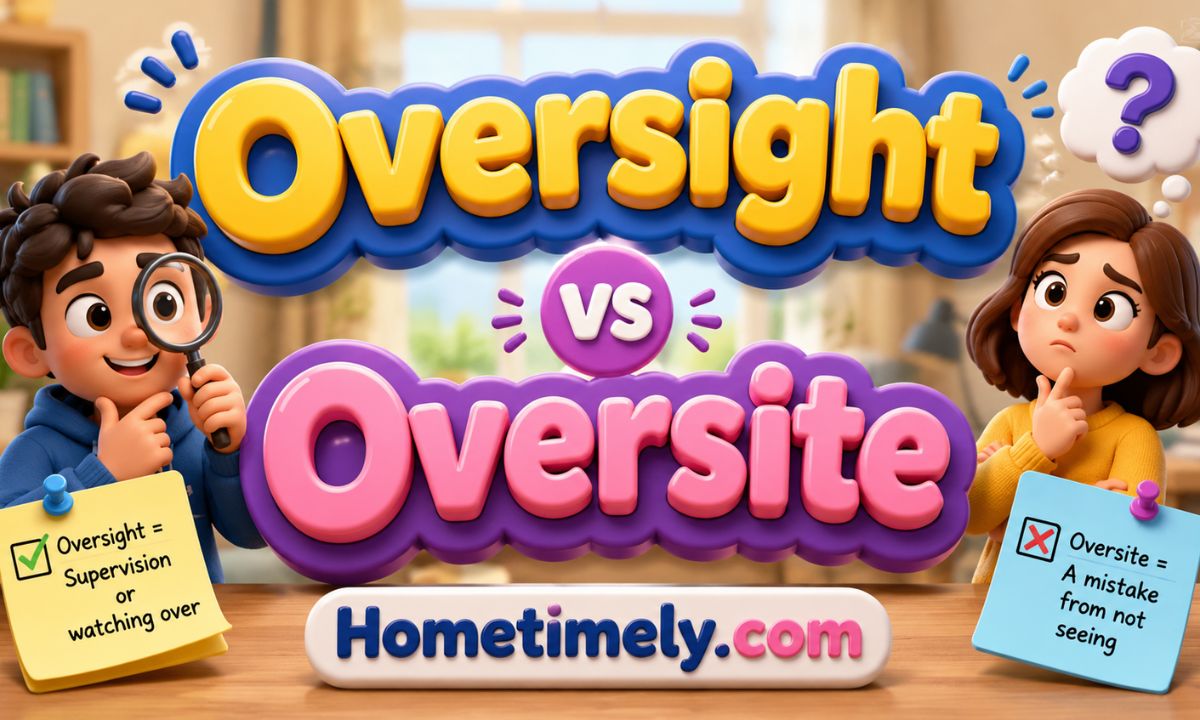
One letter. That’s the entire distance between a word that belongs in every professional document ever written and one that most English dictionaries don’t even list. Yet that single-letter gap — the t in “sight” versus the e in “site” — sends writers, students, and professionals down a rabbit hole of confusion every single day.
If you’ve typed “oversite” in a business report and felt a flicker of doubt, or if you’ve seen both spellings online and couldn’t figure out which was right, you’re in exactly the right place. This guide breaks down the oversight vs oversite debate completely — what each word means, where each one actually belongs, and how to make sure you never mix them up again.
The One-Letter Confusion That Changes Everything
English has a long history of tripping people up with words that look almost identical. Think affect vs effect, principal vs principle, compliment vs complement. The oversight vs oversite pair belongs in this same category of commonly confused words — but with a twist.
Unlike most confusable pairs, one of these words has two completely different meanings on its own. And the other word barely qualifies as a standard English term at all outside of a very specific professional context.
That’s why the confusion matters. When you write “oversite” in a memo to your manager about project supervision, you haven’t just made a spelling error. You’ve replaced a well-established English word with something that doesn’t exist in standard usage. The meaning doesn’t just shift — it disappears entirely.
Understanding this distinction is part of what linguists call writing accuracy and professionals call credibility. The words you choose signal how carefully you think. Getting this one right is a small change with a noticeable effect on how your writing reads.
Oversight — The Real English Word
Let’s start with the word that belongs in your vocabulary, your emails, your reports, and your formal documents: oversight.
Oversight Definition
Oversight has been part of the English language since the 1300s — traced back to Middle English, where it combined over (meaning above or across) and sight (meaning vision or awareness). That etymology gives you a hint at why the word ended up with two seemingly opposite meanings.
According to the Cambridge Dictionary, oversight means:
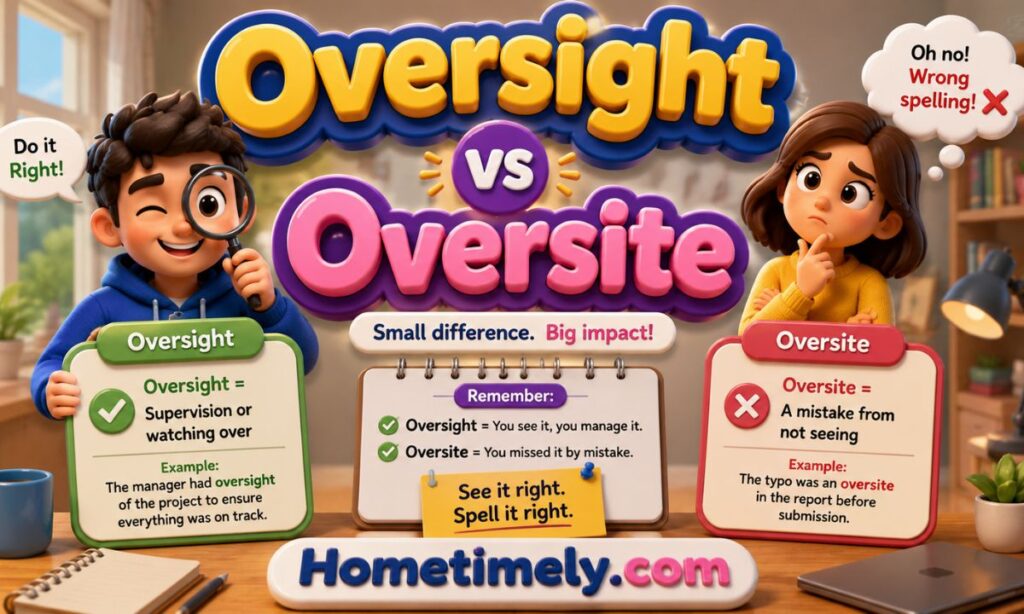
- “A mistake made because of a failure to notice something.”
- “Responsibility for making sure that something is done correctly.”
And according to Merriam-Webster, oversight is defined as:
- “Watchful and responsible care.”
- “Regulatory supervision.”
- “An inadvertent omission or error.”
This dual meaning — supervision on one hand, mistake on the other — is what makes oversight such an unusual word. Most nouns pick a lane. Oversight sits comfortably in two. The context of your sentence makes it clear which meaning you intend, and English speakers navigate that context naturally without confusion.
Types of Oversight
Because oversight carries two distinct meanings, it helps to treat them as separate use cases:
Oversight as supervision:
- Monitoring of a process, project, or organization
- Authority held by a regulatory body, manager, or committee
- Watchful governance over systems and people
Oversight as error:
- An unintentional omission
- A detail missed due to inattention
- A careless mistake that wasn’t deliberate
Both types appear constantly in real writing. Neither is more correct than the other — they’re simply different applications of the same word.
Oversight in Business and Management
In professional and organizational settings, oversight almost always means supervision. This is its most formal and widely recognized use. You’ll encounter it in:
- Corporate governance: “The board has oversight of all financial decisions.”
- Human resources: “The HR team provides oversight for employee conduct policies.”
- Project management: “She was given oversight of the product launch timeline.”
- Healthcare administration: “Clinical oversight ensures patient safety standards are met.”
- Regulatory compliance: “Federal oversight of the banking sector increased after the financial crisis.”
In these contexts, oversight implies authority, accountability, and active monitoring. It’s not passive — it’s someone or something actively watching over a process and ensuring it runs correctly.
Oversight as an Error
The second meaning is just as common in everyday speech and writing. When someone says “I apologize for the oversight,” they’re acknowledging that something was missed unintentionally. It was a slip, not a deliberate choice.
This usage shows up in:
- Emails and apology letters: “Due to an oversight, your order was not processed.”
- Formal reports: “The audit revealed several oversights in the expense tracking system.”
- Everyday conversation: “Forgetting to CC you on that email was an oversight — I’m sorry.”
Crucially, oversight in this sense always implies the error was accidental. It carries a built-in softener. Calling something an oversight is gentler than calling it a mistake or a blunder, which is why it’s a popular choice in professional communications where the goal is to acknowledge a problem without assigning blame aggressively.
Common Contexts Where Oversight Appears
In the Workplace
The workplace is where oversight gets its heaviest workout. Managers exercise oversight. Compliance departments are responsible for oversight. Internal audits exist because oversight is necessary for organizations to function properly.
Some common workplace phrases:
- “Under the oversight of the finance director…”
- “This project lacks adequate oversight.”
- “The committee was established to provide independent oversight.”
- “That error slipped through due to a lack of proper oversight.”
All four sentences use the word correctly, and all four are immediately clear. No one reading them will pause to wonder what was meant.
Government and Regulation
In government, oversight is practically a technical term. Congressional oversight, regulatory oversight, oversight committees — these phrases appear constantly in political reporting, policy documents, and legal writing.
Examples:
- Congressional oversight committees review how executive agencies use their authority.
- Financial regulatory oversight was strengthened following the 2008 economic crisis.
- Independent oversight bodies monitor elections to ensure they meet democratic standards.
In this world, oversight is always about accountability — specifically, the authority to watch, review, and if necessary, correct the behavior of institutions or individuals.
Everyday Speech
Outside formal settings, oversight shows up casually too. Most of the time, in everyday conversation, it means a small mistake.
- “Forgetting to lock the car was a total oversight.”
- “By an unfortunate oversight, the invitations were sent to the wrong address.”
- “It’s just an oversight — nothing intentional.”
The word carries a slightly formal tone even in casual use, which is why it tends to appear in apologies and explanations rather than in very informal texting or slang.
Oversite — The Often Confused Imposter
Now to the word that keeps appearing where it doesn’t belong.
Is Oversite a Real Word?
This is the question at the center of the whole debate: is “oversite” even a word?
The answer is: barely — and only in one very specific context.
In standard English dictionaries — Cambridge, Merriam-Webster, Oxford — “oversite” does not appear as a recognized entry for supervision or error. It is not a synonym for oversight in any general sense. Writing “oversite” when you mean supervision or mistake is simply a spelling error, no matter how logical it might seem in the moment.
The reason it feels logical is the word “site.” In the digital age, we interact with websites every day. “Site” has become one of the most familiar words in English, so the brain sometimes substitutes it for “sight” without consciously registering the swap.
The brain sees over + site and assumes it works. It doesn’t — not in standard English.
Oversite Meaning in Construction
Here is where oversite earns its narrow legitimacy. In the world of building and construction, oversite is a genuine technical term with a precise definition.
According to construction terminology references and building trade professionals:
Oversite (also: oversite concrete, oversite slab) refers to a layer of concrete or material laid directly over the prepared ground inside a building’s footprint, before flooring is installed. Its primary functions are to:
- Create a stable, level surface for flooring systems
- Act as a moisture barrier against rising damp from the ground below
- Distribute structural load evenly across the ground
- Protect the building’s foundation integrity over time
Oversite concrete typically ranges from 50mm to 100mm in thickness. It is laid after excavation and any required groundwork is complete, and before floor finishes are applied. The term itself comes logically from the practice of laying concrete over the site — the prepared ground surface inside the building perimeter.
This is a legitimate, recognized use. Architects, structural engineers, quantity surveyors, and construction professionals in the UK in particular use the term routinely. So in that professional context, “oversite” is the right word.
Outside of construction? It’s a misspelling.
Oversight vs Oversite in Construction Examples
Just to illustrate the difference even within a construction context:
- Correct: “The contractor prepared the oversite before laying the screed.” (referring to the concrete base layer)
- Correct: “The project manager’s oversight of the groundwork prevented a costly error.” (referring to supervision)
- Incorrect: “There was an oversite in the project schedule.” (should be oversight)
- Incorrect: “Due to the lack of oversite, the budget wasn’t properly managed.” (should be oversight)
Even on a building site, these two words serve completely different functions. One is a physical layer of material. The other is a management concept.
Oversight vs Oversite — Key Differences at a Glance
| Feature | Oversight | Oversite |
| Recognized in standard dictionaries | Yes | No (except construction) |
| Meaning 1 | Supervision / monitoring | N/A in general English |
| Meaning 2 | Accidental error / omission | N/A in general English |
| Construction meaning | Supervision of a build | Concrete base layer / slab-on-grade |
| Used in business writing | Yes — very commonly | No — considered a spelling error |
| Used in formal documents | Yes | No |
| Used in government/legal writing | Yes | No |
| Part of speech | Noun | Noun (construction only) |
| Origin | Middle English (1300s) | Technical construction term |
| Correct in everyday use | Always | Almost never |
Real-World Scenario Examples
Scenario 1 — Business Context
A compliance officer sends a memo to the board of directors:
“Going forward, all vendor contracts will be placed under the direct oversight of the legal department.”
This is correct. Oversight here means supervision and monitoring authority. If the officer had written “oversite,” the sentence would appear unprofessional, and any grammar-conscious reader would notice the error immediately.
Scenario 2 — Human Error
A project coordinator emails a client:
“Please accept our apologies — it was an oversight on our part that your delivery confirmation was not sent.”
Again, correct. The word signals an unintentional mistake without assigning blame or sounding overly harsh. Substituting “oversite” here would create a nonsensical sentence.
Scenario 3 — Construction Oversite
A site manager briefs the team:
“Once the oversite concrete is poured and cured, we can begin laying the insulation boards before the screed goes down.”
This is the one scenario where oversite is not only acceptable but expected. In a construction briefing, it has a clear, technical meaning that every member of the team understands.
Scenario 4 — The Professional Mix-Up
A marketing executive drafts a proposal and writes:
“We recommend establishing clearer oversite procedures for campaign approval.”
This is wrong — and it’s the kind of error that gets noticed. The executive meant supervision and should have written oversight. Spell-check won’t flag it as an error because “oversite” isn’t marked as incorrect in many word processors. That’s exactly what makes this mistake so easy to miss and so important to know about.
Tips to Avoid Mixing Them Up — Oversight vs Oversite
Once you know the difference, keeping them straight is easier than it sounds. Here are practical strategies:
- Connect “oversight” to “foresight” and “hindsight.” These are all -sight words related to how we perceive and understand things. Oversight belongs in that family. None of them use -site.
- Remember: oversight supervises. Oversite sits on the ground. If you’re not talking about concrete slabs, you want oversight.
- Think of the etymology. Oversight = over (above) + sight (vision). You’re watching over something from above. That gives you both meanings in one image: the manager watching over the team, and the detail you failed to see because your attention was elsewhere.
- When in doubt, say it aloud. Both words sound identical. If the meaning you’re reaching for is supervision or mistake, type oversight — because that’s the only one of these two words that carries those meanings.
- Do a final proofread with “oversite” in the search bar. Word processors won’t catch it. You have to. Before submitting any professional document, do a quick Find & Replace search for “oversite” to make sure it didn’t sneak in.
- Use the context test. Ask yourself: am I talking about a concrete floor, or something to do with managing, watching, or mistakenly missing? If it’s anything other than a construction base layer — write oversight.
Related Words and Synonyms
Oversight Synonyms (Supervision Sense)
When oversight means monitoring and management, you can substitute it with:
- Supervision
- Governance
- Administration
- Stewardship
- Management
- Regulatory control
- Monitoring
- Accountability
- Watchdog function
- Direction
Oversight Synonyms (Error Sense)
When oversight means an accidental mistake or omission:
- Slip
- Error
- Omission
- Lapse
- Blunder
- Inadvertence
- Gaffe
- Oversight (ironic use — yes, it describes itself)
- Careless mistake
- Inattention
Oversite Synonyms (Construction Sense)
When oversite is used correctly in a building context:
- Oversite concrete
- Blinding concrete
- Lean-mix concrete
- Slab-on-grade
- Ground slab
- Concrete base layer
- Sub-floor concrete
- Foundation slab
Case Study: The Costly Oversight
Consider a scenario that plays out in organizations more often than anyone likes to admit.
A mid-sized logistics company completes a major compliance audit. The internal report is circulated to senior leadership. Buried in the executive summary is this sentence:
“This audit revealed that the lack of adequate oversite in warehouse operations contributed to repeated process failures over a 12-month period.”
The word should be oversight. The intended meaning is clear enough — inadequate supervision led to repeated problems. But to any reader familiar with correct usage, the misspelling introduces a moment of hesitation. Did someone write this carefully? Is the rest of the document reliable?
In compliance writing, that doubt is costly. The document’s credibility takes a small but real hit.
Now consider the outcome if the report is sent to an external regulator. The regulator’s team notices the error. Notes are made about attention to detail within the organization. What was a simple spelling mistake has become, ironically, evidence of the very oversight it was meant to describe — only in the worst sense of the word.
This is not a hypothetical. It’s the kind of thing that happens when spell-check is treated as a final proofreading step, and when confusable words slip through unexamined. The cost of one wrong letter isn’t always visible, but it’s always real.
Also Read About This : Moment vs Momment: Spelling, Definition, and Usage
Reference — Cambridge Dictionary Definitions
Both major meanings of oversight appear in authoritative dictionary sources:
Cambridge Dictionary:
- Oversight (noun, B1 level): “A mistake made because of a failure to notice something.”
- Oversight (noun): “Responsibility for making sure that something is done correctly.”
Merriam-Webster:
- “Watchful and responsible care; regulatory supervision.”
- “An inadvertent omission or error.”
Collins English Dictionary:
- “An omission or mistake, especially one made through failure to notice something.”
- “Supervision.”
Dictionary.com:
- “An unintentional failure to notice or consider; lack of proper attention.”
- “Supervision; watchful care.”
What is notable here is that none of these major reference works carry an entry for oversite as a general English word. Wiktionary acknowledges it as a construction term. Specialized building trade glossaries define it specifically. But in the mainstream English lexicon, it does not exist as a functional alternative to oversight.
British vs American Usage
One area where oversight vs oversite gets slightly more complicated is across regional English varieties.
In British English, the term oversite is more likely to be encountered in construction documentation, planning applications, and building trade specifications. British builders, architects, and civil engineers use it as a standard technical term. If you work in UK construction, “oversite concrete” is completely normal language.
In American English, the construction use is far less common. American building professionals tend to use terms like “slab-on-grade,” “concrete sub-floor,” or simply “floor slab.” The word oversite rarely appears in American construction documents.
For oversight in its standard meanings — supervision and error — both British and American English use the same word identically. There is no regional variation here. An oversight committee in Washington and an oversight body in Westminster are both using the word correctly and in the same way.
The table below summarizes:
| Usage | British English | American English |
| Oversight (supervision) | Standard and correct | Standard and correct |
| Oversight (error) | Standard and correct | Standard and correct |
| Oversite (construction) | Recognized technical term | Rarely used — alternative terms preferred |
| Oversite (supervision/error) | Incorrect | Incorrect |
If you write for a British construction audience, oversite may belong in your vocabulary. For everything else — regardless of which side of the Atlantic you’re on — oversight is the only correct choice.
Don’t Let One Letter Cause a Major Oversight
There’s something faintly ironic about the oversight vs oversite confusion. The act of writing “oversite” when you mean supervision or mistake is itself an oversight — a failure to notice that the wrong letter has crept in.
That irony is worth holding onto, because it’s actually a useful memory device. Every time you start to type “oversite” in a context that has nothing to do with construction, ask yourself: am I making an oversight right now? If the answer is yes, fix the spelling before anyone else notices.
The confusion happens because:
- Both words sound completely identical when spoken aloud
- The word “site” is so familiar in the digital age that the brain reaches for it automatically
- Most spell-checkers don’t flag “oversite” as an error
- Many online sources — including some websites that should know better — use both spellings interchangeably
None of these factors excuse the error in professional writing. They simply explain why it happens. And now that you understand the mechanism, you’re positioned to catch it every time.
Conclusion
Here’s the full picture: oversight is a versatile, established English word with two distinct meanings — supervision and accidental error. It belongs in business documents, government reports, academic writing, and everyday conversation. It has been part of the language since the 1300s and carries the backing of every major dictionary in print.
Oversite is a technical construction term — a concrete base layer poured over prepared ground before flooring is installed. In that context, used by building professionals in the UK particularly, it is legitimate and correct. In every other context, it is a misspelling.
The rule is simple enough to remember in one sentence: if you’re not talking about concrete, you want oversight.
No matter how often “oversite” appears online, no matter how plausible it looks, and no matter how confidently your word processor fails to underline it in red — in standard English writing, there is only one word for supervision and only one word for accidental omission. Both of them are spelled oversight.
Write that down. Send that email. Submit that report. And feel entirely confident that you got it right.

Michael Brook is the creator and author behind Healthy Leeks, a platform focused on grammar, writing skills, and English language learning. Passionate about clear communication and effective writing, Michael Brook shares practical grammar tips, easy-to-follow language guides, and educational content to help readers improve their English with confidence.