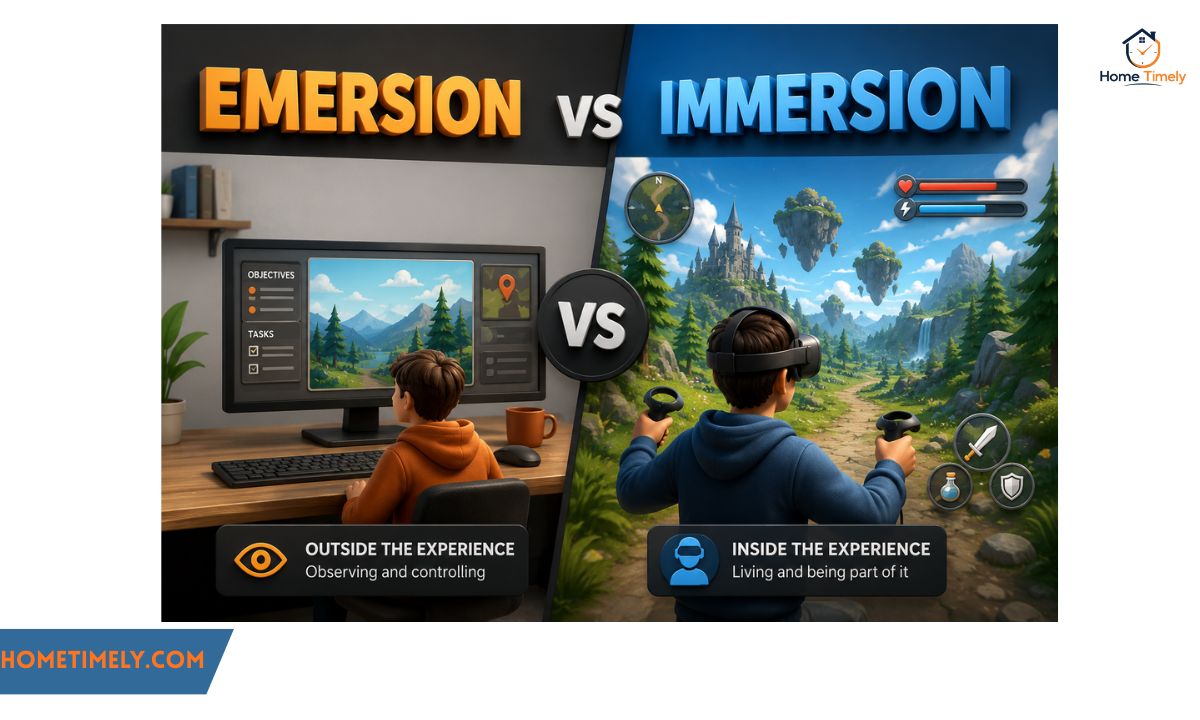
Have you ever typed “immersion” and wondered whether “emersion” was the word you actually needed? You are not alone. These two words sit just one letter apart, sound nearly identical in casual speech, and yet point in opposite directions. One describes going in; the other describes coming out. Get them mixed up, and your sentence quietly means the opposite of what you intended.
This guide breaks down everything you need to know — definitions, scientific context, etymology, psychology, education, language learning, common mistakes, and memory tricks. By the end, you will know exactly which word belongs in every sentence you write.
Emersion vs Immersion: A Quick Comparison
Before diving into details, here is a side-by-side overview that answers the core question fast.
| Feature | Emersion | Immersion |
| Core meaning | Coming out of something | Going into something |
| Direction | Outward / upward | Inward / downward |
| Root verb | Emerge (Latin: emersio) | Immerse (Latin: immersio) |
| Frequency | Rare; mostly technical/scientific | Very common; everyday and academic |
| Common fields | Marine biology, astronomy, ecology | Education, psychology, VR, language learning |
| Stage | End / exit phase | Entry / engagement phase |
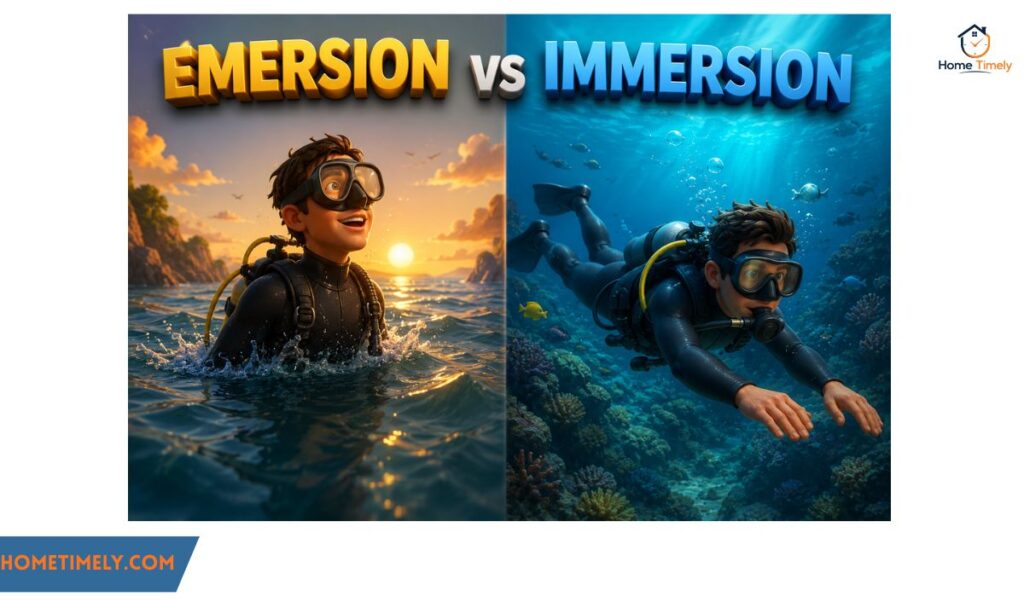
| Everyday example | A diver surfacing for air | A diver plunging into the ocean |
Emersion: Meaning, Definition, and Scientific Context
Emersion Definition
Emersion is a noun that describes the act of emerging — rising out of, coming forth from, or becoming visible after being submerged, hidden, or obscured. Think of it as the “exit moment.” When something moves from a hidden state to an exposed, visible one, that transition is emersion.
A simple image: a whale breaking the ocean surface. That upward burst into open air is emersion in its most literal form.
Scientific Fields Where Emersion Is Used
Although emersion rarely surfaces in everyday conversation, it carries real weight across several scientific disciplines.
Marine Biology
Coastal ecosystems run on tidal rhythms, and marine biologists use emersion to describe what happens when organisms that live underwater become exposed to open air. During low tide, intertidal species — barnacles, mussels, sea anemones, and kelp — experience emersion. Many have evolved remarkable adaptations to survive these alternating periods of submersion and exposure. Researchers studying coastal habitats regularly track emersion duration as a key ecological variable, since temperature, oxygen levels, and UV exposure all shift dramatically once an organism transitions from water to air.
Astronomy
In astronomy, emersion has a very precise technical meaning. It refers to the reappearance of a celestial body after it has been hidden behind another object or obscured by a shadow. During a lunar occultation, for example, a star disappears behind the Moon — that disappearance is called immersion (in astronomy). The moment the star reappears on the other side is its emersion. The same logic applies to planetary moons emerging from a planet’s shadow after an eclipse. Astronomers time emersion events with great accuracy because they can be used to calculate orbital parameters.
Environmental Science
Environmental scientists apply emersion when studying how wetlands, mangrove forests, and tidal flats respond to changing water levels. The emersion of plant roots and sediment during low-water periods influences soil chemistry, microbial activity, and plant physiology. In climate research, understanding emersion cycles helps predict how coastal ecosystems will respond to sea-level rise.
Origin and Etymology of Emersion
The word traces back to the Latin emersio, built from the prefix ex- (out of) combined with mergere (to plunge or dip). So at its Latin root, emersion literally means “a plunging out.” This is why the word naturally describes upward, outward movement — it was constructed to mean the opposite of submerging.
The connection to the verb emerge makes it easy to remember: if something emerges, emersion describes that moment of emergence.
Emersion in Literature and Metaphorical Use
Though rare, emersion does appear in literary and philosophical writing. Writers sometimes use it to describe a character’s psychological emergence from a dark period — a kind of “coming up for air” after grief, confusion, or hardship. In philosophy, emersion can represent the rise of consciousness or the moment when clarity replaces doubt. These metaphorical uses follow the same logic as the scientific ones: something hidden or submerged becomes visible and active again.
Immersion: Definition and Meaning
Immersion Definition
Immersion is a noun describing the act of being plunged into, completely surrounded by, or deeply absorbed in something — whether that something is a physical substance, an environment, an activity, or an experience. It is the entry, not the exit.
Immersion is one of the most versatile and frequently used words in modern English. It appears in education, technology, psychology, religion, cooking, and everyday speech.
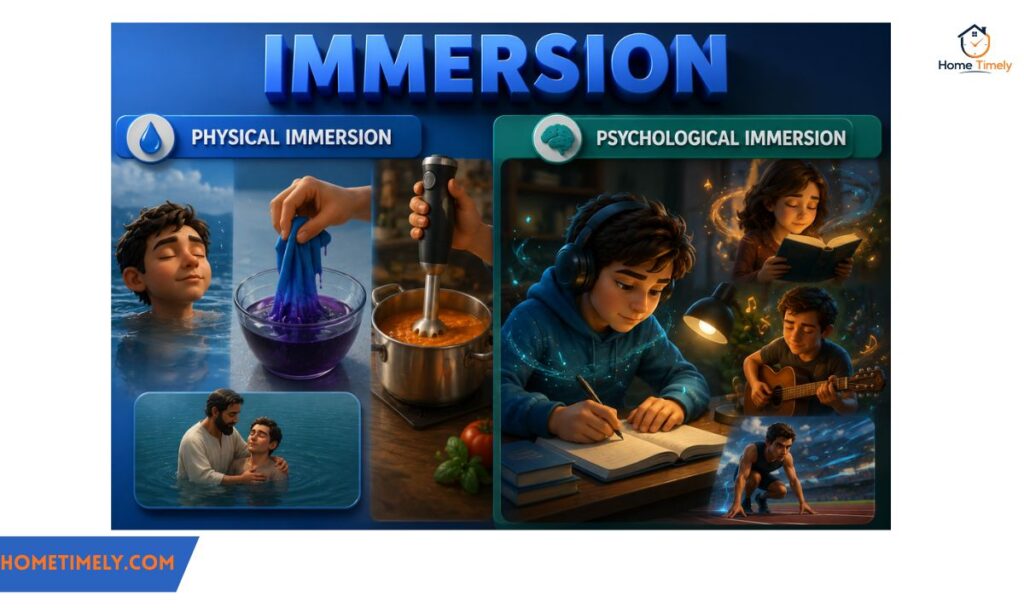
Physical Immersion
In its most literal sense, immersion means submerging something in a liquid. A cloth soaked in dye, a hand plunged into ice water, a baptism conducted by full-body submersion — these are all physical immersion. The immersion blender, a staple kitchen tool, takes its name from this: the blade is immersed directly into the pot rather than the food being poured into a separate blender jar.
Psychological Immersion
Beyond the physical, immersion describes a state of deep mental or emotional absorption. When someone is so focused on a task that time seems to dissolve, psychologists call this a state of immersion or flow. Readers who lose themselves in a novel, musicians who disappear into practice, and athletes locked into peak performance are all experiencing a form of psychological immersion.
Immersion in Technology and Digital Environments
Virtual Reality
Virtual reality headsets are designed specifically to create complete sensory immersion — the experience of being fully surrounded by a digital environment. Researchers, designers, and engineers measure the quality of a VR experience partly by its degree of immersion, asking: how convincingly does this environment replace the real world in the user’s perception?
Gaming and Entertainment
Game designers spend enormous resources building immersive worlds. Narrative depth, realistic sound design, visual fidelity, and interactive consequence all contribute to immersion. When a game successfully creates immersion, players stop thinking about pressing buttons and start thinking about the story, the world, and their place in it.
Emersion vs Immersion: Key Differences
Direction of Experience
This is the single most important distinction. Immersion moves inward — into water, into an activity, into a culture, into a digital world. Emersion moves outward — out of water, out of obscurity, out of a hidden state. One word describes entry; the other describes exit.
Stage of Experience
Immersion represents the active engagement phase. It is happening now, and the subject is fully inside the experience. Emersion represents the transition back out. If you think of any experience as a journey, immersion is the descent and emersion is the return.
Frequency of Use
Immersion appears across almost every domain of modern life — education, marketing, entertainment, psychology, sports, and daily conversation. Emersion, by contrast, is largely confined to scientific, technical, and occasionally literary contexts. In everyday writing, you will reach for immersion roughly 95% of the time. Emersion is the specialist’s term.
Emersion vs Immersion in Education
Immersion Learning Programs
Language immersion programs place students in an environment where the target language is used exclusively — not as a subject, but as the medium of instruction. A student enrolled in a French immersion program learns mathematics, history, and science in French. The goal is to recreate, as closely as possible, the conditions under which children acquire their first language: constant, contextual exposure without translation as a crutch.
Immersive learning extends beyond language. Simulation-based training in medicine, aviation, and military contexts places learners inside realistic scenarios where they make real decisions with real consequences — creating the deep engagement that textbooks alone cannot replicate.
Benefits of Immersive Learning
- Faster fluency development through contextual, not isolated, language exposure
- Stronger long-term retention compared to traditional instruction
- Enhanced critical thinking through real-world problem-solving
- Greater student motivation due to active, hands-on participation
- Cross-cultural empathy developed through genuine cultural engagement
Emersion vs Immersion in Language Learning
Immersion Phase
Language immersion is a deliberate, sustained process of surrounding yourself with the target language. Moving to a country where the language is spoken natively, enrolling in an immersion school, or committing to a “target language only” rule at home are all immersion strategies. During this phase, the learner is inside the language — hearing it, speaking it, dreaming in it.
Emersion Phase
Emersion in language learning describes the reflective phase that follows deep engagement. After sustained immersion, the learner steps back, processes what they have absorbed, and integrates it consciously. This might happen during a grammar review session, a journaling practice, or simply a quiet period of reflection after an intense immersion experience. Educators increasingly recognize that both phases matter: immersion builds intuition; emersion builds understanding.
Emersion vs Immersion in Psychology
Psychological Immersion
Psychologists use immersion to describe states of deep cognitive engagement — flow states, meditation, focused attention, and absorbed reading. During immersion, the boundary between self and activity partially dissolves. People report losing track of time, feeling energized rather than fatigued, and experiencing heightened creativity. Therapeutic practices sometimes deliberately induce states of immersion to help clients disengage from anxiety or rumination.
Emersion and Reflection in Psychology
Emersion in psychology points to the phase of reflection and conscious processing that follows intense engagement. After a powerful emotional experience, a challenging project, or a period of personal crisis, the individual undergoes emersion — surfacing, evaluating, and integrating the experience into their broader sense of self. Some psychologists describe personal growth as a cycle of immersion (going deep into an experience) and emersion (returning with new understanding).
Emersion vs Immersion: Real-World Examples
Examples of Emersion
- After the lunar eclipse reached totality, astronomers eagerly awaited the emersion of Jupiter’s moon from the planet’s shadow.
- The research team documented the emersion of intertidal organisms during the three-hour low-tide window.
- Her emersion from years of grief was gradual, but by spring she was laughing freely again. (metaphorical)
- The submarine’s emersion at dawn surprised the coastal patrol boat.
Examples of Immersion
- She achieved conversational fluency through two years of total Spanish immersion in Bogotá.
- The new VR headset delivers a level of sensory immersion that earlier hardware simply could not match.
- His immersion in the project meant he barely noticed three hours had passed.
- Baptism by full immersion is practiced by several Protestant denominations.
- Use an immersion blender to puree the soup directly in the pot.
Cultural Immersion Through Travel
One of the most popular applications of the word immersion is in the context of travel and cultural exchange. Cultural immersion means going beyond tourist sites to live, eat, work, and communicate within a local community. It involves learning customs, navigating daily life in a foreign language, building genuine relationships, and accepting discomfort as part of the growth process. Travelers who seek cultural immersion consistently report deeper learning, broader perspective, and more lasting memories than those who observe a culture from a distance.
Common Mistakes Writers Make
Mistake: Using Immersion When Emersion Is Correct
This error almost never happens, because emersion is so rarely needed. The more pressing issue is the reverse.
Mistake: Using Emersion When Immersion Is Correct
This is the common trap. A writer intending to describe deep engagement — a student absorbed in their studies, a traveler lost in a foreign culture, a gamer disappearing into a virtual world — accidentally writes “emersion.” Since the words look so similar, spellcheck will not catch it. The result is a sentence that technically says the opposite of what was intended.
Wrong: “She improved her French through complete emersion in Paris.” Correct: “She improved her French through complete immersion in Paris.”
Wrong: “The game’s emersion factor kept players engaged for hours.” Correct: “The game’s immersion factor kept players engaged for hours.”
Memory Trick for Emersion vs Immersion
Here is the simplest trick available: the double M is your anchor.
Immersion has a double M. Think of the two M’s as two arrows pointing in — into the water, into the experience, into deep engagement.
Emersion starts with E — like Exit, Emerge, Escape. All of those mean coming out.
Alternatively: Immersion = In. Emersion = Exit.
One goes in. The other comes out. That is really all you need.
Key Takeaways
Emersion
- Means coming out, rising from, or becoming visible after being submerged or hidden
- Used primarily in marine biology, astronomy, ecology, and metaphorical/literary writing
- Derived from Latin emersio (ex + mergere = to plunge out)
- Describes the exit or emergence phase of an experience
- Rarely used in everyday conversation
Immersion
- Means going into, being surrounded by, or being deeply absorbed in something
- Used across education, technology, psychology, religion, culture, and daily life
- Derived from Latin immersio (in + mergere = to plunge into)
- Describes the entry and engagement phase of an experience
- One of the most versatile and commonly used words in modern English
Reference: Cambridge Dictionary Definitions
According to the Cambridge Dictionary, immersion is defined as the act of putting something or someone into a liquid completely, or the state of being completely involved in an activity. Emersion is defined as the process of coming out from a submerged state, particularly used in scientific contexts.
Emersion vs Immersion: Four Key Differences at a Glance
| Dimension | Emersion | Immersion |
| Opposite Meanings | Emerging, coming out | Submerging, going in |
| Etymology | Latin emersio (ex + mergere) | Latin immersio (in + mergere) |
| Pronunciation | ih-MUR-zhun (3 syllables) | ih-MUR-zhun (3 syllables — nearly identical) |
| Root Verb | Emerge | Immerse |
Note on pronunciation: the two words sound almost identical in casual speech, which is precisely why confusion is so common in writing.
Frequently Asked Questions (FAQs)
Is emersion a real word?
Yes, emersion is a legitimate English word, though it is primarily used in scientific and technical contexts rather than everyday conversation.
What is the difference between emersion and emergence?
Both describe coming out of something, but emergence is the more common everyday term, while emersion is a technical variant used mainly in science.
Can immersion and emersion be used interchangeably?
No — they have opposite meanings. Immersion describes going in or deep engagement; emersion describes coming out or rising from a submerged state.
What is an immersion blender?
A handheld kitchen tool that blends food directly in the pot by submerging (immersing) its blade into the mixture. The word emersion has no role here.
Which word should I use for language learning?
Use immersion — as in “language immersion program.” Emersion can describe the reflective phase after immersion but is rarely used in this context.
Does emersion appear in everyday speech?
Rarely. You might encounter it in marine biology papers, astronomy reports, or formal scientific writing — but in daily conversation, emergence is far more common.
What is cultural immersion?
Cultural immersion means deeply engaging with a foreign culture by living within it, speaking the language, and participating in local customs rather than observing from a distance.
Conclusion
Emersion and immersion look nearly identical on the page but describe movements in opposite directions. Immersion is the plunge — going in, being surrounded, becoming absorbed. Emersion is the return — coming out, surfacing, becoming visible again. In everyday writing, immersion is your default. Reserve emersion for scientific contexts where something is literally or technically emerging from a submerged state.
The next time you reach for either word, ask yourself one simple question: is the subject going in or coming out? Answer that, and you will never confuse these two words again.

Michael Brook is the creator and author behind Healthy Leeks, a platform focused on grammar, writing skills, and English language learning. Passionate about clear communication and effective writing, Michael Brook shares practical grammar tips, easy-to-follow language guides, and educational content to help readers improve their English with confidence.


