You’ve probably used both words without thinking twice. Someone says, “I live in a subdivision,” and another person replies, “We have a small village nearby.” On the surface, they both describe places where people live. But scratch a little deeper, and you’ll find these two words carry entirely different meanings — different histories, different structures, different feelings.
Getting this distinction right matters, whether you’re writing a real estate listing, describing your neighborhood to someone from another country, searching for a home, or simply trying to communicate clearly. Using the wrong term doesn’t just cause minor confusion. It can completely misrepresent the kind of place you’re talking about.
This guide breaks everything down in clear, plain language so you walk away knowing exactly when to use each word — and why the difference matters more than most people realize.
Village vs. Subdivision — A Quick, Clear Comparison
Before diving into the deeper details, here’s the short version for those who need a fast answer:
A village is a small, naturally formed community — typically rural, with deep historical roots, cultural traditions, and a close-knit population that grew organically over time.
A subdivision is a planned residential development — typically urban or suburban, deliberately designed and built by a developer, with organized streets, modern housing, and often a Homeowners Association (HOA).
They are not the same thing. One grew. The other was built.
What Is a Village? A Simple, Human Explanation
Village Meaning in Everyday Language
The word “village” comes from the Old French village, rooted in the Latin villa, meaning “country house” or “farm.” Over centuries, it evolved to describe a small cluster of homes, shops, and communal spaces that formed naturally as people gathered for agriculture, trade, or protection.
Today, the word still carries that organic, unplanned quality. A village isn’t designed on paper by a developer. It isn’t divided into lots and sold. It grows — slowly, community by community — driven by human need and shared history rather than real estate strategy.
Key Traits of a Village
Not every small community qualifies as a village. A true village typically shares these characteristics:
- Small population — Most villages house anywhere from a few dozen to a few thousand people. Once the population grows significantly, a village may evolve into a town.
- Rural or semi-rural setting — Villages are usually found in the countryside, surrounded by farmland, forests, rivers, or natural landscape.
- Organic development — No master plan. No phased construction. The community forms gradually, with homes and businesses appearing as people settle.
- Local governance — Many villages have their own governing body: a village council, an elected headman, or a local government unit depending on the country.
- Shared identity — People in a village often share common traditions, festivals, occupations, or family histories. The sense of community is deeply personal.
- Mixed-use spaces — You’ll find homes alongside a local market, a place of worship, a school, and open communal areas — all woven together naturally.
A Real-Life Picture
Imagine a small mountain community in rural Italy. The same families have lived there for generations. There’s a central piazza where residents gather on Sunday mornings. The bakery has been in one family for 80 years. Children play in narrow cobblestone streets while elders sit outside their homes. Nobody applied to a developer to live there. Their grandparents were born there too.
That is a village in its truest form.
Why Villages Still Matter Today
Despite rapid urbanization, villages remain central to food production, cultural preservation, and sustainable living. In countries like the Philippines, India, Indonesia, and across sub-Saharan Africa, hundreds of millions of people still live in villages. Even in developed nations, villages serve as anchors of heritage and rural identity.
The term also carries weight in policy — government programs for rural development, healthcare access, and education are often specifically directed at village communities.
What Is a Subdivision? A Clear, Modern View
Subdivision Meaning in Plain Terms
The word “subdivision” has a very practical origin. It literally means the act of dividing something into smaller parts. In real estate, it refers to dividing a large parcel of land into individual lots, each intended for residential use.
A developer purchases raw land, installs infrastructure — roads, drainage, utilities, street lighting — and then sells individual lots or finished homes to buyers. The result is a residential area that was designed from scratch, with a clear plan, consistent layout, and defined rules.
Subdivisions are a modern solution to housing demand. As cities expanded and suburban growth exploded in the mid-20th century (particularly in the United States), subdivisions became the dominant form of new housing development.
What Makes a Subdivision Different
Several things set a subdivision apart from every other type of residential community:
- Deliberate planning — A subdivision exists because someone planned it. There are architectural blueprints, zoning approvals, and phased construction timelines.
- Developer-driven — A single company or developer typically creates and sells the entire project.
- Uniform design — Houses in a subdivision often follow similar architectural styles, lot sizes, and setback requirements for a cohesive look.
- Homeowners Association (HOA) — Many subdivisions are governed by an HOA, a private organization that enforces community rules, maintains shared spaces, and collects fees from residents. HOAs are typically established by real estate developers when creating planned communities, condominiums, or subdivisions.
- Urban or suburban location — Subdivisions are almost always built near existing cities, along highways, or within growing suburban corridors.
- Modern amenities — Parks, playgrounds, jogging paths, gated entrances, and community centers are often part of the package.
A Real-Life Picture
Picture a new housing development on the edge of a growing city in Texas. A developer cleared 50 acres, laid out clean streets named after trees, built 200 homes in three different floor plan options, installed a community pool, and established an HOA that charges $150 per month. Every lawn must be mowed weekly. Fences must match the approved color palette.
That is a subdivision — efficient, modern, organized, and built for contemporary family life.
Village vs. Subdivision — Differences That Actually Matter
How They Develop
This is perhaps the most fundamental difference. A village develops naturally over decades or centuries. People arrive, build homes, establish businesses, and gradually form a community. There is no timeline, no master plan, no approval process from a developer.
A subdivision develops intentionally. A developer draws it up, gets regulatory approval, constructs it in phases, and sells it. The entire process from land purchase to move-in can happen in 18 to 36 months.
How They Feel
Walking through a village feels different from walking through a subdivision. Villages have irregularity — winding paths, buildings of different ages and styles, green spaces that weren’t “designed” but simply grew. There’s an unpredictability that feels alive.
Subdivisions feel structured. Streets are straight or perfectly curved. Houses are similar in size and style. Landscaping is maintained uniformly. It feels clean, consistent, and controlled — which many people find appealing, and others find stifling.
How They’re Managed
Villages are typically managed by a local government unit — a village council, a barangay (in the Philippines), a panchayat (in India), or a parish council (in the UK). This governance is usually democratic and deeply tied to the community’s history.
Subdivisions are often managed by a Homeowners Association (HOA), a private body with the authority to enforce community rules, impose fines, and collect monthly or annual fees. HOA board members are responsible for making and enforcing rules in the best interest of the community, and HOAs collect fees from members to pay for maintenance and upkeep of shared areas.
How Space Is Used
In a village, land use is mixed and organic. You’ll find residential homes next to small shops, farmland, community gathering spaces, and places of worship — all blending together without formal zoning restrictions.
In a subdivision, land use is typically zoned as residential. Commercial activity is usually prohibited or strictly limited. The space is designed primarily for housing, with designated amenity areas set apart from homes.
A Deeper Comparison Table
| Feature | Village | Subdivision |
| Origin | Grows naturally over time | Planned and built by a developer |
| Location | Rural or semi-rural | Urban or suburban |
| Population | Small, often under a few thousand | Varies; can be hundreds to thousands |
| Governance | Local government, council, or traditional leadership | Homeowners Association (HOA) or developer |
| Land use | Mixed — homes, farms, shops, places of worship | Primarily residential; zoning-restricted |
| Architecture | Varied, historically evolved | Uniform or consistent across phases |
| Sense of community | Deep, personal, multigenerational | Newer, structured, association-driven |
| Infrastructure | May be basic or limited | Modern — paved roads, utilities, amenities |
| Cultural identity | Strong; tied to tradition and history | Minimal; based on shared residential choice |
| Legal status | Often a recognized administrative unit | Part of a larger city or municipality |
| Entry/security | Usually open | Often gated with security checkpoints |
| HOA fees | None | Common; monthly or annual dues |
Subdivision vs. Village vs. Compound
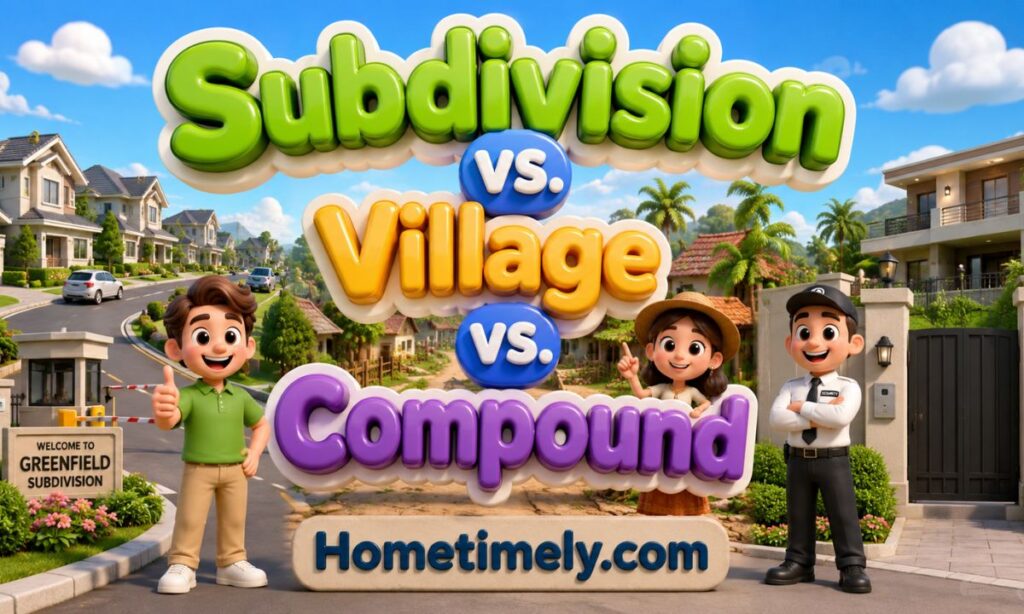
Three terms — three distinct types of residential communities.
A village, as established, is an organically grown rural community with cultural roots and local governance. A subdivision is a planned urban or suburban development built by a developer with HOA oversight.
A compound is something different again. In real estate and international usage, a compound typically refers to a group of buildings enclosed within a shared boundary — often a wall or fence — occupied by a family, a business, or an organization. Compounds are common in parts of the Middle East, Africa, and South Asia. Unlike a subdivision, a compound usually houses a single family or extended family unit, or a specialized group such as a corporate housing facility or diplomatic enclave.
Here’s a quick side-by-side breakdown:
| Term | Who lives there | How it forms | Key feature |
| Village | A natural community | Organically over time | Cultural identity, local governance |
| Subdivision | Individual families/buyers | Developer-planned | HOA rules, modern amenities |
| Compound | Single family or group | Intentionally enclosed | Shared boundary, private access |
Subdivision or Village in Tagalog
In the Philippines, both words are commonly used — and the distinction matters in everyday conversation.
The Tagalog word most closely associated with “village” is “nayon” (a small rural community or barangay). However, in Metro Manila and other urban areas, “village” is often used colloquially to describe gated residential subdivisions — places like “San Lorenzo Village” or “Forbes Park” in Makati. This is a Filipino-English usage where “village” has taken on the meaning of an upscale, gated subdivision.
“Subdivision” in Filipino English retains its standard meaning — a planned residential development, usually outside or on the edge of a city. Filipinos frequently use the term in everyday speech: “Nakatira kami sa isang subdivision” (We live in a subdivision).
In Philippine real estate, the two terms are sometimes used interchangeably in informal speech, but technically:
- Village in a Philippine context = a gated, often upscale, residential development (similar to a subdivision but with an implied higher social status or security level)
- Subdivision = a standard planned residential housing project, ranging from affordable to mid-range
The confusion is deeply embedded in Filipino real estate culture, where a “village” carries connotations of prestige, while a “subdivision” is the more generic, everyday term.
Also Read This : Knaw or Gnaw: Which Spelling Is Correct?
Why People Confuse Village and Subdivision
The Real Reasons Behind the Confusion
There are a few solid reasons why these two words get mixed up so frequently.
1. Real estate branding. Developers know that “village” sounds warmer, more charming, and more desirable than “subdivision.” So they name their projects things like “Emerald Village” or “Orchard Village” even though they are, by every technical definition, subdivisions. The marketing works, and the terminology seeps into everyday use.
2. Regional variation. In the United States, some legal jurisdictions classify small municipalities as “villages” rather than towns or cities — making the word carry administrative weight independent of rural character. In the Philippines, “village” is commonly used for upscale gated communities. In the UK, villages are genuinely small rural settlements. The same word means slightly different things in different places.
3. Emotional language. People naturally want to describe their neighborhood in the most appealing terms. Saying “I live in a village” evokes warmth and community. Saying “I live in a subdivision” sounds bureaucratic. Even if it’s technically a subdivision, people lean toward the language that feels better.
4. Dictionary overlap. Some dictionary definitions of “village” include small planned communities, blurring the line further for people who aren’t deeply familiar with real estate terminology.
A Simple Example
Consider this: A developer builds 150 homes on the outskirts of Nashville, names it “Willowbrook Village,” installs a security gate, and establishes an HOA. Residents call it “the village.” But legally, functionally, and structurally, it is a subdivision. The name is marketing. The reality is planned residential development.
Knowing this distinction saves you from misusing the word — especially in writing, real estate, or academic contexts.
How to Use “Village” and “Subdivision” Correctly
The rule is simpler than it sounds. Ask yourself two questions:
- Did this community grow naturally over time, or was it built by a developer?
- Is it located in a rural setting, or within or near an urban area?
If it grew naturally and sits in a rural or semi-rural area → use “village.”
If it was designed, built, and sold by a developer in an urban or suburban setting → use “subdivision.”
Examples That Feel Natural
Using “village” correctly:
- “She grew up in a small village in the mountains where her family had lived for four generations.”
- “The village celebrates a harvest festival every October that dates back 200 years.”
- “He drove through a quiet village with a single church, a general store, and a dozen homes.”
Using “subdivision” correctly:
- “They bought a newly built home in a gated subdivision just outside the city.”
- “The subdivision’s HOA requires all residents to submit exterior paint colors for approval.”
- “Several new subdivisions are under construction along the highway as the city continues to expand.”
Common Mistakes People Make
Calling a Subdivision a Village
This is the most frequent error. When someone describes a planned housing development as a “village” because it has a friendly name or a communal feel, they are misusing the word. Villages grow naturally; subdivisions are carefully developer-designed with modern community features. A planned community can mimic a village with a town square and pedestrian paths, but it legally remains a subdivision or residential area.
The error is understandable — but it matters in writing, real estate, and clear communication.
Calling a Village a Subdivision
Going the other way is equally inaccurate. Describing an ancient rural community as a “subdivision” strips away its cultural and historical identity. A village in rural Kenya, a hamlet in the English countryside, or a mountain community in Nepal is not a subdivision. These places have no developer, no HOA, no phased construction plan. Calling them subdivisions would be both incorrect and dismissive of their character.
Ignoring Context
Context shapes meaning significantly. In the Philippines, calling a gated community a “village” is locally accepted. In the United States, “village” can be a legal designation for small municipalities. In Britain, it strictly means a rural community. Always consider where your reader or listener is based before defaulting to one definition.
When the Line Gets Blurry
Planned Communities That Feel Like Villages
Some modern housing developments are deliberately designed to look and feel like traditional villages. They feature walkable streets, a central square, mixed-use spaces with small shops and cafes, and architectural variety. These are sometimes called new urbanist communities or neo-traditional neighborhoods.
Celebrated examples include Seaside, Florida, and Poundbury in England. They feel like villages — but they were planned, designed, and built intentionally. By technical definition, they remain planned communities or subdivisions. The village feel is aesthetic, not organic.
Villages That Became Urban
On the flip side, many historic villages have been swallowed by expanding cities. What was once a rural community surrounded by farmland is now embedded in a metropolitan area, surrounded by skyscrapers and shopping malls. Parts of London, for instance, were once distinct villages — Hampstead, Islington, Dulwich — that retained their names even as the city grew around them.
These are no longer villages in the functional sense, but they carry the name and often the community character.
Naming Tricks in Real Estate
Real estate developers have long understood the emotional power of words. A subdivision named “Oakwood Village” sounds more inviting than “Oakwood Residential Development Phase 2.” The word “village” adds warmth, nostalgia, and a sense of community — even if the development has nothing in common with a real village.
Be aware of this pattern when reading property listings or community brochures. The name tells you the marketing strategy. The features tell you what it actually is.
Village vs. Subdivision Lifestyle Differences
Village Life
Living in a village offers a lifestyle that is fundamentally different from urban or suburban existence. It tends to feature:
- Slower pace — Days are less rushed; social interactions happen organically
- Stronger community ties — Neighbors know each other personally and often for years
- Connection to nature — Open land, clean air, proximity to farms and forests
- Cultural richness — Local traditions, festivals, crafts, and shared history
- Limited amenities — Fewer shops, hospitals, schools, and entertainment options nearby
- Lower cost of living — Housing and daily expenses are often significantly cheaper
Subdivision Life
Life in a subdivision has its own distinct rhythm:
- Structured environment — Clear rules about how homes and yards should look
- Modern conveniences — Nearby commercial centers, good road access, reliable utilities
- Community amenities — Pools, parks, playgrounds, gyms, and community halls are common
- Privacy with community balance — You have your own space but also shared resources
- Consistent home values — HOA oversight often maintains or increases property values. If there is an HOA, it will require residents to maintain their homes and yards, improving the neighborhood’s overall appeal and home values.
- Uniform aesthetics — The neighborhood looks consistent, which some love and others find monotonous
Pros and Cons You Should Actually Care About
Village Living
Pros:
- Deep sense of belonging and community identity
- Lower cost of living and real estate prices
- Connection to nature, open spaces, and clean environment
- Rich cultural traditions and local character
- Greater personal freedom — fewer rules and restrictions
Cons:
- Limited access to healthcare, schools, and professional services
- Fewer job opportunities; many residents commute or rely on agriculture
- Infrastructure may be underdeveloped (roads, internet, water supply)
- Less privacy in tight-knit communities where everyone knows each other
- Slower economic growth and fewer investment opportunities
Subdivision Living
Pros:
- Modern, well-maintained infrastructure and amenities
- HOA oversight keeps the neighborhood clean and property values stable
- Good access to schools, hospitals, shopping, and employment
- Security features like gated entrances and surveillance systems
- Strong resale value due to consistent community standards
Cons:
- HOA fees add a recurring financial obligation
- Rules and restrictions can feel limiting (paint colors, fence heights, lawn care)
- Less cultural or historical character — neighborhoods can feel generic
- Cookie-cutter design may lack personality or charm
- Disputes with HOA boards can be stressful and costly
Real-Life Case Study — Two Families, Two Choices
Family A: Village Life
The Santos family moved from Manila to a small farming village in Batangas, Philippines. They built a modest home on land that had been in the family for decades. Their children attend the local elementary school a short walk away. Every year, the village holds a fiesta that brings together hundreds of residents for three days of celebration. There are no HOA fees. The family grows vegetables in their backyard. Their neighbors help when there’s a roofing job to finish.
The tradeoffs: The nearest hospital is 45 minutes away. Internet connectivity is unreliable. The roads flood during heavy rain.
Family B: Subdivision Life
The Rivera family purchased a three-bedroom home in a gated subdivision in Cavite, just outside Metro Manila. The subdivision has 24-hour security, a swimming pool, a children’s playground, and well-maintained streets. Their HOA fee is ₱2,500 per month. Their children attend a private school five minutes away. Both parents commute to Makati, about an hour each way.
The tradeoffs: They pay HOA dues monthly, follow strict community rules, and live in a neighborhood where everyone’s house looks fairly similar. Social ties are cordial but more formal than what the Santos family experiences.
What This Shows
Neither family made a wrong choice. They made different choices based on different values, priorities, and life stages. The key insight is that these two lifestyles are as different as the words that describe them. Village and subdivision are not interchangeable — in language or in life.
Which Is Better — Village or Subdivision?
There’s no universal answer, and anyone who tells you otherwise is selling something.
A village is better if you value deep community bonds, cultural heritage, a slower pace of life, and connection to nature — and if you’re willing to accept limited access to modern services in exchange.
A subdivision is better if you value modern infrastructure, security, convenience, organized community management, and easy access to urban amenities — and if you’re comfortable with HOA rules and monthly fees.
The right choice depends entirely on your lifestyle, your family’s needs, your financial situation, and what you want your daily life to feel like. Neither word — and neither way of living — is superior. They simply represent different ways of organizing human community.
Key Takeaways You’ll Actually Remember
- A village grows naturally in a rural area over time; it has cultural roots, local governance, and a close-knit community.
- A subdivision is built by a developer in an urban or suburban area; it is planned, structured, and often managed by an HOA.
- The two terms are not interchangeable, even though real estate marketing often blurs the line.
- In the Philippines, “village” is commonly used for upscale gated subdivisions — a local usage that differs from the word’s standard meaning.
- A compound is a third type: an enclosed group of buildings for a single family or organization, distinct from both villages and subdivisions.
- Real estate developers often brand subdivisions as “villages” for marketing appeal — the name doesn’t change what the community actually is.
- Use “village” for natural, rural, culturally-rooted communities. Use “subdivision” for planned, developer-built residential developments.
Conclusion
The difference between a village and a subdivision is not just a matter of vocabulary. It’s a difference in origin, governance, lifestyle, culture, and human experience. One represents centuries of organic community growth. The other represents the modern science of residential planning.
Using these words correctly signals that you understand not just language, but the real world those words describe. When you write about a small rural community with deep traditions and a local council, call it a village. When you describe a developer-built housing project with HOA rules and a security gate, call it a subdivision.
And the next time you see a housing project named “Maplewood Village,” you’ll know exactly what you’re looking at: a well-marketed subdivision with a charming name.
That’s not a criticism. It’s just clarity — which is what good language gives us.

Michael Brook is the creator and author behind Healthy Leeks, a platform focused on grammar, writing skills, and English language learning. Passionate about clear communication and effective writing, Michael Brook shares practical grammar tips, easy-to-follow language guides, and educational content to help readers improve their English with confidence.