You’re mid-sentence, typing away, and suddenly your fingers pause. Is it knaw or gnaw? You’ve heard the word a hundred times, but seeing it written down is another story entirely. You’re not alone — this is one of those small spelling questions that trips up native speakers and English learners alike.
The confusion is completely understandable. English is full of silent letters, odd spelling patterns, and words that sound nothing like they look. When a word is almost always spoken and rarely dissected on the page, the brain fills in the blanks — and sometimes fills them in wrong.
This guide answers the question once and for all, explains why the mistake happens so often, and gives you everything you need to use the word correctly in any context — personal, professional, or academic.
Knaw or Gnaw: The Correct Word
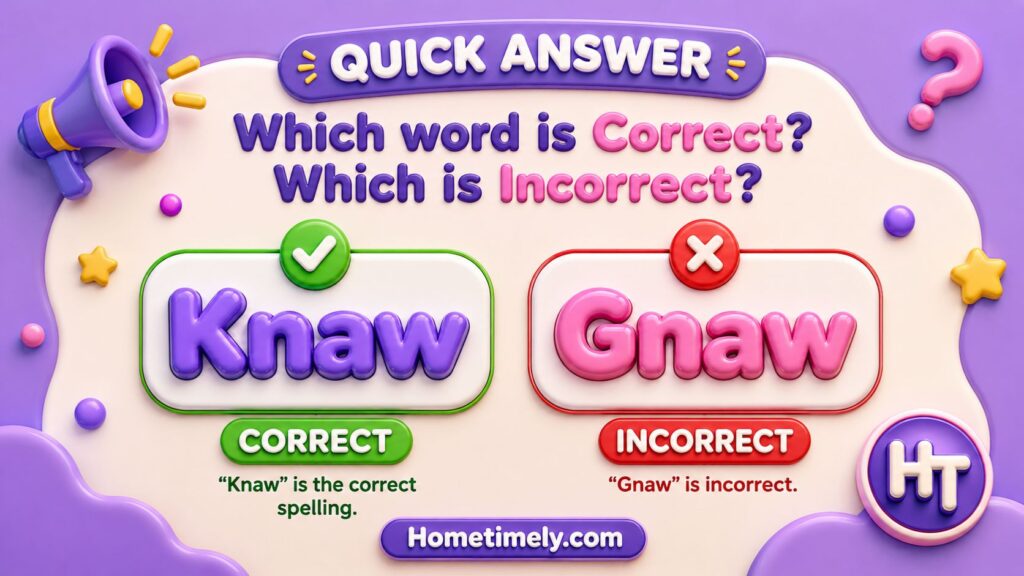
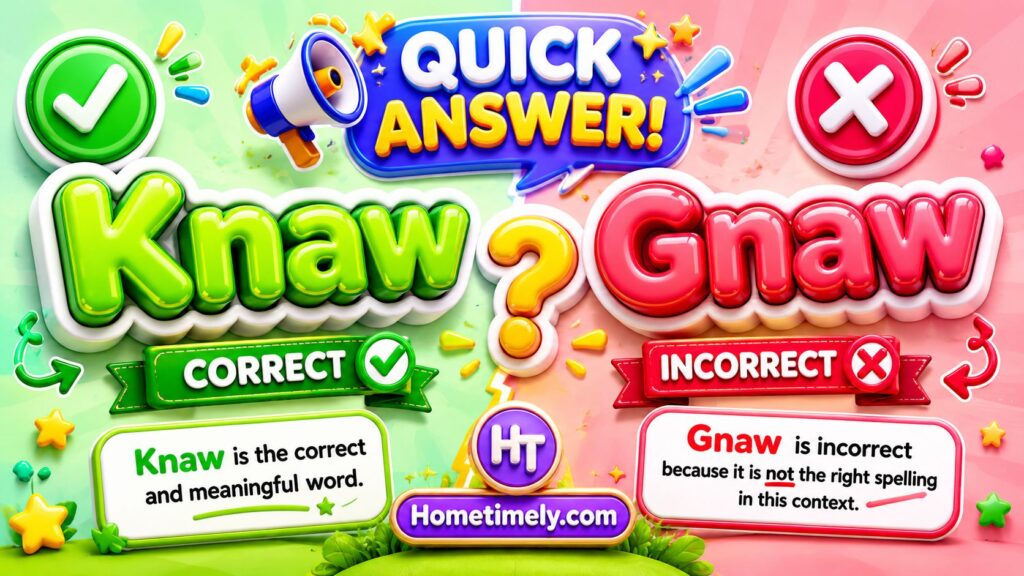
Let’s get straight to the point. Gnaw is the correct spelling. Full stop.
Knaw is not a recognized word in standard English. It does not appear in Merriam-Webster, Oxford, Cambridge, or Collins dictionaries as a valid spelling for this verb. If you write knaw in an essay, an email, or a social media post, you are making a spelling error — one that spell-checkers will flag and readers will notice.
The word you’re looking for is gnaw, pronounced exactly like “naw” (rhymes with “law” and “saw”). The g at the beginning is completely silent, which is precisely why so many people try to spell it differently.
| Spelling | Correct? | Dictionary Status |
| Gnaw | ✅ Yes | Listed in all major dictionaries |
| Knaw | ❌ No | Not a standard English word |
Always use gnaw. In every situation. In every dialect. Both British English and American English use the same spelling — there is no regional variation here.
Example sentences:
- The beaver began to gnaw through the wooden post.
- Guilt continued to gnaw at the back of her mind.
- Rats can gnaw through electrical cables and cause serious damage.
- He sat quietly, letting worry gnaw at him for hours.
- The puppy tried to gnaw off its leash.
What Does Gnaw Mean?
Gnaw is a verb with both a physical and an emotional dimension, which is part of what makes it such a useful and expressive word.
At its most basic level, to gnaw means to bite or chew on something repeatedly and persistently — usually something tough or hard. Think of a dog working on a bone, a beaver cutting through a tree trunk, or a mouse slowly working its way through a wall. The action is not a single bite. It is sustained, patient, and relentless.
But gnaw also carries figurative weight. It describes the slow, nagging persistence of an emotion — doubt, guilt, fear, anxiety — that quietly eats away at a person’s peace of mind over time.
Gnaw can mean:
- To bite or chew repeatedly — particularly when working through something hard or tough
- To wear something away gradually — through persistent friction, corrosion, or pressure
- To cause persistent emotional discomfort — worry, doubt, or guilt that never quite lets go
- To erode or damage slowly — used in both physical and abstract contexts
Physical example:
The squirrel sat at the base of the oak tree and began to gnaw through the acorn’s hard shell with its front teeth.
Emotional example:
Even after the apology, something kept gnawing at her — a feeling she couldn’t quite name but couldn’t shake either.
Both uses are grammatically correct, widely accepted, and appear in formal writing, literature, and everyday speech.
Why Do People Confuse Knaw and Gnaw?
The confusion between knaw and gnaw has a very logical root: pronunciation. The g in gnaw is completely silent. When you say the word aloud, there is no trace of the g — you simply say “naw.” This makes it nearly impossible to determine the correct spelling purely from how the word sounds.
Now add to that the fact that English has dozens of words beginning with kn where the k is equally silent: know, knee, knife, knock, knight, knit, knob, knuckle. Anyone who has learned those words might naturally assume that a word sounding like “naw” follows the same pattern and begins with kn. The logic is understandable, even if the conclusion is wrong.
This is not a sign of poor vocabulary or carelessness. It’s a sign that English spelling has deep roots in older forms of the language that do not always match modern pronunciation.
Why People Write Knaw Instead of Gnaw
There are several layers to this common mistake, and understanding them makes it easier to avoid in the future.
Common reasons for the mistake:
- The silent g is invisible in speech. When you hear gnaw, you hear “naw.” There is no phonetic clue that the word starts with a g.
- The kn pattern is extremely common in English. Words like know, knock, knife, kneel, and knight all have a silent k before an n. It is reasonable to assume knaw fits this category.
- The word is rarely seen in writing. Most people encounter gnaw far more often in speech than in print. Less visual exposure means less spelling reinforcement.
- Spell-checkers sometimes let it slip. Depending on the software, knaw may not always be flagged — particularly in casual or older text editors.
- English learners are especially vulnerable. For non-native speakers, silent letters are one of the most frustrating aspects of the language. The gn combination — which appears in gnaw, gnome, gnarled, and gnash — follows a pattern that is rare and hard to predict.
It’s worth noting that some historical and dialect records do reference knaw as an archaic or regional variant, but this form has long since disappeared from standard usage. It carries no meaning in modern English and should not be used in any formal or informal writing today.
Is Knaw a Real Word?

No. In modern standard English, knaw is not a real word.
It does not appear as an entry in Merriam-Webster, Oxford Learner’s Dictionary, Cambridge Dictionary, or Collins English Dictionary. None of the major style guides — American, British, or otherwise — recognize it as a valid spelling.
Some people come across references to knaw as a dialectal or obsolete form in very old texts, and Merriam-Webster does briefly note knaw as a dialectal British variant — but of the word know, not gnaw. These are two completely different words with different meanings and different etymological roots. Using knaw to mean what gnaw means is simply incorrect.
The takeaway is clear: if you want to say that something is biting, chewing, or slowly eroding something else — physically or emotionally — the word is gnaw, and the spelling is always g-n-a-w.
How to Remember the Correct Spelling
Memory tricks work best when they connect a new piece of information to something already familiar. Here are a few approaches that help writers consistently choose the right spelling.
Memory tip:
“Gnaw starts like gnome.”
Most people know how to spell gnome — the little garden statue, the fantasy creature. Both gnaw and gnome start with the silent gn combination. If you can remember one, you can remember the other.
Here are a few more strategies:
- Think of the gn family. English has a small but consistent group of gn words: gnaw, gnome, gnarled, gnash, gnat. Once you know the family, the spelling pattern sticks.
- Say it wrong on purpose. Mentally pronounce the g when you need to spell it — “GUH-naw.” It sounds ridiculous, but the exaggeration helps lock in the spelling.
- Write it out a few times. Muscle memory is real. Writing gnaw five or six times correctly builds the habit and makes the correct spelling feel natural.
- Use a simple rhyme: “It starts with G, though G stays free.” The g is there but stays silent — you just have to write it.
Common Uses of Gnaw
Gnaw is a versatile word that shows up in many different contexts. Understanding both its physical and emotional applications helps you use it with confidence and precision.
Physical use
In its most literal sense, gnaw describes the repeated, sustained act of biting through something — often by animals, but also by humans.
- Dogs gnaw on bones to clean their teeth or just for the satisfaction of it.
- Rodents like rats and mice gnaw through walls, cables, wood, and insulation.
- Beavers gnaw through tree trunks to fell them for dam-building.
- Termites gnaw through wooden structures, causing significant property damage.
- Humans gnaw on pencils, fingernails, or food items like corn on the cob.
The physical meaning implies both the action (biting) and the effect (wearing away). Something that is gnawed shows signs of persistent contact — grooves, bite marks, fraying, erosion.
Emotional use
The figurative meaning of gnaw is equally powerful and is used extensively in literature, journalism, and everyday conversation.
- Doubt gnaws at confidence, weakening it slowly from the inside.
- Guilt gnaws at a person’s peace of mind, resurfacing at unexpected moments.
- Fear gnaws at the edges of happiness, making enjoyment feel fragile.
- Hunger gnaws at the stomach — this one bridges physical and emotional, describing the persistent ache of an empty belly.
- Regret gnaws at people who replay past decisions they cannot change.
The emotional use of gnaw is effective because it captures something important: the slow, quiet, persistent nature of certain feelings. Unlike words such as “crush” or “destroy,” gnaw suggests something that works gradually — subtle but relentless.
How to Use “Gnaw” Correctly in Sentences
Using gnaw correctly means choosing the right form for the right tense and understanding whether you’re describing a physical action or an emotional experience.
Verb forms of gnaw:
| Form | Example |
| Base form | gnaw |
| Third person singular | gnaws |
| Past tense | gnawed |
| Present participle | gnawing |
| Past participle | gnawed (or archaic: gnawn) |
Gnaw as a Physical Action
When using gnaw to describe biting or chewing, it is typically followed by a direct object or a preposition like on, at, or through:
- The dog gnaws on its bone every evening after dinner.
- Mice had gnawed through the insulation behind the refrigerator.
- She nervously gnawed at her thumbnail during the interview.
- The rabbit gnawed the bark clean off the young sapling.
- Woodpeckers don’t gnaw — they hammer. Beavers, on the other hand, are relentless gnawers.
Gnaw as an Emotional Feeling
When using gnaw figuratively, it almost always appears with at or away at, suggesting the slow erosion of an internal state:
- A nagging suspicion had been gnawing at him all week.
- Her unfinished business gnawed away at her long after the meeting ended.
- The question gnawed at his mind: had he made the right choice?
- Loneliness can gnaw at even the most independent person over time.
- It was the silence, more than anything, that began to gnaw at her resolve.
Gnaw in Everyday Expressions
Gnaw extends beyond its literal use into a handful of recognizable phrases and expressions that appear regularly in writing and conversation.
“Gnawing feeling” — This phrase describes a persistent, uncomfortable sense of unease. “She had a gnawing feeling that she’d forgotten something important.”
“Gnawing doubt” — Refers to a doubt that lingers and resurfaces, never fully resolved. “A gnawing doubt about his loyalty stayed with her for months.”
“Gnawing hunger” — Describes a persistent, physical ache of hunger that builds gradually. “After skipping breakfast and lunch, a gnawing hunger made it impossible to concentrate.”
“Gnaw away at” — Suggests slow erosion of something over time. “Years of resentment had gnawed away at what was once a strong friendship.”
“Gnaw through” — Used for physically working through a barrier. “The rat had gnawed through three layers of drywall.”
These expressions are common enough that even writers who would never use gnaw on its own use these phrases naturally and frequently.
Also Read This : Finaly vs Finally: Differences and Usage
Similar Words People Confuse With Gnaw
Gnaw is not the only English word that causes spelling headaches due to silent letters or confusing phonetics. Here are some related confusions worth knowing:
| Confusing Pair | Correct Word | Common Error | Reason for Confusion |
| Gnaw / Knaw | Gnaw | Knaw | Silent g, familiar kn pattern |
| Know / No | Both valid | Context errors | Silent k, same sound |
| Gnarl / Narl | Gnarl | Narl | Silent g again |
| Gnash / Nash | Gnash | Nash | Same gn pattern |
| Kneel / Neil | Kneel (verb) | Mixed up | Silent k before n |
| Wrap / Rap | Both valid | Context errors | Silent w |
The pattern across many of these confusions is the same: English retained letters in spelling that it stopped pronouncing centuries ago. The spelling reflects history; the pronunciation reflects modern speech. That gap is the source of a great deal of confusion.
Words like gnarled, gnash, and gnat all share the silent gn opening with gnaw. Learning them as a group is one of the most effective ways to lock in the pattern.
Why Correct Spelling Matters
You might wonder whether a small spelling mistake like knaw versus gnaw really makes a difference. In casual texting between friends? Perhaps not. But in most other contexts, it matters more than people think.
Professional credibility: Spelling errors in emails, reports, applications, and business documents quietly undermine your credibility. Readers may not say anything, but they notice. Writing knaw when you mean gnaw signals either carelessness or a gap in language knowledge — neither impression is helpful in a professional setting.
Academic standards: In academic writing, spelling accuracy is expected and graded. A word misspelled throughout an essay suggests either insufficient proofreading or a genuine misunderstanding of the word. Both can affect your grade.
Content and SEO: For writers, bloggers, and content creators, correct spelling is part of quality. Search engines index content based in part on linguistic accuracy and readability. Errors reduce perceived authority, which affects both reader trust and search ranking.
Clarity and trust: When readers encounter misspellings, it creates a small moment of friction — a pause, a double-take, a question about whether the writer knows their subject. Correct spelling removes that friction and lets the content speak for itself.
Getting gnaw right is a small thing. But small things, done consistently, are what separate polished writing from careless writing.
Conclusion
The answer to “knaw or gnaw?” is simple and permanent: it’s always gnaw.
Knaw is not a word. It is a phonetic guess — a logical one, given how English handles silent letters — but a guess nonetheless, and an incorrect one. The correct spelling, gnaw, traces back to Old English gnagan and has been the standard form in both British and American English throughout the history of the written language.
Gnaw is a word that works hard. It describes a dog methodically working through a bone, a rodent tunneling through wood, and — just as vividly — the slow, quiet persistence of doubt, guilt, or worry that refuses to leave you alone. It is precise, expressive, and surprisingly versatile.
Now that you know the correct spelling, the meaning, the history, and the usage, you’ll never pause over this word again. When you hear “naw” and need to write it down, remember the silent g, think of gnome or gnat, and write it the right way: g-n-a-w.

Michael Brook is the creator and author behind Healthy Leeks, a platform focused on grammar, writing skills, and English language learning. Passionate about clear communication and effective writing, Michael Brook shares practical grammar tips, easy-to-follow language guides, and educational content to help readers improve their English with confidence.


