You’re mid-conversation, things are flowing, and then out of nowhere someone drops “IGL” like it’s second nature. You pause. Your eyes go back. You read it again. Still nothing.
If that sounds familiar, you are not alone. Three letters. Multiple meanings. Zero context. That is the IGL situation in a nutshell — and it trips up more people than you would think, whether they are gamers, casual texters, or just someone scrolling through a Discord server at midnight.
This guide breaks down everything you need to know about IGL: its real definitions, where it came from, how different people use it, and exactly what to say when someone uses it on you. No fluff, just the full picture — from esports briefing rooms to Instagram comment sections.
What IGL Means in Text: The Real IGL Definition
IGL does not have one single definition. That is the honest answer. Its meaning shifts depending on where you encounter it, who is saying it, and the conversation around it.
Here are the most widely recognized meanings:
| Meaning | Context | Example |
| In-Game Leader | Gaming / Esports | “We need a strong IGL for tonight’s scrimmage.” |
| I Guess, Like | Casual texting / chat | “IGL we could grab pizza later?” |
| I Guess Lol | Informal messaging | “Did you enjoy the movie?” “IGL, it was alright.” |
| I Got Late | Everyday excuse in chat | “Sorry I missed the call — IGL.” |
| I’ll Go Live | Streaming / social media | “IGL at 9pm tonight, tune in!” |
| Ion Ga Lie | Bahamian slang | “IGL that shirt does not work.” |
The dominant meaning — the one with the most consistent usage across platforms and professional communities — is In-Game Leader. If you are in a gaming space, that is almost certainly what someone means. In casual text between non-gamers, it typically leans toward the softer, hedging expressions like “I Guess, Like” or “I Guess Lol.”
Context is not just helpful here. It is everything.
Where IGL Comes From: Origin and Evolution
The story of IGL starts in competitive gaming, not on social media.
In the early 2000s, team-based PC games like Counter-Strike began taking off in tournament circuits. Players quickly discovered that raw mechanical skill — aim, reaction time, movement — was not enough to win at the highest level. Teams needed someone to coordinate. Someone to call the plays, read the opponent, and make decisions in real time under pressure.
That person became known as the In-Game Leader, and the abbreviation IGL was born inside Counter-Strike communities, gaming forums, and early esports chat rooms.
How IGL Developed Over Time
As competitive gaming expanded — through titles like Dota 2, League of Legends, Valorant, Rainbow Six Siege, and eventually Fortnite and Apex Legends — the IGL concept spread with it. The abbreviation moved from specialist jargon to mainstream gaming vocabulary.
At the same time, internet texting culture was doing its own thing. As messaging apps like WhatsApp, Snapchat, Instagram, and Twitter grew in dominance, users began shortening everything. Full sentences became fragments. Fragments became single letters or acronyms. In this environment, “IGL” found a second life as a casual shorthand for hedging phrases like “I guess, like…” — a natural product of how young people type when they want to sound relaxed and non-committal.
By the mid-2010s, IGL existed in two separate lanes: one firmly rooted in esports, the other floating loosely in internet slang. Today, both are active, and which one you encounter depends almost entirely on where you are online.
How IGL Is Used in Different Contexts
Understanding IGL means understanding the space it is used in. Here is a breakdown of how it shows up across the major digital environments:
- Gaming communities: Almost always means In-Game Leader. Used in reference to team roles, strategy sessions, and player evaluations.
- Casual texting: Usually means “I guess, like” or “I guess lol” — a filler expression that softens opinions or signals uncertainty.
- Streaming platforms: Often means “I’ll Go Live,” used by content creators to announce upcoming streams.
- Discord servers: Can appear in either gaming or casual conversation — context from the server topic usually makes it clear.
- Instagram and TikTok: Mix of gaming culture references and casual slang depending on the account niche.
- Regional slang: In some Caribbean communities, particularly the Bahamas, IGL stands for “ion ga lie” (I’m not gonna lie).
IGL Meaning in Gaming and Esports
This is where IGL carries the most weight. In competitive gaming, the In-Game Leader is not just a label — it is a defined role with real responsibilities that can determine whether a team wins or loses.
Think of the IGL like the point guard in basketball or the quarterback in American football. They may not always be the most individually impressive player on the team, but they direct the flow of everything that happens.
Games Where IGLs Play a Major Role
The IGL concept exists across nearly every team-based competitive game, but it is most formalized in:
- Counter-Strike 2 (CS2) — The IGL role is arguably more developed here than anywhere else in esports.
- Valorant — Teams designate an IGL who makes site-call decisions and manages rotations.
- Rainbow Six Siege — The IGL processes operator intel and directs team movements on both attack and defense.
- Apex Legends — In competitive play, the IGL calls when to engage, rotate, or disengage from fights.
- Fortnite (competitive) — IGLs call landing spots, rotation paths, and late-game positioning decisions.
- Dota 2 / League of Legends — Draft strategies and in-game decision-making fall heavily on the IGL equivalent.
What an IGL Actually Does
The IGL role is layered. It is not simply about calling out instructions. A good IGL is doing several things simultaneously during a match:
- Pre-round planning: Deciding which strategy the team will run at the start of each round based on the scoreline, economy, and what the enemy has been doing.
- Economy management: In games like CS2, the IGL decides when the team buys, when they save weapons, and when they force-buy despite low resources.
- Mid-round adjustments: When the original plan falls apart — and it often does — the IGL makes real-time calls to adapt. Rotate here. Fall back. Go this route instead.
- Information processing: Teammates feed the IGL info from around the map. The IGL filters that information and turns it into decisions.
- Morale management: A good IGL keeps the team calm when rounds are going badly, prevents tilt, and keeps communication productive.
- Post-game analysis: Reviewing what went wrong, studying opponents ahead of upcoming matches, and adjusting the team’s playbook accordingly.
Most IGLs sacrifice personal performance statistics for the benefit of the team. They are not the ones topping the scoreboard — they are the reason the team is on the scoreboard at all.
Case Study: How an IGL Changes a Match
Imagine a five-player CS2 team losing 4-10 at halftime. The enemy team is running the same aggressive B-site push every round. Without an IGL, each player reacts individually — some hold angles, some rotate late, and chaos follows.
With a strong IGL, the conversation at the start of round twelve sounds different. “They’re rushing B again. Double stack B, smoke the door, flash from platform. We wait for the footsteps.” The team executes as one. They win the round. They win the next one using a variation. The opponents adapt, and the chess match begins.
That ability to read a pattern and respond as a coordinated unit is what separates teams with great IGLs from teams that are just a collection of skilled individual players.
IGL Meaning in Text Messaging and Casual Chat
Outside gaming, IGL lives a quieter but real life in everyday texting.
In this context, it usually works as a verbal filler that people have converted into a typed shorthand. When someone types “IGL,” they might mean:
- “I guess, like, we could try that.” → IGL we could try that.
- “I guess lol, it was not that funny.” → IGL, not that funny.
- “I got late, sorry for missing it.” → IGL, my bad.
The tone is almost always casual and non-confrontational. People use it to soften their opinions, express mild uncertainty, or brush off a question without sounding dismissive. It fits naturally in WhatsApp groups, iMessage conversations, and Snapchat chats where typing fast and keeping things light is the unwritten rule.
One thing to note: outside gaming circles, IGL in texting is not universally standardized. Two people might use it to mean slightly different things, which is part of why the context question never really goes away.
IGL Meaning on Streaming, Discord, and Social Platforms
On platforms like Twitch, YouTube Live, and Kick, content creators use “IGL” as a quick way to tell followers they are about to go live. “IGL at 8pm — first Valorant ranked session of the season” is a typical use case you would find in a Discord announcement channel or a Twitter/X post from a streamer.
On Discord specifically, the meaning depends heavily on the server. A gaming server will almost certainly use IGL to mean In-Game Leader. A general hangout server might use it as casual slang. A streamer’s community server could use it in the “I’ll Go Live” sense. If you are unsure, look at what the server is about — that alone will usually tell you.
On Reddit, IGL appears frequently in subreddits like r/GlobalOffensive, r/VALORANT, and r/esports in clear gaming contexts. On TikTok comment sections, it appears in both gaming videos and general casual conversations, sometimes carrying different meanings within the same video’s comment thread.
Niche or Meme-Based Uses of IGL
Internet language never stays contained. IGL has picked up a few niche or humorous uses over the years:
- “IGL of the friend group” — A meme format where someone jokingly crowns the most organized or bossy friend as the “in-game leader” of real-life situations. Planning the meetup, picking the restaurant, leading the group text: that is the IGL energy.
- “Ion ga lie” — Popularized in certain Black American and Bahamian dialects, this phonetic shortening of “I’m not gonna lie” gives IGL an entirely different flavor. It is blunt, honest, and often used before a candid take.
- “I get/got laid” — A regional joke usage from parts of Texas, used humorously in context-specific situations. Clearly NSFW and not standard.
These are minor uses but worth knowing so you are not caught off guard if they appear in a thread or group chat with specific cultural roots.
IGL Meaning on Instagram
On Instagram, IGL surfaces in a few distinct ways.
Gaming creators use it in captions and Stories to signal team roles, hype up esports content, or reference competitive gameplay. A post captioned “Finally found our IGL for the tournament roster 🔥” is straightforward gaming usage.
In casual Instagram comments and DMs, it drifts toward the “I guess, like” meaning — especially in reply chains where people are being non-committal about plans, opinions on content, or casual opinions. “IGL the filter looks good” is something you might realistically see in a comment from a younger user.
Streamers and gaming influencers also use IGL in bios or highlights to signify their role — particularly those who play competitively and want to communicate their position to followers who understand the esports vocabulary.
IGL Meaning in Gaming
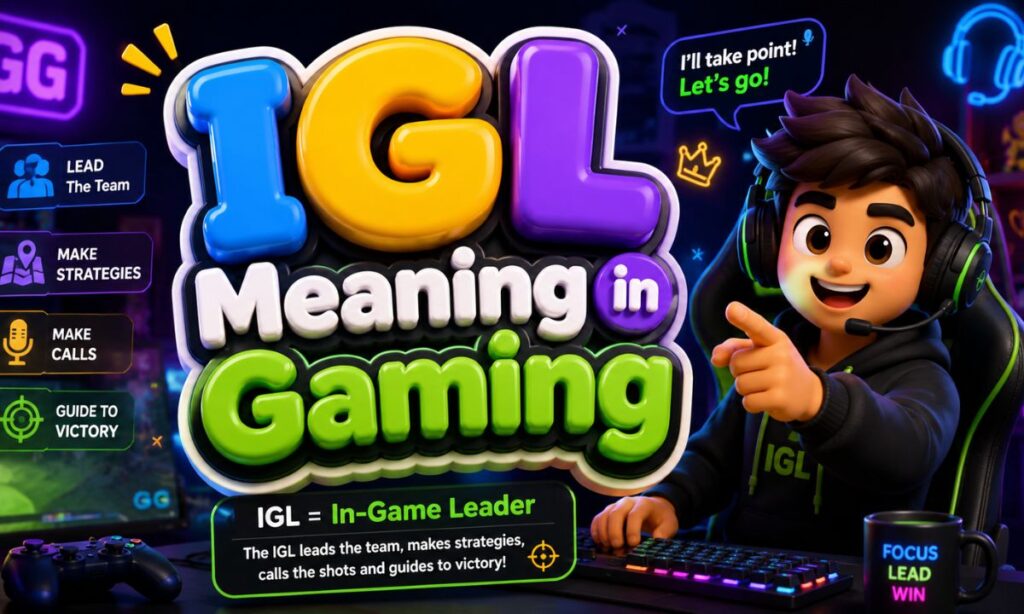
To recap and deepen the gaming definition: in this world, IGL means In-Game Leader without exception.
The IGL is the player in a competitive team who calls the shots. Not metaphorically — literally. They decide the strategy before the round begins. They adapt it as the round unfolds. They manage the team’s resources, morale, and communication in real time.
Professional esports organizations treat the IGL role with the same seriousness that traditional sports franchises treat coaching and captaincy. The IGL studies opponents, prepares playbooks, and is often the last voice heard before a critical play is executed.
Some of the most recognized IGLs in esports history include gla1ve from Astralis, who led his team to four CS Major Championships in what fans call the “Astralis era.” Karrigan of FaZe Clan is another legend — a player who famously transitioned from a mechanical rifler role to become one of the most decorated IGLs in Counter-Strike history.
IGL Meaning in Text — The Funny Side
Not everything about IGL is serious. The internet has a way of making leadership roles into comedy material.
The “IGL of the friend group” meme has been a recurring theme on Twitter/X and Reddit. It typically features someone dramatically “calling strats” for a group activity — coordinating who brings snacks to the hangout, setting waypoints on Google Maps, and telling everyone to “stop going for kills and focus on the objective” when the evening plan starts falling apart.
There is also the self-aware humor of people calling out IGLs who “give bad calls” in casual games — something any multiplayer gamer has experienced. The phrase “blame the IGL” has become a tongue-in-cheek way to deflect personal accountability after a loss, much like athletes blaming a coach when a game goes sideways.
Also Read This : Oh My Lanta Meaning and Complete Guide
IGL Meaning in CS2
Counter-Strike 2 is where the IGL role is most codified, most discussed, and most demanding.
In CS2, a match consists of multiple rounds in which two teams of five compete — Terrorists trying to plant a bomb, Counter-Terrorists trying to prevent it. Every round is a micro-strategic puzzle: which site to attack, how to use utility (smoke grenades, flashbangs, Molotov cocktails), when to eco-save weapons, and when to force-buy despite low funds.
The IGL is responsible for all of this simultaneously.
Key CS2 IGL responsibilities include:
- Site selection: Deciding whether to go A or B, and when to switch or fake.
- Execute calls: Coordinating grenade lineups and player roles for a synchronized site push.
- Mid-round reads: Interpreting enemy behavior and adjusting the plan in real time.
- Economy decisions: Calculating when the team can afford a full rifle buy versus when they need to save.
- CT-side rotations: On defense, deciding when to rotate players based on noise, footsteps, and reported intel.
What makes the IGL role difficult in CS2 specifically is that the game’s pace is unforgiving. Rounds can end in seconds. Decisions made in the opening ten seconds of a round can determine the entire outcome. An IGL cannot pause, deliberate, and return. They call in the moment, every time.
Legendary CS2 IGLs are often recognizable not by their kill-death ratios — which tend to be modest — but by their win rates, trophy cabinets, and the tactical innovations they introduced to the scene.
Misconceptions and Common Mistakes About IGL
A few misunderstandings about IGL circulate frequently online:
“IGL means the best player on the team.” Wrong. The IGL is the strategic leader, not necessarily the top fragger. Many famous IGLs have below-average personal stats because they prioritize team coordination over individual performance.
“IGL is a universal texting acronym everyone knows.” Not quite. Outside gaming communities, IGL as casual slang is not universally recognized. Using it with someone unfamiliar with gaming or internet slang culture may result in blank stares.
“IGL always means In-Game Leader.” In gaming contexts, yes. In casual texting from non-gamers, it likely means something else entirely. Context matters.
“IGLs just give orders — they do not really play the game.” Completely false. IGLs are active players who must also call strategies simultaneously. As one CS2 pro coach put it: being an IGL requires “making quick decisions and staying calm under pressure” — all while still playing at a high mechanical level.
Similar Abbreviations That Get Confused With IGL Meaning in Text
IGL exists in a crowded abbreviation space. Here are terms that get mixed up with it:
| Abbreviation | Common Meaning | How It Differs from IGL |
| IRL | In Real Life | Refers to offline existence, not leadership |
| IGL | In-Game Leader | Specific gaming role |
| IGS | I Guess So | Similar hedging tone, but less common |
| NGL | Not Gonna Lie | Direct comparison; NGL is far more widely standardized |
| IKR | I Know Right | Agreement, not speculation or leadership |
| GLHF | Good Luck Have Fun | Gaming-specific but a greeting, not a role |
| IGL | Ion Ga Lie | Regional variant with same letters, completely different meaning |
The biggest source of confusion is between IGL and NGL. They sound similar, they can be typed accidentally instead of each other, and they share a hedging quality in casual speech. NGL is far more standardized and widely understood — if someone means “not gonna lie,” they almost always say NGL rather than IGL.
How to Tell What Someone Really Means by IGL
When IGL appears in a conversation and you are not immediately sure which meaning is intended, run through these mental checkpoints:
The Quick Interpretation Guide
- What is the platform? If it is a gaming Discord, subreddit, or esports Twitter thread — In-Game Leader, almost certainly.
- What is the surrounding conversation about? Gaming topics, team coordination, competitive play → gaming IGL. Random casual chat, plans, opinions → likely “I guess, like” or similar.
- Who is saying it? A gamer talking to other gamers? Leader role. A teenager texting a friend about weekend plans? Casual hedge.
- What comes after it? “IGL, we should go to the cinema” reads like “I guess, like.” “He is a terrible IGL” reads as gaming criticism.
- What is the tone? Serious, strategic conversation → gaming. Laid-back, low-stakes chat → slang.
When in doubt, it is always acceptable to ask. “Wait, what do you mean by IGL?” is a completely normal question that any reasonable person will answer without judgment.
How to Respond When Someone Uses IGL
If They Meant In-Game Leader
In gaming contexts, you respond to the role, not just the word. If someone says “You should IGL this match,” they are asking you to take the strategic lead. Acknowledge it and step up — or decline if you are not comfortable with the responsibility.
- “Sure, I’ll call the strats. Everyone stay on comms.”
- “I’m down to IGL, but let’s agree on a default first.”
- “I’d rather not IGL today — I’m not feeling the pressure. Can you take it?”
If They Meant I Got Late
This is typically an apology or explanation. Respond with understanding or ask for context:
- “No worries, what happened?”
- “All good, we can reschedule.”
If They Meant I’ll Go Live
This is an announcement. Respond with encouragement or note to your own calendar:
- “Hype! I’ll tune in.”
- “Nice, what game tonight?”
- “Set a reminder for me, I don’t want to miss it.”
Regional and Age-Group Differences in IGL Usage
Regional Trends
IGL as gaming terminology is global — wherever Counter-Strike, Valorant, and competitive gaming have audiences, the In-Game Leader concept exists. It is widely used across North America, Europe, Southeast Asia, and South Asia, particularly in countries with strong esports scenes like South Korea, Brazil, Denmark, and Turkey.
The “ion ga lie” version of IGL is geographically more specific, rooted in Caribbean and African-American Vernacular English (AAVE) communities. It is unlikely to appear in Swedish esports forums, but it surfaces naturally in certain American social media communities.
Generational Differences
- Gen Z and younger Millennials: Comfortable with both the gaming and casual slang versions. They may switch between meanings depending on context without thinking much about it.
- Older Millennials: More likely to recognize IGL in gaming contexts if they have gaming history, but may be unfamiliar with the casual texting variation.
- Gen X and above: Unless they are active gamers or heavily online, IGL may not register at all. Using it in conversation with this demographic without context is likely to cause confusion.
IGL in Dating Apps and Social Profiles
On platforms like Tinder, Hinge, or Bumble, IGL in a bio or opening message almost always signals gamer identity. Someone listing “IGL for my competitive team” is communicating that they play seriously, that they are a leader personality type, and that gaming is a meaningful part of their life.
It can be a natural conversation starter — especially if the other person is also a gamer. “You’re an IGL? What game?” opens a genuine thread about competitive experience, favorite titles, and playstyle.
For non-gamers seeing IGL in a dating profile, the most sensible move is to ask. It is not threatening jargon — it just means the person takes their team coordination role in gaming seriously, which often signals they are communicative, strategic, and comfortable making decisions.
Does IGL Have Hidden or Inappropriate Meanings?
Yes, one exists — though it is largely regional and humorous rather than widely used.
One Urban Dictionary entry from Frisco, Texas defines IGL as “I get laid” or “I got laid,” used primarily as an inside joke. This meaning is not mainstream, not universally known, and not likely to appear in normal conversation. It is the kind of entry that reflects how creative (and sometimes juvenile) internet humor can be with acronyms.
The “ion ga lie” meaning is also worth flagging — while not inappropriate, it can be tonally blunt or raw in certain contexts, as it typically precedes an unfiltered honest opinion.
Outside these edge cases, IGL does not carry any inherently offensive or inappropriate connotation. It is safe to use in most digital spaces without concern.
Is IGL Suitable for Professional Communication?
Short answer: no, not in most cases.
In professional settings — emails, formal Slack channels, client communications, or business presentations — IGL is too ambiguous and too informal to be useful. Even in industries adjacent to gaming, like esports management or game development studios, clearer language is preferred in formal communication: “team captain,” “strategic lead,” or “shot-caller” communicate the same idea without requiring the recipient to decode an abbreviation.
The exception would be within an esports organization’s internal communications where everyone on the team already knows the terminology. In that context, “assign an IGL for the bootcamp” is completely appropriate because the shared vocabulary is established.
For everything outside that narrow professional niche, spell it out.
Comparison With Related Gaming Leadership Terms
IGL is not the only leadership-adjacent term in gaming vocabulary. Here is how it stacks up against similar roles:
| Term | Meaning | Key Difference from IGL |
| IGL | In-Game Leader | The primary strategic caller during live play |
| Captain | Team captain | Often an organizational/representative role, not always the in-game caller |
| Shot-caller | Player who makes calls | Can refer to IGL, but also to any player who calls during a round |
| Fragger IGL | IGL who also performs mechanically | A modern hybrid style where the IGL maintains high personal stats |
| Coach | Off-player advisor | Guides team outside of active play; cannot make calls during a live match in most official competitions |
| AWPer | Primary sniper | A different role entirely — skill-based, not strategy-based |
The key distinction of the IGL role is that it happens in real time, under live match pressure, while the player is also competing. It is not an advisory role or a title — it is an active, demanding function that requires constant engagement.
Quick IGL Cheat Sheet
Need the summary fast? Here it is:
| Context | IGL Meaning |
| Gaming / Esports | In-Game Leader |
| Casual texting | I Guess, Like / I Guess Lol |
| Streaming / content creation | I’ll Go Live |
| Bahamian / Caribbean slang | Ion Ga Lie (I’m not gonna lie) |
| Rare regional humor | I Get/Got Laid (not mainstream) |
When to use it:
- In gaming contexts with other gamers — freely and confidently.
- In casual texts with friends who share your slang vocabulary — fine.
- In professional or formal settings — avoid it; use clear language instead.
When to ask for clarification:
- Whenever you genuinely cannot tell which meaning applies from context.
- Whenever IGL appears in a conversation that does not clearly belong to gaming or casual chat.
Reference: Cambridge Dictionary Definitions
The Cambridge Dictionary does not currently have a dedicated entry for “IGL” as a standalone abbreviation, which reflects its status as an informal, community-specific term rather than formally adopted language. However, the concepts behind each of its meanings are well-grounded in standard English:
- Leader (Cambridge): “a person in control of a group, country, or situation.”
- Guess (Cambridge): “to give an answer to a particular question when you do not have all the facts and so cannot be certain if you are correct.”
- Lie (Cambridge, in the “ion ga lie” sense): “to say or write something that is not true in order to deceive someone” — though in the slang context, “not gonna lie” functions as an expression of candor, the opposite of deception.
The gap between formal dictionary definitions and real-world usage is exactly where IGL lives. It is an organic, community-driven abbreviation — which is why understanding context matters far more than looking it up in a dictionary.
Conclusion
IGL is one of those abbreviations that looks simple but carries a surprising amount of weight once you understand the full picture.
At its core, it means In-Game Leader — a specific, demanding, and respected role in competitive gaming where one player takes responsibility for the team’s strategy in real time. That meaning dominates gaming communities, esports commentary, Discord servers, and anywhere competitive players gather.
Outside that world, IGL drifts into casual territory: a soft expression of uncertainty, a streaming announcement, a regional phrase for honesty, or the punchline to a meme about whoever in your friend group always ends up planning everything.
The takeaway is simple: look at where IGL appears and who is using it. That context will tell you everything you need to know. And when it does not — just ask. Clarity beats confusion every time, even if the question feels obvious.

Michael Brook is the creator and author behind Healthy Leeks, a platform focused on grammar, writing skills, and English language learning. Passionate about clear communication and effective writing, Michael Brook shares practical grammar tips, easy-to-follow language guides, and educational content to help readers improve their English with confidence.