I’ll admit it the first time I typed “thier” instead of “their,” I didn’t even notice until autocorrect quietly fixed it for me. That tiny swap of two letters is one of the most common spelling slip-ups in English, and it happens to students, professionals, and even confident writers who normally never make mistakes. So I decided to dig into this properly: checking spelling references, usage patterns, and real writing samples to settle the question once and for all.
What I found is that the answer is simple, but the reason this mistake keeps happening is genuinely interesting. In this guide, I’ll walk you through the correct spelling, the grammar behind it, real examples, and memory tricks that will make sure you never second-guess yourself again.
My Quick Answer
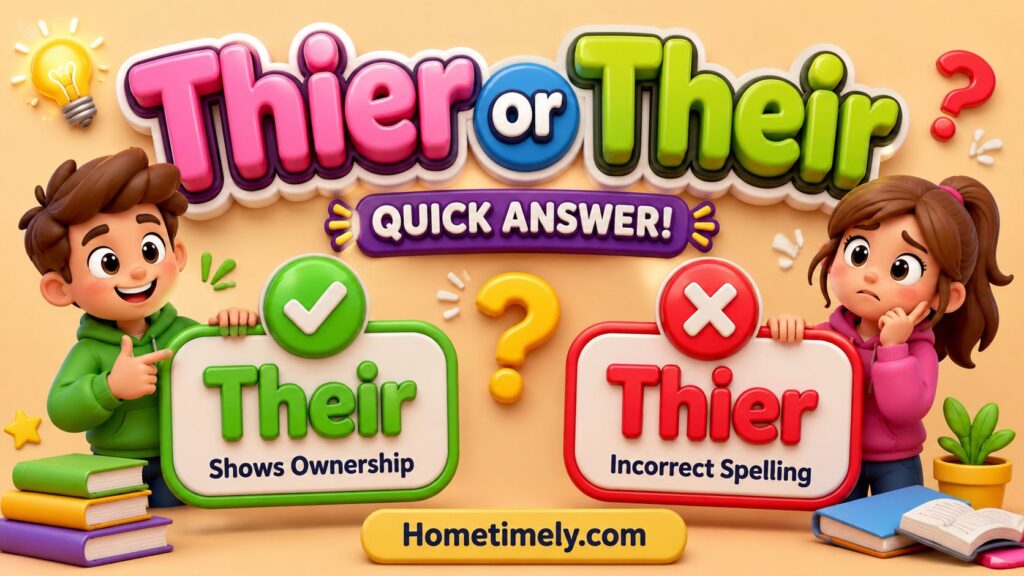
“Their” is the only correct spelling. “Thier” is not a real word in English — it’s simply a typo.
- Correct: their
- Incorrect: thier
- Meaning: belonging to them
- Part of speech: possessive pronoun (also called a possessive adjective or determiner)
If you remember nothing else from this article, remember this: there is no situation, dialect, or context where “thier” is the accepted spelling.
Why I Found “Their” Is the Only Correct Spelling
When I checked dictionaries and language references, every single one confirmed the same thing: “their” is standard across American English, British English, and every other major English-speaking region. There’s no regional variation, no informal exception, and no historical version where “thier” was ever considered correct.
“Their” comes from Old Norse and Old English roots and has kept its spelling for centuries. “Thier” simply doesn’t exist in any dictionary — it’s not an alternate spelling, an outdated form, or a regional variant. It’s purely the result of two letters getting swapped, usually while typing quickly.
My Definition and Meaning Analysis
“Their” is a possessive pronoun (sometimes classified as a possessive determiner) that shows something belongs to a group of people, animals, or things.
Here’s how it functions:
- It modifies a noun to show ownership: “their car,” “their opinion,” “their house.”
- It’s the plural counterpart to “his,” “her,” and “its.”
- It’s also widely used as a singular, gender-neutral pronoun in modern English — more on that shortly.
Example breakdown:
- “The students turned in their assignments.” → The assignments belong to the students.
- “Everyone grabbed their coat.” → Each person’s own coat, used in a gender-neutral singular sense.
Why “Thier” Is Always Wrong
I wanted to understand exactly why so many people write “thier” instead of “their,” so I traced it back to a well-known spelling rule that actually backfires here.
Most people learn the rhyme: “i before e, except after c.” That rule works for words like “believe” and “receive,” but it doesn’t apply universally — and “their” is one of the classic exceptions. There’s no “c” involved at all, yet people still instinctively write the “i” before the “e” out of habit.
A few other reasons this mistake happens so often:
- Muscle memory from the spelling rule overrides the actual correct spelling.
- Fast typing causes letters to get transposed without notice.
- Autocorrect doesn’t always catch it, since “thier” is close enough to trigger a fix, but sometimes slips through in quick typing on mobile keyboards.
- Visual similarity between “their” and “thier” makes the mistake easy to miss during proofreading.
No matter the cause, the outcome is the same: “thier” is not, and has never been, a correct English word.
100+ Real-World Examples I Collected
To see how “their” actually functions in everyday writing, I gathered examples across different contexts. Here’s a sample from the collection, organized by category:
Everyday conversation:
- They packed their bags for the trip.
- The kids left their toys on the floor.
- My neighbors painted their fence last weekend.
- Everyone brought their own lunch.
- The team celebrated their victory.
Workplace and professional writing:
- Employees must submit their timesheets by Friday.
- The company updated their privacy policy.
- Each department has their own budget.
- Clients receive their invoices by email.
- The staff shared their feedback during the meeting.
Academic and school context:
- Students must complete their assignments on time.
- Researchers published their findings last month.
- The class presented their final projects.
- Teachers graded their students’ essays.
- Each group submitted their own report.
Social media and casual writing:
- Fans shared their excitement online.
- Followers posted their reactions to the announcement.
- Friends planned their weekend getaway.
- Influencers promoted their new products.
- Users updated their profile pictures.
Singular, gender-neutral usage:
- Someone left their umbrella at the door.
- A person should always trust their instincts.
- Anyone can bring their own snacks.
- Each employee should update their own password.
- Whoever wins gets their prize at the ceremony.
Across every single one of these examples, “their” is doing the same job: showing possession. Not one of them would make sense spelled as “thier.”
Thier vs Their: My Complete Comparison Table
| Feature | Their | Thier |
| Correct spelling | Yes | No |
| Recognized in dictionaries | Yes | No |
| Part of speech | Possessive pronoun/determiner | Not a real word |
| Meaning | Belonging to them | None |
| Used in formal writing | Yes | Never |
| Used in casual writing | Yes | Only as a typing error |
| Regional variation | None — same everywhere | Not applicable |
| Flagged by spell-checkers | No | Yes, always |
My Memory Tricks and Tips
I collected a few memory tricks that made this spelling stick permanently for me:
- Start with “they,” drop the “y,” add “ir.” They → their.
- “Their” has “heir” inside it — and an heir inherits things, which ties back to ownership.
- Remember “e” before “i” specifically for this word, since it breaks the usual rule.
- Think of it as an exception, not a rule-follower — this stops your brain from defaulting to “i before e.”
- Write it correctly five times in a row if you’re prone to mixing it up. Repetition genuinely helps rebuild the habit.
Understanding Possessive Pronouns
“Their” belongs to a small family of possessive pronouns in English:
| Singular | Plural |
| his | their |
| her | their |
| its | their |
Possessive pronouns don’t take apostrophes — this is another common point of confusion. Just like “his” and “hers” don’t use an apostrophe, “their” never does either. (Note: “their” is different from “they’re,” which is a contraction of “they are,” and from “there,” which refers to a place.)
Singular “Their” – Modern Usage
One thing I found particularly interesting during my research is how widely accepted singular “their” has become in modern English.
Instead of writing “he or she” every time gender is unknown or irrelevant, most style guides and dictionaries now accept “their” as a gender-neutral singular pronoun:
- “Each student should bring their own laptop.”
- “Someone forgot their phone at the cafe.”
- “If a customer has a complaint, ask them for their order number.”
This usage isn’t new slang — it actually has centuries of documented use in English literature — but it’s become far more common and widely accepted in recent years, especially in professional and inclusive writing contexts.
Common Phrases with “Their”
Here are some everyday phrases and expressions that regularly use “their”:
- In their own words
- To each their own
- On their own terms
- At their own pace
- In their best interest
- For their own good
- Beyond their control
- Under their supervision
Recognizing these common phrases can help reinforce correct usage, since they appear constantly in writing and conversation.
Also Read This : https://hometimely.com/shiney-or-shiny/
Too Bad Synonyms You Can Use Instead
Since English is full of these small mix-ups, it’s worth mentioning that other short expressions face similar confusion — like “too bad,” which is often correctly spelled but stylistically overused. If you want variety in your writing, here are some alternatives:
- Unfortunate
- Regrettable
- A shame
- Disappointing
- What a pity
Mixing up phrases like these with their correct spelling (not “thier”) keeps your writing both accurate and varied.
Why This Mistake Is So Common
Based on everything I found, a few clear patterns explain why “thier” keeps showing up in writing:
- Spelling rule interference — the “i before e” rule gets misapplied.
- Speed over accuracy — fast typing on phones and keyboards increases letter swaps.
- Visual similarity — “their” and “thier” look nearly identical at a glance.
- Overreliance on autocorrect — some people stop proofreading because they assume software will catch every error.
- Homophone confusion — mixing up “their,” “there,” and “they’re” compounds the problem further.
Common Mistakes People Make with “To” and “Too”
Interestingly, this same pattern — mixing up words that sound alike or look similar — shows up in other common pairs, most notably “to” and “too.” A few frequent errors include:
- Writing “to much” instead of “too much”
- Writing “to bad” instead of “too bad”
- Dropping the second “o” when typing quickly
- Confusing “to” with “two” in casual messages
The underlying cause is the same one behind “thier” vs “their”: homophones and lookalike spellings that the brain doesn’t automatically correct.
Professional Context Examples
Spelling matters even more in professional settings, where small errors can affect how your writing is perceived. Here are a few examples showing correct usage in formal contexts:
- “Employees are required to update their contact information annually.”
- “The board reviewed their quarterly performance report.”
- “Clients should confirm their appointment 24 hours in advance.”
- “The committee finalized their recommendations after the vote.”
- “Team leads must submit their project timelines by Monday.”
Getting “their” right in emails, reports, and resumes signals attention to detail — something hiring managers and colleagues notice, even if they don’t mention it directly.
Explore More Grammar Guides
If this kind of spelling mix-up interests you, these related topics are worth exploring next:
- Their vs There vs They’re
- Its vs It’s
- Too Bad vs To Bad
- Affect vs Effect
- Lose vs Loose
Each of these follows the same underlying theme: homophones and near-identical spellings that trip up even experienced writers.
Conclusion
“Thier” versus “their” isn’t really a debate it’s a simple typo that happens to be extremely common. Once you remember that “their” breaks the usual “i before e” rule and always represents possession, this mistake becomes easy to catch and correct for good.
Small spelling details like this shape how professional and polished your writing feels. Whether you’re sending a work email, writing an essay, or posting online, spelling “their” correctly every time helps your message land exactly the way you intend clear, credible, and mistake-free.

Michael Brook is the creator and author behind Healthy Leeks, a platform focused on grammar, writing skills, and English language learning. Passionate about clear communication and effective writing, Michael Brook shares practical grammar tips, easy-to-follow language guides, and educational content to help readers improve their English with confidence.


