Spot this word on a job application, a legal document, or a news article, and you might pause: is it “cognisant” or “cognizant”? Both spellings exist, both are correct, and both mean exactly the same thing. The only real difference is geography. Here’s everything you need to know to pick the right one every time.
Cognisant
“Cognisant” is the British English spelling, used across the UK, Australia, New Zealand, and much of the Commonwealth. It follows the same “-ise/-s” pattern found in words like “recognise” and “organise.”
Cognizant
“Cognizant” is the American English spelling, and it’s also the more widely used version worldwide. It follows the “-ize/-z” pattern seen in words like “recognize” and “organize.”
Cognisant or Cognizant: Quick Answer
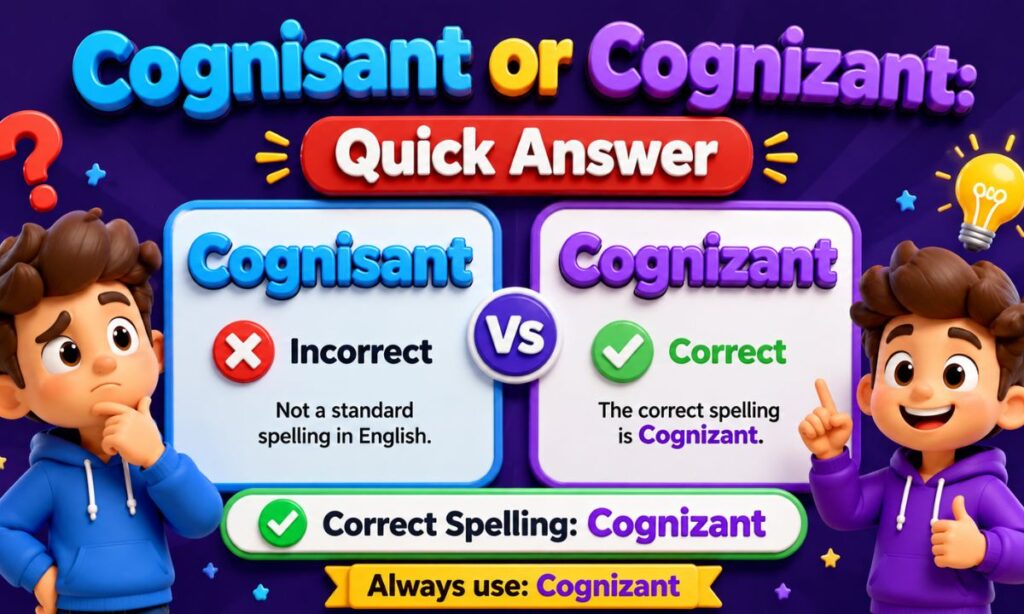
- Both words mean “aware of” or “having knowledge of something.”
- Cognizant is the standard spelling in American English and is also the more common spelling globally.
- Cognisant is the accepted British English variant, commonly used in the UK, Australia, and other Commonwealth countries.
- The meaning and pronunciation are essentially identical — only the spelling changes.
- If you’re unsure which to use, “cognizant” is the safer default for international or mixed audiences, since it appears more frequently in global content and search data.
The Origin of Cognisant / Cognizant
Both spellings trace back to the Latin verb cognoscere, meaning “to know” or “to become acquainted with.” The word entered English usage in a recognizable adjective form around the 19th century, appearing first in formal, legal, and academic writing to describe someone who had knowledge or awareness of a particular fact or situation.
Interestingly, language historians note that the “z” spelling actually appeared first, recorded in British writing in the early 1800s, before British publishers later gravitated toward the “s” version to align with other “-ise” style words already common in their spelling conventions. American English, meanwhile, settled firmly on the “z” spelling, following the broader American preference for “z” over “s” in words like “realize,” “organize,” and “recognize.”
So while it’s easy to assume the “s” spelling is older or more “proper,” the history is more nuanced. Both forms have deep roots, and neither is a modern shortcut or a careless variation.
British English vs American English Spelling
The “s” versus “z” pattern in “cognisant” and “cognizant” mirrors a much bigger spelling divide in English. British English generally favors “-ise” endings, while American English favors “-ize” endings, in word pairs such as:
- Organise / Organize
- Realise / Realize
- Recognise / Recognize
- Analyse / Analyze (a slightly different pattern, but the same regional split)
“Cognisant” and “cognizant” follow this exact same logic. If you already default to British spelling conventions in your writing — using “colour,” “centre,” or “organise” then “cognisant” will feel like the natural fit. If you write in American English, with “color,” “center,” and “organize,” then “cognizant” is the consistent choice.
It’s worth noting that even within British English, “cognizant” is not considered wrong. Some UK dictionaries list it as an accepted variant, and it does appear in British writing from time to time. However, “cognisant” remains the more idiomatic and expected choice for a British audience.
Cognisant vs. Cognizant: Pronunciation Explained
Despite the spelling difference, both words are pronounced almost identically. Most speakers say the word with a “z” sound in the middle, regardless of which spelling they use in writing.
- Cognisant: pronounced approximately “KOG-nih-zant”
- Cognizant: pronounced approximately “KOG-nih-zant”
In other words, the spelling difference is purely visual. You won’t hear a “s” sound like in “hiss” when someone says “cognisant” out loud — the middle consonant is still voiced as a “z” sound in everyday speech, even among British speakers who write it with an “s.” This is one of the more interesting quirks of this word: the written form varies by region, but spoken pronunciation stays consistent.
Which Spelling Should You Use?
Choosing between “cognisant” and “cognizant” comes down to two main factors: who’s reading your content, and what type of writing you’re producing.
1. Audience Based Advice
- Writing for American readers: Use “cognizant.” It’s the standard spelling in US dictionaries, style guides, and professional writing.
- Writing for British, Australian, or Commonwealth readers: Use “cognisant.” It matches regional spelling conventions and reads as more natural and polished.
- Writing for a global or international audience: “Cognizant” is generally the safer choice, since it’s more widely recognized across international business, technology, and online content, partly due to the global reach of American English in digital media.
- Unsure of your audience: Pick one spelling and stay consistent throughout your entire document, website, or publication.
2. Academic & Professional Writing
In academic and professional contexts, consistency matters more than which specific spelling you choose. Most major style guides have a clear preference:
- The Chicago Manual of Style and the AP Stylebook (both American) favor “cognizant.”
- The Oxford Style Manual (British) favors “cognisant.”
- Legal and government writing in the US almost exclusively uses “cognizant.”
- Legal and government writing in the UK and Commonwealth nations tends to use “cognisant.”
If you’re writing a research paper, business report, or formal document, check whether your institution or publication follows American or British English conventions, then apply that spelling throughout.
Cognisant vs Cognizant: Spelling, Meaning & Regional Variations
Meaning and Usage
Both “cognisant” and “cognizant” function as adjectives meaning aware of, informed about, or having knowledge of something. They’re typically followed by the preposition “of”:
- “She was cognisant of the risks before signing the contract.”
- “He remained cognizant of the deadline throughout the project.”
Neither word functions as a verb or a noun. You can’t say “to cognizant” or “the cognisant,” since the word only works as a descriptor.
Spelling Clarification
To spell each version correctly:
- Cognisant: C-O-G-N-I-S-A-N-T
- Cognizant: C-O-G-N-I-Z-A-N-T
The only difference is the sixth letter: “s” in the British form, “z” in the American form. A simple memory trick is to connect the spelling to other words you already know from each regional style if you write “organise,” go with “cognisant”; if you write “organize,” go with “cognizant.”
Common Mistakes with Cognisant / Cognizant
Even confident writers occasionally trip over this word. Watch for these common errors:
- Mixing spellings in the same document. Using “cognisant” in one paragraph and “cognizant” in another looks inconsistent and unpolished.
- Misspelling the word entirely. Variations like “cognisent,” “cognizent,” or “cognicent” are incorrect in both English varieties.
- Using it as a verb or noun. “Cognisant” and “cognizant” are adjectives only phrases like “to cognizant the risk” are grammatically incorrect.
- Assuming a meaning difference. Some writers mistakenly think one spelling implies a stronger or more formal type of awareness. In reality, the meaning is identical; only the spelling changes.
- Choosing the wrong regional spelling for your audience. Using “cognisant” throughout an American press release, or “cognizant” throughout formal UK legal writing, can look slightly out of place, even though it isn’t technically wrong.
Cognisant or Cognizant in Sentences and Real Usage
1. Basic Sentence Examples
- “The manager was cognizant of the budget constraints.” (American)
- “She remained cognisant of the cultural sensitivities involved.” (British)
- “Employees should be cognizant of workplace safety rules.” (American)
- “The committee was fully cognisant of the risks before approving the plan.” (British)
2. Cognisant vs Conscious
“Cognisant” and “conscious” are related but not perfectly interchangeable. “Conscious” often refers to a general state of awareness, sometimes even a physical or mental state, such as being awake or alert. “Cognisant” (or “cognizant”) specifically implies knowledge or awareness of a particular fact, situation, or consequence.
For example:
- “He was conscious after the accident.” (Awake, alert a physical state)
- “He was cognizant of the accident’s long-term consequences.” (Aware of specific information)
While the two words overlap in casual usage, “cognisant/cognizant” leans more toward informed awareness, while “conscious” leans more toward general alertness or perception.
3. UK vs US Sentence Style
British and American sentences using this word tend to follow the same grammatical structure, differing only in spelling:
| Context | British English | American English |
| Business report | “The board remained cognisant of shareholder concerns.” | “The board remained cognizant of shareholder concerns.” |
| Legal document | “The court was cognisant of prior rulings.” | “The court was cognizant of prior rulings.” |
| Everyday writing | “I’m cognisant of the time difference.” | “I’m cognizant of the time difference.” |
4. Quick Usage Tips
- Always pair “cognisant/cognizant” with “of,” not “about” or “to.”
- Use it in formal or semi-formal writing; it can feel slightly stiff in casual conversation.
- Avoid pluralizing it there’s no such word as “cognisants” or “cognizants.”
- Match the spelling to your document’s overall English variety, especially in professional or published content.
5. Common Search Based Clarifications
People frequently search for quick clarifications around this word, including:
- Is “cognisant” a real word? Yes, it’s a fully accepted British English spelling.
- Is “cognizant” more correct than “cognisant”? Neither is more correct; they’re regional variants of the same word.
- Can I use either spelling in Canada? Canadian English typically leans toward “cognizant,” though some British-influenced usage still appears.
- Does the meaning change based on spelling? No, the meaning stays exactly the same regardless of which version you use.
Cognisant / Cognizant in Everyday Examples
This word shows up more often in formal and professional writing than in casual conversation. Common real-world contexts include:
- Business communication: “Our team remains cognizant of evolving market conditions.”
- Legal writing: “The defendant was cognisant of the contractual obligations at the time of signing.”
- Academic writing: “Researchers must remain cognizant of potential bias in their data collection methods.”
- News reporting: “Officials said they were fully cognisant of the risks before approving the project.”
- HR and workplace policies: “Staff should be cognizant of company guidelines regarding remote work.”
Across all these examples, the tone stays formal and informative, which reflects how this word is typically used: in professional, academic, legal, or journalistic writing rather than everyday casual speech.
Synonyms for Cognisant and Cognizant
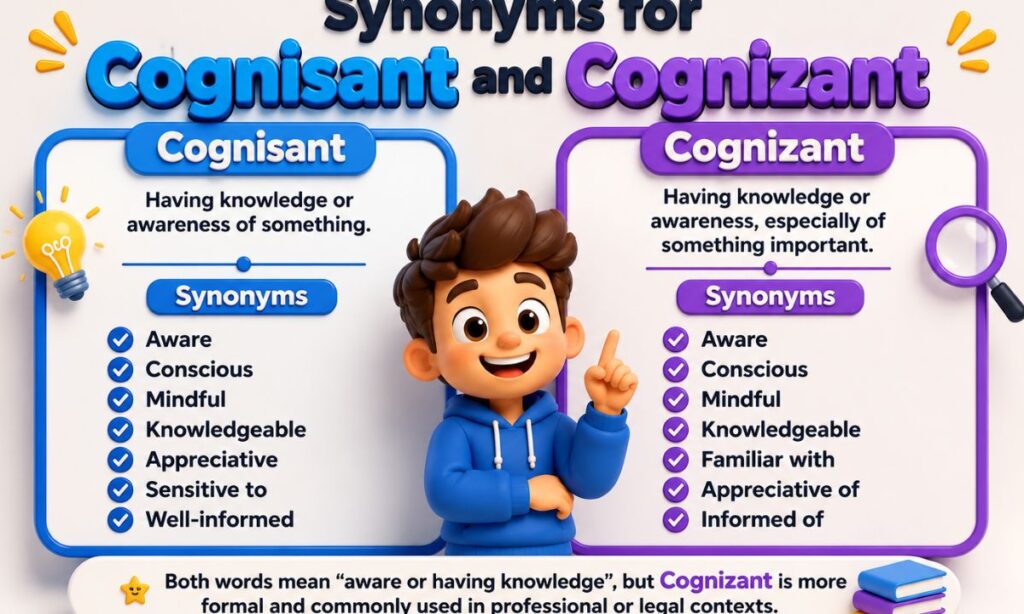
If you’re looking for alternative words with a similar meaning, consider:
- Aware
- Conscious
- Informed
- Knowledgeable
- Mindful
- Attentive
- Familiar (with)
- Alert (to)
- Sensible (of) in more formal or older usage
- Perceptive
These synonyms can be useful when you want to vary your sentence structure or avoid repeating “cognisant/cognizant” too often in the same piece of writing, which is especially helpful in long-form business or academic documents.
Also Read This : Offered or Offerred: Which Spelling Is Correct?
Cognisant / Cognizant: Google Trends & Usage Data
Search and usage data consistently show that “cognizant” is the more frequently used spelling worldwide, largely because of the global dominance of American English in digital content, business communication, and online publishing.
- United States: “Cognizant” is used almost exclusively, both in search behavior and published content.
- United Kingdom: “Cognisant” remains common in formal and academic writing, though “cognizant” also appears due to American media influence.
- Australia and New Zealand: “Cognisant” is the standard spelling, closely following British English conventions.
- Canada: Usage leans toward “cognizant,” aligning more closely with American spelling norms, though British-style usage still appears in some formal or governmental writing.
- Global online content: “Cognizant” generally ranks higher in overall usage frequency, reflecting the broader global reach of American spelling conventions in digital and business writing.
For content creators and businesses targeting an international audience, this data suggests that “cognizant” is often the more universally recognized choice, while “cognisant” remains the stronger option specifically for UK and Commonwealth audiences.
Comparison Table: Cognisant vs Cognizant
| Feature | Cognisant | Cognizant |
| Region | British English, Commonwealth | American English, global usage |
| Spelling pattern | “-s” (like organise, realise) | “-z” (like organize, realize) |
| Pronunciation | Same (sounds like “z”) | Same |
| Meaning | Aware, informed, knowledgeable | Aware, informed, knowledgeable |
| Common in | UK legal, academic, business writing | US legal, academic, business writing |
| Style guide preference | Oxford Style Manual | Chicago Manual of Style, AP Stylebook |
| Global search frequency | Lower | Higher |
| Recommended for global content | Only if targeting UK/Commonwealth | Yes, generally safer default |
Conclusion
“Cognisant” and “cognizant” are two correct spellings of the same word, separated only by regional English conventions. Use “cognizant” for American or global audiences, and “cognisant” for British and Commonwealth readers. Whichever you choose, the most important rule is consistency stick with one spelling throughout your writing, and you’ll come across as clear, professional, and confident every time.

Michael Brook is the creator and author behind Healthy Leeks, a platform focused on grammar, writing skills, and English language learning. Passionate about clear communication and effective writing, Michael Brook shares practical grammar tips, easy-to-follow language guides, and educational content to help readers improve their English with confidence.