
If you’ve ever paused mid-sentence wondering whether to write “students,” “student’s,” or “students’,” you’re not alone. This tiny apostrophe causes more confusion than almost any other punctuation mark in the English language. One misplaced mark can completely change what a sentence means — and in academic writing, professional emails, or even a simple social media caption, that mistake can make you look careless.
The good news? Once you understand the logic behind these three forms, you’ll never second-guess yourself again. This guide breaks down the difference between students, student’s, and students’ in plain language, backed by clear examples, grammar rules, and simple memory tricks you can use immediately. Whether you’re a student, teacher, blogger, or professional writer, by the end of this article you’ll be able to use all three forms with total confidence.
Students
“Students” is the simple plural form of “student.” It refers to more than one person who is learning or studying, and it carries no ownership or possession at all. No apostrophe is needed here — it’s just a straightforward plural noun, the same way “books,” “teachers,” or “schools” work.
Student
Before diving into the possessive forms, it helps to remember what the base word actually means. “Student” is a singular noun referring to one person enrolled in a course of study, whether at a school, college, or university. Everything else student’s, students, students’ builds from this single root word.
Students vs Student’s vs Students’: Quick Answer
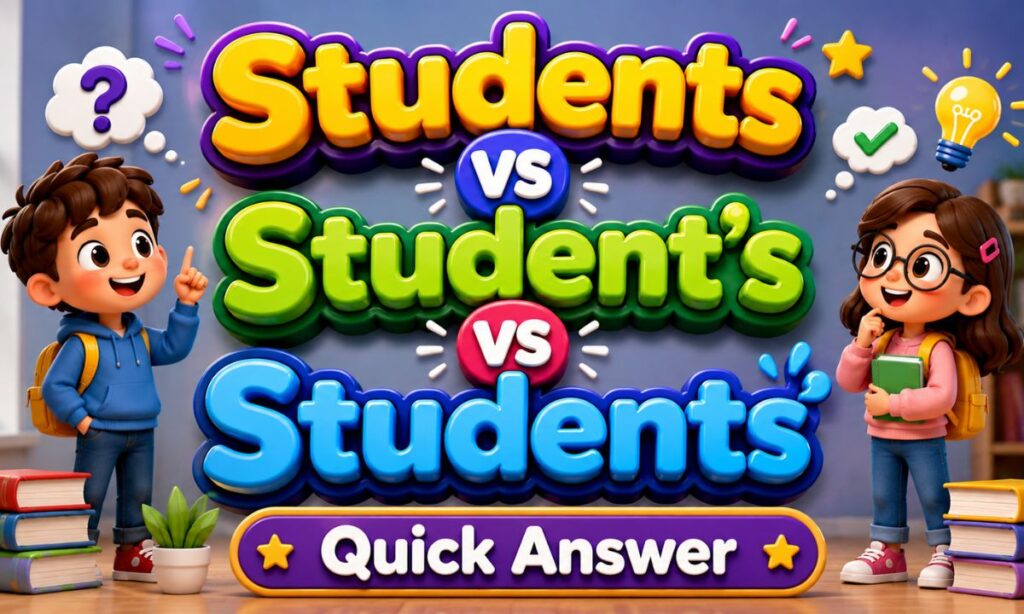
Here’s the short version if you’re in a hurry:
- Students = plural noun (more than one student, no ownership)
- Student’s = singular possessive (something belonging to one student)
- Students’ = plural possessive (something belonging to more than one student)
The apostrophe is the entire key to the puzzle. No apostrophe means simple plural. An apostrophe before the “s” means one owner. An apostrophe after the “s” means multiple owners.
Examples:
- The students arrived early for the exam. (plural, no possession)
- The student’s essay won first prize. (belongs to one student)
- The students’ essays were displayed in the hallway. (belongs to several students)
Students vs Student’s vs Students’: Definitions with Examples & Top Queries
Let’s go deeper into each form so there’s zero ambiguity left.
Students (Definition)
“Students” is the regular plural of “student,” formed simply by adding an “s.” It describes two or more learners without indicating that they own or possess anything. It’s the version you’ll use most often in everyday writing since most sentences about groups of learners don’t involve ownership at all.
Examples:
- All students must submit their assignments by Friday.
- The students enjoyed the science fair.
- Several students raised their hands to answer.
- Students from different countries joined the exchange program.
Student’s (Definition)
“Student’s” is the singular possessive form. It shows that something belongs to, or is associated with, one specific student. You form it by adding an apostrophe plus “s” to the singular noun “student.”
Examples:
- The student’s laptop was left in the library.
- I read the student’s thesis over the weekend.
- The teacher praised the student’s creativity.
- The student’s attendance record was flawless.
Students’ (Definition)
“Students'” is the plural possessive form. It shows that something belongs to, or is shared among, more than one student. Because “students” already ends in “s,” you simply add an apostrophe after the existing “s” — you do not add another “s.”
Examples:
- The students’ projects were displayed in the auditorium.
- The teacher collected the students’ notebooks.
- The students’ feedback helped improve the course.
- The students’ lounge was recently renovated.
User Queries:
Based on how people actually search for this topic, here are the most common questions writers type into search engines:
- Does “students” need an apostrophe?
- Is it “student’s” or “students'” for more than one person?
- What is the plural possessive of “student”?
- How do you show that something belongs to multiple students?
- Is “students’s” ever correct? (No — this form doesn’t exist in standard English.)
Students vs. Student’s vs. Students’: Grammar Rules
English possessives follow a fairly predictable pattern, and once you memorize it, the confusion mostly disappears.
- Singular noun → add ‘s to show possession (student → student’s).
- Regular plural noun ending in “s” → add only an apostrophe to show possession (students → students’).
- Irregular plural nouns that don’t end in “s” → add ‘s just like singular nouns (children → children’s, women → women’s, people → people’s).
- No possession, just plural → no apostrophe at all (students).
A quick way to test which form you need is to rephrase the sentence using “of.” For example, “the student’s book” can become “the book of the student” (one student). “The students’ books” becomes “the books of the students” (multiple students). If the “of” phrase makes sense with one person, use student’s. If it only makes sense with a group, use students’.
Student or Students: Understanding Singular and Plural Forms
Before you even think about apostrophes, you need to be sure whether you’re talking about one person or many. This distinction shapes every decision that follows.
- Student is singular: one learner, one identity, one set of belongings.
- Students is plural: a group of learners, referred to collectively.
This matters because English grammar treats singular and plural nouns differently when forming possessives. A common error happens when writers assume the rule for singular possession also applies to plurals — it doesn’t, which is exactly why “students’s” is incorrect and why native speakers sometimes hesitate before writing “students’.”
The Origin of Students vs Student’s vs Students’
The word “student” comes from the Latin word studens, meaning “one who studies” or “one who applies themselves to learning.” As English evolved from Old and Middle English, the apostrophe was introduced much later — largely during the 16th and 17th centuries — as a way to mark possession and contraction. Originally, possessives were formed by adding “-es” (an old genitive case ending), and over time this evolved into the apostrophe-plus-s convention we use today.
The plural possessive rule (adding just an apostrophe after an existing “s”) developed as a practical shortcut, since writing “students’s” would be clunky and redundant. This is why modern English grammar settled on “students'” instead. Understanding this history helps explain why the rule feels a little unusual at first — it’s a compromise built for readability, not a random exception.
Interestingly, older forms of English didn’t rely on apostrophes for possession at all. Writers instead used constructions like “the book of the student” or “his book,” and apostrophes were later borrowed largely from French printing conventions. By the 18th century, grammarians had standardized apostrophe use for possession in English textbooks, and the singular/plural distinction we know today became the accepted norm. This is also why some older texts and legal documents occasionally show inconsistent apostrophe placement — the rule took time to settle into its modern form. Today, virtually every major style guide, from APA to MLA to Chicago, agrees on the same singular and plural possessive conventions described in this article.
Students vs Student’s vs Students’: British vs American English 🇬🇧🇺🇸
The good news is that the core possessive rules for “student,” “student’s,” and “students'” are identical in both British and American English. There is no spelling variation here, unlike words such as “colour/color” or “organise/organize.” However, there are a few subtle stylistic differences worth knowing.
Comparison Table
| Aspect | British English | American English |
| Basic possessive rule | Same (apostrophe + s for singular, apostrophe only for plural) | Same |
| Word “student” definition | Traditionally used more for college/university learners | Commonly used for school and university learners alike |
| Style guide preference | Favors traditional punctuation strictness (e.g., Oxford style) | Favors similar rules, with AP and Chicago style guides both agreeing on possessive forms |
| Institutional naming | “Students’ Union” is common in the UK | “Student Government” or “Student Council” more common in the US |
| Formal writing tone | Slightly more conservative punctuation use | Slightly more flexible in informal contexts |
As you can see, the grammar itself doesn’t change across regions — what changes is terminology and institutional naming conventions, not the apostrophe rules themselves.
Students vs Student’s vs Students’: Which One Should You Use?
Use “Students” When:
- You’re referring to more than one learner with no possession involved.
- You’re describing a general group (e.g., “the students in this class”).
- No object or item is being “owned” by anyone in the sentence.
Use “Student’s” When:
- You’re referring to something that belongs to exactly one student.
- The sentence can be rephrased as “belonging to [one] student.”
- You’re describing an individual’s work, belongings, or achievement.
Use “Students'” When:
- You’re referring to something shared by, or belonging to, multiple students.
- The sentence can be rephrased as “belonging to [several] students.”
- You’re describing a group project, collective feedback, or shared space.
Memory Trick:
Think of it this way: one student, one apostrophe before the “s.” Many students, apostrophe after the “s.” If there’s no ownership at all, skip the apostrophe entirely. Saying it out loud as “belonging to one” versus “belonging to many” almost always reveals the correct form instantly.
Student’s or Students’: How Apostrophes Change Meaning
The position of the apostrophe isn’t just a technical detail — it can completely alter what a sentence communicates. Consider these two sentences:
- “The student’s grades improved this semester.” (One student’s grades improved.)
- “The students’ grades improved this semester.” (Multiple students’ grades improved.)
Both sentences are grammatically correct, but they describe entirely different situations. This is why apostrophe placement matters so much in academic reports, school newsletters, and official communication — a single misplaced mark could suggest a policy applies to one person when it was meant for an entire class, or vice versa.
Common Mistakes with Students vs Student’s vs Students’
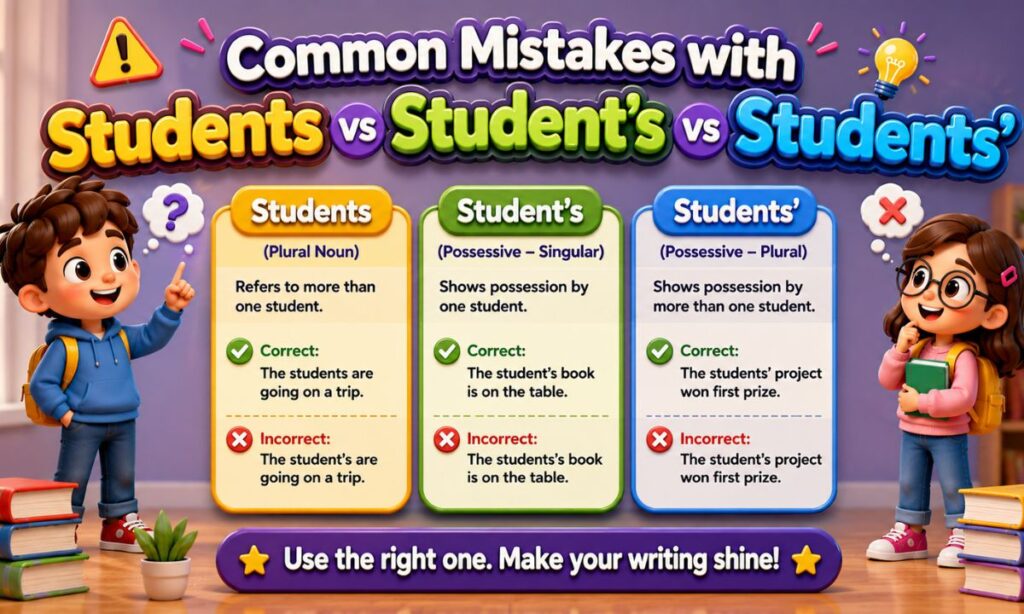
1. Using apostrophe for plural
One of the most frequent errors is adding an apostrophe simply because a word ends in “s.” Writing “student’s” when you actually mean multiple students with no possession (e.g., “the student’s arrived early” instead of “the students arrived early”) is incorrect. Apostrophes are never used just to make a word plural.
2. Forgetting apostrophe for possession
The opposite mistake also happens often — writers drop the apostrophe entirely even when possession is intended. “The students notebook was missing” should be “The student’s notebook was missing” (if referring to one student) or “The students’ notebook was missing” (if referring to several).
3. Confusing singular and plural possession
Because “student’s” and “students'” sound identical when spoken aloud, writers often mix them up in text. Always pause and ask: am I talking about one student or more than one? That single question resolves almost every instance of confusion.
4. Guessing usage
Many people place the apostrophe based on how a word “feels” rather than checking the actual meaning of the sentence. This guesswork leads to inconsistent writing. Instead, always identify the subject (one student or many) before deciding where the apostrophe belongs.
5. Overcorrecting in formal writing
Ironically, some writers become so cautious about apostrophes that they start adding them where none belong, such as writing “the 1990’s” instead of “the 1990s,” or “CD’s” instead of “CDs.” This same overcorrection sometimes spills into writing about students, producing awkward forms like “student’s” when a simple plural was intended. The fix is the same in every case: check for possession first, and only add an apostrophe when ownership is genuinely being expressed.
6. Mixing up its and it’s in related contexts
While not directly about “students,” this related mistake often appears in the same paragraphs. Remember that “its” shows possession (the school lost its funding) while “it’s” is a contraction of “it is” or “it has.” Keeping this distinction in mind reinforces the same core principle behind student’s versus students’: apostrophes signal either possession or omission, never simple plurality.
Also Read This : Enquiries vs. Inquiries: Which Is Correct for Formal and Professional Writing?
Students vs Student’s vs Students’ in Everyday Examples
Daily Life:
- The student’s backpack was left on the bus.
- The students walked home together after school.
- The students’ parents attended the meeting.
Social Media:
- “Shoutout to all the amazing students who finished finals this week!”
- “Check out this student’s incredible art project.”
- “So proud of our students’ achievements this semester.”
School Writing:
- The student’s research paper cited five sources.
- All students must complete the assignment by Monday.
- The students’ exam scores were the highest in school history.
Professional Writing:
- The internship program is designed for graduate students.
- The student’s portfolio impressed the hiring committee.
- The company reviewed the students’ applications carefully.
Easy Trick to Remember the Difference
Here’s a simple three-step method you can apply to any sentence:
- Ask: Am I talking about one student or multiple students?
- Ask: Does this sentence show ownership, or is it just describing a group?
- If one student owns something → student’s. If many students own something → students’. If there’s no ownership at all → students.
Some writers also find it helpful to visualize the apostrophe as a small flag marking “who owns this.” If the flag sits right after “student,” only one person owns the item. If it sits after the full word “students,” the ownership is shared.
Students vs Student’s vs Students’: Usage Trends & Popularity
Language data shows that “students” (the plain plural) is used far more frequently than either possessive form in everyday writing, simply because most sentences about groups of learners don’t involve possession at all. “Student’s” appears more often in academic and journalistic writing, particularly when discussing individual achievements, case studies, or personal experiences. “Students'” shows up most in institutional, educational, and administrative writing — think school policies, students’ unions, and collective reports.
Key Insight:
Writers tend to make more mistakes with plural possessives than singular ones, largely because plural possessives look and sound unusual at first glance. The apostrophe appearing after an already-plural word can seem counterintuitive until the rule becomes second nature.
Trend:
With the rise of digital and social media writing, apostrophe errors involving “students” have become more common in casual online content, where speed often takes priority over precision. However, in formal or published writing — including educational blogs, research papers, and news sites — correct possessive usage remains a strong marker of credibility and professionalism.
Students or Student’s: Common Grammar Questions Explained
A frequent point of confusion is deciding between “student” and “students” in phrases like “one of the student” versus “one of the students.” The correct structure is always “one of the students,” since “one of” requires a plural noun afterward — you’re selecting one item from a group.
Another common question involves compound possession, such as describing something shared between a teacher and a class. In these cases, you’d typically write “the teacher’s and students’ shared project” to show that both the teacher and the students each have a stake in the ownership, though many style guides recommend rephrasing such sentences for clarity rather than stacking possessives.
Writers also frequently ask whether it’s acceptable to write “students’s” as an alternative plural possessive. It is not — standard English grammar never adds an extra “s” after an apostrophe that follows a plural noun already ending in “s.” The correct and only accepted form remains “students’.”
A related question involves irregular nouns that don’t end in “s” in their plural form, such as “children” or “people.” These words follow the singular possessive pattern even though they are plural, becoming “children’s” and “people’s.” This often confuses writers who assume every plural noun should take an apostrophe-only ending like “students’.” The rule specifically depends on whether the plural already ends in “s” — if it does, add only an apostrophe; if it doesn’t, add an apostrophe plus “s,” exactly as you would for a singular noun.
Finally, many writers wonder whether it’s ever correct to drop the apostrophe entirely in official names, such as “Students Union” versus “Students’ Union.” Style guides differ slightly here: some institutions deliberately drop the apostrophe as a branding choice, while grammatically strict writing still favors including it. When in doubt for formal or academic writing, keep the apostrophe, since it reflects standard grammatical accuracy rather than stylistic preference.
Comparison Table
| Form | Type | Meaning | Example Sentence |
| Students | Plural noun | More than one student, no ownership | The students finished their exams. |
| Student’s | Singular possessive | Belongs to one student | The student’s essay was excellent. |
| Students’ | Plural possessive | Belongs to multiple students | The students’ essays were excellent. |
Keeping a quick-reference table like this nearby — whether in a notebook or bookmarked from a trusted Enquiries vs. Inquiries: Which Is Correct for Formal and Professional Writing? — can save you from second-guessing yourself in the middle of writing an important email or assignment.
Conclusion
The difference between “students,” “student’s,” and “students'” ultimately comes down to two simple questions: how many students are you talking about, and is anything being owned or possessed? Once you can answer those two questions, choosing the correct form becomes almost automatic.
To recap: use “students” for a simple plural with no possession, “student’s” when something belongs to exactly one student, and “students'” when something belongs to more than one student. Apostrophes may look like small, unimportant marks, but as this guide has shown, their placement can completely change the meaning of a sentence.
Whether you’re writing a school assignment, a professional report, or a quick social media post, taking a few extra seconds to check singular versus plural — and possession versus simple plurality — will make your writing clearer, more polished, and more credible. For further practice, try applying the same logic to similar possessive puzzles, such as those covered in guides on Enquiries vs. Inquiries: Which Is Correct for Formal and Professional Writing?, and soon this kind of grammar decision will become second nature every time you write.

Michael Brook is the creator and author behind Healthy Leeks, a platform focused on grammar, writing skills, and English language learning. Passionate about clear communication and effective writing, Michael Brook shares practical grammar tips, easy-to-follow language guides, and educational content to help readers improve their English with confidence.


