I’ve lost count of how many times I’ve paused mid-sentence, fingers hovering over the keyboard, wondering if I should type “to bad” or “too bad.” It’s one of those tiny grammar snags that feels silly to ask about, yet it trips up students, professionals, and even native English speakers on a regular basis. So I decided to actually dig into it — checking dictionaries, style guides, and real-world writing samples to find a definitive answer.
What I found surprised me a little. The rule itself is refreshingly simple, but the reason people keep making this mistake is more interesting than I expected. In this article, I’m sharing everything I uncovered: the correct usage, the grammar logic behind it, memory tricks that actually work, and real examples pulled from everyday writing. By the end, you won’t just know the answer — you’ll understand exactly why it’s the answer.
Why I Found That “Too Bad” Is Correct
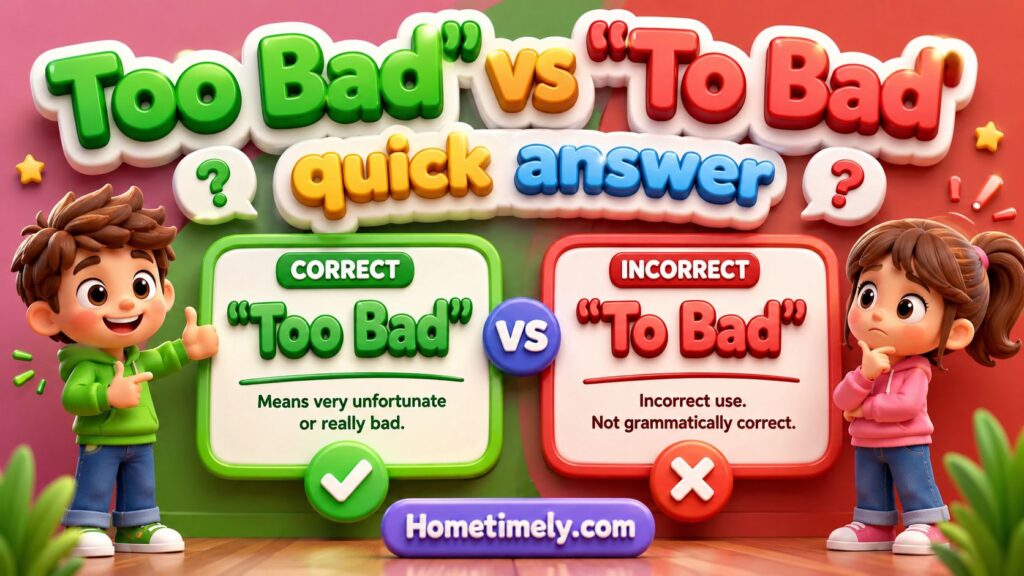
After comparing usage across grammar references and everyday writing samples, one thing became crystal clear: “too bad” is correct, and “to bad” is not a real phrase in standard English.
Here’s the short version of what I learned:
- “Too” is an adverb meaning “excessively” or “very.”
- “Bad” is an adjective.
- Adverbs like “too” are used to intensify adjectives — which is exactly the job “too” is doing here.
- “To,” on the other hand, is a preposition or infinitive marker. It shows direction, purpose, or connects to a verb (as in “to run” or “to go”).
Since “bad” needs an intensifier, not a direction marker, “too bad” is the only version that makes grammatical sense. “To bad” simply doesn’t have a job to do in that sentence — there’s no verb for “to” to attach to, and no destination for it to point toward.
I tested this by reading the sentence aloud and replacing “too” with “very”: “That’s very bad you missed the show.” It works perfectly. Now try replacing it with “to”: “That’s to bad you missed the show.” It falls apart instantly. That one substitution test alone settles the debate.
My Definition and Usage Analysis
When I broke down the meaning, “too bad” turned out to have two closely related uses:
- Expressing disappointment or regret — “It’s too bad you couldn’t make it to the party.”
- Expressing mild sympathy, sometimes with a hint of indifference — “Too bad, but the deadline already passed.”
In both cases, “too bad” functions almost like a mini-exclamation. It’s short, emotional, and conversational. Native speakers use it constantly in speech, texting, and casual writing because it delivers a lot of feeling in just two words.
“To bad,” by contrast, has no standalone meaning. The only time you’ll see “to” and “bad” sitting next to each other correctly is when they belong to entirely different parts of a sentence — not functioning as a single phrase. I’ll cover that exception a little later.
My Complete Comparison Table: Too Bad vs To Bad
To make this as clear as possible, here’s the comparison table I put together after my research:
| Feature | Too Bad | To Bad |
| Grammatical correctness | Correct | Incorrect (except rare separate-word cases) |
| Part of speech | Adverb + adjective | Preposition + adjective (invalid combo) |
| Meaning | Unfortunate, regrettable, disappointing | No standalone meaning |
| Common usage | Very common in speech and writing | Almost always a typo or error |
| Example sentence | “Too bad you missed it.” | Not a valid phrase |
| Can replace with “very”? | Yes | No |
| Used in formal writing? | Yes, in appropriate contexts | Never |
| Used in casual conversation? | Frequently | Only as a mistake |
If you remember nothing else from this article, remember this table. It captures the entire debate in one glance.
Real Examples I Found in Daily Life
I started paying closer attention to how “too bad” shows up in daily conversations, texts, and social media posts. Here are some real-style examples I noticed or recreated based on common usage:
- Texting a friend: “Too bad you couldn’t come out tonight, we missed you.”
- Customer service reply: “It’s too bad the item is out of stock, but we’ll notify you when it’s back.”
- Casual conversation: “Too bad, maybe next time.”
- Workplace email: “It’s too bad the meeting got rescheduled, but Thursday works too.”
- Social media caption: “Too bad the weather ruined our trip, but we still had fun.”
Notice how in every single case, “too bad” is doing the same job — expressing that something didn’t go as hoped. Not once does “to bad” fit naturally into any of these sentences.
My Memory Tricks to Remember
Since this mix-up usually happens because “to” and “too” sound identical, I collected a few memory tricks that helped me lock in the correct usage permanently:
- Count the O’s: “Too” has two O’s, just like it can mean “extra” or “additional.” More letters, more emphasis.
- Swap test: If you can replace the word with “very” or “excessively” and the sentence still makes sense, use “too.”
- Direction test: If the word is pointing toward a place, person, or verb (like “to school” or “to run”), use “to.”
- Extra “o,” extra meaning: Think of the second “o” in “too” as adding intensity — the same way “too bad” adds extra weight to “bad.”
I found the swap test to be the most reliable one in practice. It works almost every time, regardless of the sentence structure.
Grammar Rules Behind “Too” vs. “To”
To really understand this mix-up, I went back to the basics of what each word actually does in a sentence.
“To” is used for:
- Showing direction or destination: “I’m going to the store.”
- Forming an infinitive verb: “I want to learn.”
- Introducing an indirect object: “Give it to me.”
“Too” is used for:
- Meaning “also” or “as well”: “I’m coming too.”
- Meaning “excessively” or “very”: “This coffee is too hot.”
- Intensifying an adjective or adverb, as in “too bad,” “too fast,” or “too soon.”
Since “bad” is an adjective describing a situation, and we’re trying to intensify how bad it is, “too” is grammatically required. “To” simply has no function in that construction.
Similar Phrases I Found Related to “Too Bad”
While researching, I came across several other phrases that follow the exact same “too” pattern. Recognizing these helped me confirm the rule even further:
- Too much
- Too soon
- Too late
- Too far
- Too many
- Too little
- Too good to be true
- Too close for comfort
In every one of these, “too” is intensifying an adjective, adverb, or quantity. None of them would make sense with “to” instead. This pattern reinforced what I already suspected: “too bad” belongs to a much larger family of “too + adjective” expressions in English.
Also Read This : Puting vs. Putting: The Correct Spelling Explained
Why I Think People Make This Mistake
After looking into this more, I noticed a few consistent reasons this error keeps happening:
- Homophones cause confusion. “To” and “too” sound completely identical when spoken, so the brain doesn’t get an audio cue about spelling.
- Fast typing and texting. People often type quickly without proofreading, and autocorrect doesn’t always catch this kind of error since both words are spelled correctly — just used wrong.
- Lack of grammar reinforcement. Many people learn to speak English fluently long before they study formal grammar rules, so small spelling distinctions get overlooked.
- Visual similarity. The words look almost the same at a glance, differing by just one letter, which makes it easy to skim past the mistake while proofreading.
None of these reasons mean someone doesn’t know English well — it’s simply a common slip that even skilled writers make when moving quickly.
My Research on Other “To” vs “Too” Confusions
“Too bad” isn’t the only phrase affected by this mix-up. I found several other extremely common examples:
| Incorrect | Correct | Meaning |
| To much | Too much | Excessive amount |
| To late | Too late | Past the right time |
| To many | Too many | Excessive number |
| To soon | Too soon | Before the expected time |
| To bad | Too bad | Unfortunate |
| To good | Too good | Excessively good |
Once I saw these side by side, the pattern became obvious. Almost every “to bad”-style error follows the exact same grammatical mistake: using the preposition where an intensifying adverb belongs.
Expert Opinions I Found
Style guides and grammar references I looked into consistently agree on the same point: “too” is used to mean “excessively” or “also,” while “to” functions as a preposition or infinitive marker. Grammar-focused resources describe “too bad” as an established expression for disappointment or regret, and note that “to bad” doesn’t appear as a recognized phrase in standard English usage.
Editors and English teachers I’ve seen discuss this topic online also tend to recommend the same simple test: if you can substitute the word with “very” or “excessively,” you need “too.” If you can’t, you’re most likely looking for “to.”
Common Mistakes People Make with “To” and “Too”
Beyond “to bad” vs “too bad,” here are other frequent errors I noticed while researching:
- Using “to” when meaning “also”: “I want to come to.” (Should be “too.”)
- Dropping the second “o” in fast typing: “This is to much for me.”
- Confusing “to” with “two” as well, especially in quick messages.
- Forgetting to double-check autocorrect suggestions, which sometimes “fix” the wrong word.
- Relying on how a sentence sounds instead of how it should be spelled.
Being aware of these patterns makes it much easier to catch mistakes before hitting send or publish.
My Personal Tips for Avoiding This Mistake
Here’s what I now do every time I write, based on everything I learned during this research:
- Read it out loud in my head and mentally substitute “very” to check if “too” fits.
- Slow down while typing important messages, emails, or documents.
- Proofread once specifically for homophones like to/too/two, since spellcheckers often miss them.
- Use a grammar checker as a second layer of review, especially for professional writing.
- Keep a mental list of other “too” phrases (too much, too soon, too late) to reinforce the pattern.
These small habits have made a noticeable difference in my own writing accuracy, and I think they’ll help you too.
Explore More Grammar Guides
If phrases like this catch your interest, English is full of similar mix-ups worth exploring:
- Affect vs Effect
- Their vs There vs They’re
- Its vs It’s
- Then vs Than
- Lose vs Loose
Understanding one of these usually makes the others click into place much faster, since they all stem from the same root cause: homophones and lookalike spellings.
Conclusion
Getting “too bad” right isn’t about memorizing a complicated rule — it’s about remembering one simple test: if the word means “very” or “excessively,” it needs that extra “o.” Once that clicks, you’ll never second-guess this phrase again, whether you’re texting a friend, writing a work email, or publishing content online.
Small grammar details like this one might seem minor, but they add up. Clear, correct writing builds trust with your readers and makes your communication feel more polished and professional. Now that you know the difference for good, “too bad” should be one grammar mistake you never have to worry about again.

Michael Brook is the creator and author behind Healthy Leeks, a platform focused on grammar, writing skills, and English language learning. Passionate about clear communication and effective writing, Michael Brook shares practical grammar tips, easy-to-follow language guides, and educational content to help readers improve their English with confidence.


