I kept seeing “spicey” in restaurant menus, recipe blogs, and social captions, and it always made me pause. So I sat down and dug through dictionaries, spelling rules, and real usage patterns to settle it once and for all. What I found was a clean, consistent rule that makes this an easy call every single time.
If you’ve ever typed “spicey” and hesitated before hitting send, this guide breaks down exactly why one spelling wins, how the confusion started, and how to lock in the correct form for good.
Quick Answer: Spicy ✅ or Spicey ❌
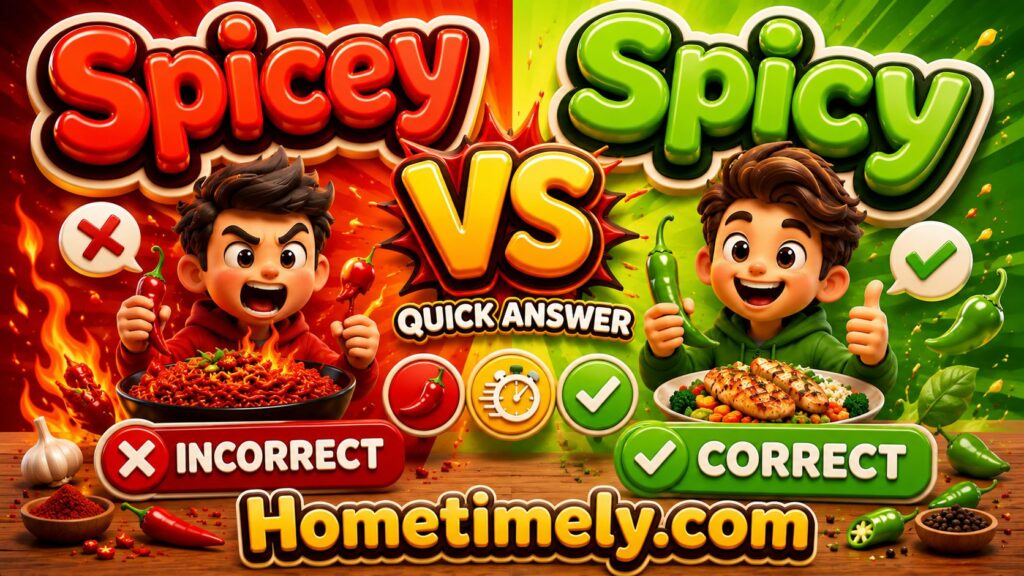
Here’s the short version: “spicy” is correct, and “spicey” is a common misspelling.
- ✅ Correct: This curry is too spicy for me.
- ❌ Incorrect: This curry is too spicey for me.
Every major dictionary I checked, including Merriam-Webster and Cambridge, lists “spicy” as the standard spelling. “Spicey” does not appear as an accepted alternative in any of them.
Why I Found It’s Spelled “Spicy”
The answer comes down to a basic English spelling rule I’d honestly forgotten about. When a word ends in a silent “e” and you want to turn it into an adjective by adding “-y,” standard practice is to drop that silent “e” first.
- spice → spic~~e~~ + y → spicy
- ice → ic~~e~~ + y → icy
- price → pric~~e~~ + y → pricy
“Spicey” breaks this pattern by keeping the “e,” which is why it reads as a mistake to anyone familiar with the rule, even if it looks logical at first glance.
My Definition and Meaning Analysis
“Spicy” is an adjective with more range than most people realize. Based on how it actually gets used, I found it falls into a few clear categories:
- Literal heat: Describing food that contains chili, pepper, or strong seasoning.
- Aromatic flavor: Describing a dish rich in warm spices like cinnamon, clove, or cumin, even without heat.
- Figurative excitement: Describing something bold, lively, or slightly scandalous — a “spicy” rumor or a “spicy” plot twist.
- Tone or personality: Describing someone with a sharp, playful, or provocative attitude.
Spicy Meaning with Easy Examples
- The wings were so spicy I needed a glass of milk.
- Her reply to the comment was a little spicy.
- This chai has a warm, spicy aroma from the cinnamon and cardamom.
- The show’s finale had a spicy twist nobody saw coming.
The Pattern: Similar Word Transformations
Once I noticed the drop-the-silent-e rule, I started spotting it everywhere. It’s not unique to “spicy” at all — it’s a consistent feature of English spelling.
| Base word | Correct adjective | Common mistake |
| spice | spicy | spicey |
| ice | icy | icey |
| price | pricy | pricey* |
| space | spacey | — |
| noise | noisy | noisey |
*Note: “pricey” is actually an accepted informal variant in some dictionaries, which adds to the confusion — but “spicey” has no such exception and is considered incorrect across all standard style guides.
Spicy vs Spicey: My Visual Comparison
Side by side, the difference is small on the page but significant in terms of correctness:
- S-P-I-C-Y → 5 letters, follows standard spelling rules, dictionary-approved.
- S-P-I-C-E-Y → 6 letters, keeps the silent “e,” not recognized in standard English.
Visually they look almost identical, which is exactly why the mistake spreads so easily through autocorrect, texting, and quick social posts.
Real-World Examples I Use
Here’s where I actually see “spicy” show up in daily writing and conversation:
- Menus and food packaging: “Extra spicy,” “mild to spicy,” “spicy mayo.”
- Recipe blogs: “Adjust the spicy level to taste.”
- Social media captions: “That take was spicy 🔥.”
- Product reviews: “The sauce is spicy but not overwhelming.”
- Casual conversation: “Things got a little spicy at dinner.”
Pronunciation Guide I Use
Both “spicy” and the misspelled “spicey” are pronounced exactly the same way: SPY-see. That’s actually part of the problem since pronunciation gives no clue about spelling, people rely on visual memory instead, and “spicey” simply looks close enough to pass at a glance.
Also Read This : Vendor or Vender? The Correct Spelling Explained (With Examples)
Spicy vs Spicey: My Summary Table
| Feature | Spicy | Spicey |
| Status | Correct, standard spelling | Misspelling, non-standard |
| Spelling rule | Drops silent “e” before “-y” | Incorrectly keeps the “e” |
| Dictionary recognition | Merriam-Webster, Cambridge, Oxford | Not recognized as standard |
| US vs UK usage | Identical in both | Same error appears in both |
| Formal writing use | Recommended | Should be avoided |
| Pronunciation | SPY-see | SPY-see (identical) |
Common Mistakes I’ve Learned to Avoid
Looking back at where I personally slipped up, and where I see others slip up too, a few patterns keep repeating:
- Assuming the adjective must keep every letter from the base noun (“spice” plus “y” without dropping the “e”).
- Trusting autocorrect blindly instead of double-checking uncommon suggestions.
- Copying spelling habits from social media captions, where errors spread fast and look normalized.
- Confusing “spicy” with words like “pricey,” which does keep its “e” as an accepted informal spelling.
When to Use “Spicy” in Different Contexts
- Formal writing: Always use “spicy” in reports, articles, professional emails, and academic work.
- Recipes and food blogs: “Spicy” is the standard, expected spelling readers look for.
- Marketing and branding: Stick with “spicy” unless “spicey” is being used intentionally as a stylized brand name.
- Casual texting and social captions: “Spicy” still reads as correct and polished, while “spicey” can come across as a typo.
Synonyms and Related Terms I Found
Depending on the context, several words can substitute for “spicy” while keeping a similar meaning:
- Hot — for describing chili heat specifically.
- Fiery — for intense, aggressive heat.
- Piquant — for a sharp, pleasantly pungent flavor.
- Zesty — for a lively, tangy kick.
- Peppery — for heat with a pepper-forward taste.
- Provocative — for the figurative, bold-content meaning.
Cultural Context and Spiciness Levels
Spice tolerance and vocabulary vary a lot by cuisine and region, which is worth knowing if you’re writing about food specifically:
- Mild: A gentle warmth, common in beginner-friendly dishes.
- Medium: Noticeable heat that builds but stays approachable.
- Hot: Strong, immediate heat, often from fresh or dried chilies.
- Extra hot / fiery: Intense heat aimed at spice enthusiasts, often using concentrated chili extracts or superhot peppers.
Cuisines like Indian, Thai, Mexican, and Sichuan Chinese cooking are frequently described as “spicy,” though the flavor profile behind that heat differs significantly from one to the next.
Easy Trick to Remember the Correct Spelling
Here’s the memory trick that stuck for me: spice loses its “e” before it gets “-y.” Picture the silent “e” falling off the end of the word the moment “-y” walks in. If you can picture “ice” becoming “icy” without its “e,” you can apply the exact same logic to “spice” becoming “spicy.”
Explore More Grammar Guides
If sound-alike or look-alike spelling pairs like this one trip you up often, it helps to build a personal reference list. Word pairs such as “icy vs icey,” “noisy vs noisey,” and “unfazed vs unphased” all follow similar logic, and understanding the underlying spelling rule makes future writing faster and far more confident.
Final Verdict
After digging through dictionaries, spelling rules, and everyday usage, the answer is clear and consistent: “spicy” is correct, and “spicey” is a misspelling that should be avoided in any serious writing.
The confusion makes sense once you see the pattern English drops the silent “e” before adding “-y,” the same way “ice” becomes “icy” and “noise” becomes “noisy.” Once that rule clicks, “spicy” becomes the only spelling that ever feels right again.

Michael Brook is the creator and author behind Healthy Leeks, a platform focused on grammar, writing skills, and English language learning. Passionate about clear communication and effective writing, Michael Brook shares practical grammar tips, easy-to-follow language guides, and educational content to help readers improve their English with confidence.