
I kept seeing both spellings pop up in emails, social posts, and even news articles, so I decided to dig into the dictionaries, style guides, and usage data myself. What I found settled the debate pretty quickly, and it also explained exactly why so many smart writers keep getting this one wrong.
If you’ve ever paused mid-sentence wondering whether to type “unphased” or “unfazed,” this guide walks through everything I learned the correct spelling, the word’s real origin, memory tricks that actually stick, and the small grammar trap hiding underneath it all.
My Quick Answer
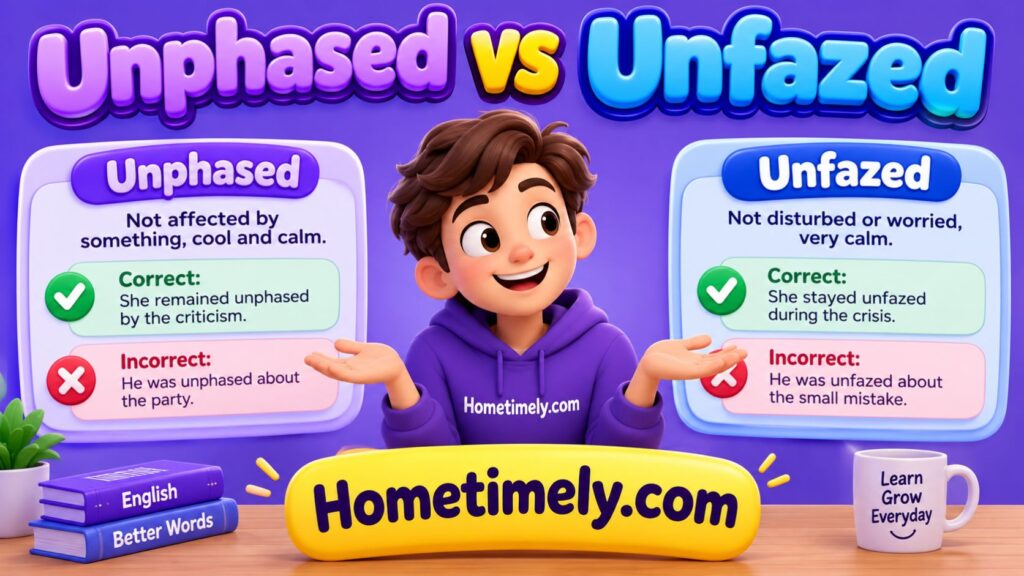
Here’s the short version before we go deeper: “unfazed” is correct, and “unphased” is a misspelling.
- ✅ Correct: She stayed unfazed by the criticism.
- ❌ Incorrect: She stayed unphased by the criticism.
Every major dictionary I checked Merriam-Webster, Cambridge, and Oxford lists “unfazed” as the standard entry. None of them recognize “unphased” as a legitimate alternative spelling.
Why I Found That “Unfazed” Is Correct
The reason comes down to word roots. “Unfazed” is built from the verb faze, which means to disturb, unsettle, or intimidate someone. Add the prefix “un-” and you get “unfazed,” meaning not disturbed, not shaken, not bothered.
“Unphased,” on the other hand, borrows from an entirely different word: phase, meaning a stage or period in a process. Grammatically, “unphased” would describe something that hasn’t gone through stages — not someone who’s staying calm under pressure. That meaning almost never fits the sentences people actually use it in, which is exactly why dictionaries treat it as a misspelling rather than a real word.
My Definition and Usage Analysis
When I broke down how “unfazed” is actually used in real writing, three things stood out:
- Part of speech: It’s an adjective, describing a person’s state of mind or reaction.
- Common verbs it follows: It almost always pairs with linking verbs like be, seem, appear, look, or remain.
- Common preposition: It’s frequently followed by by — as in “unfazed by the news.”
Here’s what that looks like in practice:
- He remained unfazed by the harsh feedback.
- The goalkeeper seemed unfazed by the pressure of the final.
- Despite the chaos, she appeared completely unfazed.
My Complete Comparison Table: Unfazed vs Unphased
I put together this table to make the difference easy to scan at a glance.
| Feature | Unfazed | Unphased |
| Status | Correct, standard English | Misspelling, non-standard |
| Root word | Faze (to disturb) | Phase (a stage) |
| Meaning | Not bothered, calm, unaffected | Not staged / not in a phase (rarely accurate) |
| Dictionary recognition | Merriam-Webster, Cambridge, Oxford | Not recognized as standard |
| US vs UK usage | Same spelling in both | Same error appears in both |
| Formal writing use | Recommended | Should be avoided |
| Everyday online use | Dominant spelling | Common typo, but still wrong |
Real Examples I Found in Daily Life
I started paying attention to where this word shows up in everyday contexts, and it turns out “unfazed” is everywhere once you notice it:
- Sports commentary: “The rookie looked completely unfazed in his first playoff game.”
- Business news: “Investors remained unfazed after the earnings report.”
- Parenting and relationships: “My toddler was totally unfazed by the thunderstorm.”
- Workplace conversations: “She stayed unfazed during the client’s tough questions.”
In every one of these, “unfazed” describes composure under pressure never a literal stage or step in a process, which is a strong clue that “unphased” was never the right fit to begin with.
My Memory Tricks to Remember
A few tricks helped this stick permanently for me:
- Z is for zero: UnfaZed has a Z, which I like to think of as “zero disturbance.”
- Phase means stage: If you’re tempted to write “unphased,” ask whether you actually mean “not broken into stages.” If not, you need “unfazed.”
- Say it, then check it: Faze rhymes with “gaze” and “daze” both words connected to a person’s state of mind, just like faze.
The “Faze” vs “Phase” Confusion: My Deep Dive
The entire mix-up traces back to one simple fact: faze and phase are homophones. They sound identical when spoken aloud, but they come from completely different word families and mean completely different things.
- Faze (verb): to disturb, worry, or intimidate. Nothing seems to faze him.
- Phase (noun/verb): a stage in a process, or to introduce something gradually. We’re entering the second phase of the project.
Because “phase” is the far more common word in everyday writing used in business, science, and casual speech people’s brains default to it, even when the sentence actually calls for “faze.”
Easy Trick to Remember the Correct Spelling
Here’s the trick I now use without even thinking about it: if the sentence is about someone’s emotional reaction, the word has a Z. If the sentence is about a stage or step, the word has “ph.” Emotion equals Z, stages equal ph that’s the whole rule.
My Research on “Faze” – The Root Word
Digging into etymology sources, I found that “faze” traces back to American English in the 1800s, likely evolving from the older dialectal word “feeze,” meaning to frighten or drive off. It’s always been used as a verb describing disturbance or unsettlement, which is exactly the meaning “unfazed” inherited.
Similar Sound-Alike Confusions I Found
While researching, I noticed “unfazed” isn’t alone English is full of these near-identical sound traps. A few common ones:
- Affect vs. Effect
- Complement vs. Compliment
- Discreet vs. Discrete
- Stationary vs. Stationery
- Principal vs. Principle
Just like “unfazed” and “unphased,” these pairs sound close enough to trip up even careful writers, which is why quick reference checks are worth the extra few seconds.
Common Mistakes People Make with Unfazed
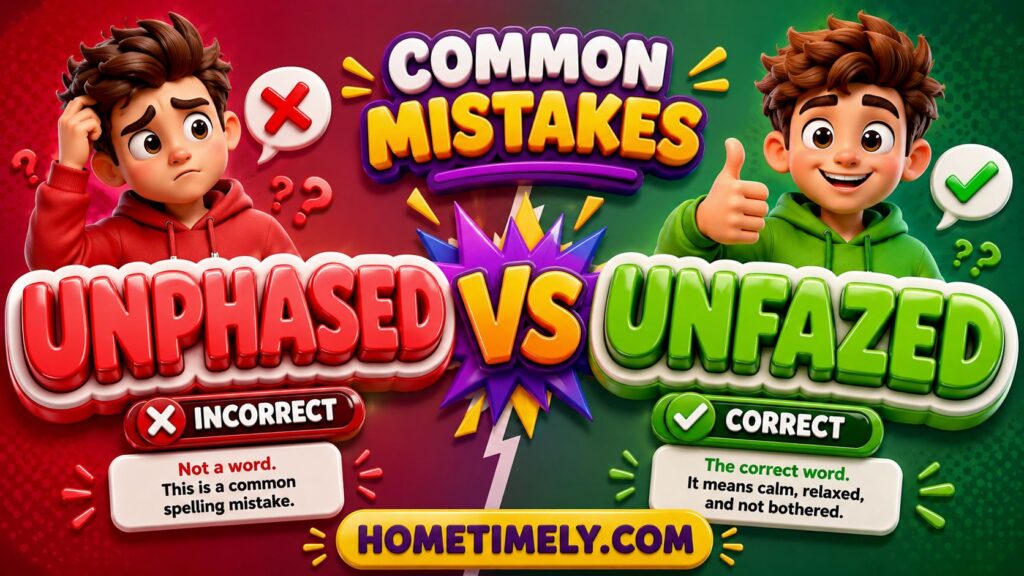
Based on what showed up repeatedly across forums, comment sections, and even published articles, here are the patterns I noticed most:
- Assuming “unphased” is a British spelling variant (it isn’t both US and UK English agree on “unfazed”).
- Trusting autocorrect, which doesn’t always flag “unphased” as wrong.
- Associating the word with “phase one, phase two” project language out of habit.
- Using “unphased” in professional documents without a second check, which can look careless to readers who know the rule.
Expert Opinions and Dictionary Evidence I Found
Every reputable language resource I checked pointed the same direction. Grammar and usage guides consistently describe “unfazed” as meaning not worried or disturbed, while treating “unphased” as a common misspelling rather than a legitimate alternative. Language reference sites go a step further, noting that “unfazed” is simply the more natural, everyday choice when describing how someone reacts to stress or surprise.
Style and grammar authorities are equally consistent on the regional question. There’s no British variation of the word in both American and British English, “unfazed” is correct and “unphased” is not. That settles the common myth that “unphased” might be acceptable outside the US.
Also Read This : “Too Bad” vs “To Bad”: I Finally Found the Real Answer
Common Contexts Where I Use “Unfazed”
Once I understood the rule, I started noticing exactly where “unfazed” naturally fits:
- Describing composure: “The pilot remained unfazed during turbulence.”
- Describing confidence: “She’s unfazed by public speaking.”
- Describing resilience: “The team stayed unfazed after the early setback.”
- Describing indifference to criticism: “He seemed unfazed by the negative reviews.”
My Personal Tips for Avoiding This Mistake
Here’s what actually works for me when I’m writing quickly and want to avoid slipping into “unphased”:
- Read the sentence back and ask if you’re describing an emotion or a stage.
- If you mean “calm” or “unbothered,” always default to the Z spelling.
- Keep a quick mental note: faze rhymes with gaze, daze, and amaze — all emotion words.
- When in doubt, run it through a grammar checker before publishing anything formal.
- Save this comparison table somewhere handy if you write often.
Explore More Grammar Guides
If commonly confused word pairs trip you up, it’s worth building a personal reference list. Pairs like affect/effect, discreet/discrete, and complement/compliment follow similar sound-alike logic, and learning the roots behind each one makes future writing noticeably faster and more confident.
Final Verdict
After all this research, the conclusion is simple and consistent across every dictionary, style guide, and usage source I checked: “unfazed” is correct, and “unphased” is a misspelling that should be avoided in any serious writing.
The confusion makes sense once you see it “faze” and “phase” sound identical but come from different word families entirely. Once that root difference clicks, the correct spelling becomes second nature, and “unphased” stops showing up in your writing for good.

Michael Brook is the creator and author behind Healthy Leeks, a platform focused on grammar, writing skills, and English language learning. Passionate about clear communication and effective writing, Michael Brook shares practical grammar tips, easy-to-follow language guides, and educational content to help readers improve their English with confidence.


