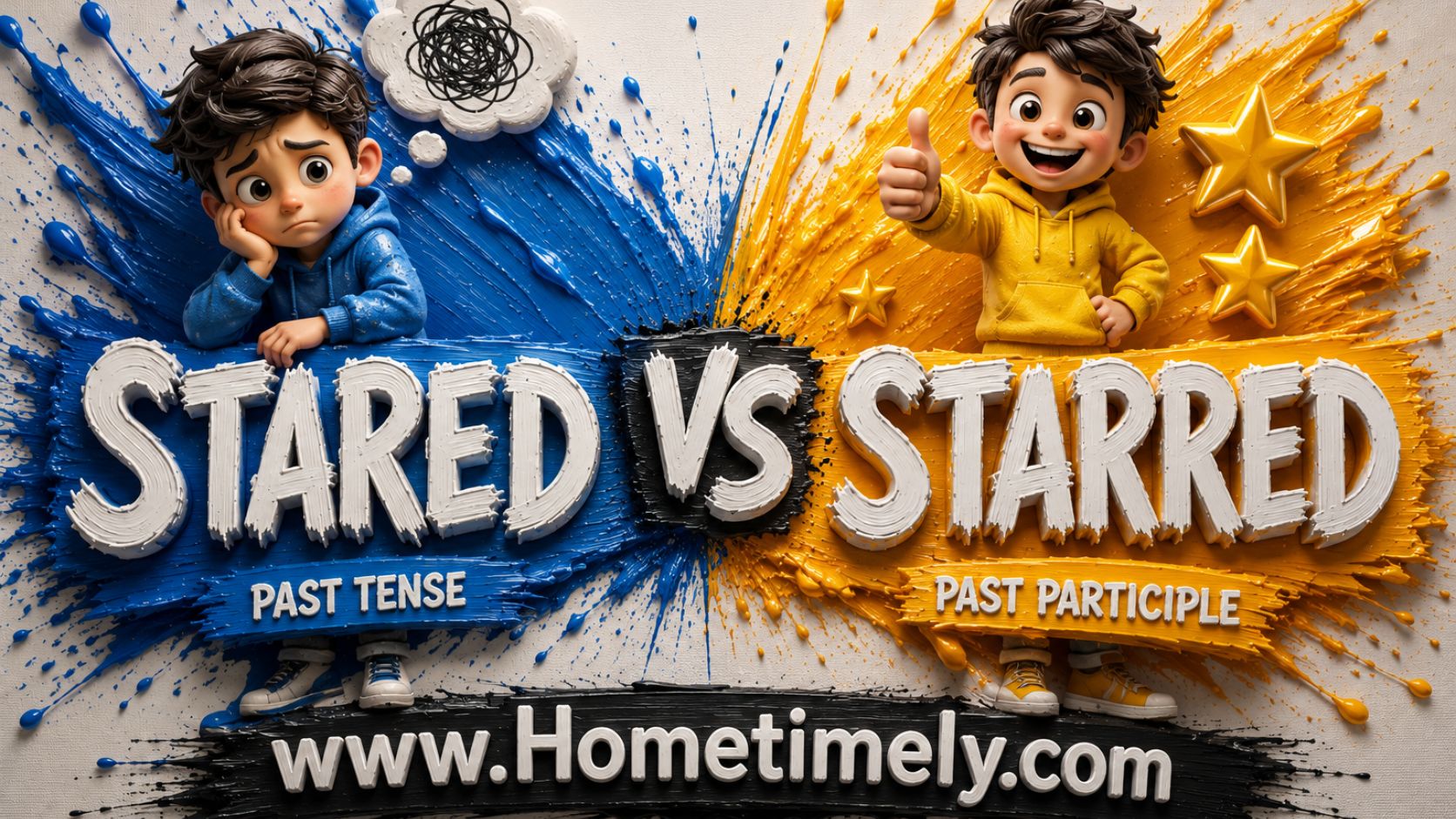
Have you ever typed a sentence and paused, wondering — is it stared or starred? You are not alone. These two words look nearly identical, sound the same in casual speech, and trip up even confident English writers every single day. One small letter makes all the difference, yet that difference completely changes your meaning.
In this guide, you will get a precise, clear, and practical breakdown of stared vs starred — their meanings, grammar roles, correct usage, common mistakes, memory tricks, and practice exercises. By the end, you will never mix them up again.
Difference Explained with Precision
At the core, these two words belong to entirely different verbs:
- Stared is the past tense of stare — to look fixedly or intensely at something or someone.
- Starred is the past tense of star — to feature prominently in a production, or to mark something with a star symbol.
The confusion is natural because they differ by only one letter — a single extra r in starred. But their meanings operate in completely separate domains: one is about eyes and observation, the other is about recognition, prominence, or marking.
Quick Comparison Table
| Feature | Stared | Starred |
| Base verb | Stare | Star |
| Meaning | Looked fixedly at something | Featured as a lead / marked with a star |
| Word type | Past tense verb | Past tense verb / adjective |
| Context | Observation, emotion, curiosity | Entertainment, ratings, bookmarking |
| Spelling | One r before -ed | Double r before -ed |
| Example | She stared at the door. | She starred in the film. |
Deep Explanation with Context
What Does “Stared” Mean?
Stared comes from the Old English word starian, meaning to gaze or look intently. It describes a prolonged, focused gaze — not a quick glance, but a long, deliberate look that often carries emotion.
Writers use stared to convey curiosity, shock, admiration, disbelief, or unease. It adds emotional depth to a sentence and shows the reader what a character is feeling without telling them directly.
Key characteristics of “stared”:
- Always describes a visual action (looking)
- Implies duration — a sustained gaze, not a brief glance
- Often accompanied by emotion or intent
- Can be directed at a person, object, or even an empty space
Expanded Usage Table — “Stared”
| Situation | Example Sentence |
| Curiosity | The child stared at the magician in complete wonder. |
| Shock | He stared at the accident, unable to move. |
| Sadness | She stared out the window as the rain fell. |
| Anger | The teacher stared at the student who interrupted. |
| Confusion | I stared at the math problem for ten minutes. |
| Admiration | He stared at the painting as if it held a secret. |
Important Insight: If your sentence involves eyes, vision, or a gaze — always choose stared. Ask yourself: “Is someone looking at something?” If yes, stared is your word.
Complete Functional Understanding of “Starred”
Starred traces its root to the Old English steorra, meaning star. As a verb, it carries three distinct modern meanings:
- To play a leading role — He starred in a Broadway musical.
- To mark with a star symbol — She starred the email to find it later.
- Used as an adjective — A Michelin-starred restaurant.
Each of these uses connects to the concept of a star — whether it is the bright performer at the center of a production, a gold star marking importance, or a rating system built on stars.
Expanded Usage Table — “Starred”
| Context | Example Sentence |
| Film/TV | The actor starred in three Oscar-nominated films. |
| Theatre | She starred alongside the country’s best performers. |
| Email/Apps | He starred the message so he wouldn’t forget it. |
| GitHub/Tech | Over 40,000 developers starred the repository. |
| Ratings | They dined at a two-starred restaurant in Paris. |
| Adjective use | The guide lists only starred hotels in the region. |
Key Insight: If your sentence involves importance, a leading role, achievement, or marking something for reference — use starred. Ask: “Is something being recognized, featured, or flagged?” If yes, choose starred.
Clear Analytical Comparison
The simplest way to understand the difference is to link each word to its domain:
- Stared → Eyes → Looking → Emotion
- Starred → Stars → Recognition → Performance or Marking
Analytical Comparison Table
| Dimension | Stared | Starred |
| Sensory domain | Visual (eyes) | Symbolic (stars, roles) |
| Emotional weight | High — implies feeling | Low to neutral — factual |
| Typical subject | Any person | Performers, items, files |
| Typical object | A person, object, view | A film, email, project |
| Modern digital use | Rare | Common (starred emails, repos) |
| Adjective form | Not typically used | Yes — “starred review,” “starred hotel” |
Advanced Clarity
One often overlooked fact: in modern digital contexts, starred has grown significantly in everyday use. When you mark a favourite on Google Maps, save an email in Gmail, or bookmark a GitHub repository — that action is called starring. You would say “I starred that article” not “I stared that article.” This digital usage makes it even more important to understand the word correctly today.
Usage Table — Digital Contexts
| Platform | Correct Usage |
| Gmail | I starred the invoice email. |
| GitHub | She starred the open-source project. |
| Google Maps | He starred the restaurant for later. |
| Trello/Notion | They starred the most important cards. |
Advanced Insight: The rise of digital starring has given this word a whole new everyday life beyond entertainment. If you are using a star icon on any app or platform, the verb is always starred, never stared.
How to Use “Starred” in a Sentence
Understanding grammar placement helps you use starred naturally and correctly.
As a past tense verb:
- She starred in the leading role of the production.
- He starred alongside some of the industry’s biggest names.
As a passive construction:
- The film was starred by an internationally acclaimed cast.
As an adjective (describing a noun):
- They booked a Michelin-starred chef for the event.
- This is a starred item in your reading list.
Usage Table — Sentence Structures for “Starred”
| Structure | Example |
| Subject + starred + in | He starred in the documentary. |
| Subject + starred + alongside | She starred alongside veteran actors. |
| Adjective + noun | A starred review appeared in the magazine. |
| Past passive | The production was starred by two legends. |
| Digital/tech use | I starred your message for follow-up. |
Advanced Insight: When starred functions as an adjective, it always comes before the noun it modifies — a starred rating, starred hotels, a starred message. This is called an attributive adjective, and it is perfectly standard in both British and American English.
Common Mistakes in Stared vs Starred Grammar
Most errors with these two words follow predictable patterns. Knowing the mistake makes it easy to avoid.
Error Analysis Table
| Incorrect Sentence | Correct Sentence | Why It’s Wrong |
| He starred at me in silence. | He stared at me in silence. | “Starred” doesn’t mean looking. |
| She stared in the new film. | She starred in the new film. | “Stared” doesn’t mean performing. |
| I stared the email for reference. | I starred the email for reference. | Digital marking uses “starred.” |
| The dog stared in three commercials. | The dog starred in three commercials. | Featuring uses “starred.” |
| They starred at the broken window. | They stared at the broken window. | Looking uses “stared.” |
The most frequent mistake is writing “starred at” when you mean “stared at.” Writers confuse the spelling when typing quickly and the spellchecker rarely catches it because both are real words.
Why People Confuse Stared and Starred
Confusion Factors Table
| Reason | Explanation |
| Near-identical spelling | Only one extra letter separates them |
| Identical pronunciation | Both sound like “STAYRD” in casual speech |
| Fast typing errors | The double r is easily missed when typing quickly |
| No spellcheck warning | Both are valid words, so auto-correct won’t flag it |
| Similar verb structure | Both are regular past tense verbs with -ed endings |
| Phonetic spelling | Writers spell what they hear, not what they mean |
The pronunciation overlap is the biggest culprit. In everyday speech, both words collapse into the same sound. This means you cannot rely on how a word sounds — you must rely on what it means.
Context Matters: The Key to Accuracy
The single most reliable tool for choosing correctly is context. Read your sentence and ask what the action involves.
Context Table
| If the sentence involves… | Use… | Example |
| Looking, gazing, watching | Stared | She stared at the horizon. |
| A film, show, or performance | Starred | He starred in the series. |
| A star rating or award | Starred | It was a Michelin-starred dish. |
| Bookmarking or flagging | Starred | I starred the document. |
| Surprise, curiosity, confusion | Stared | They stared in disbelief. |
| A lead actor or performer | Starred | The production starred two icons. |
Staring vs Starring: Extended Clarification
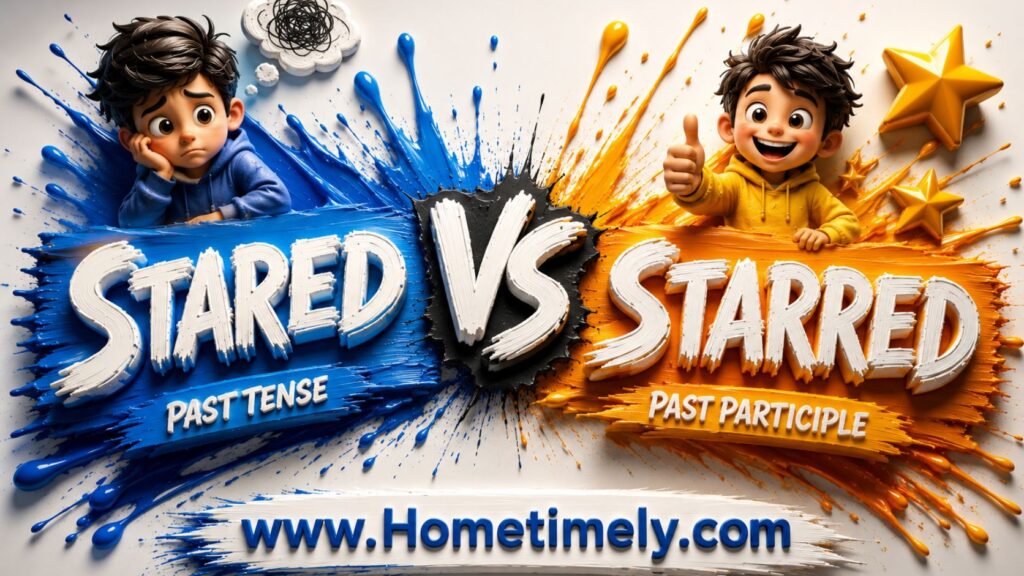
The present participle forms carry the same distinction and are equally confused.
- Staring = actively looking at something right now
- Starring = currently featuring in a role or being marked
Comparison Table
| Word | Meaning | Example |
| Staring | Looking intently (present) | She is staring at the screen. |
| Starring | Featuring in a role (present) | He is starring in a new series. |
| Stared | Looked intently (past) | He stared at the empty seat. |
| Starred | Featured in a role (past) | She starred in the award show. |
Synonyms and Related Vocabulary Expansion
Expanding your vocabulary around these words helps you write with more variety and precision.
Synonym Table
| Word | Synonyms / Related Terms |
| Stared | Gazed, glared, peered, gawked, ogled, fixed eyes on, looked intently |
| Starred | Featured, headlined, appeared in, led, performed in, bookmarked, marked, flagged |
Using synonyms like gazed or peered instead of stared also adds stylistic range to your writing. Similarly, words like headlined or featured can replace starred in entertainment contexts.
Pronunciation
Despite their different meanings, the two words sound virtually identical in everyday speech, which is the root cause of most confusion.
Pronunciation Table
| Word | Phonetic Spelling | Sounds Like | Syllables |
| Stared | /stɛːrd/ | “STAYRD” | 1 |
| Starred | /stɑːrd/ | “STARD” or “STAYRD” | 1 |
In careful, formal speech there is a slight vowel difference — stared uses a longer “AY” sound, while starred uses a shorter, rounder “AH” sound. But in natural conversation, both collapse into a nearly identical sound. This is why pronunciation alone is never a reliable guide. Always check spelling and meaning.
Memory Technique: Retain the Difference Easily
The best memory techniques link the word’s form to its meaning.
Memory Table
| Word | Memory Trick | Visual Association |
| Stared | One r = one pair of eyes looking | Think: “one gaze, one r“ |
| Starred | Double r = two arms of a star shape | Think: “two rs like a star’s points” |
| Stared | Contains “ARE” — “eyes ARE focused” | “I ARE looking” = stared |
| Starred | Contains “STAR” — the full word is inside! | S-T-A-R-R-E-D hides “STAR” |
The easiest trick of all: look for the word STAR inside STARRED. The word star is literally contained in starred. If you can see STAR in the word, it has something to do with stars, roles, or marking — not looking.
Practice Exercises: Stared vs Starred
Fill in the Blanks
Complete each sentence with either stared or starred:
- He ______ at the ceiling, deep in thought. (Answer: stared)
- She ______ in a critically acclaimed drama last year. (Answer: starred)
- The audience ______ in amazement as the magician performed. (Answer: stared)
- The chef ______ in a popular cooking series on television. (Answer: starred)
- I ______ the important files so I could find them quickly. (Answer: starred)
- He ______ at her without saying a single word. (Answer: stared)
- The actor ______ alongside three Oscar winners. (Answer: starred)
- They both ______ at the unusual shape in the sky. (Answer: stared)
Multiple Choice Questions
1. Which sentence is correct?
- a) She starred at the broken mirror for a long time.
- b) She stared at the broken mirror for a long time. ✅
2. Which sentence uses “starred” correctly?
- a) The cat starred at the fish tank all morning.
- b) The actor starred in a biographical drama. ✅
3. Choose the right word: “He ______ the email so he could reply later.”
- a) stared
- b) starred ✅
Context-Based Practice
Read each situation and decide which word fits:
- Situation: A person cannot take their eyes off a beautiful sunset. → stared
- Situation: An actor played the main character in a Netflix film. → starred
- Situation: Someone saved a document by clicking the star icon. → starred
- Situation: A child looked wide-eyed at a Christmas tree. → stared
- Situation: A restaurant received a prestigious culinary rating. → starred
Keyword Comparison / Key Differences
| Aspect | Stared | Starred |
| Root word | Stare | Star |
| Letter count | 6 letters | 7 letters |
| Number of rs | One | Two |
| Part of speech | Past tense verb | Past tense verb / adjective |
| Primary domain | Vision / emotion | Performance / marking |
| Can follow “at” | Yes — “stared at” | No — never “starred at” |
| Can precede “in” | Rarely | Yes — “starred in” |
| Digital use | None | Yes — starred emails, repos |
Correct Usage in Sentences
Starring
- The streaming platform announced the new series starring two award-winning leads.
- She is starring in her first major theatrical production this fall.
- The advertisement features a starring role for a well-known comedian.
Staring
- He was staring at the screen so long his eyes began to water.
- Stop staring — it is impolite to look at people that way.
- She caught him staring and immediately looked away.
Tips to Remember the Correct Usage
- Find STAR in starred — the word STAR is hidden inside STARRED. If your sentence is about stars, roles, or marking, the word already tells you.
- “Stared at” is always correct; “starred at” is never correct — if you want to write “stared at,” make sure there is only one r.
- Double r = double importance — when something or someone is featured prominently, it gets the double r.
- Test with a synonym — can you replace the word with “gazed”? Use stared. Can you replace it with “featured”? Use starred.
- Check the preposition — “stared at” follows the eyes. “Starred in” follows the role.
Frequently Asked Questions
Is it “stared” or “starred” when looking at someone?
Always stared — looking or gazing uses the single-r form.
Can “starred” describe a rating system?
Yes — “a Michelin-starred restaurant” or “a two-starred hotel” are both correct and common.
Do British and American English spell these words differently?
No — both dialects use the exact same spelling for stared and starred.
Can “starred” ever be an adjective?
Yes — “a starred review” or “starred items” are standard adjective uses.
Why doesn’t spellcheck catch the mistake?
Because both words are real, correctly spelled English words — spellcheck only catches misspellings, not wrong-word errors.
Is “starring” the same as “staring” in pronunciation?
They are very similar but not identical — staring has a long “AY” sound, while starring has a shorter “AH” sound.
Conclusion
The difference between stared and starred comes down to one clear principle: context. Stared lives in the world of vision and emotion — it is what your eyes do. Starred lives in the world of recognition and roles — it is what performers do, what apps do with bookmarks, and what critics do with ratings.
Remember: look for STAR hiding inside STARRED. If your sentence involves a star in any sense — fame, marking, or rating — that double r belongs there. If your sentence involves eyes, a gaze, or intense focus, keep it clean with a single r and use stared.
Small distinctions like this are what separate clear, confident writing from writing that leaves readers pausing — and that pause is worth avoiding.

Michael Brook is the creator and author behind Healthy Leeks, a platform focused on grammar, writing skills, and English language learning. Passionate about clear communication and effective writing, Michael Brook shares practical grammar tips, easy-to-follow language guides, and educational content to help readers improve their English with confidence.


