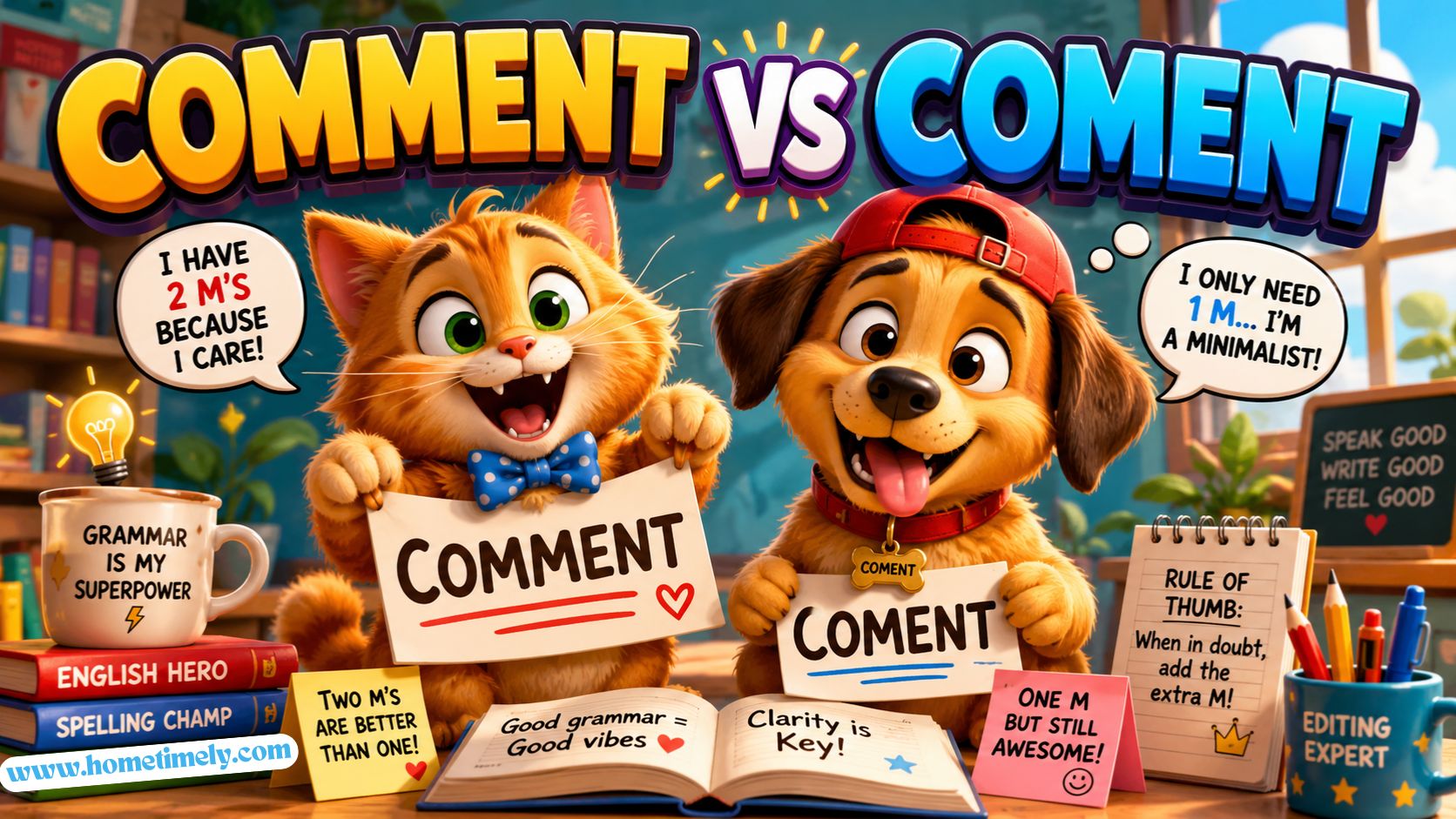
You type out a quick response on Instagram. Hit post. Then you see it—a glaring red underline beneath your words. You wrote “coment” instead of “comment.”
That single missing letter changes nothing about your intent but everything about your credibility.
Few spelling errors slip past readers quite like this one. The word “comment” appears everywhere—from YouTube comment sections to professional codebases, from academic essays to casual Facebook posts . Yet its most common misspelling, “coment,” continues to trip up writers of all skill levels.
This guide does more than just tell you which spelling is correct. You will learn why the double ‘m’ matters, how to use “comment” correctly across different contexts (social media, programming, formal writing), and practical strategies to make the correct spelling automatic.
Whether you are a student polishing an essay, a developer documenting code, or a social media manager engaging with audiences, mastering this small detail will elevate your writing.
What Is Comment in English? A Definition That Actually Helps
A comment is an expressed opinion, observation, or reaction to something.
That definition sounds simple, but let us break down what this actually means in practice .
When you comment, you are doing one of three things:
| Purpose | Description | Real-World Example |
| Expressing an opinion | Sharing what you think about something | “This movie was absolutely brilliant” |
| Providing an explanation | Clarifying or adding information | “The scene works because of the director’s use of shadow” |
| Offering criticism | Evaluating something (constructively or not) | “The argument fails to address the main issue” |
Think of a comment as your verbal reaction to anything—a news article, a piece of code, a social media post, or even someone’s outfit. It is the textual equivalent of nodding, frowning, or leaning in to say something.
Here is what makes a comment distinct from other forms of communication:
Unlike a formal review or an academic paper, a comment tends to be:
- Shorter – Usually a few sentences or less
- More conversational – Direct responses to specific content
- Public-facing – Often visible to others in comment sections
- Immediate – Created in response to something just seen or read
The word itself comes from the Latin commentari, meaning “to interpret” or “to write down.” That origin matters because it reveals something important: a comment is not just noise. It adds something to the original content, whether insight, agreement, disagreement, or humor.
Why Small Details Carry Big Weight
One missing letter might seem trivial. But spelling “comment” correctly signals something about you as a writer.
Consider what readers assume when they see “coment”:
- Carelessness or rushing
- Lack of attention to detail
- Lower credibility (especially in professional contexts)
- Possible non-native English writing (which is understandable but avoidable with practice)
These assumptions may not be fair. But they happen. In a world where first impressions increasingly happen through text, small errors carry outsized weight.
The flip side is equally true: When you spell “comment” correctly every time, readers notice your polish. They trust your other words more. They take you seriously.
That single ‘m’ you add? It is doing more work than you think.
How Do You Spell Comment Correctly? Make It Automatic
The correct spelling is C-O-M-M-E-N-T.
Two ‘m’ letters. One ‘e’. One ‘n’. One ‘t’. Eight letters total.
The most common misspelling—”coment”—drops one of the ‘m’s. This error is so frequent that search engines auto-suggest it, and millions of social media posts contain the mistake.
Why Do People Spell It Wrong?
Several factors contribute to this persistent error:
| Reason | Explanation |
| Pronunciation ambiguity | The double ‘m’ sounds nearly identical to a single ‘m’ in spoken English |
| Word patterns | Words like “comment” (double consonant) are less common than single-consonant patterns |
| Typing speed | Rushed typing skips the second ‘m’ |
| Autocorrect reliance | Dependence on spell-check prevents memory formation |
Here is a memory trick that actually works:
Think of the phrase: “COMMunicate your MENTion.”
- “COMM” reminds you of the double ‘m’ at the start
- “MENT” reminds you of the ending
Every time you type “comment,” visualize those two ‘m’s standing side by side. They are partners. Do not separate them.
Spelling Variations Across English Dialects
Good news: “comment” does not change spelling between American and British English.
| Form | American English | British English |
| Noun | comment | comment |
| Verb (present) | comment | comment |
| Verb (past) | commented | commented |
| Verb (continuous) | commenting | commenting |
No confusion here. Both dialects agree on the double ‘m’. The only variation appears in derived forms, but the root spelling remains consistent across all English varieties.
Comment Usage in Sentences: Writing That Feels Human
Knowing how to spell “comment” is one thing. Using it naturally in sentences is another.
As a Noun (The Most Common Usage)
When “comment” functions as a noun, it names the thing you are writing or saying—the actual words of your response.
Examples:
- “Her comment about the budget shortage sparked a heated discussion.”
- “I left a comment on your blog post about renewable energy.”
- “The professor had no comment on the exam controversy.”
- “That was an insensitive comment to make at a funeral.”
Notice how the noun form often pairs with articles (“a comment,” “the comment”) or possessive pronouns (“her comment,” “your comment”).
As a Verb (The Action of Responding)
When “comment” functions as a verb, it describes the act of giving your opinion or observation.
Examples:
- “The CEO refused to comment on the merger rumors.”
- “Please comment on this document by Friday.”
- “Several users commented that the update broke their workflow.”
- “I would rather not comment until I have all the facts.”
A common question: Should you say “comment” or “comment on”?
| Structure | When to Use | Example |
| “comment on” + topic | Standard usage for addressing a subject | “She commented on his lack of preparation” |
| “comment that” + clause | When directly stating what was said | “He commented that the weather was beautiful” |
| “comment” alone (intransitive) | When the topic is understood from context | “I cannot comment at this time” |
Adjective and Adverb Forms
Less common but still useful:
Commentary (noun) – Extended discussion or analysis
“The DVD includes director’s commentary throughout the film”
Commentator (noun) – A person who provides comments professionally
“Sports commentators analyzed the play for ten minutes”
Commentative (adjective) – Tending to comment frequently
“Her commentative style makes meetings run long”
Write Comments That People Actually Want to Read
Spelling matters, but content matters more. Here is how to write comments that add value rather than noise:
Do this:
- Add specific observations others missed
- Ask genuine questions (not rhetorical traps)
- Acknowledge good points before disagreeing
- Keep it concise—most people scan, not read
Avoid this:
- “First!” or other low-effort posts
- Personal attacks disguised as criticism
- Repeating what five people already said
- Walls of text with no paragraph breaks
The best comments feel like conversations, not performances. Write as if you are speaking to a friend—respectful, clear, and honest.
One Letter and Different Meaning: Comment vs Commend
Comment and commend look similar but mean completely different things.
This confusion happens less often than “coment,” but it is worth addressing because the consequences of mixing them up range from awkward to embarrassing.
| Word | Spelling | Meaning | Example |
| Comment | C-O-M-M-E-N-T | To express an opinion or observation | “Let me comment on your proposal” |
| Commend | C-O-M-M-E-N-D | To praise or recommend formally | “I commend you for your hard work” |
Imagine writing to your boss: “I comment your leadership style.”
You meant to praise them. Instead, you told them you have an opinion about their leadership. The sentence is not technically wrong, but it is weird. It misses the mark entirely.
Memory trick: “Commend” contains the letter ‘D’ for “Deserve praise.” “Comment” has ‘T’ for “Talk about something.”
Here is a quick test:
| Sentence | Correct Word | Why |
| “The judge had high _____ for her integrity.” | Commend | The sentence discusses praise, not opinion |
| “His _____ on the article appeared below the fold.” | Comment | The sentence refers to a written response |
| “I cannot _____ until I review the data.” | Comment | The sentence describes the act of responding |
| “I _____ you for speaking up.” | Commend | The sentence expresses praise |
This distinction matters most in professional writing. An email to a colleague that confuses these two words will raise eyebrows—not because the error is huge, but because it signals carelessness on something small.
Comment Section Meaning on Social Media: More Than Just Replies
If you have spent any time on the internet in the past decade, you know what a comment section is. But the term deserves a closer look because comment sections have evolved into something far more complex than simple feedback boxes.
A comment section is the area beneath online content where users post their responses, reactions, and discussions.
Every major platform has one, though they call it different things:
| Platform | Name for Comment Feature | Unique Characteristics |
| YouTube | Comments | Threaded replies, like/dislike counts, pinned comments |
| Comments (under posts/Reels) | Emoji-heavy, brand participation, @mentions common | |
| Comments | Reaction buttons, nested replies, editing allowed | |
| Comments | Voting system, sorting by “best” or “controversial” | |
| Comments | Professional tone, longer form, networking-focused | |
| TikTok | Comments | Video replies, stitch integration, fast-moving |
| X (Twitter) | Replies | Chronological, quote-tweeting, hashtag integration |
Why Comment Sections Changed the Internet
Before comment sections, online content was a one-way broadcast. You read an article or watched a video, and that was it—your reaction stayed in your head.
Comment sections flipped that model completely .
They created three fundamental shifts:
1. Audiences became participants
Every reader became a potential contributor. The line between “creator” and “consumer” blurred. A blog post was no longer finished when published; it was finished when the conversation in the comments died down.
2. Communities formed around content
Regular commenters developed reputations. Inside jokes emerged. Rivalries started. The comment section became its own social space, sometimes more engaging than the content it accompanied.
3. Feedback became immediate and public
Creators could no longer hide from criticism. Every typo, every weak argument, every questionable claim could be called out minutes after publishing. This forced higher quality from creators but also enabled pile-ons and harassment.
The Dark Side of Comment Sections
Not everything about comment sections is positive.
Common problems include:
- Trolling – Deliberately provocative comments designed to upset others
- Spam – Promotional content or bots flooding discussions
- Echo chambers – Dissenting opinions downvoted or shouted down
- Harassment – Targeted attacks on creators or other commenters
- Misinformation – False claims spread through comment sections
Many platforms now use AI moderation, user reporting systems, and comment filtering to address these issues. Some publications have removed comment sections entirely, redirecting discussion to curated social media platforms instead .
Brand Participation in Comment Sections
One unexpected development: brands now actively participate in comment sections, particularly on Instagram and TikTok .
Why brands comment:
- Humanizes the company (a brand that jokes feels relatable)
- Increases visibility (comments appear in feeds of users who liked the original post)
- Builds community (engaged brands feel more accessible)
Examples include Wendy’s roasting competitors in replies, Duolingo posting absurdist comments on viral videos, and smaller brands networking through strategic comments on industry influencers’ posts.
The comment section transformed from a passive feedback form into an active marketing channel.
Comment Meaning in Programming: Documentation That Executes
In programming, a comment is text embedded in source code that the computer completely ignores.
This definition surprises non-programmers. Why write text that the computer does not run?
Because humans read code, not just computers.
Consider this scenario:
You write a complex function that calculates shipping costs based on weight, distance, shipping method, and current fuel prices. The code works perfectly. Six months later, another developer (or future you) needs to fix a bug.
Without comments, that person must reverse-engineer your logic from scratch. With good comments, they understand your intent immediately and fix the issue in minutes instead of hours.
Comments serve three main purposes in code:
| Purpose | Description | Example |
| Explanation | Clarifying what complex code does | # Calculate tax after applying all discounts |
| Documentation | Describing functions, parameters, and return values | // Returns user’s full name as a single string |
| Debugging | Temporarily disabling code without deleting it | // console.log(debugVariable); |
Comment in C Language: Structure and Practical Use
The C programming language established comment syntax that influenced countless other languages including C++, Java, JavaScript, C#, and PHP.
C supports two types of comments: one for single lines and one for multiple lines .
Single-Line Comments (C99 and Later)
Introduced in the C99 standard, single-line comments start with two forward slashes (//) and continue until the line ends.
c
// This entire line is ignored by the compiler
int x = 10; // This comment starts after the code
// You can also use single-line comments
// to create multi-line explanations
// by starting each line with slashes
Best for: Short explanations, marking TODO items, temporarily disabling a single line of code.
Multi-Line Comments (Traditional C)
Multi-line comments begin with /* and end with */. Everything between these markers is ignored, regardless of how many lines it spans.
c
/* This function calculates the factorial of a number
using recursion. Input must be non-negative.
Returns 1 for input 0 or 1. */
int factorial(int n) {
if (n <= 1) return 1;
return n * factorial(n – 1);
}
Important limitation: Multi-line comments in standard C cannot be nested . This means you cannot put one /* comment */ inside another. The first */ ends the entire comment, potentially causing compiler errors.
c
/* Outer comment starts
/* Inner comment would break things */
This text is no longer inside the comment! */
Inline Comments (Placed Within Statements)
Comments can appear in the middle of code lines, though this technique is used sparingly.
c
int result = calculate(/* parameter one */ 5, /* parameter two */ 10);
When to use inline comments:
- Explaining specific arguments in function calls
- Marking which closing brace belongs to which block
- Temporarily changing a single value during debugging
Comment Out vs Uncomment: A Tool Every Developer Uses
“Commenting out” means converting working code into a comment so the computer ignores it.
“Uncommenting” means removing comment markers to restore ignored code to active status.
This technique is fundamental to debugging and testing .
Why Developers Comment Out Code
| Scenario | Why Comment Out Instead of Delete |
| Testing alternative implementations | Keep old version safe while trying new approach |
| Isolating bugs | Temporarily disable sections to find error source |
| Documenting removed features | Preserve code that might be needed later |
| Teaching or demonstrating | Show what code would look like without deleting it |
Here is the rule most experienced developers follow: Commented-out code that stays in production for more than a few days should either be deleted or turned into a proper documentation comment. Dead code clutters codebases and confuses future readers.
Keyboard Shortcuts by Development Environment
| Environment | Comment Shortcut | Uncomment Shortcut |
| Visual Studio | Ctrl + K, Ctrl + C | Ctrl + K, Ctrl + U |
| VS Code | Ctrl + / (Windows/Linux) or Cmd + / (Mac) | Same shortcut toggles |
| IntelliJ / WebStorm | Ctrl + / | Same shortcut toggles |
| Sublime Text | Ctrl + / | Same shortcut toggles |
| Eclipse | Ctrl + / | Same shortcut toggles |
Most modern editors use the same shortcut to both comment and uncomment (toggling). Select the code and press the shortcut once to comment it; press again to uncomment.
Types of Comments in Programming Languages: A Structured Approach
Different programming languages handle comments differently, but patterns emerge across language families .
Comparison Table: Comment Syntax by Language
| Language | Single-Line | Multi-Line | Documentation Comments |
| Python | # comment | “””multi-line””” | “””Docstring””” |
| JavaScript | // comment | /* comment */ | /** JSDoc */ |
| Java | // comment | /* comment */ | /** Javadoc */ |
| C / C++ | // comment | /* comment */ | /// (C++/CLI) |
| C# | // comment | /* comment */ | /// or /** */ |
| HTML | <!– comment –> | (same syntax) | N/A |
| CSS | /* comment */ | (same syntax) | N/A |
| SQL | — comment | /* comment */ | N/A |
| Ruby | # comment | =begin/=end | # |
| Go | // comment | /* comment */ | // |
| Rust | // comment | /* comment */ | /// or //! |
| PHP | // or # | /* comment */ | /** */ |
Documentation Comments (Special Category)
Many languages support special “documentation comments” that tools can extract to generate API documentation automatically.
Examples:
- Javadoc (Java): /** Description @param name @return value */
- JSDoc (JavaScript): /** @param {string} name @returns {number} */
- XML Documentation (C#): /// <summary>Description</summary>
These comments follow strict formatting rules because external tools parse them. Writing good documentation comments is a skill separate from writing regular explanatory comments.
Comment Formatting Rules and Best Practices That Actually Work
Writing comments that help rather than hurt requires discipline. Bad comments waste space. Good comments save time.
The Golden Rule of Comments
Comment the “why,” not the “what.”
| Bad Comment (States the Obvious) | Good Comment (Explains Reasoning) |
| i = i + 1; // Add 1 to i | i = i + 1; // Skip the header row (index 0) |
| return total * 1.05; // Multiply by 1.05 | return total * 1.05; // Apply 5% sales tax (effective Jan 2025) |
| while (x > 0) // Loop while x positive | while (x > 0) // Continue until all items processed |
If the code clearly shows what it does, you do not need a comment explaining it. Comments should explain why the code does something—especially when the reason is not obvious.
Practical Commenting Guidelines
Do comment:
- Complex algorithms (explain the approach)
- Business rules and constraints (“Maximum 3 attempts per user”)
- Workarounds for bugs in other systems (“Waiting for API fix; using fallback”)
- The purpose of functions and important variables
- Assumptions the code makes (“Input array must be sorted”)
Do not comment:
- Obvious operations (x = 5; // Set x to 5)
- Outdated information (keep comments updated or delete them)
- Every line of code (makes code harder to read, not easier)
- What you think you will do later (TODO comments are fine; vague plans are not)
Formatting Best Practices
c
// Single-line comments should use proper spacing
// Each line gets its own double-slash
/* Multi-line comments
* often use an asterisk at the start of each line
* for visual clarity (though this is style preference)
*/
Consistency matters more than which style you choose. Pick a commenting convention and stick to it across your project.
What Are Comments Used for in Coding? Real-World Applications
Beyond basic explanation, comments serve several specialized purposes in professional software development.
1. Automatic Documentation Generation
Tools like Doxygen (C++), Javadoc (Java), Sphinx (Python), and JSDoc (JavaScript) parse specially formatted comments to create API reference websites.
java
/**
* Calculates the area of a circle.
* @param radius The distance from center to edge (must be positive)
* @return The area (π × r²)
* @throws IllegalArgumentException if radius is negative
*/
public double calculateArea(double radius) {
if (radius < 0) throw new IllegalArgumentException();
return Math.PI * radius * radius;
}
2. Debugging with Comment Toggles
Developers often wrap debugging output in comments, enabling it only when needed.
javascript
const DEBUG = true;
function processData(data) {
if (DEBUG) {
// console.log(‘Input data:’, JSON.stringify(data));
}
// Processing logic here
}
3. TODO and FIXME Markers
Many IDEs highlight special comment tags to track unfinished work.
| Tag | Meaning | Example |
| TODO | Work that still needs completion | // TODO: Add error handling for network timeout |
| FIXME | Known bug that needs fixing | // FIXME: This calculation fails for negative inputs |
| HACK | Temporary workaround | // HACK: Sleeping 100ms to wait for DOM update |
| XXX | Warning or danger | // XXX: This recursive function may cause stack overflow |
| NOTE | Important observation | // NOTE: This order matters for authentication |
4. Legal Headers and Licensing
Open-source projects often include copyright and license information in block comments at the top of each file.
c
/*
* Copyright (c) 2024 Example Corp.
* SPDX-License-Identifier: MIT
*
* Permission is hereby granted, free of charge…
*/
How To Properly Use The Words In A Sentence
Correct spelling means nothing without correct usage. Let us examine exactly how to use “comment” and why “coment” has no legitimate place in English writing.
How To Use “Comment” In A Sentence
As a noun (most common):
| Sentence | Notes |
| “She left a thoughtful comment on my article.” | Standard noun usage |
| “The teacher wrote positive comments on every essay.” | Plural form |
| “No comment until the investigation concludes.” | Fixed phrase |
| “His comment about deadlines was fair but harsh.” | Comment + about + topic |
As a verb:
| Sentence | Notes |
| “Please comment on the draft by Friday.” | Comment + on + object |
| “Several users commented that the login was slow.” | Comment + that + clause |
| “I cannot comment without seeing the data.” | Comment alone (intransitive) |
| “She commented wisely on a difficult subject.” | Comment + adverb |
As part of compound terms:
| Term | Meaning | Example |
| Comment section | Area beneath content for responses | “The comment section exploded with debate” |
| Comment box | Text input field for writing comments | “Type your response in the comment box” |
| Comment thread | Chain of replies to a comment | “Follow the comment thread to see the full argument” |
| Comment moderation | Reviewing comments before publication | “Comment moderation filters spam automatically” |
How To Use “Coment” In A Sentence
You cannot. Because “coment” is not a real word.
No dictionary recognizes “coment” as a valid English word. It has no definition. No legitimate usage exists in any context—not in social media, not in programming, not in academic writing.
Every time you see “coment” in writing, it is a misspelling of “comment.”
But people do type it. Here is how it appears incorrectly:
| Incorrect | Correct Version |
| “Please coment on this post” | “Please comment on this post” |
| “Leave a coment below” | “Leave a comment below” |
| “I have no coment” | “I have no comment” |
| “She coment that it was late” | “She commented that it was late” |
The bottom line: Never use “coment.” It is always wrong. If you catch yourself typing it, stop and add the second ‘m’.
Common Mistakes To Avoid
Even experienced writers make predictable errors with “comment” and related words. Recognizing these patterns helps you avoid them.
1. Spelling Errors
| Mistake | Correct Form | Frequency |
| Coment | Comment | Very common |
| Commment (three ‘m’s) | Comment | Uncommon, but happens |
| Commente | Comment | Rare |
| Commentt (double ‘t’) | Comment | Very rare |
Why this happens: The double ‘m’ is easy to type once and forget. The brain registers “com-” and moves on, skipping the second ‘m’ entirely.
Fix: Train yourself to pause after “com” and deliberately type the second ‘m’ before “ment.”
2. Incorrect Usage
Mistake: Using “comment” when “commend” is intended
| Context | Incorrect | Correct |
| Praising someone | “I comment your bravery” | “I commend your bravery” |
| Performance review | “She received high comment from management” | “She received high commendation from management” |
Mistake: Using “comment” as a transitive verb without “on” or “that”
| Incorrect | Correct |
| “He commented the proposal” | “He commented on the proposal” |
| “She commented the weather” | “She commented that the weather was nice” OR “She commented on the weather” |
Exception: With “that” clauses, no “on” is needed. “He commented that the proposal had merit” is correct.
Mistake: Missing preposition with “comment on”
Some writers drop “on” when it is required:
| Incorrect | Correct |
| “Please comment the document” | “Please comment on the document” |
| “Refuse to comment the topic” | “Refuse to comment on the topic” |
3. Grammar Errors
Subject-verb agreement with “comment” as a noun:
| Incorrect | Correct |
| “The comment were helpful” | “The comments were helpful” (plural) OR “The comment was helpful” (singular) |
| “Her comment suggest changes” | “Her comment suggests changes” (singular verb) |
Verb tense consistency:
| Incorrect | Correct |
| “He comment yesterday” | “He commented yesterday” |
| “They are comment right now” | “They are commenting right now” |
Using “comment” as a countable vs. uncountable noun:
“Comment” is usually countable (one comment, two comments). But in fixed phrases like “no comment,” it functions as uncountable.
| Correct | Why |
| “I have a comment to make” | Countable, so needs an article |
| “I have no comment” | Fixed phrase, uncountable |
| “She made several comments” | Countable, plural |
| “No comments yet” | Plural countable |
Practice Exercises: Comment vs Coment
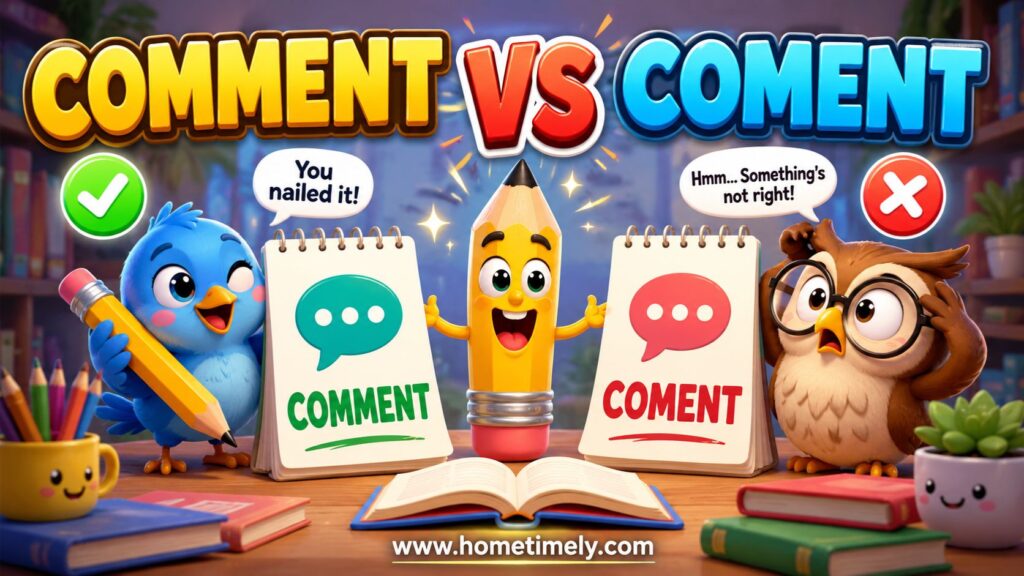
Apply what you have learned with these exercises. Answers are provided for self-checking.
Exercise 1: Fill in the Blank
Choose the correct word (comment or comment’s correct form) to complete each sentence.
- “Please _____ on this document before the deadline.”
- “The _____ section of that YouTube video is surprisingly civil.”
- “I have no _____ on the allegations at this time.”
- “She _____ that the meeting had been rescheduled.”
- “His _____ about my presentation was actually helpful.”
Exercise 2: Identify Correct and Incorrect Usage
Mark each sentence as Correct or Incorrect. For incorrect sentences, explain why.
- “I left a coment on her Instagram post.”
- “The professor had no comment on the cheating scandal.”
- “Please coment the attached file.”
- “Several users commented that the feature was broken.”
- “He refused to comment without an attorney present.”
Exercise 3: Sentence Correction (Rewrite Accurately)
Rewrite each incorrect sentence correctly.
- “She coment on every single post in the thread.”
- “The comment thread were filled with spam.”
- “I cannot coment until I review the evidence.”
- “His coment about my work was unexpected.”
- “They commented the article but not the conclusion.”
Exercise 4: Improving Sentence Quality
These sentences are grammatically correct but poorly written. Improve them following the “comment the why, not the what” principle.
- total = total * 0.9; // Multiply by 0.9
- // This function returns the user’s age
function getAge() { … } - for (int i = 0; i < 10; i++) // Loop 10 times
Exercise 5: Meaning-Based Selection
Choose whether “comment” or “commend” belongs in each sentence.
- “The judge took a moment to _____ the witness for honesty.”
- “Please _____ on the draft proposal by end of day.”
- “Her _____ about the design was constructive.”
- “I _____ you for standing up when it mattered.”
- “No _____ from the CEO yet about the merger.”
Exercise 6: Programming Concepts
Identify the comment type in each code snippet.
- // This is a temporary fix
- /* This function calculates the square root using the Newton-Raphson method */
- int result = calculate(/* use default */ 0);
- # TODO: Add validation for empty inputs
Answer Key
Exercise 1 (Fill in the Blank):
- comment
- comment
- comment
- commented
- comment
Exercise 2 (Identify Correct/Incorrect):
- Incorrect – “coment” is misspelled; should be “comment”
- Correct
- Incorrect – “coment” misspelled; should be “comment on the attached file”
- Correct
- Correct
Exercise 3 (Sentence Correction):
- “She commented on every single post in the thread.”
- “The comment thread was filled with spam.” (subject-verb agreement)
- “I cannot comment until I review the evidence.”
- “His comment about my work was unexpected.”
- “They commented on the article but not the conclusion.” (needs “on”)
Exercise 4 (Improving Sentence Quality):
- total = total * 0.9; // Apply 10% discount for loyalty program members
- // Returns age in years based on birthdate stored in user object
function getAge() { … } - for (int i = 0; i < 10; i++) // Process all 10 items in the queue
Exercise 5 (Meaning-Based Selection):
- commend
- comment
- comment
- commend
- comment
Exercise 6 (Programming Concepts):
- Single-line comment
- Multi-line (block) comment
- Inline comment
- TODO comment (special marker comment)
Key Insight
After everything covered in this guide, one truth stands above the rest:
“Comment” always has two ‘m’s. Always. No exceptions. Not in casual texting. Not in social media. Not in code. Not ever.
That single letter distinguishes competent writing from careless writing. It separates those who learn from those who guess.
But deeper than the spelling lesson lies a more important insight: small details reveal character. The writer who masters the tiny things masters the big things too. The developer who comments code clearly documents complex systems effectively. The social media manager who spells correctly builds brand trust faster.
Every time you type “comment,” you make a choice. Choose excellence. Choose precision. Choose the second ‘m’.
You have all the tools now—the definitions, the examples, the memory tricks, the practice exercises. The only thing left is application. Start today. Write one perfect comment. Then another. Soon, correct spelling becomes automatic, and you stop thinking about letters and start focusing on meaning.
That is the ultimate goal: not just spelling words correctly, but communicating so clearly that readers never think about your spelling at all. They just understand.
Conclusion
The rule is simple and absolute: “comment” always has two ‘m’s. “Coment” is never correct—not in social media, not in professional writing, not in code. That single letter separates careful communicators from careless ones.
Master this small detail, and you signal attention to precision in everything you write. Whether you’re leaving a YouTube comment, documenting a function in C, or responding to a colleague, the correct spelling builds trust and credibility. Now go write with confidence—and never drop that second ‘m’ again.

Michael Brook is the creator and author behind Healthy Leeks, a platform focused on grammar, writing skills, and English language learning. Passionate about clear communication and effective writing, Michael Brook shares practical grammar tips, easy-to-follow language guides, and educational content to help readers improve their English with confidence.


