Have you ever typed “encorporate” mid-sentence and felt a flicker of doubt? Maybe you let it slide, figuring autocorrect would catch it — or maybe you convinced yourself both spellings were valid options. Either way, you are not alone.
The encorporate vs incorporate debate is one of those persistent spelling traps in English that catches students, professionals, and even experienced writers off guard. The two words sound similar when spoken quickly, which is exactly where the confusion begins.
This guide settles the debate once and for all — with clear definitions, grammar rules, usage examples, comparison tables, and practice exercises to make the correct spelling stick.
The Quick Answer You Need First
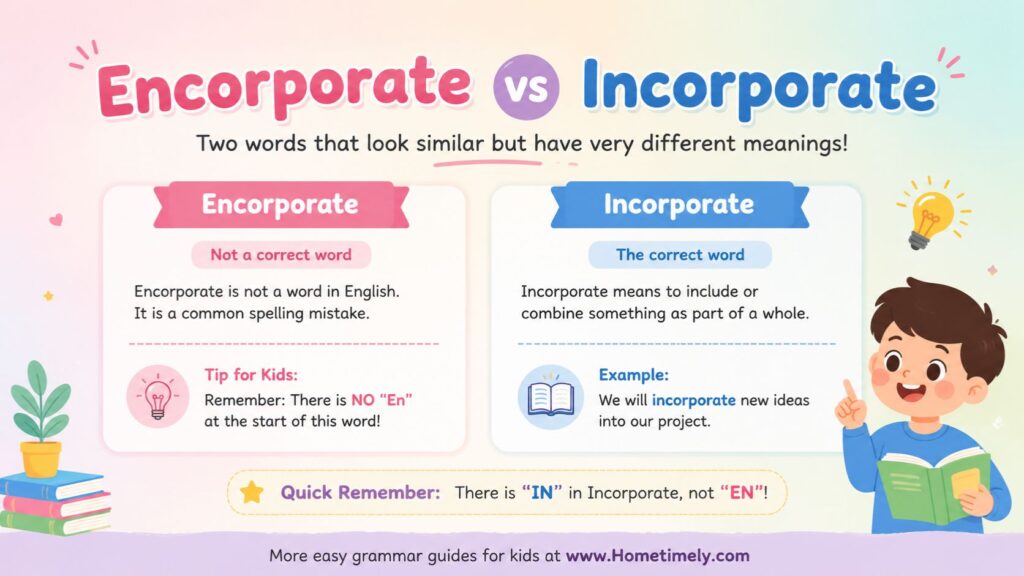
Incorporate is the correct spelling. It is a real, widely used English word.
Encorporate is not a standard English word. It does not appear in Merriam-Webster, Oxford, or the Cambridge Dictionary as a recognized entry. In virtually every context, it is simply a misspelling.
One rule: Start with “IN” — never “EN.”
What Does “Incorporate” Really Mean?
Incorporate Definition
According to the Cambridge Dictionary, incorporate is a verb with two core meanings:
- To include something as part of something larger
- To legally form a company into a corporation
The word traces back to the Latin incorporare — from the prefix in- (meaning “into”) and corporare (meaning “to form into a body”). Literally, it means to bring something into a body or whole. That Latin root explains why the prefix is “in” and not “en.”
Incorporate Meaning in Simple Words
At its most basic, incorporate means to add something into something else so it becomes part of the whole — not just placed next to it, but genuinely combined into it.
Think of it like mixing flour into dough. The flour does not sit beside the dough. It becomes part of it. That blended-in quality is exactly what incorporate communicates.
Quick Examples
- She incorporated new data into her research paper.
- The design team incorporated user feedback into the final product.
- The company was incorporated in Delaware in 2019.
Incorporate Meaning in Business (Important Context)
Incorporate Definition (Business)
In legal and business contexts, incorporate carries a highly specific meaning. According to the Cambridge Business English Dictionary, to incorporate a company means to legally register it as a corporation — giving it a separate legal identity from its owners.
What Happens When a Business Is Incorporated
When a business is incorporated, it gains several legal protections and structural changes:
- The company becomes a separate legal entity
- Owners receive limited liability protection — personal assets are shielded from business debts
- The business can own property, enter contracts, and sue or be sued in its own name
- The company must file articles of incorporation with the relevant government authority
- It can issue shares and take on shareholders
Example
The founders decided to incorporate their startup before seeking outside investment, protecting their personal finances from business risk.
This business usage appears constantly in legal documents, contracts, company registrations, and financial filings. Getting the spelling right in these contexts is not optional — it is a professional requirement.
What Is “Encorporate”? (The Honest Truth)
Encorporate Definition
There is no standard definition for “encorporate” — because it is not a recognized word in modern English.
It does not appear in:
- Merriam-Webster Dictionary
- Oxford English Dictionary
- Cambridge Dictionary
- Collins English Dictionary
In some very old historical texts from earlier centuries, variant spellings appeared before English orthography was fully standardized. However, those archaic forms have no relevance to modern writing and should never be used as justification for the spelling today.
Is Encorporate a Real Word? Let’s Settle It Clearly
No. “Encorporate” is not a real word in standard modern English.
| Question | Answer |
| Is “encorporate” in the dictionary? | ❌ No |
| Is it accepted in British English? | ❌ No |
| Is it accepted in American English? | ❌ No |
| Is it ever correct outside of historical texts? | ❌ No |
| Can it be used as an alternative spelling? | ❌ Never |
| Does it have a meaning of its own? | ❌ No recognized meaning |
Why Encorporate vs Incorporate Confuses So Many People
Main Reasons for Confusion
English has a large collection of common words that begin with the prefix “en-“ — and many of them are legitimate, frequently used words:
- enable, encourage, enforce, engage, ensure, enrich, enroll, encounter
This pattern is deeply ingrained in English speakers’ minds. When a writer reaches for incorporate, the brain sometimes auto-substitutes “en-” based on habit and pattern recognition — producing “encorporate” without any conscious decision.
Additional causes include:
- Fast typing — The words sound similar at speed; fingers type the familiar pattern before the brain intervenes
- Lack of spell-check flagging — Some writing tools do not always catch this variant
- Phonetic spelling tendencies — Non-native English speakers especially tend to spell what they hear
- Seeing it online — Because so many people make this mistake, “encorporate” appears across the internet, which creates a false sense of legitimacy
Key Insight
The prefix in incorporate is “in-“, not “en-“. This is because the word comes directly from Latin incorporare, where in- means “into.” The “in-” prefix makes logical sense — you are putting something into a larger body. “En-” has no etymological basis here.
Difference Between Encorporate and Incorporate (Clear Comparison)
| Feature | Incorporate | Encorporate |
| Correct spelling | ✅ Yes | ❌ No |
| Found in dictionaries | ✅ Yes | ❌ No |
| Standard English word | ✅ Yes | ❌ No |
| Latin origin | ✅ incorporare | ❌ No valid root |
| Used in business/legal writing | ✅ Widely used | ❌ Never acceptable |
| Used in academic writing | ✅ Frequently | ❌ Would be flagged as error |
| Used in everyday writing | ✅ Common | ❌ Misspelling |
| Prefix | in- | ~~en-~~ (incorrect) |
How to Spell Incorporate Correctly (And Never Forget It Again)
Correct Spelling
I – N – C – O – R – P – O – R – A – T – E
Twelve letters. No ambiguity. The spelling has been consistent since the word entered English in the early 15th century.
Common Mistakes
Writers frequently produce these incorrect variations alongside “encorporate”:
- ~~encorporate~~ → incorporate
- ~~incoperate~~ → incorporate
- ~~incorporrate~~ → incorporate
- ~~encorperate~~ → incorporate
- ~~incorporpate~~ → incorporate
Memory Trick
Connect the word to its meaning. Incorporate means to put something IN — inside a larger whole. Since the action goes IN, the prefix is IN. If you remember that, you will never write “encorporate” again.
Another approach: think of the word corporation inside incorporate. A corporation is already embedded in the middle of the word — in-CORPORAT-e. The structure of the word literally shows you its meaning.
How to Use Incorporate in a Sentence
Examples of Incorporate in Sentences
General usage:
- The new phone model incorporates several features borrowed from tablet design.
- Try to incorporate regular exercise into your daily routine.
- The report incorporates data from three separate studies.
Academic writing:
- The researcher sought to incorporate qualitative methods alongside quantitative analysis.
- Students are encouraged to incorporate primary sources into their essays.
Business and legal:
- The startup was incorporated in Texas before expanding nationally.
- The partnership decided to incorporate to protect its members’ personal assets.
Common Sentence Structures
Incorporate most often appears in these grammatical patterns:
| Structure | Example |
| incorporate + object | The design incorporates natural materials. |
| incorporate + object + into + object | We incorporated her suggestions into the plan. |
| be incorporated + in/into | The feature was incorporated into the update. |
| incorporate as | The business was incorporated as an LLC. |
Incorporate vs Include vs Integrate (Key Differences)
These three words overlap in meaning but are not interchangeable. Understanding the distinction sharpens your writing considerably.
Comparison Table
| Word | Core Meaning | Implies | Example |
| Include | To contain as part | Simple addition, item is present | The package includes a manual. |
| Incorporate | To add into a structure | Active absorption, structural change | We incorporated the manual into the onboarding flow. |
| Integrate | To combine so parts work together | Full blending, functional unity | The systems were integrated to share data seamlessly. |
Simple Explanation
- Include is the most passive of the three. Something is simply there as part of a group.
- Incorporate is more active. You are taking something and embedding it into a structure so it becomes part of it.
- Integrate is the most complete. It implies full blending where the parts no longer function independently.
Example
The app includes a search function. The developers incorporated user feedback to improve it. Once complete, the update integrated the search function with the database for real-time results.
Incorporate vs Integrate: Practical Difference
In everyday writing, the practical distinction is this:
- Use incorporate when you are adding something into a system, plan, report, or structure
- Use integrate when you want to emphasize that the added element now functions together with the whole
We incorporated the new safety standards into our manual. (Added them in) The safety systems were integrated into the plant’s automation network. (They now work together as one)
Incorporate Synonym List (Improve Writing Variety)
Incorporate Synonyms
Repeating incorporate too often can make writing feel monotonous. These synonyms work depending on context:
| Synonym | Best Used When |
| include | Simple, direct addition |
| integrate | Emphasizing functional unity |
| embed | Something placed deeply within |
| absorb | One thing taken into another |
| blend | Mixing two elements together |
| combine | Joining two or more things |
| merge | Two things becoming one |
| weave in | Naturally introducing into existing content |
| fold in | Informal; especially in creative contexts |
| encompass | Including within a broader scope |
Example
Instead of: We incorporated the new rules. We also incorporated the feedback. We then incorporated the changes.
Try: We incorporated the new rules, integrated the feedback, and embedded the changes into the final version.
Encorporate vs Incorporate vs Incorporated
Incorporated Meaning (Business Context Explained)
Incorporated is the past tense and past participle of incorporate. In business, it carries a specific legal designation — it appears after a company name (abbreviated as Inc.) to indicate that the business has been legally registered as a corporation.
Incorporated Meaning
According to the Cambridge Business English Dictionary, Incorporated (Inc.) is used after the name of a company organized as a legal corporation in the United States.
Examples
- Apple Inc. — Apple, Incorporated
- The firm was incorporated in 2001 under state law.
- Shareholders of the newly incorporated entity received documentation.
| Form | Grammatical Role | Example |
| Incorporate | Verb (present) | They incorporate new ideas regularly. |
| Incorporated | Verb (past) / Adjective / Business title | The company was incorporated last year. / Apple Inc. |
| Incorporating | Verb (present participle) | She is incorporating the changes now. |
| Incorporation | Noun | The process of incorporation took six weeks. |
| Encorporate | ❌ Not a word | Should never be used |
Common Mistakes Writers Make
1. Mistake: Using “encorporate”
Scenario: A student writes a cover letter and types: “I have been able to encorporate strong leadership skills into every role I’ve held.”
Problem: “Encorporate” is not a real word. It immediately signals a spelling error to any reader.
Correct Version: “I have been able to incorporate strong leadership skills into every role I’ve held.”
Impact: Spelling errors on professional documents can result in applications being dismissed, credibility being questioned, or documents being returned for correction.
2. Mistake: Confusing with “include”
Using include when the context actually calls for incorporate weakens the precision of your writing. Include is passive; incorporate implies active, structural addition.
3. Mistake: Misusing the business meaning
Using incorporate to mean “include” in a legal contract where the business registration meaning is expected — or vice versa — can create ambiguity in formal documents. Always consider which meaning applies.
Grammar Rules for Verbs: Why “Incorporate” Works
Verb Forms
| Form | Example |
| Base form | incorporate |
| Third person singular | incorporates |
| Past tense | incorporated |
| Present participle | incorporating |
| Past participle | incorporated |
| Noun form | incorporation |
Where “Incorporate” Fits Best
Writing: Adding ideas, data, sources, or elements into documents, essays, reports, and designs
Business: Registering a company as a legal entity; forming a corporation
Technical fields: Embedding features into systems, software, products, or processes
Why “Encorporate” Is Always Incorrect
The answer lies in etymology and consistency:
- The word descends from Latin incorporare, where in- means “into”
- No major English dictionary has ever recognized “encorporate” as a standard entry
- The prefix “en-” has no etymological connection to this word’s Latin root
- Both British English and American English use the same spelling: incorporate
- There is no regional variation — unlike some British/American spelling differences (e.g., colour/color), this is not a case where two spellings are accepted in different regions
One wrong letter reduces your professional credibility, especially in academic submissions, legal documents, and business communications where precision is expected.
Quick Practice (Make It Stick)
Fill in the Blank
Use incorporate, incorporated, or incorporating to complete each sentence:
- The team plans to _______ the new guidelines into the existing framework.
- Our company was _______ in 2018 under state law.
- She is currently _______ client feedback into the revised proposal.
- The architect designed a space that _______ both modern and traditional elements.
Fix the Sentence
Rewrite each sentence, correcting the spelling error:
- We need to encorporate more data before publishing.
- The startup was encorporated in California last year.
- Please encorporate these changes into the final version.
Real-Life Situations Where People Search “Encorporate or Incorporate”
Understanding who makes this mistake helps prevent it:
Students writing dissertations or essays often type quickly and fall into phonetic patterns — “encorporate” comes out when attention is on the argument, not the spelling.
Business owners drafting formation documents, contracts, or pitch decks sometimes second-guess themselves on this word, especially when working in a second language.
Writers producing long-form content may not notice the error until a proofreader catches it — or doesn’t.
ESL learners follow English’s many “en-” words as a pattern and apply that prefix to incorporate without realizing the root is different.
Job seekers writing cover letters and resumes — where this error can be particularly costly — are among the most common searchers of this term.
Key Takeaways
Incorporate Is Correct and Widely Used
- The only accepted spelling in all forms of standard English — academic, business, legal, and casual
- Used across British English, American English, and all global varieties of the language
Encorporate Is a Spelling Mistake
- Not found in any major dictionary
- No historical or regional justification for its use in modern writing
- What happens if you use it: It signals to readers, editors, and recruiters that you have made a spelling error — particularly damaging in professional or academic documents
Incorporate Means to Combine or Include
Examples:
- The curriculum incorporates critical thinking across all subjects.
- He managed to incorporate humor into an otherwise serious presentation.
- The report incorporates findings from twenty separate studies.
It Also Means to Form a Company Legally
Incorporate Meaning in Business:
To formally register a business as a legal corporation, creating a separate legal entity distinct from its owners.
What That Involves:
- Filing articles of incorporation
- Receiving a certificate of incorporation
- Gaining limited liability protection
- Being able to issue shares and hold assets as a company
Example: She incorporated her consulting business before signing her first major contract.
Insight: In legal and financial writing, using the wrong spelling of this word can undermine the professionalism of the entire document. Given how frequently incorporate and incorporated appear in company formation paperwork, contracts, and official filings, accuracy here is especially important.
Reference: Cambridge Dictionary Definitions
For authoritative reference, the Cambridge Dictionary provides three definitions of incorporate:
- Cambridge Advanced Learner’s Dictionary: “to include something as part of something larger” — with the example: “This aircraft incorporates several new safety features.”
- Cambridge Business English Dictionary: To legally make a company into a corporation — e.g., “Our company was incorporated in Delaware after World War I.”
- Cambridge Learner’s Dictionary: “to include something as part of another thing” — with the example: “He began to incorporate dance and mime into his plays.”
None of these sources — nor any other major dictionary — contains an entry for “encorporate.” The word simply does not exist in recognized English.
Frequently Asked Questions (FAQs)
Q: Is “encorporate” ever correct?
No — it is always a spelling error in modern English, never accepted in any dictionary or style guide.
Q: What is the correct spelling — encorporate or incorporate?
Always incorporate — starting with “in,” not “en.”
Q: What does incorporate mean?
It means to include something as part of a larger whole, or to legally register a business as a corporation.
Q: Why do people write “encorporate” instead of “incorporate”?
Because English has many common “en-” words (enable, encourage), the pattern transfers incorrectly to this word by habit.
Q: What is the noun form of incorporate?
The noun form is incorporation — referring to either the act of including something or the legal process of forming a corporation.
Q: Can incorporate be used in both business and general writing?
Yes — in general writing it means to include or blend in; in business and legal writing it means to legally form a corporation.
Q: What is the difference between incorporate and integrate?
Incorporate means to add something into a structure; integrate means to blend elements so they function together as a unified whole.
Q: What does “Inc.” stand for after a company name?
Inc. is the abbreviation for Incorporated, indicating the company is legally registered as a corporation.
Conclusion
The encorporate vs incorporate question has one answer, and it is not complicated: incorporate is always correct. There is no “en-” version, no regional alternative, and no historical exception that applies to modern writing.
The confusion is understandable — English prefixes are inconsistent, and typing fast does not leave room for second-guessing. But now that you understand why the correct spelling uses “in-” (because the Latin root means “into a body”), the error should feel much harder to repeat.
Next time you reach for this word — whether in a business document, academic essay, or professional email — start with “in” and the rest will follow naturally.
I-N-C-O-R-P-O-R-A-T-E. That is the only version that belongs in your writing

Michael Brook is the creator and author behind Healthy Leeks, a platform focused on grammar, writing skills, and English language learning. Passionate about clear communication and effective writing, Michael Brook shares practical grammar tips, easy-to-follow language guides, and educational content to help readers improve their English with confidence.