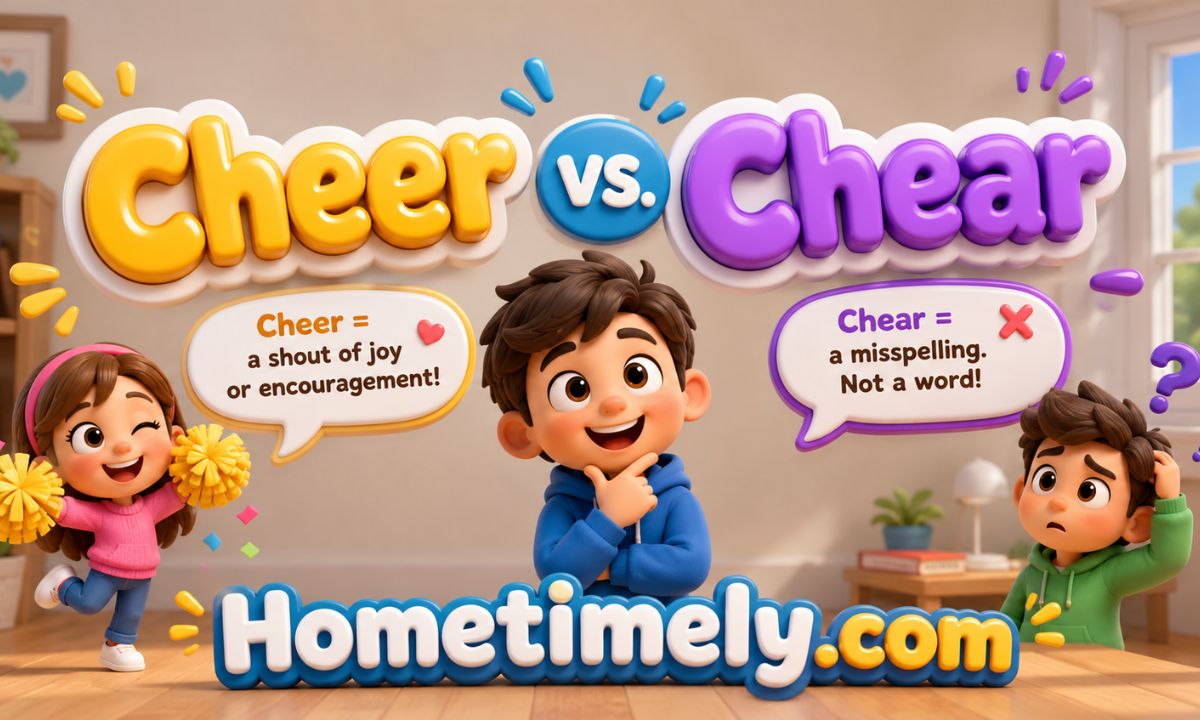
Picture this: you’re finishing a motivational email to your team, you type the word “chear” and pause. Something feels off. You stare at it. Both spellings look plausible for a split second — and then the doubt sets in.
This happens more often than most writers admit. The words cheer and chear sound identical when spoken, which is exactly why the confusion exists. But in writing, only one of them belongs in any sentence you’ll ever produce.
This guide gives you everything you need — the correct spelling, the full meaning, grammar rules, real examples, a memory trick, and practice exercises — so you never second-guess yourself on this word again.
Cheer vs. Chear: The Simple Truth
Let’s settle it immediately, before anything else.
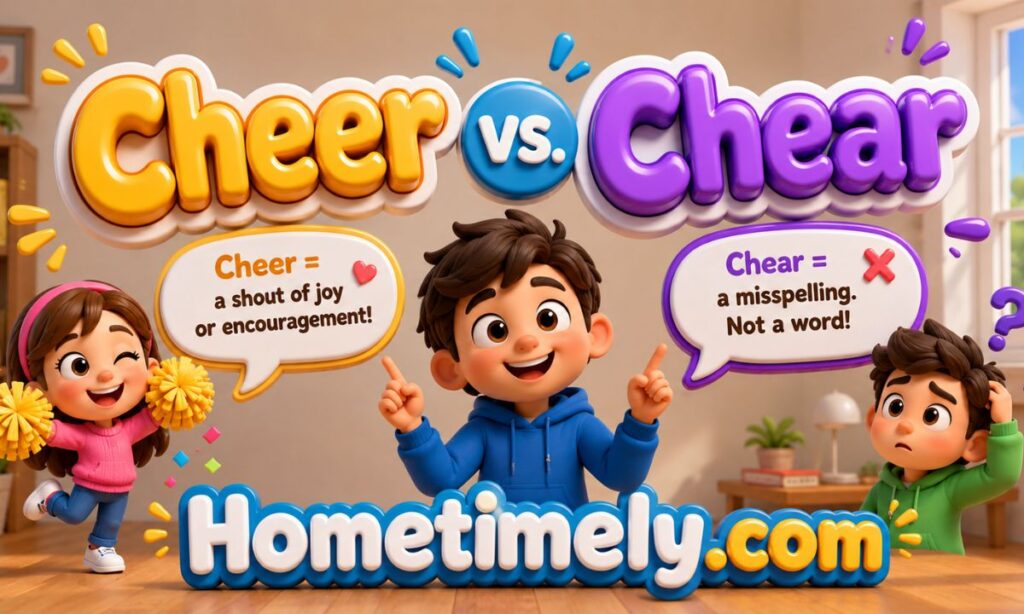
Cheer is correct. Chear is not.
That’s the whole story in two sentences. But if you want to understand why — and make sure it sticks — keep reading.
Here’s a clean comparison:
| Word | Status | Used In |
| Cheer | ✅ Correct, modern English | All writing, formal and informal |
| Chear | ❌ Obsolete / spelling error | Historical texts only |
Cheer works as both a noun and a verb. It expresses joy, encouragement, comfort, and positive emotional energy. Chear, on the other hand, was an older spelling variant that existed in early English texts — before spelling became standardized — and it has long since fallen out of use. No modern dictionary, style guide, or grammar authority recognizes it as acceptable today.
If your spell-checker underlines it in red, that’s not a glitch. It’s correct.
What “Cheer” Really Means
Before you can use a word well, you need to understand its depth. And “cheer” has more of it than most people realize.
The word has a genuinely fascinating history. According to Merriam-Webster, cheer is a loanword from Anglo-French, which itself derived from Medieval Latin cara and possibly Greek kara — all of which meant “face.” When the word first entered Middle English around the 13th century, it literally referred to a person’s face or countenance, particularly as it showed emotion.
Over time, that meaning shifted inward. By the mid-13th century, cheer had come to describe a person’s state of mind, their mood, or spirit — whether joyful or sorrowful. You could have “heavy cheer” (sadness) or “good cheer” (happiness). By the late 14th century, the positive sense had taken over completely, and cheer came to mean merriment, hospitality, and eventually the festive food and drink at celebrations.
The meaning “a shout of encouragement” is actually the newest sense — recorded from around 1720, possibly originating from nautical slang when sailors would salute ships with cheers.
Core meanings of cheer
Today, “cheer” carries several layered meanings, all tied to positivity and human connection:
- Joy or happiness — a general feeling of warmth and good spirits
- Encouragement — the act of lifting someone’s mood or supporting them
- A shout of approval — the vocal expression at sporting events, celebrations, or rallies
- Festive hospitality — food, drink, and entertainment at celebrations (“holiday cheer”)
- Cheerleading — used colloquially as a standalone noun: “She competed in cheer for three years”
That’s a lot of meaning packed into five letters.
Cheer as a Noun and a Verb
One of the most useful things about “cheer” is its grammatical flexibility. It functions as both a noun and a verb — and knowing which role it’s playing in a sentence helps you use it more precisely.
Cheer as a noun
When “cheer” is a noun, it refers to a thing — a feeling, an expression, an atmosphere, or a specific shout.
- A feeling of happiness: The room was filled with warmth and cheer.
- A shout of approval: A loud cheer erupted from the stands.
- A plural form for toasts or farewells: Cheers! Here’s to the new year.
- A competitive sport: She’s been doing cheer since middle school.
As a noun, “cheer” often appears with articles (a cheer, the cheer) or in uncountable form (spreading cheer, full of cheer).
Cheer as a verb
When “cheer” is a verb, it describes an action — something someone does or causes.
- To shout in support: The fans cheered loudly when the team scored.
- To comfort or uplift: She cheered him up after a difficult week.
- To express enthusiasm: The audience cheered the announcement.
- To become happier: He cheered up once he heard the news.
As a verb, “cheer” follows standard conjugation patterns:
| Form | Example |
| Base | cheer |
| Third person singular | cheers |
| Past tense | cheered |
| Present participle | cheering |
| Past participle | cheered |
Cheer vs. Chear Synonyms
If you’re looking for variety in your writing, knowing the synonyms of “cheer” helps you express the same emotions without repetition.
As a noun (joy / good mood):
- Gaiety, merriment, cheerfulness, delight, elation, high spirits, buoyancy, levity
As a noun (a shout):
- Applause, ovation, acclamation, hurrah, huzzah, roar, acclaim
As a verb (to uplift someone):
- Encourage, hearten, uplift, brighten, gladden, buoy, inspire, console, comfort
As a verb (to shout in support):
- Applaud, acclaim, root for, cheer on, salute, hail
Here’s a quick synonym reference:
| Context | Cheer | Synonyms |
| Happiness | “full of cheer” | joy, delight, merriment |
| Encouragement | “cheer someone up” | hearten, uplift, inspire |
| Vocal support | “a loud cheer” | applause, ovation, hurrah |
| Festive atmosphere | “holiday cheer” | spirit, warmth, festivity |
None of these synonyms can substitute for “chear,” simply because “chear” isn’t a word worth substituting with anything — you just replace it with “cheer.”
What About “Chear”? Is It Ever Correct?
This is the question most people are really asking, so let’s give it a thorough answer.
Technically, chear did exist in older forms of English. In historical texts from the 16th and 17th centuries, before spelling became standardized, writers occasionally used “chear” as a variant spelling of “cheer.” You can find it in some early printed works and manuscripts where orthographic consistency wasn’t yet the norm.
But that’s where its legitimacy ends.
In modern English — meaning anything written after the 18th-century standardization of spelling — “chear” is not a valid word. It does not appear in Merriam-Webster, Oxford, Cambridge, Collins, or any other reputable dictionary as a current form. No major grammar guide recommends it. No style manual lists it as an acceptable variant.
If you use “chear” today, readers won’t think you’re quoting a medieval text. They’ll think you made a typo. And in professional settings — emails, reports, articles, social media posts — that perception matters.
The verdict: unless you’re transcribing a 17th-century poem or studying historical linguistics, “chear” has no place in your writing.
Why People Mix Up Cheer and Chear
If “chear” isn’t a word, why do so many people write it? The answer comes down to how our brains process language — and it’s more logical than it might seem.
Here’s what’s going on behind the scenes
1. Pronunciation gives no clue. Both “cheer” and “chear” are pronounced identically: /tʃɪr/. When you hear the word spoken, there’s no signal telling you which spelling is correct. The confusion lives entirely in the transition from sound to text.
2. Rhyming patterns mislead the brain. Words like hear, fear, dear, near, and clear all end in “-ear.” Your brain, which loves patterns, naturally tries to apply the same structure to a word that sounds similar. Since “chear” follows the “-ear” pattern and sounds right to the ear, it feels correct — even when it isn’t.
3. Fast typing and muscle memory. In the age of smartphone keyboards and rapid digital messaging, people type at speed. The “-ear” ending is easy to produce quickly, especially if your fingers have formed that habit with other words.
4. Autocorrect isn’t always reliable. Some devices and platforms autocorrect or autocomplete based on what looks familiar, not necessarily what’s correct. If “chear” isn’t flagged, the error slips through invisibly.
5. The old spelling left a faint trace. Because “chear” genuinely existed in historical English, it has a kind of ghost presence in the language. It doesn’t look completely alien, which makes it easier for the brain to accept it without suspicion.
Understanding these patterns doesn’t just explain the mistake — it shows you exactly where to focus your attention to avoid it.
Cheer Up: Meaning and Usage
“Cheer up” is one of the most common and emotionally significant uses of the word, and it deserves its own explanation.
As a phrasal verb, cheer up means either to become happier or to make someone else feel better. It’s recorded in use from as early as the 1670s.
Intransitive (no object — the subject cheers themselves):
- She cheered up once the results came in.
- He started to cheer up after the walk.
Transitive (with object — someone cheers another person):
- She brought flowers to cheer him up.
- They threw a party to cheer up their colleague.
As a command or encouragement:
- Cheer up! Things will get better.
- Come on, cheer up — it’s not that bad.
The phrase carries warmth and genuine emotional intent. It’s one of those expressions where word choice matters a great deal — and misspelling it as “chear up” would immediately distract the reader from the comfort you’re trying to offer.
How to Use Cheer Naturally in Sentences
Knowing a word is one thing. Using it naturally is another. Here’s how “cheer” sounds across different tones and contexts.
Everyday examples
- The children’s laughter brought a sense of cheer to the whole house.
- We could hear the crowd cheer from three blocks away.
- She texted him just to cheer him up before the big interview.
- A little holiday cheer goes a long way in December.
- They cheered as the final whistle blew.
Professional tone examples
- The team let out a spontaneous cheer when the project was approved.
- Her words of encouragement brought genuine cheer to the entire department.
- The announcement was greeted with cheers from shareholders.
- A quick note of thanks can cheer a colleague more than you’d expect.
- He closed the email with a warm “Cheers,” signaling both gratitude and goodwill.
Emotional context examples
- He tried everything to cheer his sister up after the loss.
- A single act of kindness can cheer someone whose day has fallen apart.
- The visit cheered her more than any medicine could.
- There was a quiet cheer in the room — not loud, but deeply felt.
- Even on the hardest days, she managed to cheer everyone around her.
Notice how naturally “cheer” fits across all of these contexts. It moves between formal and informal, spoken and written, without effort. That versatility is part of what makes it such a rich word.
Common Mistakes That Slip Through
Even writers who know “cheer” is correct can make errors in how they use it. Here are the most frequent missteps — beyond the basic spelling issue.
Mistakes to watch for
- Writing “chear” instead of “cheer” — the core error this article addresses
- Writing “chears” instead of “cheers” — the same vowel confusion in plural/verb form
- Writing “cheary” instead of “cheery” — the adjective form follows the same pattern: double “e”
- Misusing “cheer” and “cheer up” — saying “she tried to cheer him” when you mean “cheer him up” (with a direct object, the phrasal verb usually needs “up”)
- Confusing “cheers” as a noun vs. as an expression — “Three cheers for the team!” (noun, plural) vs. “Cheers!” (interjection for a toast or farewell)
A quick correction example
| Incorrect | Correct |
| The crowd gave a loud chear. | The crowd gave a loud cheer. |
| She tried to chear him up. | She tried to cheer him up. |
| Wishing you joy and chear this season. | Wishing you joy and cheer this season. |
| The fans cheared wildly. | The fans cheered wildly. |
| Chears to a successful year! | Cheers to a successful year! |
Each of these is a simple, single-letter mistake — but each one disrupts the reader’s trust in the writing.
A Memory Trick That Actually Works

Spelling rules are only useful if you can actually recall them under pressure. Here’s a memory device that works for most people:
Think of the double “e” as the sound of excitement.
When you cheer, you stretch the sound: ch-EEE-r. That elongated “ee” sound matches the spelling. The two “e” letters aren’t just sitting there — they represent the energy and enthusiasm the word itself carries.
Another approach: anchor “cheer” to a word you already know perfectly well.
“You need two eyes to cheer.”
Think of the two “e” letters as a pair of eyes — and cheering is something you do with your whole face, including your eyes. It’s a small visual association, but it’s surprisingly sticky.
Or try rhyming anchors: cheer rhymes with beer, peer, steer, and career — all spelled with double “e.” When you feel the urge to write “chear,” run through that list. Every word rhyming with “cheer” uses the double “e.” That’s your signal.
Words That Look Similar but Mean Something Else
English has several words that share sounds or visual patterns with “cheer” but carry entirely different meanings. Knowing the distinctions keeps you from reaching for the wrong word.
| Word | Pronunciation | Meaning |
| Cheer | /tʃɪr/ | Joy, encouragement, or a shout of support |
| Sheer | /ʃɪr/ | Pure/utter (sheer determination), or thin fabric |
| Steer | /stɪr/ | To guide or direct; also a young bull |
| Peer | /pɪr/ | An equal; also to look closely |
| Veer | /vɪr/ | To change direction suddenly |
| Smear | /smɪr/ | To spread a substance; to tarnish a reputation |
| Sear | /sɪr/ | To burn or scorch the surface of something |
None of these words are synonyms of “cheer,” and none of them share its meaning. The only thing connecting them is a similar sound — which is precisely why writers sometimes misspell “cheer” after accidentally pattern-matching to words like “smear” or “sear” that use “-ear.”
Keeping these words clearly separate in your mind prevents cross-contamination of their spellings.
Also Read This : Party’s or Parties? Learn the Difference and Use Them Correctly
Why This Small Detail Matters More Than You Think
One misspelled word. Five letters. Does it really matter?
Yes — more than most people expect.
According to a 2025 HubSpot report cited by writing researchers, 59% of readers say they avoid content with noticeable spelling errors. A single mistake doesn’t just look careless — it triggers doubt in the reader’s mind about the accuracy and professionalism of everything else on the page.
Here’s where it shows up
- Professional emails: Opening a message with “Sending our best chears” immediately signals inattention to detail.
- Marketing content: A brand writing “holiday chear” in a campaign loses credibility at the exact moment it’s trying to connect emotionally with customers.
- Academic writing: Using “chear” in an essay or report invites grade penalties and undermines an argument that might otherwise be strong.
- Social media: Posts with spelling errors spread — but sometimes for the wrong reasons. Screenshots of embarrassing errors can go viral.
- SEO and digital content: Search engines index text as written. A page using “chear” won’t rank for users searching “cheer” — and the mismatch can quietly hurt organic traffic.
The grammar and spelling of your writing is, in many contexts, the first signal readers use to judge your reliability. Getting “cheer” right is one of those small details that adds up into a larger impression of competence.
A Real-World Example
Here’s a scenario that illustrates how the mistake happens — and what it costs.
A freelance content writer was hired to produce a motivational article for a sports coaching platform. Throughout the piece, they used “chear” instead of “cheer” in five separate places — phrases like “the crowd gave a loud chear” and “this is the time to chear your team on.”
When the article was published, it received minimal engagement despite covering a popular topic. The client reviewed it carefully after noticing low click-through rates. The repeated spelling error had undermined the article’s authority in a niche where credibility matters enormously. Readers skimmed the page but didn’t share it or return.
After the correction — replacing every instance of “chear” with “cheer” — the article was updated and reshared. Engagement improved noticeably.
It wasn’t the content that failed. It was five letters, repeated five times, that quietly told readers: this wasn’t written carefully enough to trust.
That’s the real cost of one small spelling error.
Expanding Your Vocabulary Around “Cheer”
Once you’re confident with “cheer,” building the words around it strengthens your overall command of this corner of the English language.
Words with similar meaning
| Word | Part of Speech | Meaning |
| Cheerful | Adjective | Full of good spirits, noticeably happy |
| Cheerfully | Adverb | In a happy, positive manner |
| Cheerfulness | Noun | The quality or state of being cheerful |
| Cheery | Adjective | Bright, lively, and pleasant in mood |
| Cheering | Adjective/Verb | Encouraging; the act of shouting approval |
| Cheerio | Interjection | British farewell or greeting (informal) |
| Cheerleader | Noun | One who leads organized cheering; a vocal supporter |
| Cheerless | Adjective | Gloomy, without warmth or joy |
| Dishearten | Verb | The opposite of cheer — to discourage |
| Upbeat | Adjective | Optimistic, positive in mood — closely related in tone |
Expressions that feel natural
Some of the most effective uses of “cheer” appear in fixed expressions that native speakers use without thinking:
- Good cheer — warmth, festivity, hospitality: Spreading good cheer throughout the season.
- Three cheers for — — a traditional way of expressing collective celebration: Three cheers for the graduating class!
- Cheer on — to encourage someone actively as they perform: The whole town cheered on the local team.
- Words of cheer — comforting or encouraging language: A simple card with words of cheer can change someone’s day.
- Cheers! — a toast before drinking; also British informal for “thank you” or “goodbye”: Cheers for the help today.
- Be of good cheer — an older, slightly formal expression meaning “stay positive”: Be of good cheer; the situation will improve.
Practice Makes It Stick
Reading about a word helps. Using it actively helps more. Here are two short exercises to lock the correct spelling and usage into memory.
Fill in the blanks
Use the correct form of cheer in each sentence:
- The audience broke into spontaneous ______ when the winner was announced.
- She tried to ______ him up with a homemade meal and a good film.
- He wrote a card full of warmth and ______ for his colleague’s retirement.
- The whole stadium was ______ the team on during the final minutes.
- ______ to new beginnings and everything they bring!
(Answers: 1. cheers / 2. cheer / 3. cheer / 4. cheering / 5. Cheers)
Spot the error
Which of these sentences contains a spelling mistake?
- The fans were cheering wildly in the stands.
- She sent a message filled with holiday chear.
- He cheered up considerably after the meeting.
- Three cheers for the entire volunteer team!
- The news brought real cheer to everyone in the building.
(Answer: Sentence 2 — “chear” should be “cheer”)
If you caught it immediately, you’re already thinking like a careful writer. If it took a moment, re-read the memory trick section above and run through it a few more times.
Final Thoughts
The difference between cheer and chear is ultimately simple: one is the word, and the other is a mistake. But the implications of that mistake — in professional writing, digital content, academic work, and even personal messages — can be more significant than a single misplaced vowel suggests.
Cheer is a word with centuries of history, a rich network of meanings, and a versatility that makes it indispensable in English. It describes joy, voices encouragement, captures the sound of a stadium, and closes a friendly email with warmth. It’s everywhere, which is exactly why getting it right matters everywhere.
The next time you type those five letters, trust the double “e.” It sounds like energy, looks like enthusiasm, and happens to be the only spelling that counts.

Michael Brook is the creator and author behind Healthy Leeks, a platform focused on grammar, writing skills, and English language learning. Passionate about clear communication and effective writing, Michael Brook shares practical grammar tips, easy-to-follow language guides, and educational content to help readers improve their English with confidence.