Every single day, billions of people exchange this two-word greeting without thinking twice about how it’s written. Yet the moment you sit down to type it in an email, caption a social media post, or write a professional message, a small doubt creeps in: is it goodmorning (one word) or good morning (two words)?
You’re not alone in wondering. Both forms show up constantly online — on WhatsApp chats, Instagram captions, greeting cards, and even published content. That widespread confusion is exactly why this article exists. By the time you finish reading, you’ll know the correct spelling, understand why the mistake happens so often, and know exactly how to use it in every situation — formal, casual, or digital.
Quick Answer: Goodmorning or Good Morning?
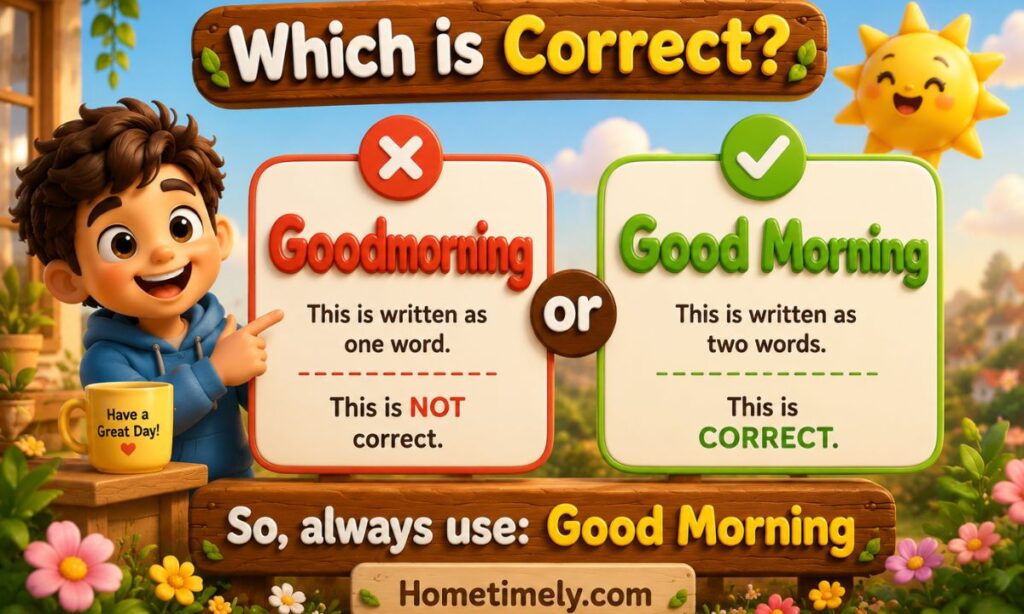
The answer is short, clear, and definitive: good morning — always two separate words.
- ✅ Good morning → Correct. Standard English. Accepted in every dictionary.
- ❌ Goodmorning → Incorrect. Not recognized in any standard dictionary, including Merriam-Webster, Oxford, or Cambridge.
The key difference is spacing and correctness — “good morning” is two words and is grammatically correct, while “goodmorning” written as one word is not recognized in standard English.
Think of it like “thank you” or “happy birthday.” You’d never write “thankyou” or “happybirthday” as one word, and the same logic applies here. The two-word rule holds in every context, every time.
The History and Origin of Good Morning
Understanding where a phrase comes from often makes it easier to remember how it’s written correctly.
The greeting “good morning” as a salutation dates to around the year 1400, formed from good (adjective) and morning, with earlier forms including “good morwe” (late 14th century) and “good morn.”
It derives from Middle English gud mornynge (also as goode morne, gode morne), which itself came from Old English gōdne morgen, understood as an ellipsis for an expression such as “I wish you a good morning.”
The phrase gained particular popularity in the 18th century, especially in polite society where greetings were an essential aspect of social interaction.
Interestingly, the phrase has always remained two distinct words. Unlike “goodbye,” which evolved and contracted from “God be with ye” over centuries, good morning never merged historically into one word. English greetings were built on an adjective-plus-noun structure, and that structure kept them separate.
A popular myth on social media claims that “good morning” derived from a taunt directed at enslaved people during the colonial era, confusing the word “mourning” with “morning.” This claim is false. The phrase has been used for many centuries, dating back well before the modern colonial era, and “morning” and “mourning” originate from entirely different word stems.
British vs. American English: Spelling and Style
One of the most common questions people ask is whether British and American English differ on this point. They do not.
Unlike many spelling debates in English, British and American English agree completely here — both follow the same rule: two words, always.
The pronunciation differs slightly between the two dialects. The Cambridge Dictionary lists the American English pronunciation as /ɡʊd ˈmɔrnɪŋ/ and the British English pronunciation as /ɡʊd ˈmɔːnɪŋ/ — but neither spelling changes. Whether you’re writing to a colleague in London or a client in New York, good morning is the only correct form.
Goodmorning or Good Morning Meaning
Beyond spelling, it helps to understand what “good morning” actually means and how it functions grammatically.
The Cambridge Advanced Learner’s Dictionary defines good morning as “something you say to greet someone politely when you meet them in the morning.”
The Longman Dictionary of Contemporary English classifies it as a formal interjection, used to say hello when greeting someone in the morning, while noting that in informal everyday English, people often just say “Morning.”
Grammatically, the phrase works as an open compound — two independent words used together to function as a single greeting expression. “Good” is an adjective describing the quality of the “morning,” and “morning” is the noun. Because each word carries its own independent meaning, English grammar keeps them apart. Merging them into “goodmorning” breaks that structure without any historical or grammatical justification.
In linguistics and semantics, it functions as an open compound that demonstrates correctness in orthography, while “goodmorning” is considered an incorrect spelling and a common variation picked up in casual social interaction.
Goodmorning or Good Morning in Spanish
When you translate “good morning” into Spanish, the equivalent phrase is buenos días — literally meaning “good days” (note the plural).
Buenos días is an essential part of the Spanish language and is widely used as a formal way to greet people from sunrise until noon.
The full original phrase was buenos días os dé Dios, which translates to “good days for ye of God,” later shortened over time to simply buenos días.
Here’s a quick reference for morning greetings across several major languages:
| Language | Morning Greeting | Literal Meaning |
| Spanish | Buenos días | Good days |
| French | Bonjour | Good day |
| German | Guten Morgen | Good morning |
| Italian | Buongiorno | Good day |
| Portuguese | Bom dia | Good day |
| Japanese | おはようございます | Early rising (honorific) |
Unlike English, where “good morning” can be used fairly casually, “buenos días” in Spanish holds a tone of formality and is commonly used in professional settings and when addressing people you don’t know well.
Correct Usage in Writing
Knowing the correct spelling is just the start. Using it correctly across different writing contexts matters just as much.
Formal Writing
In formal writing — emails, business correspondence, academic work, cover letters — the rules are strict.
- Always write good morning as two words.
- Capitalize only the first word when it begins a sentence or greeting line: Good morning, Mr. Johnson.
- Add a comma after “good morning” when directly addressing someone by name: Good morning, Sarah, not Good morning Sarah.
- Avoid exclamation marks in very formal contexts unless the tone warrants it.
Examples:
- Good morning, everyone. I’d like to start today’s meeting with a brief update.
- Good morning, Dr. Patel. Thank you for your time.
Informal or Casual Writing
In casual writing — texts, personal emails, notes to friends — the same two-word rule applies, even if the tone is relaxed.
- You can shorten it to just Morning! in very casual texts.
- Exclamation marks work fine in friendly messages.
- Lowercase is acceptable when not at the start of a sentence: She sent him a quick good morning text.
Examples:
- Morning! Hope you slept well.
- Just wanted to say good morning before your big presentation today.
Social Media or Online Posts
This is where “goodmorning” as one word appears most frequently — but it’s still wrong.
For captions or posts, either form may be understood, but for clarity and professionalism, sticking to good morning (two words) is always the safer choice.
In content marketing and blogging, using the correct spelling also matters for SEO — search engines index text precisely, and the correct form “good morning” is what users actually search for.
Examples:
- ✅ Good morning from the mountains! ☀️
- ❌ Goodmorning from the mountains! ☀️
Grammar and Structure
English Grammar Rules
The grammar behind “good morning” is simple once you see it clearly.
Structure: Adjective (good) + Noun (morning) = Open compound greeting
English creates compound words when two words merge conceptually into a single new unit with a distinct meaning — like “sunrise,” “breakfast,” or “nightfall.” These words merged because the combined concept differs from either word alone.
“Good morning” does not meet that standard. “Good” describes what kind of morning is being wished — it’s a describing word that adds meaning to “morning.” This pattern appears in other phrases too, like “nice day” or “happy birthday.” We don’t write “niceday” or “happybirthday,” and the same logic applies to “good morning.”
No grammar authority — British or American — accepts “goodmorning” as a compound word.
Example Sentences
Here are correctly written example sentences to model your own usage:
- Good morning, everyone — let’s get started.
- She wished her team a good morning before the presentation.
- He called the office at 9 a.m. to say good morning to the staff.
- The email began with a warm good morning and a project update.
- Good morning! I hope you had a restful night.
Capitalization Rules
Capitalization of “good morning” depends entirely on where it appears in a sentence — not on formality or context.
Rule 1 — Start of a sentence: Capitalize the G in Good.
Good morning, how are you?
Rule 2 — Mid-sentence use as a noun or reference: Lowercase both words.
She whispered a soft good morning as she walked in.
Rule 3 — Email greeting line: Capitalize only the G (since it starts the line).
Good morning, James,
Rule 4 — Titles or headings: Both words may be capitalized per title case rules.
Good Morning, Vietnam (movie title)
Rule 5 — Mid-sentence quoted greeting: Capitalize the G only if it’s a direct quote starting the quoted speech.
He said, “Good morning,” and sat down.
Quick Reference Table
| Situation | Correct Form | Example |
| Start of sentence | Good morning | Good morning, class. |
| Mid-sentence reference | good morning | She sent a good morning text. |
| Email greeting line | Good morning | Good morning, Ms. Lee, |
| Social media caption | Good morning | Good morning from Tokyo! |
| Title or heading | Good Morning | Good Morning, America |
| Direct address in quotes | Good morning | “Good morning,” he said. |
Common Mistakes with Good Morning
Even people who know the correct spelling make errors in usage. Here are the most frequent ones — and how to fix them.
Mistake 1: Writing it as one word
- ❌ Goodmorning, everyone!
- ✅ Good morning, everyone!
Mistake 2: Adding a hyphen
- ❌ Good-morning, how are you?
- ✅ Good morning, how are you?
Mistake 3: Missing the comma before a name
- ❌ Good morning John I hope you’re well.
- ✅ Good morning, John, I hope you’re well.
Mistake 4: Over-capitalizing mid-sentence
- ❌ She greeted everyone with a warm Good Morning.
- ✅ She greeted everyone with a warm good morning.
Mistake 5: Using it past noon Good morning is specifically for the morning hours — roughly from sunrise to noon. After noon, switch to good afternoon.
Quick Tips to Avoid Mistakes
- Think of the space as a signal of separate ideas: good (adjective) + morning (noun) = greeting.
- Compare it to “happy birthday” — you’d never merge that into one word either.
- Use grammar-checking tools like Grammarly or LanguageTool to catch spacing errors.
- Before sending any professional message, read the greeting aloud — you’ll naturally pause between the two words.
- In email templates, lock in the correct form: Good morning, [Name], — so it’s automatic.
- Remember: even if autocorrect or fast typing drops the space, that doesn’t make it right.
Using Good Morning in Everyday Life
Spoken vs. Written Usage
In spoken English, “good morning” is effortless — no one trips over where one word ends and the next begins. In writing, that natural pause between the two words can get lost.
Spoken: You naturally stress both syllables — GOOD MOR-ning — and the brief rhythmic pause signals two words.
Written: That rhythm disappears, which is why some people unconsciously close the gap and type it as one word.
In informal everyday English, people often drop the word “good” entirely and just say “Morning!” — but when writing the full phrase, both words always appear separately.
Examples
Here’s how good morning appears across everyday settings:
- Phone call opening: “Good morning, you’ve reached ABC Company. How can I help you?”
- Team meeting start: “Good morning, everyone. Let’s go through today’s agenda.”
- Email subject line: “Good Morning Check-In — Monday Recap”
- Text to a friend: “Morning! Coffee at 9?”
- Instagram caption: “Good morning from the coast. ☀️”
- Customer service chat: “Good morning! Thank you for reaching out.”
Cultural and Regional Nuances
While the spelling of “good morning” never changes, the way people use it carries rich cultural meaning across the world.
In many East Asian cultures, morning greetings carry deep respect and hierarchy — who speaks first and how you say it depends on the relationship. In Japanese, おはようございます (ohayou gozaimasu) is reserved for formal settings, while おはよう (ohayou) is casual.
In Arab cultures, the morning greeting Sabah al-khayr (صباح الخير) is typically answered with Sabah al-noor (صباح النور) — “morning of light” — a layered exchange that reflects hospitality and warmth.
In Spanish-speaking countries, non-verbal communication plays a crucial role alongside buenos días — a friendly smile, warm tone, and good eye contact add depth to the greeting, and depending on the country, a handshake, nod, or even a kiss on the cheek might accompany it.
In British English, the full “good morning” is considered more formal, while a simple “Morning!” is the standard casual version. In American English, both forms are equally common in everyday settings.
These cultural differences don’t change how “good morning” is spelled in English — but they’re a reminder that a greeting carries far more than two words.
Good Morning in Digital Communication
Digital communication has become the biggest driver of the “goodmorning” spelling error. Here’s why:
- Speed: People type fast on smartphones and skip the spacebar.
- Autocorrect: Some keyboards autocorrect or autocomplete greetings incorrectly.
- Social norms: Seeing “goodmorning” widely in informal chats creates a false sense that it’s acceptable.
- Copy-paste habits: People copy text without verifying whether the original was correct.
In professional communication — emails, reports, and official documents — a greeting like “goodmorning” can seem careless. First impressions, whether in person or online, reflect your attention to detail and literacy.
In customer service messaging, chatbots and support platforms are increasingly flagged for grammar errors by users. Starting a chat with “Goodmorning, how can I help?” can subtly undermine trust in the brand’s professionalism.
For content creators, bloggers, and SEO writers: search engines process and index your text literally. The correct form “good morning” matches actual search intent. Writing “goodmorning” in a headline or body text is not only incorrect — it creates a mismatch with what your audience searches for.
Also Read This : Breakroom or Break Room: Which One Is Correct and Why?
Google Trends and Usage Data
Search data tells a clear story. Millions of users every month search variations of this question — “goodmorning or good morning,” “is good morning one word,” “how to spell good morning,” “good morning spelling” — and consistently land on the same answer: two words.
Google’s autocomplete system actually recognizes and corrects “goodmorning” to “good morning” in many search queries, reflecting how the search engine itself processes the phrase as two words. Content analysis of top-ranking published articles, news sites, and official communications shows that the one-word version is almost entirely absent from edited professional text.
The one-word version appears more in informal texting but not in published or professional content — which proves people search to verify, not to use the incorrect form.
Search volume for “good morning” as a phrase dwarfs “goodmorning” by a significant margin, confirming that the two-word form dominates real-world usage at every level.
Good Morning vs GM
In digital messaging, especially in group chats and WhatsApp, “GM” has emerged as a shorthand for “good morning.” It’s widely understood in casual and semi-professional digital spaces.
| Form | Context | Professionalism Level |
| Good morning | All contexts | High |
| Morning! | Casual text / spoken | Medium |
| GM | Informal group chats / crypto/Web3 spaces | Low to medium |
| Goodmorning | Incorrect in all contexts | N/A |
“GM” has particularly taken root in online communities like crypto Twitter (now X), where it became a cultural shorthand for positivity and community. But in any business email, official document, or client-facing communication, “GM” is inappropriate — only the full, correctly spelled “good morning” will do.
Reference Cambridge Dictionary Definitions
The Cambridge Dictionary is one of the most authoritative sources in the English-speaking world. Here is what it says about “good morning”:
The Cambridge Advanced Learner’s Dictionary defines good morning as “something you say to greet someone politely when you meet them in the morning.”
The Cambridge Dictionary classifies it as an interjection (pronunciation: /ɡʊd ˈmɔrnɪŋ/) defined as “used as a greeting in the morning,” with the example: “Good morning, class.”
The entry lists the phrase exclusively as two words. There is no entry for “goodmorning” in any Cambridge dictionary — not as an alternate spelling, a variant, or a colloquialism.
Collins English Dictionary similarly classifies good morning as an interjection, noting: “You say ‘Good morning’ when you are greeting someone in the morning.”
The Longman Dictionary of Contemporary English labels it a formal interjection while noting that in informal everyday English, people often shorten it to simply “Morning.”
Merriam-Webster, Oxford, and every other major dictionary align on the same position: two words, always.
Conclusion
The answer to “goodmorning or good morning” is about as clear as it gets in the English language: it’s always good morning, written as two separate words, in every context, in every country, in every register.
The confusion exists because we live in a world of fast typing, autocorrect shortcuts, and informal digital chat — environments where speed often beats accuracy. But grammar rules don’t bend to convenience. “Good morning” is an open compound — an adjective and a noun that remain distinct because they each carry independent meaning.
Whether you’re opening a business email, captioning a travel photo, texting a friend, or greeting a room full of colleagues, the rule is the same: two words, one space, clear intention.
The next time someone sends you a “Goodmorning!” message, you can smile, respond with a perfectly spelled “Good morning!” back, and know you’ve already won the grammar round for the day.

Michael Brook is the creator and author behind Healthy Leeks, a platform focused on grammar, writing skills, and English language learning. Passionate about clear communication and effective writing, Michael Brook shares practical grammar tips, easy-to-follow language guides, and educational content to help readers improve their English with confidence.