
Few English plurals trip people up as often as this one. You type a sentence about stomachs, pause for a half-second, and suddenly you’re not sure whether it’s “bellies” or “bellys.” Spellcheck usually catches it before you hit publish, but the hesitation is real, and it happens to native speakers and English learners alike.
The good news is that the rule behind this word is short, consistent, and easy to remember once it clicks. This guide walks through the correct spelling, the grammar rule that explains it, how the word is used in real sentences, and the common mistakes that trip writers up most often. By the end, you won’t have to think twice about it again.
Bellies or Bellys The Quick Answer
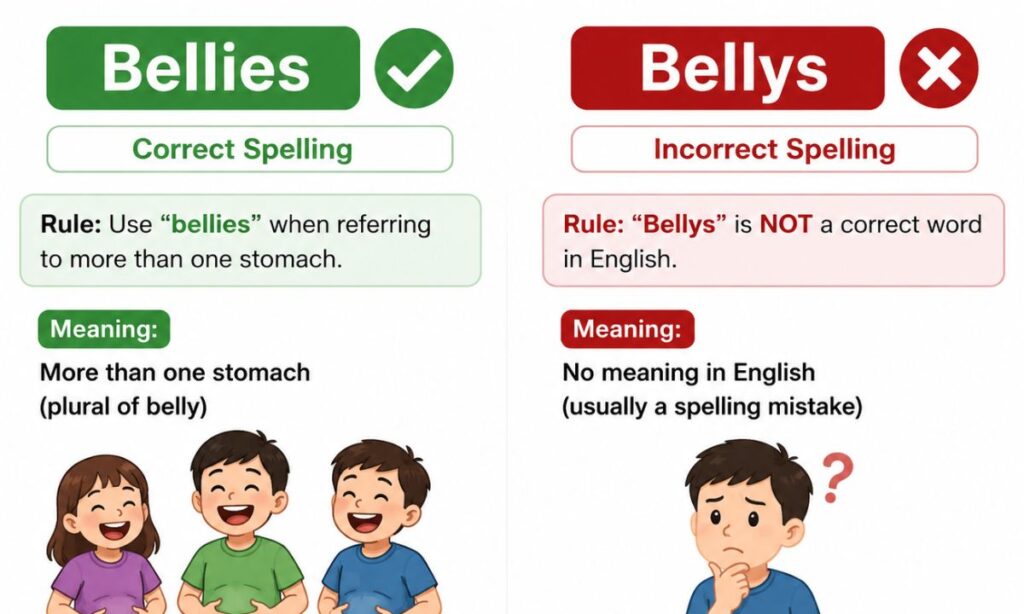
The correct plural of “belly” is bellies. “Bellys” is not a recognized English word — it’s a spelling mistake, not an alternate form.
| Form | Status | Example |
| Bellies | Correct | The puppies rolled onto their bellies. |
| Bellys | Incorrect | The puppies rolled onto their bellys. ❌ |
| Belly’s | Correct (singular possessive) | The belly’s shape changed during pregnancy. |
| Bellies’ | Correct (plural possessive) | The babies’ bellies’ soft skin was sensitive. |
This isn’t a matter of regional preference or style choice. It’s a basic pluralization rule that applies across British English, American English, and every other major English dialect. There’s no UK/US split here, unlike words such as “colour” versus “color.”
Meaning of Belly and Bellies
Before getting deeper into spelling, it helps to understand what the word actually means, since context shapes how it’s used.
“Belly” is a noun that refers to:
- The front part of the human or animal body between the chest and the hips, where the stomach sits
- The stomach itself, in casual or figurative speech (“My belly hurts”)
- The underside of an animal, such as a fish or a snake
- The rounded, bulging part of an object, like the belly of a ship or the belly of a guitar
“Bellies” is simply the plural of all of these meanings. When you’re talking about more than one stomach, more than one rounded object, or a group of people or animals, you reach for “bellies.”
Examples in context:
- The children patted their full bellies after the picnic.
- The dolphins’ bellies flashed white as they leapt out of the water.
- Both ships had wide bellies built for cargo.
Why “Bellys” Is Wrong
“Bellys” breaks one of the most consistent rules in English noun pluralization. Here’s the rule in plain terms:
When a noun ends in a consonant + y, you drop the “y” and add “-ies” to form the plural.
Belly ends in “l” (a consonant) followed by “y,” so the plural becomes “bell” + “ies” = bellies.
Compare this to nouns that end in a vowel + y. Those simply take an “-s,” with no spelling change at all:
| Consonant + y (change to -ies) | Vowel + y (just add -s) |
| Belly → Bellies | Boy → Boys |
| Baby → Babies | Toy → Toys |
| City → Cities | Day → Days |
| Puppy → Puppies | Key → Keys |
| Lady → Ladies | Monkey → Monkeys |
Because “belly” falls into the first category, “bellys” simply has no grammatical basis. It doesn’t appear in dictionaries, style guides, or accepted English usage. When it shows up, it’s almost always the result of someone applying the “just add s” rule without remembering the consonant-y exception — or a fast-typing mistake that autocorrect didn’t catch.
The Origin of Belly
The word “belly” has a long history in English. It traces back to the Old English word belg (sometimes spelled bælg or belig), which originally meant a bag, sack, or pouch — not specifically the stomach.
Over centuries, the meaning narrowed and shifted toward the body part we now associate with the word: the stomach and abdominal region. This kind of semantic shift is common in English, where a word for an object (a bag) gradually comes to describe a body part that resembles or contains something (the abdomen, which “holds” digested food).
The plural form followed the standard English pattern that developed for consonant-plus-y nouns, which is why “bellies” — not “bellys” — became the accepted plural as the spelling of English settled into its modern form.
This kind of pattern isn’t unique to “belly.” English absorbed a huge number of words from Old English, Old Norse, and Norman French, and as spelling conventions standardized over the fourteenth through seventeenth centuries, certain endings were regularized across large groups of words at once. The consonant + y → ies rule is one of those standardizations, which is why it applies so consistently to “belly,” “baby,” “city,” “lady,” and dozens of other unrelated nouns that all happen to share the same ending pattern. Understanding that this is a systemic spelling rule — not a quirky exception specific to one word — is often what finally makes the rule stick for writers who have struggled with it.
British English vs American English
One of the most common questions writers have is whether this word changes between British and American English, the way many other words do.
It doesn’t.
| Feature | British English | American English |
| Plural spelling | Bellies | Bellies |
| Singular spelling | Belly | Belly |
| Possessive | Belly’s / Bellies’ | Belly’s / Bellies’ |
| Pronunciation | Bel-eez | Bel-eez |
Unlike pairs such as “colour/color,” “theatre/theater,” or “travelling/traveling,” there’s no transatlantic split for this word. Major style guides on both sides of the Atlantic, including those followed by British and American publishers and editors, agree that “bellies” is the only correct plural. This makes the word a safe, universal choice no matter who your audience is.
Bellies or bellys pronunciation
Pronunciation can be a small source of confusion too, mostly because some people aren’t sure how the “-ies” ending should sound.
The correct pronunciation of “bellies” is: BEL-eez (rhymes with “valleys”).
A few quick pronunciation notes:
- The stress falls on the first syllable: BEL-eez, not bel-EEZ.
- The “-ies” ending sounds like a long “e” — similar to the ending in “babies” or “cities.”
- “Bellys,” even though it isn’t a correct spelling, would be pronounced the same way if anyone tried to say it aloud. The pronunciation doesn’t change; only the spelling does.
If you’re ever unsure how to spell the word, saying it slowly and comparing it to other familiar -y words like “puppies” or “ladies” can help you remember the correct ending.
It’s also worth noting that pronunciation is one of the main reasons “bellys” keeps showing up in casual writing. Because the spoken word doesn’t reveal the spelling change, people who are typing quickly, texting, or writing from memory often default to the visually “simpler” version. This is a common pattern across many irregular plurals in English — the ear doesn’t always guide the hand correctly, which is why understanding the written rule matters more than relying on sound alone.
Bellies or bellys origin

As covered above, “bellies” comes from the Old English term for a bag or pouch, which gradually evolved to describe the stomach and midsection of the body. “Bellys,” on the other hand, has no historical origin at all — it isn’t a variant spelling that fell out of use or a regional form that survived in some dialect. It’s simply a modern misapplication of the basic pluralization rule, most often seen in:
- Fast, informal typing or texting
- Social media captions and comments
- Early drafts that haven’t been proofread
- Writing by English learners who are still mastering plural patterns
Because “bellys” has no legitimate linguistic history, you won’t find it in dictionaries, academic writing, or edited publications. It exists almost exclusively as an error.
Common Mistakes with Bellies
Even confident writers slip up occasionally. Here are the mistakes that show up most often:
- Writing “bellys” instead of “bellies.” This is by far the most common error, usually from applying the simple “add s” rule out of habit.
- Confusing “belly’s” with “bellies.” “Belly’s” is a singular possessive (the belly’s shape), while “bellies” is a plural noun. They aren’t interchangeable.
- Mixing up “belly” with “belie.” “Belie” is a completely unrelated verb meaning to give a false impression or contradict something. It has nothing to do with stomachs.
- Getting the possessive plural wrong. The correct plural possessive is “bellies'” (the babies’ bellies’ softness), not “bellys'” or “belly’s” when referring to more than one.
- Overgeneralizing the rule to vowel-y words. Some writers, once they learn the consonant-y rule, mistakenly apply it to words like “boy” or “toy,” producing “boies” or “toies.” The rule only applies when a consonant comes before the “y.”
A useful way to internalize all of this is to build a personal reference list of consonant + y nouns you encounter often — words like “belly,” “baby,” “city,” “puppy,” “party,” and “country” — and quiz yourself on their plurals periodically. Because the rule is completely regular, once it’s memorized for a handful of examples, it transfers automatically to nearly every other word with the same ending pattern. This is one of the more “learnable” grammar rules in English, unlike irregular plurals such as “mouse/mice” or “child/children,” which simply have to be memorized individually with no underlying pattern to lean on.
How to Use Bellies Correctly in Sentences
Once you know the spelling is settled, the next step is using “bellies” naturally and accurately across different types of writing.
1. Literal Usage: Talking About Stomachs
This is the most direct and common use of the word, referring to actual stomachs or midsections.
- The babies had round, full bellies after their bottles.
- The swimmers floated face-down, bellies skimming the surface of the pool.
- Vets often check a dog’s belly during a routine physical exam.
2. Figurative Usage: Emotions or Experiences
“Bellies” frequently shows up in figurative expressions describing feelings, especially nervousness, excitement, or amusement.
- The students felt butterflies in their bellies before the exam results were posted.
- Laughter shook their bellies until tears rolled down their faces.
- Nerves twisted in their bellies as the plane began its descent.
3. Idiomatic Expressions
English has several set phrases built around “belly,” and the plural form fits naturally into many of them.
- Belly laughs: “The comedy show left the audience with aching bellies from laughing so hard.”
- Fire in the belly: “Both candidates entered the race with fire in their bellies.”
- Full bellies: “After Thanksgiving dinner, everyone sat back with full bellies.”
4. Common Mistakes to Avoid
When using “bellies” in sentences, keep these guardrails in mind:
- Don’t switch to “bellys” mid-sentence out of habit — proofread plural forms specifically.
- Don’t use “belly’s” when you mean more than one belly.
- Watch for autocorrect, which sometimes “fixes” the word incorrectly on certain keyboards.
5. Quick Tips for Writers
- Read the sentence aloud. If “bellys” sounds off compared to “babies” or “cities,” that’s a useful cue.
- Picture the word: belly → drop the y → bell + ies → bellies.
- Keep a mental list of similar consonant-y words (baby, city, puppy, lady) as a quick reference pattern.
- When in doubt, check a dictionary rather than relying on instinct or autocorrect.
Also Read This : Message vs Messege: Meaning, Spelling & Examples
Bellies in Everyday Language
Beyond grammar guides, “bellies” appears constantly in everyday speech, parenting language, fitness culture, and storytelling.
- Parents talk about “baby bellies” and “tummy time.”
- Fitness content frequently references “flat bellies,” “belly fat,” or “belly breathing” techniques.
- Children’s books and cartoons often describe animals with “round bellies” or “soft bellies” as a way to make characters feel warm and approachable.
- In casual conversation, people describe being “hungry” or “full” by referencing their bellies rather than using more clinical words like “stomach” or “abdomen.”
This widespread, informal usage is part of why the spelling mistake “bellys” appears so often online — the word is used constantly in casual writing, where proofreading tends to be lighter.
The word also carries strong emotional and sensory associations in everyday speech. A “full belly” suggests comfort and contentment, while an “empty belly” signals hunger or hardship. Phrases like “belly up” (to fail or go bankrupt, as in a business going belly up) and “belly to belly” (close physical contact) show how flexible and embedded the word has become in informal English. None of these idiomatic uses change the spelling rule when the word is pluralized — “bellies” remains correct whether you’re describing literal stomachs, financial failures, or emotional states.
Marketing and lifestyle content adds another layer of everyday usage. Health and wellness articles frequently discuss “gut health” and “bellies” in the same breath, parenting blogs document “baby bellies” through pregnancy and infancy, and recipe sites describe how a dish will “fill your bellies” after a long day. Because this word shows up across so many casual, high-volume content categories, getting the spelling right has real value for anyone publishing online — readers notice small errors, even if they can’t always articulate why a sentence feels slightly off.
Bellies Shoes
“Bellies” also has a specific meaning in the world of footwear. In several regions, particularly South Asia, “bellies” (sometimes styled “belly shoes”) refers to a style of flat, ballet-style women’s shoes — soft, slip-on flats without heels. This usage is distinct from the anatomical meaning but follows the exact same plural spelling rule, since it’s still the plural of the noun “belly” used as a product category name (a single shoe in that style might be casually called a “belly shoe” or “belly”).
If you’re shopping for or writing about this type of footwear, the correct plural remains “bellies” — for example, “She wore a pair of gold bellies to the wedding,” not “bellys.”
This footwear usage is a good reminder that English words frequently develop specialized meanings within specific industries or regions without losing their original grammar rules. Whether a fashion blogger is describing a new collection of embroidered bellies, an e-commerce listing is categorizing “women’s bellies” alongside sandals and heels, or a customer is asking a store assistant for a comfortable pair of bellies, the plural form follows the same consonant + y rule as the anatomical meaning. Retailers and content writers covering footwear should treat “bellys” as a spelling error here too, since search engines and readers both expect consistent, dictionary-correct spelling regardless of which meaning of the word is being used.
Case Study How Clear Guidance Prevents Mistakes
Spelling habits are often shaped by repeated exposure rather than memorized rules. A useful illustration: in online writing communities — particularly forums frequented by younger writers and English learners — the misspelling “bellys” tends to spread simply because people see it used by others and copy the pattern without questioning it.
When a moderator, teacher, or experienced writer steps in with a short, clear explanation of the rule (consonant + y becomes ies), the correction tends to spread quickly through the same social pattern that spread the mistake. Peer correction reinforces the right spelling, and over time, the error becomes far less common in that space.
The takeaway for writers and content creators is straightforward: clear, simple explanations of grammar rules — rather than vague reminders to “just spell it correctly” — are what actually change writing habits. Understanding why “bellies” is correct sticks far better than memorizing it as an isolated exception.
Bellies Usage Patterns and Trends
Search interest in “bellies vs bellys” has remained steady over time, largely because the confusion is genuinely common rather than a passing trend. A few patterns worth noting:
- The error appears far more often in casual digital writing — texts, social captions, forum posts — than in edited, professional content.
- English learners are statistically more likely to make this mistake early on, since the consonant-y rule isn’t always taught explicitly or practiced enough to become automatic.
- Autocorrect tools on most major platforms now flag “bellys,” which has gradually reduced how often it appears in finished, published writing, even though it still shows up frequently in first drafts.
- Content created for search engines benefits from using the correct spelling consistently, since search engines and readers alike associate accurate grammar with higher-quality, more trustworthy writing.
There’s also a generational element to this pattern. Younger writers who grew up primarily texting and messaging on mobile keyboards, where autocorrect handles much of the spelling burden automatically, sometimes develop weaker intuitive grasp of less-common plural rules, since the correction happens silently and is never explained. Older writers and those trained through traditional classroom grammar instruction tend to apply the consonant-y rule more automatically, having drilled it through repeated examples like “baby/babies” and “city/cities” in school. Either way, the trend across published, professional content is clear: “bellies” remains the dominant and expected spelling, and “bellys” is treated as an error to be corrected during editing, not a stylistic variant to be preserved.
Reference Cambridge Dictionary Definitions
Major English dictionaries, including Cambridge Dictionary, list “belly” as a noun referring to the front part of the body between the chest and the legs, where the stomach is located, with “bellies” given as its standard plural form. No major dictionary lists “bellys” as an accepted variant or alternate spelling. This consistency across dictionaries — rather than any single source — is what confirms “bellies” as the only standard, accepted plural in modern English.
Conclusion
The choice between “bellies” and “bellys” isn’t really a choice at all — it’s a straightforward application of a rule that governs many other English nouns ending in consonant + y, from “baby” to “city” to “puppy.” Bellies is correct in every context: literal, figurative, idiomatic, formal, and casual. Bellys, by contrast, is a spelling mistake with no dictionary support, no regional variant status, and no historical basis.
Once the consonant-y rule clicks, this spelling stops being a source of hesitation. The next time you’re writing about stomachs, soft toys, round-bellied animals, or even a pair of flat shoes, you can type “bellies” with full confidence — and your writing will read as polished and correct because of it.

Michael Brook is the creator and author behind Healthy Leeks, a platform focused on grammar, writing skills, and English language learning. Passionate about clear communication and effective writing, Michael Brook shares practical grammar tips, easy-to-follow language guides, and educational content to help readers improve their English with confidence.