Have you ever typed a sentence, paused right before adding “-corporate,” and wondered whether it should start with “in” or “en”? You’re not imagining things — this is one of those words that sounds almost identical either way when spoken quickly, which is exactly why so many writers hesitate over it.
The confusion is understandable, but the answer is straightforward once you know the reasoning behind it. This guide walks through the correct spelling, where the word comes from, and why the alternative version simply doesn’t hold up in standard English.
Encorporate
“Encorporate” is not a recognized English word. It doesn’t appear in any major dictionary, and it has no accepted definition. It’s a spelling error that usually results from mishearing the word or assuming it follows the same pattern as words like “encourage” or “enable.”
Incorporate
“Incorporate” is the correct spelling in every form of English. It means to include something as part of a larger whole, or, in a business and legal context, to formally register a company as a corporation.
Encorporate or Incorporate: Quick Answer
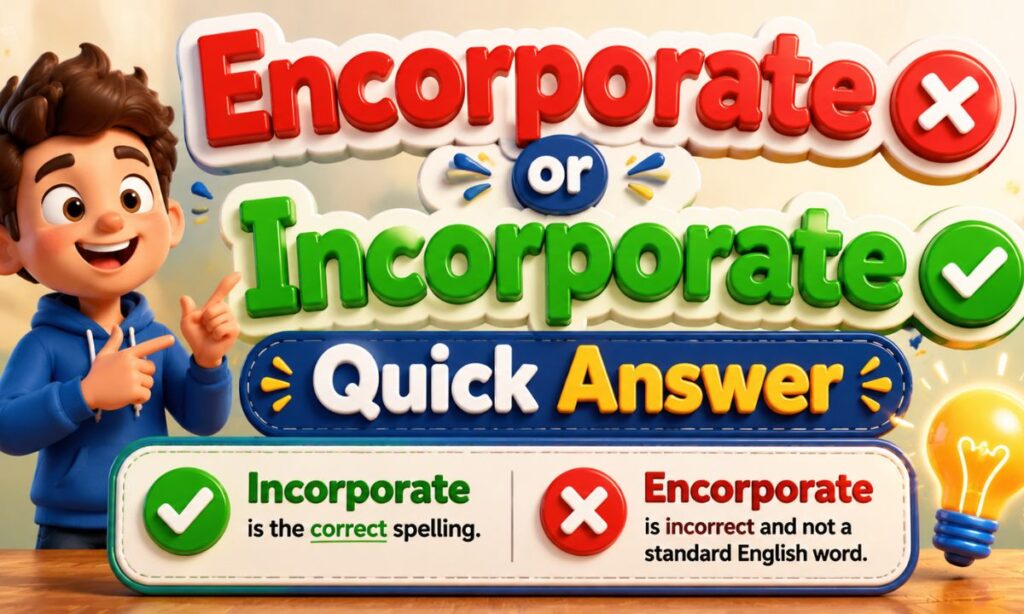
If you only have ten seconds, here’s everything you need to know: always use “incorporate.” There is no situation — formal, informal, academic, or legal — where “encorporate” is the correct choice. It isn’t a regional variant, an older spelling, or an acceptable alternative. It’s simply a mistake, and one that spell checkers and grammar tools will flag immediately.
- Correct: We plan to incorporate your feedback into the next draft.
- Incorrect: We plan to encorporate your feedback into the next draft.
- Correct: The founders decided to incorporate the business in Delaware.
- Incorrect: The founders decided to encorporate the business in Delaware.
The Origin of Encorporate/Incorporate
Understanding the word’s history makes the correct spelling much easier to remember.
“Incorporate” comes from the Latin word “incorporare,” which combines the prefix “in-” (meaning “into” or “within”) with “corpus,” meaning “body.” Put together, the word literally meant “to form into one body” or “to bring into a single whole.” This root traveled through Middle English relatively unchanged, and the modern spelling “incorporate” has remained standard for centuries.
“Encorporate” has no comparable root. There’s no Latin or French ancestor that produced an “en-” version of this word. Its appearance in modern writing is a spelling error rather than a genuine linguistic variant, and it holds no historical or etymological legitimacy, despite occasionally surfacing in older or informal texts.
The reason the mistake happens so often comes down to prefix confusion. English has plenty of common words that begin with “en-” — encourage, enable, enrich, endure — so it’s a natural (if incorrect) assumption that “incorporate” might follow the same pattern. But this word’s Latin root locks in the “in-” prefix permanently.
British English vs American English Spelling
One reassuring fact about this word: you don’t need to worry about regional spelling differences. Unlike pairs such as “organize/organise” or “color/colour,” “incorporate” is spelled exactly the same in American, British, Australian, and Canadian English. There is no accepted “en-” version anywhere in the English-speaking world.
- United States: Incorporate
- United Kingdom: Incorporate
- Canada: Incorporate
- Australia: Incorporate
- International/ESL contexts: Incorporate
This consistency makes “incorporate” one of the simpler words to get right once you commit the spelling to memory — there’s no need to adjust it based on your audience or publication style guide.
Which Spelling Should You Use?
The answer never changes based on context: always use “incorporate.” Whether you’re writing a legal document, a casual email, a school essay, or a social media caption, “incorporate” is the only acceptable spelling.
Here’s a simple breakdown of where you’ll typically see it:
- Legal and business writing: “The company was incorporated in 2021.”
- Academic writing: “Students should incorporate multiple sources into their essays.”
- Everyday communication: “Try to incorporate more vegetables into your meals.”
- Technology and product writing: “The app will incorporate new security features next month.”
No matter the setting, “encorporate” should never appear. If you see it in something you’re reading, it’s a typo or spelling mistake, not an accepted stylistic choice.
Incorporate or Encorporate: Spelling Variations & Common Errors
Beyond the main “en-” versus “in-” mix-up, a few related typing errors tend to show up alongside this word. Knowing them in advance helps you catch mistakes before they slip into a final draft.
| Incorrect Form | Why It Happens | Correct Form |
| Encorporate | Prefix confusion with “en-” words | Incorporate |
| Incoperate | Missing “r,” rushed typing | Incorporate |
| Incorprate | Dropped vowel, fast typing | Incorporate |
| Incorporrate | Extra “r,” pattern confusion | Incorporate |
| Encorprate | Combination of both errors above | Incorporate |
Recognizing these patterns can help you proofread more effectively, especially in longer documents where a single misspelling might otherwise go unnoticed.
Common Mistakes with Encorporate/Incorporate
Even confident writers slip up here occasionally. Here are the most frequent reasons this happens:
- Mishearing the word in conversation. Spoken quickly, “incorporate” can sound close to “encorporate,” especially to non-native speakers still building their ear for English pronunciation.
- Assuming an “en-” prefix pattern. Because so many common verbs start with “en-,” some writers default to that prefix without checking the specific word’s origin.
- Typing too quickly. Like many spelling errors, this one often comes down to rushed typing rather than a genuine misunderstanding of the rule.
- Confusing it with similar words. Words like “encircle,” “encourage,” and “enrich” share a similar rhythm, which can create false pattern recognition.
- Trusting an unverified source. If a writer copies phrasing from an uncorrected document, forum post, or casual message, the mistake can spread further.
Easy Trick to Remember the Correct Spelling
Here’s a memory shortcut that sticks: think of the word “IN” as the key to unlocking the spelling. When you incorporate something, you’re putting it in — inside a company, inside a plan, inside a whole. That small connection between “in” and “incorporate” is enough to anchor the correct spelling in your mind.
Another helpful approach is to break the word into its parts: “in” + “corporate.” Since “corporate” is a familiar, correctly spelled word on its own, all you need to do is remember to attach “in-” rather than “en-” to the front of it.
A quick visual comparison also helps:
- ✅ IN-corporate → correct, clean, standard
- ❌ EN-corporate → incorrect, doesn’t exist in any dictionary
Incorporating, Incorporated & Other Forms Explained
“Incorporate” changes form depending on tense and use, just like any regular English verb. Here’s how the full family looks:
| Form | Spelling | Example |
| Base verb | Incorporate | We should incorporate this idea. |
| Past tense | Incorporated | The business was incorporated last year. |
| Present participle | Incorporating | She is incorporating feedback into the design. |
| Adjective | Incorporated | The incorporated entity filed its paperwork. |
| Noun (related) | Incorporation | The incorporation process took several weeks. |
Every one of these forms keeps the same “in-” prefix. There is no version of this word family, in any tense or form, that uses “en-” instead.
Encorporate/Incorporate in Everyday Examples
Seeing the correct spelling used naturally across different writing styles helps reinforce it in daily use.
Emails
“Please incorporate the client’s latest comments before we send the final version tomorrow.”
News Articles
“The new legislation will incorporate stricter guidelines for data privacy across the industry.”
Social Media
“Small changes can make a big difference — try to incorporate one healthy habit into your routine this week.”
Formal Writing
“The committee agreed to incorporate the proposed amendments into the official policy document.”
Across all four contexts, the spelling never changes. That consistency is exactly why “incorporate” is considered a reliable, low-risk word once you’ve learned it correctly.
British vs American English: Is There Any Difference?
As mentioned earlier, no — there’s no British-versus-American distinction here. This sets “incorporate” apart from many other commonly confused English words. For comparison, consider words that genuinely do shift between regions:
| Word Type | American English | British English |
| Color-related | Color | Colour |
| Organize-related | Organize | Organise |
| Travel-related | Traveled | Travelled |
| Incorporate-related | Incorporate | Incorporate |
Notice that “incorporate” stays identical while the others shift. This means you can use it confidently in any English-speaking market, publication, or audience without needing to adjust your spelling for regional style guides.
Also Read This : Stopping or Stoping: The Complete Guide to Correct English Usage
Encorporate/Incorporate: Google Trends & Usage Data
Search interest data consistently shows that “incorporate” is searched far more often than “encorporate,” and largely for legitimate, correct usage — business formation, academic writing, and everyday vocabulary building. Searches specifically comparing the two spellings tend to come from:
- Students double-checking essay vocabulary
- Business owners exploring how to legally register a company
- ESL learners building confidence with tricky English spelling patterns
- Professionals proofreading emails, proposals, or reports before sending them
Search patterns also spike around tax season and new business registration periods, when more people are researching how to legally “incorporate” a company and want to confirm they’re using the term correctly in official paperwork.
Comparison Table: Encorporate vs Incorporate
Here’s a condensed reference table you can return to any time you need a quick check.
| Feature | Incorporate | Encorporate |
| Correct spelling | Yes | No |
| Found in dictionaries | Yes | No |
| Used in legal/business writing | Yes | Never |
| Used in academic writing | Yes | Never |
| Regional spelling differences | None | Not applicable |
| Flagged by spell checkers | No | Yes |
| Latin root | Incorporare | None |
| Prefix | in- | en- (incorrect) |
Conclusion
The choice between “incorporate” and “encorporate” isn’t really a choice at all — only “incorporate” is correct, and it has been for centuries, thanks to its clear Latin roots in “in-” and “corpus.” The confusion largely comes down to pronunciation and the influence of other common “en-” words, but once you understand the actual origin of the word, the correct spelling becomes much easier to lock in permanently.
Whether you’re registering a business, writing a school paper, drafting a professional email, or posting on social media, remembering the simple “in” connection — putting something in, inside, or into a whole — will keep you spelling this word correctly every time. Skip “encorporate” entirely, and your writing will read as clear, accurate, and professional across every context you use it in.

Michael Brook is the creator and author behind Healthy Leeks, a platform focused on grammar, writing skills, and English language learning. Passionate about clear communication and effective writing, Michael Brook shares practical grammar tips, easy-to-follow language guides, and educational content to help readers improve their English with confidence.