
If you’ve ever paused mid-sentence wondering whether to write “stopping” or “stoping,” you’re not alone. This single missing letter trips up students, professional writers, and even native English speakers on a regular basis. The good news is that the rule behind it is simple once you see it clearly, and this guide walks through everything — the grammar rule, the rare technical meaning of “stoping,” regional spelling differences, and real examples you can use right away.
By the end of this article, you’ll never have to second-guess this spelling again.
Stopping
“Stopping” is the present participle and gerund form of the everyday verb “stop.” It describes the act of halting, pausing, or ending movement, action, or a process. You’ll see it in sentences like “The train is stopping at every station” or “She’s stopping by the office later.”
Stoping
“Stoping” is a much rarer word, and it isn’t a standard verb form at all. It’s a technical noun and verb used almost exclusively in mining and geology, referring to the process of removing ore from underground to create an open space known as a “stope.” Outside of that specialized field, “stoping” is almost always a spelling mistake.
Stopping or Stoping: Quick Answer
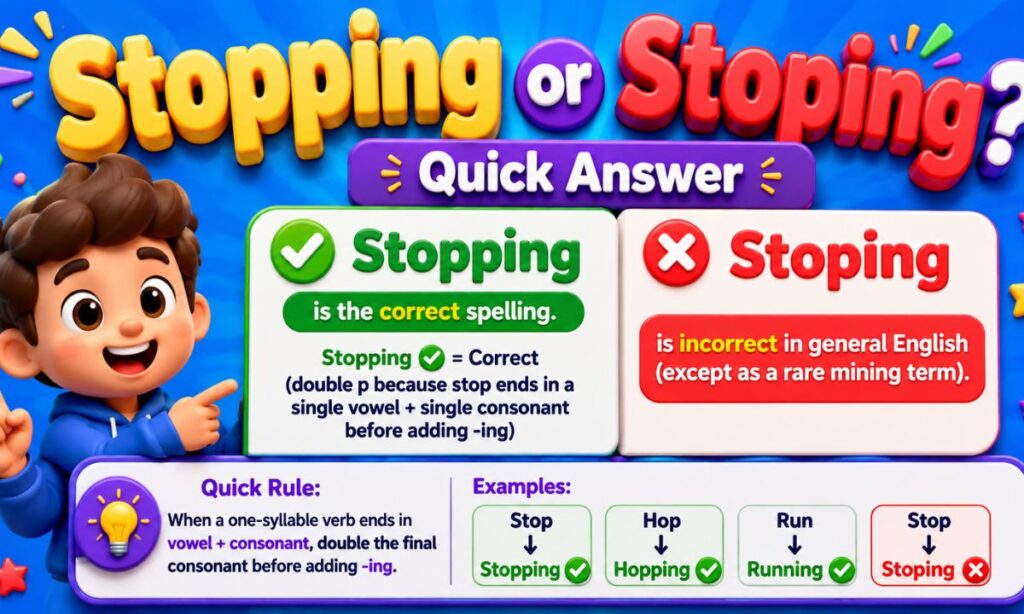
Here’s the short version, in case you’re in a hurry:
- Correct spelling for everyday use: stopping
- “Stoping”: technically valid, but only in mining and geology contexts
- Rule at play: the doubling of the final consonant when adding “-ing” to short, one-syllable verbs ending in a single consonant after a single vowel
If you’re writing an email, essay, article, or text message about pausing or halting something, “stopping” is the word you want — every time.
The Origin of Stopping
The verb “stop” has deep roots in English, tracing back to Old English “stoppian,” meaning to plug or block up, which itself came from a Late Latin word related to stuffing or plugging with material. Over centuries, the meaning broadened from physically blocking something to the more general sense we use today: to cease, halt, or bring to an end.
When English grammar rules developed around adding suffixes like “-ing” or “-ed,” a consistent pattern emerged for short verbs. Words that end in a single vowel followed by a single consonant — and carry the stress on that final syllable — double the last consonant before adding the suffix. “Stop” fits this pattern exactly, which is why it becomes “stopping” and not “stoping.”
This isn’t a random quirk. The doubled consonant actually protects the pronunciation of the word. Without it, “stoping” would visually suggest a long vowel sound, similar to words like “hoping” or “coping,” which would completely change how the word is meant to be pronounced.
Linguists sometimes call this the “short vowel protection rule,” because the doubled letter acts as a visual signal that the vowel before it stays short. English relies heavily on spelling patterns like this to help readers pronounce words correctly without needing a phonetic guide next to every sentence. Once you understand that the doubled consonant is doing a specific job — protecting the short “o” sound — the spelling stops feeling arbitrary and starts feeling logical.
It’s also worth noting that “stop” has stayed remarkably stable in meaning for centuries. While plenty of English words have drifted far from their original definitions, “stop” has kept its core sense of blocking, halting, or ending something intact the entire time. That stability is part of why the word feels so intuitive to use correctly in speech, even when the spelling occasionally trips people up in writing.
Is “Stoping” a Real Word?
Yes — but not in the way most people assume. “Stoping” does exist in English, just not as a form of the verb “stop.”
In mining engineering and geology, stoping refers to a method of extracting valuable ore from an underground deposit, leaving behind a cavity called a stope. There are several recognized stoping methods, including:
- Room-and-pillar stoping
- Cut-and-fill stoping
- Sublevel stoping
- Longhole stoping
You might come across a sentence like “The mining crew began stoping the ore body at the lower level,” and in that context, the word is completely correct. However, if you’re writing about pausing traffic, ending a habit, or a bus halting at a stop sign, “stoping” is simply the wrong word — it’s not an accepted alternative spelling, just a common typo that happens to overlap with a real technical term.
What makes this particularly confusing is that “stoping” isn’t a slang term or a niche internet abbreviation — it genuinely appears in engineering textbooks, mining safety reports, and geology journals. That legitimacy is exactly why some spell-checkers and dictionaries don’t automatically flag it as an error, which allows the mistake to slide through unnoticed in general writing. If you work in an unrelated field and see “stoping” appear in your document, it’s almost certainly meant to be “stopping.”
To put the distinction in perspective, think of it the same way you’d think of “bark” (a tree’s outer layer) versus “bark” (the sound a dog makes) — except in this case, the two words aren’t even spelled the same. They just happen to look nearly identical, which is what causes the mix-up in the first place.
British English vs American English Spelling
One of the first things people assume when they see two possible spellings is that it must be a British-versus-American English issue, similar to “colour” versus “color” or “organise” versus “organize.” That’s not the case here.
| Region | Correct Spelling | Notes |
| American English (US) | stopping | No regional variation |
| British English (UK) | stopping | No regional variation |
| Canadian English | stopping | Follows British convention, same spelling |
| Australian English | stopping | Follows British convention, same spelling |
Unlike many spelling pairs that split along regional lines, the double-consonant rule for “stop” is universal. Every major English-speaking region uses “stopping,” so you don’t need to adjust your spelling based on your audience’s location. This consistency makes it one of the easier rules to memorize, since there’s no regional exception to keep track of.
Which Spelling Should You Use?
In nearly every situation you’ll encounter — casual conversation, business writing, academic papers, social media, resumes, or creative writing — “stopping” is the spelling you need.
Use stopping when you mean:
- Ending or pausing movement (“The car is stopping at the light”)
- Halting an action or habit (“He’s stopping smoking this month”)
- Preventing something from continuing (“This policy is stopping fraud”)
- Making a brief visit (“We’re stopping in Denver for the night”)
Use stoping only when you’re specifically discussing underground mining or ore extraction. If your writing has nothing to do with geology or mining engineering, you almost certainly want “stopping.”
A quick decision checklist:
- Does the sentence involve mining, ore, or underground excavation? If yes, “stoping” may be correct — double-check with a technical dictionary if you’re unsure.
- Does the sentence involve movement, action, habits, or general pausing? If yes, use “stopping.”
- Still unsure? Default to “stopping.” It’s correct roughly 99% of the time in everyday writing, and it’s the spelling every major dictionary lists as the standard participle of “stop.”
This kind of simple checklist is especially useful for non-native English speakers, students, and content writers who need a fast, reliable way to double-check their spelling without pausing their entire writing process.
How to Spell “Stopping” Correctly (Common Questions)
Why do we double the “p”?
English has a well-established spelling convention for one-syllable (or stress-final) verbs that end in a single consonant preceded by a single vowel. This pattern is often remembered by the acronym CVC — consonant, vowel, consonant.
“Stop” breaks down as:
- s-t (consonant cluster)
- o (single vowel)
- p (single consonant)
Because it ends in this CVC pattern, the final consonant doubles before adding “-ing,” “-ed,” or “-er.” This same rule explains why “run” becomes “running,” “sit” becomes “sitting,” and “swim” becomes “swimming.” Without doubling the consonant, the spelling would misrepresent how the word is pronounced, since a single consonant after a vowel typically signals a long vowel sound in English (think “hoping” versus “hopping”).
What about “stopped”?
The same doubling rule applies to the past tense. “Stop” becomes “stopped,” not “stoped,” for exactly the same reason — the short “o” sound needs the doubled consonant to stay intact. So if you remember the rule for “stopping,” you already know the rule for “stopped” too:
- stop → stopping (present participle/gerund)
- stop → stopped (past tense/past participle)
- stop → stops (third-person singular)
Common Mistakes with Stopping
Even confident writers slip up occasionally. Here are the mistakes that show up most often:
- Dropping the second “p”: Typing quickly often causes people to write “stoping” by accident, especially on mobile keyboards.
- Confusing it with similar-looking words: Some writers assume “stoping” follows the same pattern as “hoping” or “coping,” which mistakenly suggests a single consonant is correct.
- Autocorrect gaps: Not every spell-checker flags “stoping” as wrong, since it’s a legitimate word in mining contexts, which means the error can slip through unnoticed.
- Overcorrecting other doubled words: Some people, once they learn the doubling rule, mistakenly start doubling consonants in words that don’t need it, such as writing “openning” instead of “opening” (since “open” is stressed on the first syllable, not the second).
A simple way to catch the mistake before hitting publish is to read the word out loud. “Stopping” should sound like a short, quick “o,” while “stoping” would sound closer to “stope-ing” — clearly not what you intended.
- Relying entirely on autocomplete suggestions. Mobile keyboards sometimes predict the next word based on frequency rather than context, and if you’ve typed “stoping” once before, your device may keep suggesting it again.
- Skipping proofreading on shorter words. Writers often proofread longer, more complex words carefully but skim past short, familiar-looking words like “stopping,” assuming they can’t possibly be wrong.
- Writing under time pressure. Fast typing — texting, live chat, note-taking — is one of the most common places this typo shows up, simply because there’s less time to double-check each word.
If you want a foolproof method, try this: whenever you type “stop” plus a suffix, pause for half a second and count the letters. S-T-O-P-P-I-N-G has eight letters. If what you typed has only seven, you’re missing a “p.”
Stopping in Everyday Examples
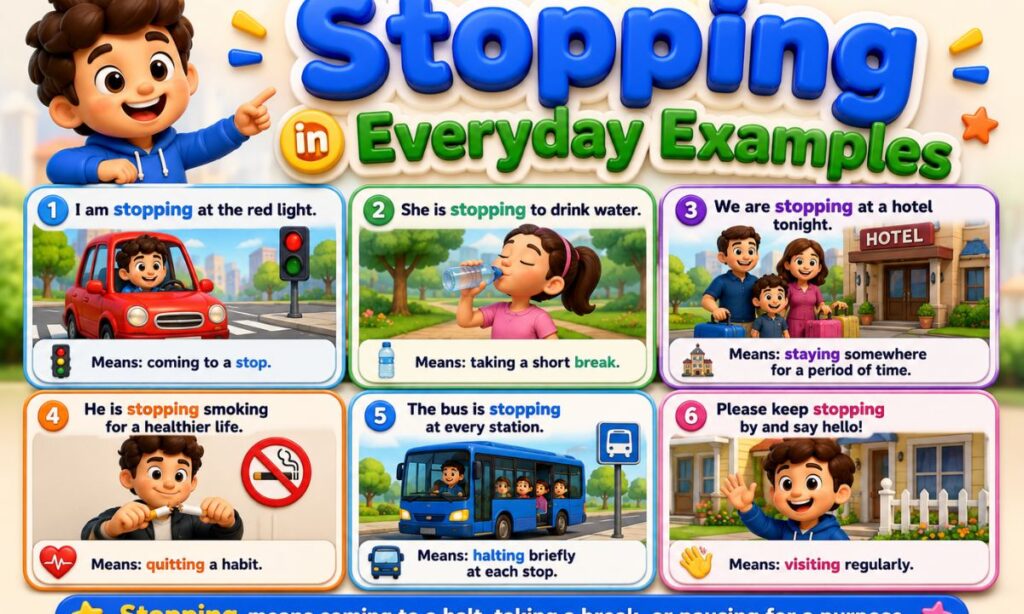
Seeing the word in context makes the correct usage easier to remember. Here are some natural, everyday examples:
- The bus is stopping at three more stations before the airport.
- We’re stopping for coffee on the way to the meeting.
- Doctors recommend stopping unhealthy habits gradually rather than all at once.
- The company is stopping production of the older model next quarter.
- Please keep stopping by the shelter to check on the puppies.
- Nothing is stopping you from applying for that promotion.
- The rain finally started stopping around midnight.
- He’s been stopping himself from checking his phone during meetings.
Notice how “stopping” works equally well for physical movement, habits, business decisions, and abstract ideas like self-control. That flexibility is part of why it’s such a commonly used word in English.
You’ll also find “stopping” used heavily in specific industries and everyday scenarios:
- Transportation: “This is a limited-stop service — we’re not stopping at every station.”
- Health and wellness: “Stopping caffeine cold turkey can cause headaches.”
- Customer service: “We apologize for the delay — our system flagged and stopped your order for review.”
- Sports commentary: “The goalkeeper is stopping every shot tonight.”
- Legal and policy writing: “This regulation is aimed at stopping unfair pricing practices.”
- Parenting and education: “Try stopping the tantrum early by offering a distraction.”
Across all of these examples, the spelling never changes based on tone, formality, or industry. Whether you’re writing a legal brief or a text to a friend, “stopping” stays exactly the same.
Stopping: Google Trends & Usage Data
Search behavior consistently shows that people are far more likely to search for or use “stopping” than “stoping.” This lines up with what you’d expect from a common, everyday verb form compared to a niche technical term used mostly by geologists and mining engineers.
Search interest for “stoping” tends to spike only around technical or academic queries — students researching mining engineering, geology coursework, or industry terminology. Meanwhile, “stopping” sees consistent, high-volume search traffic year-round, driven by everyday questions about grammar, spelling checks, and general writing help.
A few patterns worth noting:
- “Stopping” searches spike around back-to-school periods, when students are brushing up on grammar rules.
- “Stoping” searches are a small fraction of total volume and are concentrated among mining and earth-science audiences.
- Spell-check tools and search engines frequently suggest “Did you mean: stopping?” when users type “stoping,” reinforcing how rare the intentional use of that spelling really is.
Historical text databases that track word frequency across decades of published books and articles show a similar story: “stopping” has appeared consistently and heavily throughout modern English writing, while “stoping” shows only small, occasional spikes tied to periods of increased mining activity or geology publishing. This long-term pattern confirms that “stopping” isn’t just currently more popular — it has been the dominant form for as long as reliable language data has existed.
For content creators and website owners, this usage gap also has a practical takeaway: if you’re writing about grammar, spelling, or language topics, your audience is overwhelmingly searching to confirm “stopping” as correct, not to learn about mining terminology. Structuring content around that intent — as this guide does — better matches what most readers are actually looking for.
Keyword Variations Comparison Table
People phrase this question in a lot of different ways when searching online. Here’s how the most common variations compare:
| Search Variation | Correct Answer | Context |
| stopping or stoping | stopping | General grammar |
| stoping or stopping | stopping | General grammar |
| is stoping a word | Yes, but only in mining | Technical/geology |
| stopped or stoped | stopped | Past tense form |
| stopping vs stoping meaning | Different meanings entirely | Vocabulary clarification |
| how do you spell stopping | s-t-o-p-p-i-n-g | Spelling |
| stoping definition | Ore extraction in mining | Technical term |
| double p stopping rule | CVC doubling rule | Grammar rule |
Also Read This : Focuses or Focusses: The Complete Guide to Correct Usage
This kind of variation is common with words that involve a doubled consonant, since many writers aren’t entirely sure which spelling “looks right” until they double-check it.
Common Mistakes People Make
Beyond simple typos, there are a few conceptual misunderstandings worth clearing up:
- Assuming “stoping” is a casual or informal spelling. It isn’t. It’s either a technical mining term or a spelling error — there’s no informal, “text-speak” version where it’s acceptable.
- Believing the doubling rule is optional. Doubling the consonant isn’t a stylistic choice; it’s a fixed spelling convention that affects how the word is read and pronounced.
- Mixing up “stoping” with words like “coping” or “hoping.” These words don’t double their consonant because their base forms (“cope,” “hope”) already end in a silent “e,” which is dropped before adding “-ing” — a completely different rule than the one governing “stop.”
- Thinking regional English changes the spelling. As covered earlier, this is one of the few spelling rules that stays identical across American, British, Canadian, and Australian English.
- Assuming spell-checkers catch every instance. Because “stoping” is a legitimate dictionary word in a technical field, some grammar tools won’t underline it in red, which means the mistake can slip past automated proofreading.
- Treating the doubling rule as unique to “stop.” Learners sometimes think this is a special exception just for this one word, when in reality it applies to dozens of common English verbs, including “grab,” “drop,” “plan,” and “shop.”
- Forgetting that stress placement matters for longer words. The doubling rule applies most reliably to one-syllable words like “stop.” For multi-syllable words, the rule depends on which syllable is stressed — for example, “prefer” becomes “preferring” (stress on the second syllable), while “offer” becomes “offering,” not “offerring” (stress on the first syllable).
Stopping vs Stoping: Spelling Rules and Meaning
Correct usage:
- Stopping: “The car kept stopping at every red light.”
- Stoping: “The mining team used sublevel stoping to extract the ore safely.”
Key difference:
“Stopping” is a common verb form used in everyday English to describe halting or pausing. “Stoping” is a specialized technical noun and verb limited to mining and geology, describing underground ore extraction. They are not interchangeable, and using one in place of the other changes both the meaning and the accuracy of your writing.
Common search variations explained:
Many searches combine both words because people are unsure which one applies to their situation. If your sentence involves everyday movement, habits, or processes, you want “stopping.” If your sentence is specifically about mining, ore bodies, or underground excavation, “stoping” is the accurate technical term. When in doubt, ask yourself: is this about mining? If the answer is no, use “stopping.”
Other common variations you might type into a search bar include phrases like “is stoping a typo,” “stopping spelling check,” “why two p’s in stopping,” and “stoping vs stopping meaning difference.” All of these point back to the same underlying answer: the standard verb form is “stopping,” and “stoping” only belongs in a technical, industry-specific sentence.
Related verb forms (important for clarity)
Understanding how “stop” changes across tenses helps reinforce the doubling rule permanently:
| Base Verb | Present Participle | Past Tense | Third-Person Singular |
| stop | stopping | stopped | stops |
| run | running | ran | runs |
| sit | sitting | sat | sits |
| plan | planning | planned | plans |
| swim | swimming | swam | swims |
Notice the consistent pattern: every one of these verbs follows the CVC doubling rule, which confirms that “stopping” isn’t an exception — it’s simply following standard English grammar.
Once you’ve internalized this pattern with a few examples, it becomes much easier to apply the same logic to new or unfamiliar verbs. Whenever you’re unsure whether to double a final consonant, run through this three-step test:
- Is the word one syllable, or is the stress on the final syllable?
- Does it end in a single consonant, preceded by a single vowel?
- Are you adding a suffix that starts with a vowel, such as “-ing” or “-ed”?
If you answer “yes” to all three, double the final consonant. This test works for “stop,” “run,” “plan,” “sit,” “grab,” “drop,” and dozens of other common English verbs — and it will keep you from ever second-guessing “stopping” again.
Conclusion
The rule behind “stopping” versus “stoping” comes down to one of English’s most consistent spelling conventions: doubling the final consonant in short verbs that follow a consonant-vowel-consonant pattern. “Stopping” is the correct choice for virtually every situation you’ll ever write in, from casual texts to formal reports. “Stoping” survives only as a specialized term in mining and geology, describing the extraction of underground ore.
The next time you’re typing quickly and pause on that word, remember the simple test: say it out loud. If it sounds like a short, quick “o,” you need the double “p” — write “stopping.” Keep that rule in mind, and you’ll spell it correctly every single time going forward.

Michael Brook is the creator and author behind Healthy Leeks, a platform focused on grammar, writing skills, and English language learning. Passionate about clear communication and effective writing, Michael Brook shares practical grammar tips, easy-to-follow language guides, and educational content to help readers improve their English with confidence.


