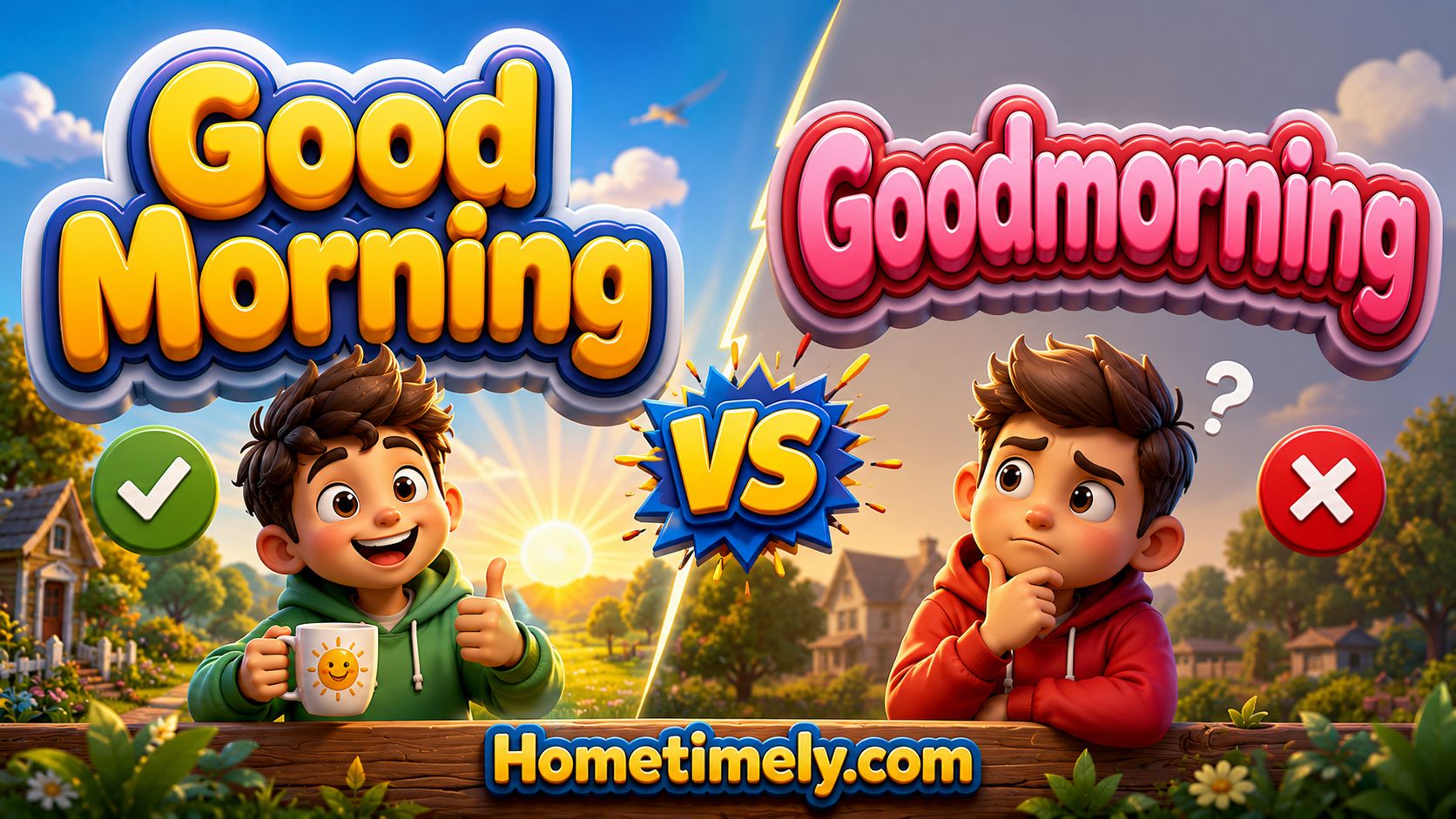
I’ve typed “goodmorning” in a rush text more times than I’d like to admit, then stared at it wondering if autocorrect would catch it. If you’ve landed here asking the same question, you’re about to get a clear, no-nonsense answer, plus everything else you need to use this greeting correctly for the rest of your life.
My Quick Answer
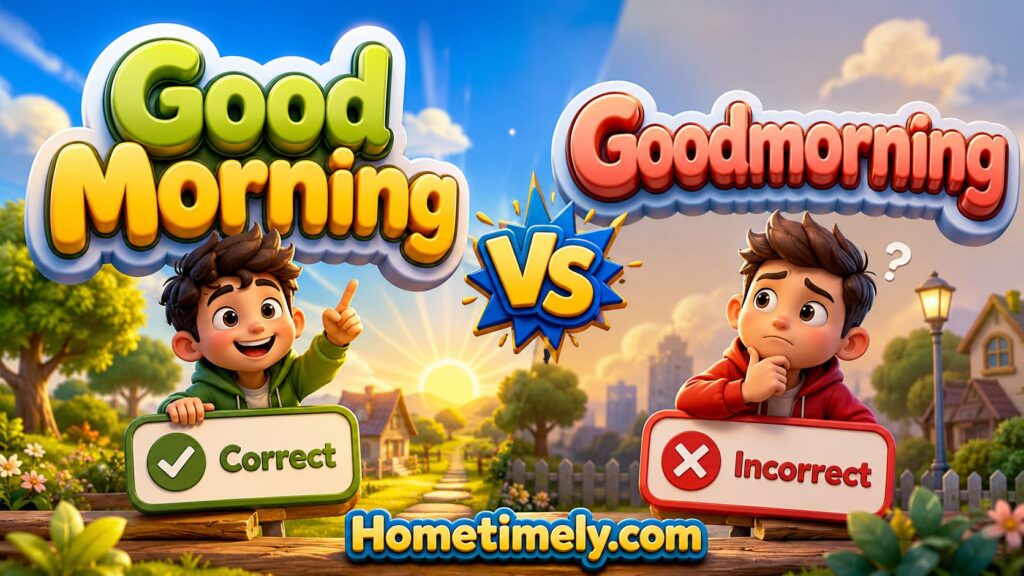
“Good morning” is always two words. Never one. Never hyphenated.
It’s made up of an adjective (“good”) and a noun (“morning”), and English grammar keeps that pairing separate. Whether you’re writing a formal email, texting a friend, or posting a caption, the rule doesn’t change:
- ✅ Good morning
- ❌ Goodmorning
- ❌ Good-morning
That’s it. That’s the whole answer in one breath. Everything below explains why, so you never have to second-guess yourself again.
Why I Found It’s Written as Two Words
When I first dug into this, I expected some complicated exception buried in a style guide. There isn’t one. The reason is refreshingly simple: “good” and “morning” each carry their own grammatical job.
- “Good” is an adjective. It describes quality.
- “Morning” is a noun. It names a time of day.
Put them together and you get a standard adjective + noun phrase, the same structure as “nice day,” “long week,” or “quiet evening.” English doesn’t fuse adjective-noun pairs into single words just because we say them together often. If it did, we’d also be writing “niceday” and “longweek,” and nobody does that.
This is technically called an open compound, meaning two words that function together as a unit but are still spelled with a space between them. Dictionaries, including major English references, list “good morning” this way, and no credible grammar authority recognizes the single-word spelling as correct.
A few reasons the two-word form has stuck around for centuries:
- The words retain independent meaning. You could theoretically say “a good morning” as a description, not just a greeting. “I had a good morning” works just as well as “Good morning, everyone.”
- It follows a consistent family pattern. “Good afternoon,” “good evening,” and “good day” are all two words, and nobody questions those.
- No linguistic pressure to merge. Compound words usually form when a phrase is used so frequently and functionally that it needs a new, single identity (like “breakfast” from “break” + “fast,” or “sunrise” from “sun” + “rise”). Greetings haven’t gone through that shift.
It also helps to know where the phrase came from. “Good morning” traces back to Middle English, where people said something closer to “God give you good morrow.” Over centuries, that mouthful got trimmed down, but the two-word structure survived every stage of the shortening. The phrase never went through a period where it functioned as a single grammatical unit the way true compounds do, which is exactly why it never fused into one word.
I also looked at how linguists classify phrases like this. In language studies, “good morning” is treated as a collocation, a pairing of words that naturally go together through repeated use, but that still keeps each word’s independent grammatical identity. Collocations are common in English (“strong coffee,” “heavy rain,” “fast food”) and almost none of them merge into single words just because we say them constantly. Frequency of use is not the same as grammatical fusion, and that distinction is really the whole answer to this question.
The “Goodnight” Confusion: Why It’s Different
This is where almost everyone trips up, and honestly, it’s a fair mix-up.
“Goodnight” is often written as one word, especially when used as an interjection to end a conversation (“Goodnight, see you tomorrow”). So people assume “goodmorning” should follow the same pattern. It doesn’t, and here’s the distinction I found most useful.
| Feature | Good Morning | Good Night |
| Standard spelling | Two words | Often one word (informal use) |
| Grammatical role | Greeting (adjective + noun) | Farewell / parting phrase |
| Compound status | Open compound | Increasingly treated as closed compound |
| Formal writing | Always two words | Two words preferred; one word common informally |
| Historical shift | Never merged | Merged over long-term casual usage |
“Goodnight” evolved differently because it’s frequently used as a farewell exclamation and sometimes even as a noun or adjective in its own right (think “goodnight kiss” or “she gave him a quick goodnight”). That kind of repeated, flexible use is exactly the condition that pushes a phrase toward becoming a single compound word over time.
“Good morning,” on the other hand, has stayed firmly in its lane as a greeting. It hasn’t picked up secondary uses that would justify merging it, so it never made that shift. Even style guides that accept “goodnight” casually still insist on “good morning” as two words in every context.
It’s worth noting that even “goodnight” isn’t universally accepted as one word in every style guide. Many formal writing standards still prefer “good night” as two words, treating the single-word version as an informal variant rather than the official standard. So even the phrase people point to as “proof” that greetings can merge is still debated among grammar authorities. That should tell you something about how firmly “good morning” holds its two-word status: there isn’t even a casual exception to point to.
When and How I Use “Good Morning” Correctly
Getting the spacing right is step one. Getting the punctuation and context right is what actually makes your writing look polished. Here’s how I apply it in real situations.
As a Greeting Before a Name or Group
When you’re addressing someone directly, a comma goes between “morning” and the name or group you’re speaking to.
- Good morning, Sarah.
- Good morning, team.
- Good morning, everyone.
Skipping that comma is one of the most common small errors people never notice they’re making.
As a Standalone Greeting
- Good morning!
- Good morning, all.
Inside a Sentence
- She said good morning to her manager before the meeting started.
- I always start my emails with “Good morning.”
- He greeted the staff with a cheerful good morning.
In Professional or Email Communication
For formal writing, capitalize the first letter and keep it clean:
- Good morning, Mr. Ahmed,
- Good morning, team,
Avoid exclamation points in formal business emails unless the tone calls for it. A simple comma keeps it professional.
Common Mistakes I’ve Found and How to Avoid Them
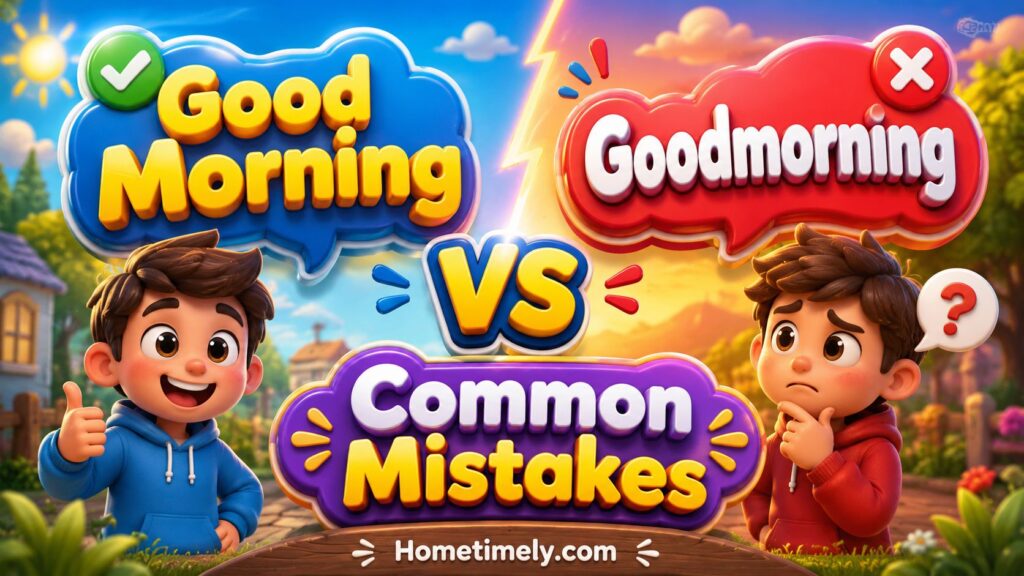
Here are the errors I see most often, and the fix for each one.
- Writing “goodmorning” as one word. Fix: Always insert the space. Think of it as two separate words doing two separate jobs.
- Adding a hyphen: “good-morning.” Fix: No hyphen is needed. This isn’t a compound adjective modifying another noun (like “well-known author”), so it stays unhyphenated.
- Forgetting the comma before a name or group. Fix: “Good morning, John” not “Good morning John.”
- Capitalizing both words unnecessarily. Fix: In a sentence, only capitalize “Good” unless it starts a title, where title-case rules apply.
- Assuming casual texting habits are grammatically correct. Fix: Autocorrect and texting shortcuts don’t set the grammar standard. “Goodmorning” showing up often in casual chats doesn’t make it correct English.
- Confusing it with “goodnight” and assuming the same merging applies. Fix: Remember they evolved differently. Treat them as separate cases entirely.
- Using it as a one-size-fits-all greeting regardless of time. Fix: While plenty of people say “good morning” out of habit even in the afternoon, it’s technically meant for the morning hours. Save “good afternoon” and “good evening” for later in the day if you want to be precise.
- Dropping the capital letter in formal openings. Fix: When starting an email or letter, capitalize “Good” since it begins the sentence: “Good morning, team,” not “good morning, team.”
I’ve noticed that most of these mistakes come from speed, not a lack of understanding. Once you slow down and actually look at what you typed, the two-word version tends to look obviously correct, and “goodmorning” starts to look exactly as odd as “goodafternoon” would.
Memory Tips I Use to Remember the Rule
A few tricks have kept this rule locked in for me permanently:
- Picture a sunrise between the words. Visualize the space between “good” and “morning” as the gap where the morning sun rises. It sounds simple, but the image sticks.
- Compare it to its siblings. If you’d never write “goodafternoon” or “goodevening” as one word, don’t write “goodmorning” that way either. All three follow the same pattern.
- Say it slowly in your head. “Good. Morning.” Two distinct beats, two distinct words.
- Run it through a spell-checker. Any standard grammar tool will flag “goodmorning” instantly. If in doubt, type it out and check.
- Remember the formula. Adjective + Noun = two words, always. “Good” describes “morning,” it doesn’t become part of it.
Can “Goodmorning” Ever Be Correct?
Short answer: no, not in standard English.
There’s no context — formal, informal, academic, or casual — where “goodmorning” is recognized as correct spelling. It doesn’t appear as a valid entry in major dictionaries, and professional editors correct it without hesitation.
That said, here’s where the confusion tends to come from:
- Fast texting and social media captions, where people drop spaces for speed or aesthetic.
- Non-native English learners who bring greeting structures from other languages, where similar phrases are sometimes written as single words.
- Visual habit from “goodnight,” which primes people to assume all time-of-day greetings merge the same way.
- Branding and stylized usage, where a business or app might deliberately use “goodmorning” as a product or app name for stylistic reasons. That’s a design choice, not a grammar rule, and it doesn’t make the spelling standard.
If you’re writing anything meant to be taken seriously — a resume, a work email, a blog post, an assignment — stick to two words every time.
Other Greeting Patterns I Discovered
Once I understood the good morning rule, I checked how it holds up across other everyday greetings. The pattern is remarkably consistent.
| Greeting | Correct Form | Word Count |
| Good morning | Good morning | Two words |
| Good afternoon | Good afternoon | Two words |
| Good evening | Good evening | Two words |
| Good day | Good day | Two words |
| Good night | Good night (often one word informally) | Two words / one word casually |
| Have a nice day | Have a nice day | Multiple words |
| Rise and shine | Rise and shine | Multiple words |
Notice that every single “good + time of day” greeting follows the identical adjective-noun structure. Once that pattern clicks, you’ll never second-guess any of them again.
Real-World Examples I’ve Collected
Seeing the phrase used naturally makes the rule easier to internalize than any explanation. Here are examples pulled from everyday writing situations:
- “Good morning, everyone. Let’s get started with today’s agenda.”
- “Good morning! I hope you slept well.”
- “The barista greeted every customer with a warm good morning.”
- “Good morning, Dr. Malik. I have the reports ready for you.”
- “I forgot to say good morning to my neighbor this morning.”
- “Good morning, team — quick reminder about the 10 a.m. call.”
- “She always begins her emails with ‘Good morning’ regardless of the actual time.”
Notice how the phrase adapts to fit the sentence but never once loses its two-word structure.
I’ve also noticed how the phrase shows up differently across mediums:
- In emails: Almost always paired with a comma and a name — “Good morning, Ayesha,”
- In text messages: Often shortened to just “Morning!” without “good” at all, which is grammatically fine as an informal greeting on its own.
- In spoken language: The words blend together in pronunciation, which is exactly why so many people assume it should be written as one word. What you hear and what you write don’t always match in English.
- On social media: Frequently paired with emojis or hashtags, but the core spelling rule doesn’t change just because the platform is casual.
- In customer service scripts: Almost universally two words with a comma, since these scripts are written by professionals who follow standard grammar conventions.
Examples of “Good Morning” Used in Sentences
A quick reference list you can scan anytime you need a refresher:
- Good morning, class. Please take your seats.
- He walked in, said good morning, and sat down at his desk.
- Good morning, everyone! Welcome to today’s workshop.
- I texted her a simple “good morning” before heading to work.
- The receptionist greets every visitor with a polite good morning.
- Good morning, Mom! Breakfast is ready.
- “Good morning,” she whispered, still half-asleep.
- Wishing you a good morning and a productive day ahead.
Also Read This : It’s Called vs It Called: Correct Meaning, Usage & Examples
Good Morning vs Goodmorning: My Summary Table
| Aspect | Good Morning ✅ | Goodmorning ❌ |
| Grammatical correctness | Correct | Incorrect |
| Dictionary recognition | Yes | No |
| Formal writing (email, business) | Required | Never acceptable |
| Casual texting | Preferred | Sometimes seen, still wrong |
| Spell-checker result | Passes | Flagged as error |
| Structure | Adjective + Noun | Not a recognized compound |
| Professional impression | Polished, careful | Careless, rushed |
Why People Search for “Goodmorning” as One Word
If so many people search for this exact misspelling, it’s worth understanding why, rather than just correcting it and moving on.
- Speed of typing. On mobile keyboards, skipping the space feels faster, especially for a phrase typed dozens of times a day.
- Visual association with “goodnight.” Since one commonly appears merged, people assume its counterpart behaves the same way.
- App and brand names. Some fitness, sleep, or productivity apps use “GoodMorning” or “Goodmorning” as a stylized brand name, which reinforces the one-word look in people’s minds.
- Non-native speaker influence. In some languages, equivalent greetings are single compound words, so learners naturally carry that structure into English.
- Habitual repetition. The more often people see or type a misspelling, especially in casual chats, the more normal it starts to look, even though it never becomes grammatically correct.
Search engines see high volume for “goodmorning one word” precisely because the confusion is common and genuine, not because the spelling is secretly acceptable.
Explore More Grammar Guides
If phrases like this trip you up, you’re definitely not alone, and there are plenty of similar rules worth clearing up:
- Good afternoon vs goodafternoon: is it one word or two?
- Good evening: correct usage and common mistakes
- Goodnight vs good night: when to use which
- Common English compound word mistakes to avoid
- Adjective-noun phrases that are often wrongly merged
Bookmark this guide, share it with anyone who still types “goodmorning,” and keep your writing sharp every single morning.
Wrapping It Up
“Good morning” will always be two words, no matter how casual the setting or how fast you’re typing. It’s an adjective describing a noun, just like “good afternoon” and “good evening,” and it has never evolved into a merged compound the way “goodnight” has. Keep the space, add the comma before a name, and you’ll never write it wrong again.

Michael Brook is the creator and author behind Healthy Leeks, a platform focused on grammar, writing skills, and English language learning. Passionate about clear communication and effective writing, Michael Brook shares practical grammar tips, easy-to-follow language guides, and educational content to help readers improve their English with confidence.