You’re describing something new, and you pause mid-sentence. Do you write “it’s called a gadget” or “it called a gadget”? One tiny apostrophe changes everything, and getting it wrong can make a sentence feel broken even if the reader can’t quite explain why. This guide clears up the confusion for good, with plain-English rules, real examples, and a comparison table you can bookmark.
Quick Answer
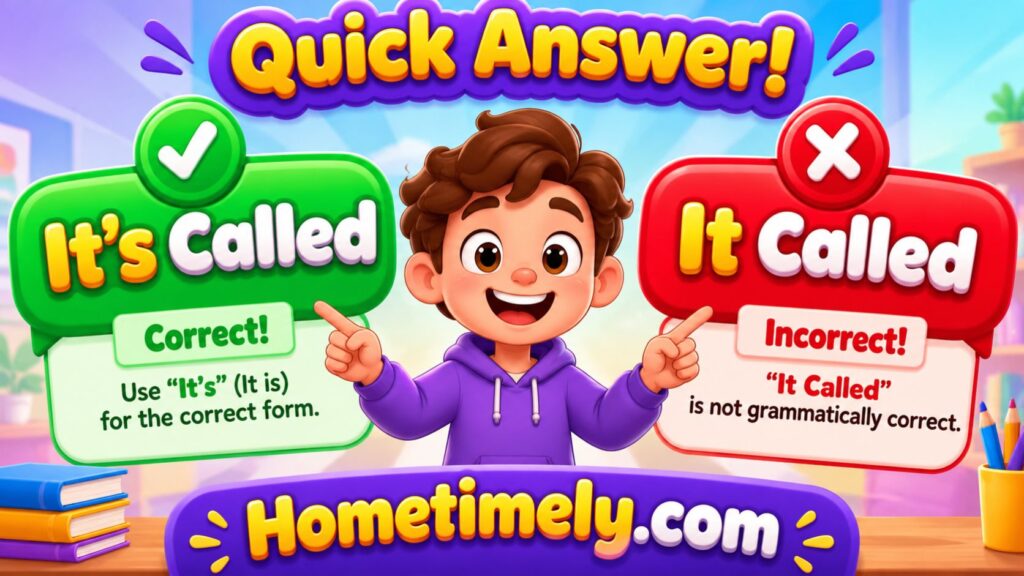
“It’s called” is correct almost every time you’re naming, labeling, or identifying something. It’s short for “it is called,” and it works as a passive construction the thing is being named, not doing anything itself.
“It called” is only correct in the rare case where “it” is the subject actively performing the action of calling, usually in the past tense: “The phone rang, then it called again.”
| Phrase | Structure | Use Case | Example |
| It’s called | Contraction of “it is called” | Naming or identifying something | “It’s called a thermostat.” |
| It called | Simple past tense verb | Something performed the act of calling | “It called out twice before stopping.” |
| Its called | ❌ Always incorrect | Never a valid phrase | N/A |
Meaning and Explanation
“It’s called” is the phrase you reach for whenever you want to tell someone the name of something. It works because “it’s” expands to “it is,” turning the phrase into “it is called” a complete, grammatically sound sentence fragment.
“It called,” on the other hand, drops that helping verb entirely. Without “is” or “was” sitting in front of “called,” the sentence needs “it” to actually be doing the calling. That only makes sense in a narrow set of situations, usually involving phones, sounds, or something summoning attention.
So the core difference comes down to function:
- “It’s called” = naming or defining something (passive voice)
- “It called” = an action performed by “it” (active, past tense)
What Does “It’s” Mean in English Grammar?
“It’s” is a contraction, and contractions in English always stand in for two separate words joined together. In this case, “it’s” can mean either:
- “It is” — used for present states or facts: “It’s called a violin.”
- “It has” — used with the present perfect tense: “It’s called for a change in strategy” (meaning “it has called for”).
This is different from “its” without an apostrophe, which is a possessive pronoun showing ownership: “The dog wagged its tail.” Mixing up “it’s” and “its” is one of the most common grammar slips in English, largely because the two words are homophones they sound completely identical when spoken.
When you’re deciding whether to use an apostrophe, try the substitution test:
- Replace “it’s” with “it is” in the sentence.
- If the sentence still makes sense, the apostrophe is correct.
- If it sounds wrong or nonsensical, you need “its” instead.
For example: “It’s called a keyboard” → “It is called a keyboard” ✅ makes sense, so the apostrophe stays.
Common Mistakes
Even experienced writers slip up with this phrase. Here are the errors that show up most often:
- Dropping the apostrophe entirely — writing “its called” instead of “it’s called.” This form is never correct in standard English.
- Using “it called” when naming something — as in “it called a router,” which sounds like the router itself dialed a number.
- Confusing “it’s” with “its” — mixing up the contraction with the possessive pronoun.
- Overcorrecting in formal writing — some writers avoid contractions altogether in academic work, which is a stylistic choice, not a grammar rule. “It is called” remains a safe, formal alternative.
- Skipping the helping verb — writing “it called photosynthesis” instead of “it’s called photosynthesis,” leaving the sentence incomplete and confusing.
Also read This : Acception vs. Exception: What’s the Difference? Meaning, Examples & Easy Tricks
The Difference Between “Its,” “It’s,” and “It Is”
Because these three forms look and sound so similar, it helps to see them side by side.
| Form | Type | Meaning | Example |
| Its | Possessive pronoun | Shows ownership | “The company changed its logo.” |
| It’s | Contraction | Short for “it is” or “it has” | “It’s called a spreadsheet.” |
| It is | Full phrase | Uncontracted present tense | “It is called a spreadsheet.” |
A quick way to remember: “its” never has an apostrophe because it already shows possession, just like “his” or “hers” don’t take apostrophes either. Apostrophes in this trio only appear when two words are being squeezed into one — “it” plus “is,” or “it” plus “has.”
Its Called vs It Called: Comparison Table
Here’s a side-by-side breakdown to settle the confusion once and for all.
| Feature | It’s Called | It Called |
| Grammatical role | Passive naming construction | Active past-tense verb phrase |
| Expands to | “It is called” | N/A (already a complete verb form) |
| Common use | Defining, naming, labeling | Describing an action that happened |
| Tense | Present | Past |
| Example | “It’s called a violin.” | “It called for backup.” |
| Correctness | Correct in nearly all naming contexts | Correct only when “it” performs an action |
American vs British English
There’s no meaningful spelling or grammar difference between American and British English when it comes to “it’s called” versus “it called.” Both dialects follow the same contraction rules and the same passive-naming structure.
That said, a few subtle tendencies are worth noting:
- American English speakers use contractions like “it’s called” freely in both spoken and written casual communication, including blogs, marketing copy, and social media.
- British English writing, especially in academic or formal publications, sometimes favors the fully expanded “it is called” for a more formal tone, though this is a stylistic preference rather than a strict rule.
- Both varieties treat “its called” (without the apostrophe) as an error, and neither dialect makes an exception for it.
In short, the rule holds steady no matter which side of the Atlantic you’re writing for.
Examples in Everyday Sentences
Seeing the phrase used naturally makes the rule stick. Here are examples across different everyday contexts:
Naming and identifying (use “it’s called”):
- “It’s called a stethoscope, and doctors use it to listen to your heartbeat.”
- “This dish is traditional in the region — it’s called paella.”
- “It’s called machine learning, and it powers most modern recommendation systems.”
- “What’s that instrument? It’s called a mandolin.”
Describing a past action (use “it called”):
- “The alarm went off, and it called everyone outside immediately.”
- “The system detected an error, so it called the backup server automatically.”
- “The bird made a strange noise — it called out three times before flying away.”
Incorrect usage to avoid:
- ❌ “Its called a router.” (missing apostrophe)
- ❌ “It called a smartphone because it combines many functions.” (missing helping verb; should be “it’s called”)
Final Thoughts
Getting “it’s called” and “it called” right comes down to one simple question: is something being named, or is something performing an action? If you’re identifying, defining, or labeling anything, “it’s called” is almost always the phrase you need. Save “it called” for the rare moments when “it” genuinely did the calling.
Keep the substitution trick in your back pocket swap in “it is” and see if the sentence still holds up. That one habit will keep your writing clear, confident, and free of one of English’s sneakiest little mix-ups.

Michael Brook is the creator and author behind Healthy Leeks, a platform focused on grammar, writing skills, and English language learning. Passionate about clear communication and effective writing, Michael Brook shares practical grammar tips, easy-to-follow language guides, and educational content to help readers improve their English with confidence.