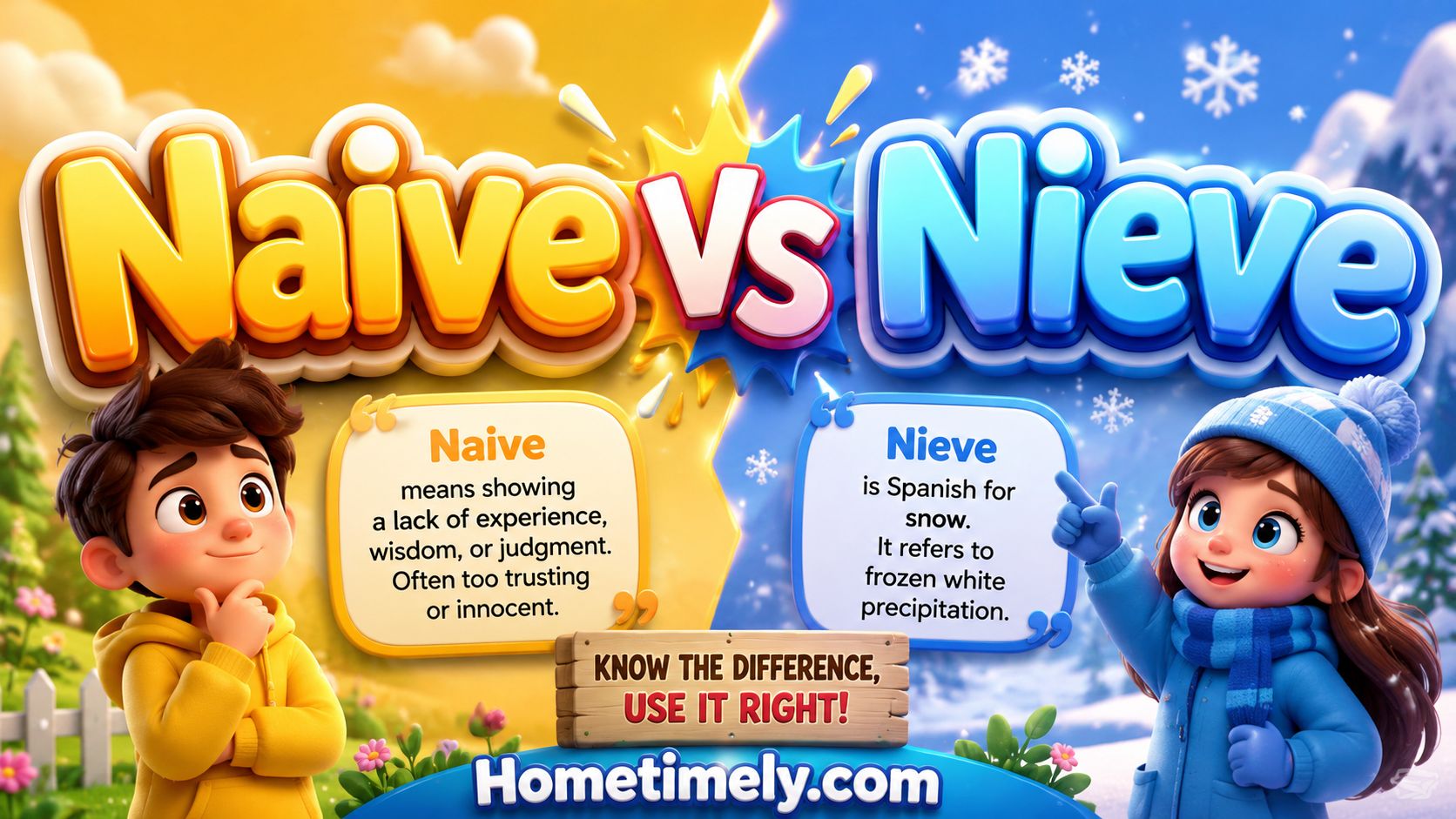
I kept seeing this question pop up in comment sections, group chats, and even a few work emails: is it “naive” or “nieve”? So I decided to dig into it properly checking dictionaries, tracing the word’s origin, and testing it across different writing styles. What I found settled the debate for good, and I’m breaking it all down here so you never have to second-guess yourself again.
My Quick Answer
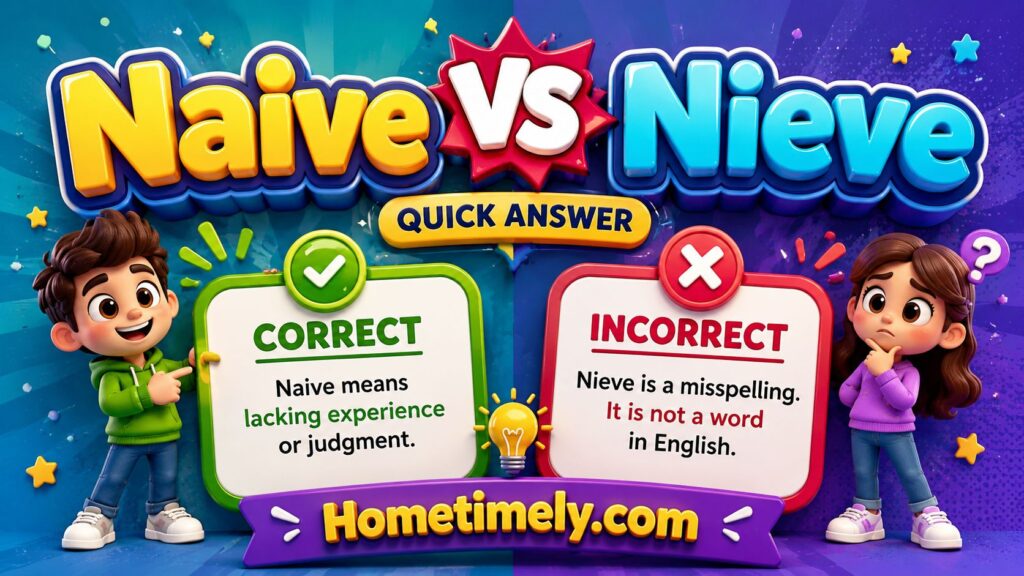
The correct English spelling is naive (or naïve with the two dots, called a diaeresis, if you want the more traditional look). Nieve is not an English word at all it’s a Spanish word meaning “snow,” and it has no legitimate place in English writing outside of that language context.
If you’re in a hurry, here’s the short version:
- ✅ Naive — correct in every English context
- ✅ Naïve — also correct, slightly more formal or literary
- ❌ Nieve — incorrect in English; it’s a borrowed mix-up from Spanish
That’s really all you need to walk away with. But if you want to understand why this mix-up happens so often and how to make sure it never trips you up again keep reading.
Why I Found It’s Spelled “Naive”
When I traced the word back, everything clicked into place. “Naive” comes from the French adjective naïf (masculine) and naïve (feminine), which itself descends from the Latin word nativus, meaning “native” or “natural.” English absorbed the French spelling more or less directly, keeping that “a” right after the “n.”
That’s the key detail people miss. The word was never built around an “ie” sound pattern like “believe” or “relieve.” It’s rooted in “nativus,” so the “a” isn’t optional or accidental — it’s structural. Once you see the French and Latin lineage, the spelling stops feeling random and starts making sense.
The two dots over the “i” (the diaeresis) originally told readers to pronounce each vowel separately, rather than blending “ai” into one sound. Modern English has mostly dropped that mark for convenience, which is why “naive” without the dots has become the standard digital spelling, while “naïve” still shows up in more formal or literary writing.
My Definition and Meaning Analysis
At its core, naive is an adjective that describes someone (or something) that lacks experience, worldliness, or critical judgment. It usually implies innocence rather than stupidity a naive person isn’t dumb, they just haven’t been exposed to enough of the world to see through certain situations.
Here’s how I’d break the meaning down after comparing multiple dictionary definitions:
- Lacking experience or sophistication — someone new to a job, industry, or life stage
- Overly trusting — believing things too easily, without questioning motives
- Simplistic in judgment — approaching a complex problem with an oversimplified view
- Innocent or unguarded — in a slightly more positive, endearing sense
The word can also shift grammatical form depending on what you need:
| Word Form | Example |
| Adjective | She had a naive view of how the business world worked. |
| Adverb | He naively assumed everyone was telling the truth. |
| Noun (British) | Her naivety surprised her coworkers. |
| Noun (French-style) | His naiveté about politics was obvious. |
Context matters a lot here. “Naive” can be gentle and almost affectionate (“a naive but well-meaning intern”) or pointed and critical (“a naive assumption that cost the company money”). The tone depends entirely on how it’s used in the sentence.
Naive vs Nieve: My Comparison Table
To make the comparison crystal clear, I put together this side-by-side breakdown of both words.
| Feature | Naive | Nieve |
| Language | English (from French) | Spanish |
| Correct in English? | Yes | No |
| Meaning | Inexperienced, unsophisticated, easily fooled | “Snow” (in Spanish) |
| Part of speech | Adjective | Noun (in Spanish) |
| Common usage | Everyday and formal English writing | Spanish vocabulary lessons, Spanish media |
| Alternate spelling | Naïve (with diaeresis) | N/A |
| Typical mistake | None — this is the correct form | Often typed by accident instead of “naive” |
This table alone answers most of the confusion. If you’re writing in English and want to describe someone as inexperienced or easily fooled, “naive” is the only option on the table. “Nieve” simply doesn’t carry that meaning in English at all — it belongs to a completely different language and vocabulary.
Naive in American vs British English
One thing I wanted to check was whether American and British English treat this word differently, since spelling variations are common between the two (think “color” vs “colour”). The answer surprised me a little.
- American English: “Naive” (without the diaeresis) is the standard, widely accepted spelling in books, journalism, and everyday writing.
- British English: Both “naive” and “naïve” appear regularly, with “naïve” showing up more often in literary, academic, or traditional publications.
Unlike many American-British spelling pairs, this isn’t really a regional split — it’s more of a stylistic choice. Neither version is considered wrong on either side of the Atlantic. The diaeresis is simply a matter of formality and personal or house style, not a hard grammar rule tied to a specific country.
If you’re writing for a global audience or a digital platform, “naive” without the dots is the safer, more universally readable choice. If you’re writing something more literary or want to nod to the word’s French roots, “naïve” works just as well.
Examples I Use in Different Contexts
I like testing words in real sentences because that’s where spelling and meaning actually stick. Here are examples I’ve used or come across across different writing situations:
Everyday conversation:
- I was naive to think the sale prices would last all week.
- Don’t be so naive — read the fine print before you sign anything.
Workplace and professional writing:
- The report’s projections were naive, since they ignored market volatility.
- She admitted her first business plan was naive about how long fundraising takes.
Academic or formal writing:
- The study’s naive assumption was that all participants would respond honestly.
- Critics called the early economic model naive in its treatment of consumer behavior.
Creative or narrative writing:
- He arrived in the city young, naive, and full of hope.
- Her naive optimism was both her biggest flaw and her most endearing trait.
Across every one of these, the meaning stays consistent — a lack of experience or overly simple judgment — but the tone shifts depending on the setting. That flexibility is exactly why “naive” shows up so often in both casual and formal English.
Common Related Words I Found
While researching, I noticed a small cluster of words that often travel alongside “naive.” Knowing these helps you vary your vocabulary and avoid repeating the same word too often.
- Innocent — similar meaning, but focuses more on purity than lack of experience
- Gullible — leans harder into being easily tricked or deceived
- Inexperienced — a more neutral, less judgmental synonym
- Unsophisticated — emphasizes a lack of worldly polish or refinement
- Credulous — a formal word for someone who believes things too readily
- Wide-eyed — an idiomatic, softer way of describing naivety
- Naïveté / Naivety — the noun forms describing the state of being naive
Understanding these related words also helps explain why “naive” feels so natural in English — it fits into a whole family of words describing trust, inexperience, and innocence, none of which relate to “nieve” or its Spanish meaning of snow.
Why People Make the “Nieve” Mistake
After going through dozens of examples of this error online, I noticed the mistake isn’t random — it follows a few very specific patterns.
- Phonetic guesswork — Some people hear the word spoken and guess at the spelling based on sound alone, landing on an “ie” pattern instead of “ai.”
- Spanish language crossover — Spanish speakers, or people learning Spanish, already know “nieve” as a real word (snow), so their brain autocorrects to a familiar spelling.
- Pattern matching with other English words — Words like “believe,” “relieve,” and “retrieve” all use “ieve,” which makes “nieve” feel like it should fit the same mold.
- Autocorrect and typing speed — Fast typing on a phone keyboard sometimes triggers autocorrect suggestions that swap the letters without the writer noticing.
None of these reasons make “nieve” correct — but they do explain why the mistake is so common and so easy to make without realizing it.
Common Causes of the Naive vs Nieve Confusion
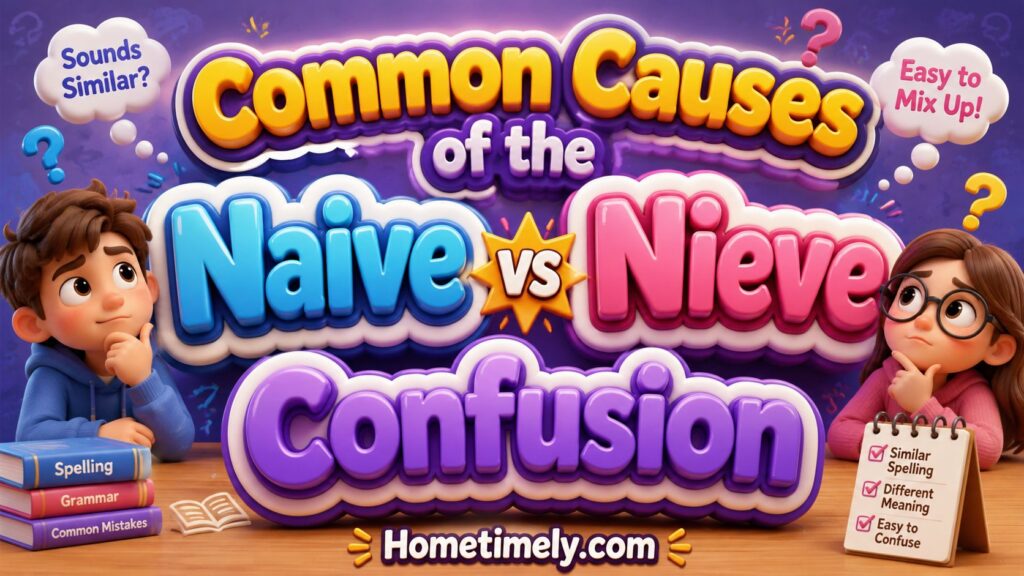
Zooming out a bit further, I found the confusion really comes down to three bigger-picture causes:
- Cross-language interference — English borrows heavily from French, Latin, and Spanish, and when two languages have visually similar words with completely different meanings, mix-ups are inevitable.
- Inconsistent spelling exposure — Many people read “naive” far less often than they hear it spoken, so their mental image of the spelling is weaker than their mental image of the sound.
- Lack of correction in casual writing — Texts, social media captions, and quick comments rarely get proofread, so a wrong spelling can spread simply because no one stops to check it.
Once you understand these root causes, the fix becomes much easier: read the word more, write it more deliberately, and remember its French origin rather than relying purely on how it sounds.
Naive in Different Fields
“Naive” isn’t just a casual, everyday word — it shows up across a surprising range of professional and academic fields, often with a slightly specialized meaning.
| Field | How “Naive” Is Used |
| Psychology | Describes untrained or inexperienced judgment, as in a “naive observer” |
| Statistics/Data Science | “Naive Bayes” refers to a simplified probabilistic model that assumes independence between variables |
| Medicine | A “treatment-naive” patient is someone who hasn’t yet received a particular therapy |
| Immunology | “Naive cells” are immune cells that haven’t yet encountered a specific antigen |
| Art and Literature | “Naive art” or “naive style” describes work created without formal training, often prized for its simplicity |
| Business | A “naive forecast” is a basic prediction model that assumes the future will simply repeat the past |
Seeing the word used this way was one of the more interesting parts of my research — it shows that “naive” has earned a real, technical place in specialized vocabulary, far beyond its everyday meaning of “inexperienced.”
Formal vs Informal Usage
I also compared how the word shifts across formal and informal writing, since tone changes quite a bit depending on the setting.
Formal usage:
- Prefers “naïve” in some traditions, though “naive” is equally accepted
- Common in academic papers, research, journalism, and business reports
- Often paired with precise, analytical language (“a naive assumption,” “a naive model”)
Informal usage:
- Almost always written as “naive” without the diaeresis
- Common in texting, social media, casual conversation, and blogs
- Often used more playfully or affectionately (“so naive, it’s kind of cute”)
The core meaning doesn’t change between the two only the spelling style and the emotional tone shift slightly. Knowing your audience helps you decide whether “naive” or “naïve” fits better.
Also Read This : Thier or Their? I Analyzed Which Spelling Is Actually Correct
Common Mistakes to Avoid
Based on everything I found, here are the specific mistakes worth watching out for:
- ❌ Writing “nieve” when you mean inexperienced or easily fooled
- ❌ Assuming “naive” and “nieve” are interchangeable spellings of the same word
- ❌ Confusing the diaeresis mark with an accent used for stress or pronunciation emphasis
- ❌ Using “naive” when you actually mean “stupid” — the word implies inexperience, not low intelligence
- ❌ Forgetting that the noun form is “naivety” or “naiveté,” not “naiveness” (which isn’t standard)
Avoiding these small errors instantly makes your writing look more polished, whether you’re sending a professional email or writing a school essay.
Explore More Grammar Guides
If this kind of word comparison was helpful, it’s worth exploring other commonly confused English pairs words that sound alike, look alike, or get mixed up across different languages. Building this kind of vocabulary awareness makes a noticeable difference in how confident and polished your writing feels, whether you’re drafting a quick message or a formal report.
Grammar clarity isn’t about memorizing endless rules it’s about understanding the small patterns, like word origins and language crossover, that explain why certain mistakes happen in the first place. Once you see the pattern, the correct spelling tends to stick for good.
Conclusion
After all this research, the takeaway is simple: “naive” (or “naïve”) is the only correct choice in English, while “nieve” belongs to Spanish and means something completely different. The confusion is understandable given how similar the words look, but now that you know the origin, the meaning, and the common triggers behind the mix-up, you’re equipped to use it correctly every time.
Whether you’re writing a casual text, a professional report, or an academic paper, sticking with “naive” keeps your writing accurate and credible. Bookmark this comparison if you ever find yourself second-guessing the spelling again a quick glance back will settle the question in seconds.

Michael Brook is the creator and author behind Healthy Leeks, a platform focused on grammar, writing skills, and English language learning. Passionate about clear communication and effective writing, Michael Brook shares practical grammar tips, easy-to-follow language guides, and educational content to help readers improve their English with confidence.


