If you’ve ever typed out a quick text about a messy diaper or a rough day and paused halfway through, wondering whether it’s “poopie” or “poopy,” you’re definitely not the only one. I’ve run into this exact moment more times than I’d like to admit texting a babysitter, writing a caption, even drafting a lighthearted email and every time, that tiny spelling choice made me stop and think.
This guide breaks the whole thing down in plain language. I’ll walk you through the correct spelling, why one version dominates over the other, when the “wrong” spelling actually has a place, and how to remember the difference for good. No jargon, no fluff — just the answer you came here for, backed by real usage patterns and simple grammar logic.
My Quick Answer
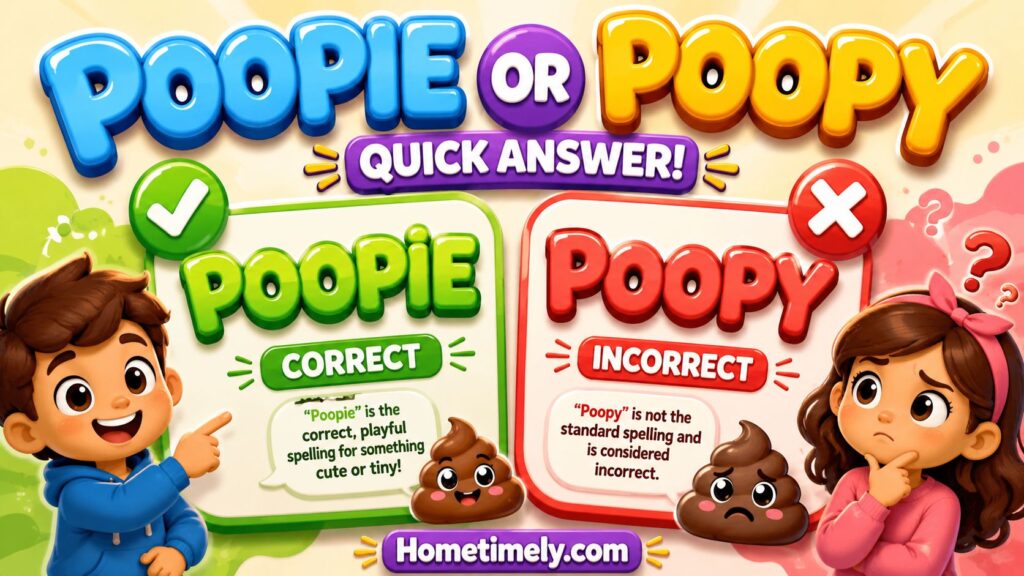
Here’s the short version, if you’re in a hurry: “poopy” is the standard, dictionary-recognized spelling, while “poopie” is an informal variant that shows up mostly in baby talk, parenting content, and playful writing.
- Poopy — correct, standard, widely accepted
- Poopie — not incorrect exactly, but nonstandard and childish
If you’re writing anything that needs to look polished a blog post, a work message, a caption for a wider audience go with “poopy.” Save “poopie” for casual, cutesy moments where the extra “ie” softens the word even further.
Why It’s Usually Spelled “Poopy”
English has a well-worn pattern for turning nouns into casual adjectives: add a “-y” at the end. Think of words like messy, sleepy, silly, and happy. “Poopy” follows this exact same rule. It takes the noun “poop” and turns it into a descriptive word, the same way “mud” becomes “muddy” or “rain” becomes “rainy.”
Because this “-y” pattern is so common and so consistent, “poopy” simply looks and feels more natural to native English speakers. It’s the version that:
- Appears in major dictionaries and style guides
- Shows up more often in search results and everyday writing
- Reads as the “safe” choice for bloggers, parents, teachers, and copywriters alike
- Matches the spelling logic readers already expect from similar adjectives
“Poopie,” on the other hand, breaks from that pattern slightly by doubling the vowel sound with an “-ie” ending instead. That ending isn’t wrong in casual English you see it in words like “doggie” or “sweetie” but it pushes the word further into baby-talk territory rather than standard adjective form.
My Meaning Analysis: It’s Not Just About Feces!
Here’s something a lot of people miss: “poopy” rarely means only literal feces. In everyday conversation, it’s stretched to cover a whole range of situations that have nothing to do with a diaper.
I’ve noticed the word gets used in at least three distinct ways:
- Literal meaning — describing an actual mess, like a poopy diaper or a poopy litter box.
- Figurative meaning — describing something unpleasant, disappointing, or just plain bad. “That was a poopy day at work” doesn’t involve anything gross; it just means the day went badly.
- Playful exaggeration — used in jokes, kids’ books, and social captions purely for comic effect, without any real reference to mess at all.
This flexibility is part of why the word has stuck around in casual English. It’s short, expressive, and instantly understood even by people who’d never use it in a formal setting.
Is “Poopie” Ever Correct?
Technically, “poopie” isn’t flagged as a spelling error the way a genuine typo would be. It’s better described as a nonstandard variant rather than an outright mistake. You won’t find it listed as the primary entry in most dictionaries, but it’s understood everywhere it appears because context makes the meaning obvious.
Think of it less like a grammar rule violation and more like a stylistic choice. It’s similar to writing “kitty” instead of “kitten,” or “doggie” instead of “dog” softer, cuter, and clearly aimed at a specific tone rather than formal accuracy.
So while “poopie” won’t get red-underlined for being objectively wrong, it will read as noticeably more casual and in some cases, less polished than “poopy.”
When I Use “Poopie” Instead
There are a handful of situations where reaching for “poopie” actually makes more sense than defaulting to “poopy.” I tend to use it when:
- Talking directly to young children — the softer “-ie” sound fits naturally into baby talk and nursery language.
- Writing dialogue for a kid character — in a story or script, “poopie” can make a child’s voice feel more authentic.
- Matching a family’s own “cute” spelling — some households just prefer it, and consistency matters more than the dictionary in personal messages.
- Going for extra playfulness — in memes, captions, or lighthearted social posts where a babyish tone is the whole point.
Outside of these specific cases, “poopy” is almost always the safer, more broadly understood choice.
Poopie vs Poopy: Quick Comparison Table
| Feature | Poopy | Poopie |
| Standard spelling | Yes | No |
| Found in dictionaries | Yes | Rarely |
| Common in adult writing | Yes | No |
| Common in baby talk | Sometimes | Yes |
| Tone | Casual, direct | Extra cute, childish |
| Best for formal-ish writing | Yes (with caution) | No |
| Search popularity | Higher | Lower |
| Word-building pattern | Standard “-y” adjective | Nonstandard “-ie” ending |
Examples I Use (So You Don’t Have To Guess)
Seeing the words in real sentences usually clears up any lingering doubt faster than a rule ever could. Here are some examples that show the natural fit for each spelling:
Using “poopy”:
- The baby has a poopy diaper again.
- Ugh, today has been such a poopy day.
- Those shoes got poopy after we walked through the yard.
- His attitude was pretty poopy during the meeting.
Using “poopie”:
- Time for a poopie change, sweetie!
- Did you make a poopie in your diaper?
- The kids giggled at the poopie joke in the book.
- Mommy needs to check your poopie pants.
Notice the pattern? “Poopie” leans almost exclusively into child-directed or child-related contexts, while “poopy” comfortably covers everything from literal messes to figurative bad moods, and works for both kids and adults.
Poopie vs Poopy: My Summary Table
| Situation | Recommended Spelling |
| Blog post or article | Poopy |
| Text message to a friend (adult context) | Poopy |
| Talking to a toddler | Poopie or Poopy |
| Caption for a parenting page | Either, depending on tone |
| Workplace or professional email | Neither — use a neutral term |
| Children’s storybook dialogue | Poopie (for softer tone) |
| Describing a bad day figuratively | Poopy |
| Medical or clinical note | Neither — use “stool” or “bowel movement” |
If you’re writing for a professional or academic audience, it’s worth skipping both words entirely. Neutral alternatives like soiled, stool, bowel movement, or contaminated communicate the same idea without sounding out of place in a formal document.
Also Read This : “Too Bad” vs “To Bad”: I Finally Found the Real Answer
Explore More Grammar Guides
Confusing word pairs like this one pop up constantly in English, especially with informal or slang terms that never quite settled into one “official” spelling. If this kind of comparison was helpful, it’s worth digging into other commonly mixed-up spellings like “grey vs gray,” “alright vs all right,” or “doughnut vs donut” since the same logic around tone, audience, and standard usage tends to apply across the board.
Easy Trick to Remember the Correct Spelling
Here’s the memory trick I rely on: think of “poopy” as part of the same family as happy, sleepy, and messy. All of them end in a simple “-y,” and all of them describe a state or quality. If you can spell those words without hesitation, you already know how to spell “poopy” correctly.
For “poopie,” just remember it belongs with words like doggie, sweetie, and cutie — the extra “-ie” ending is reserved for cute, childish, or affectionate language, not standard descriptive writing.
So next time you’re stuck, ask yourself one question: Am I writing like an adult describing something, or am I talking baby talk? If it’s the former, choose “poopy.” If it’s the latter, “poopie” is fair game.
Conclusion
At the end of the day, this comes down to tone rather than a strict right-or-wrong grammar rule. “Poopy” is the spelling that fits nearly every situation casual writing, blog content, texts, and even lightly professional contexts where a plain word will do. It’s recognized, expected, and unlikely to raise eyebrows.
“Poopie,” meanwhile, has its own small but valid place in baby talk, kids’ dialogue, and playful family language. Neither spelling is offensive or particularly formal, so the real decision just comes down to who you’re talking to and how soft or serious you want the word to sound. Keep that audience in mind, and you’ll never second-guess this spelling again.

Michael Brook is the creator and author behind Healthy Leeks, a platform focused on grammar, writing skills, and English language learning. Passionate about clear communication and effective writing, Michael Brook shares practical grammar tips, easy-to-follow language guides, and educational content to help readers improve their English with confidence.


