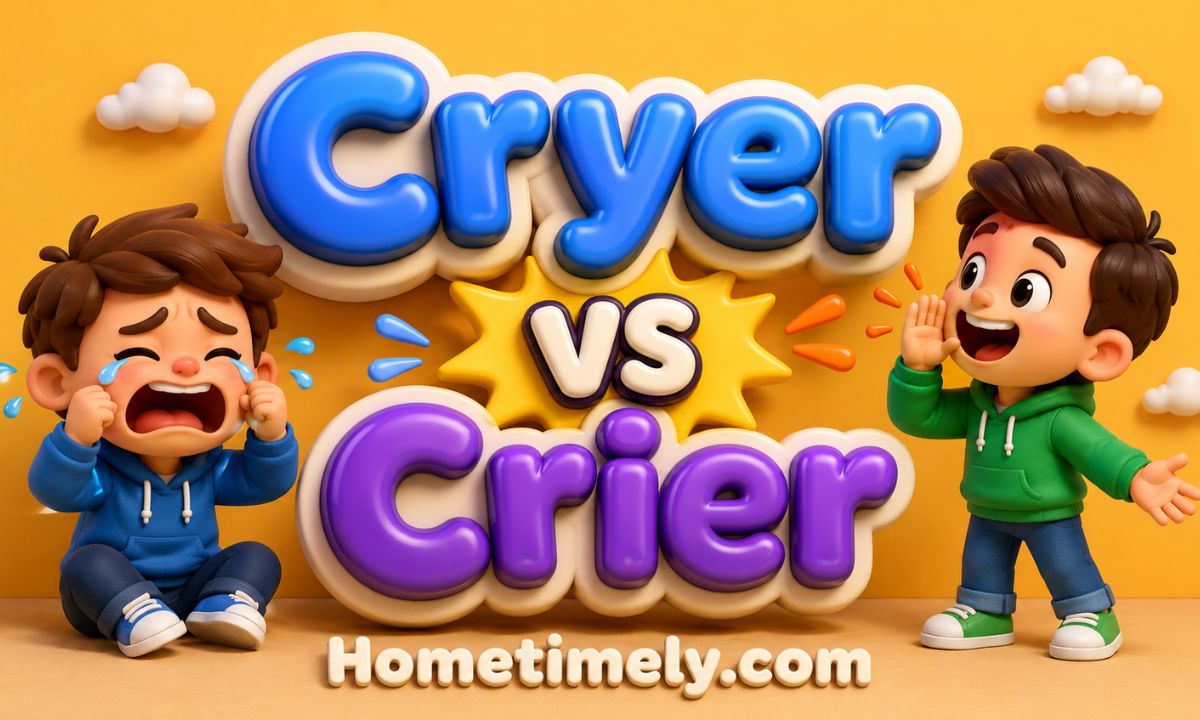
If you have ever paused mid-sentence wondering whether to write “cryer” or “crier,” you are not alone. These two words sound exactly the same when spoken aloud, yet only one of them is considered correct in modern English. The other survives mostly as a spelling mistake, an old surname, or a leftover from historical texts.
This confusion pops up everywhere, from students writing essays to content creators typing captions, and even in casual conversations on forums like Reddit. The good news is that once you understand the simple spelling rule behind this word, you will never second-guess it again.
This guide breaks down exactly what “crier” means, where “cryer” comes from, why the mix-up happens so often, and how to use each word correctly with real examples.
The Quick Reality Check
Let’s settle the confusion immediately, before going any further into the details.
- Crier is the correct, standard spelling in modern English.
- Cryer is considered nonstandard. It appears mainly as a surname, in old texts, or as a simple spelling error.
If you are describing someone who cries often, or someone who makes public announcements, the word you want is crier. Every major dictionary, including Merriam-Webster, Cambridge, and Oxford, recognizes “crier” as the standard form. None of them list “cryer” as an accepted modern spelling for this meaning.
Keep that in mind as the baseline, and everything else in this article will simply build on that foundation.
What Crier Actually Means
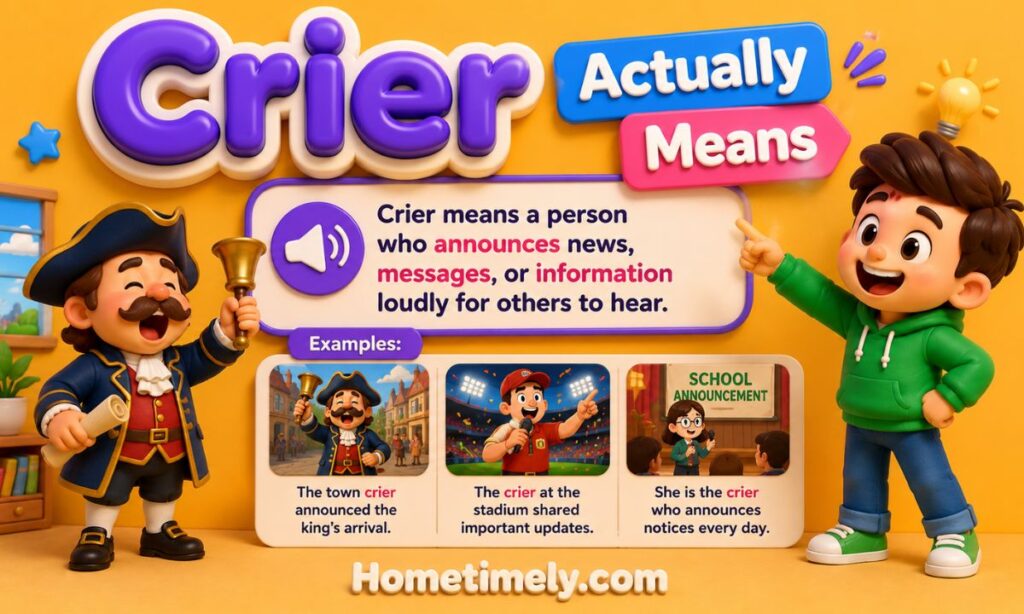
The word “crier” carries two related but distinct meanings, both tracing back to the verb “cry.”
Simple meaning of crier
In everyday use, a crier refers to one of the following:
- A person who cries easily or frequently. This is an emotional description, often used casually. For example: “She has always been a crier during sad movies.”
- A person who makes public announcements aloud. This meaning is historical and formal, most famously tied to the role of the town crier.
Both meanings share the same root idea: someone who “cries out,” whether that means shedding tears or shouting information loudly enough for others to hear.
Where the word comes from
“Crier” is formed from the verb “cry” plus the agent suffix “-er,” the same pattern used to build words like “runner” from “run” or “speaker” from “speak.” An agent noun like this simply names the person who performs the action of the verb.
English spelling rules require that when a word ends in “y” preceded by a consonant, the “y” typically changes to “i” before adding a suffix like “-er.” That is exactly what happens here:
- cry → cri + er → crier
This same rule applies to other common words, such as “carry” becoming “carrier” and “worry” becoming “worrier.” Once you see the pattern, the logic behind “crier” becomes much easier to remember.
What a Crier Looks Like in Real Life
Beyond the dictionary definition, it helps to picture how the word “crier” actually shows up in real situations, both emotionally and historically.
An emotional crier might be:
- Someone who tears up during movies, weddings, or emotional conversations
- A person known among friends and family for being sensitive or quick to cry
- Someone who cries as a natural response to stress, joy, or empathy
A public crier, on the other hand, refers to something far more formal and historical.
Historical role
Long before newspapers, radio, or the internet existed, communities relied on a designated person to spread news aloud. This person was known as the town crier.
Town criers held an official, and often legally protected, position. Their responsibilities typically included:
- Announcing royal proclamations and new laws
- Sharing news of births, deaths, and public events
- Ringing a bell or shouting “Oyez!” to gather a crowd before speaking
- Reading messages aloud in market squares and town centers
Since literacy rates were low for much of history, the town crier played an essential role in keeping communities informed. Even today, some towns in the United Kingdom and elsewhere preserve the tradition through ceremonial town crier competitions and events, though the practical need for the role has long since disappeared.
Cryer vs crier reddit
Search around online discussion boards like Reddit, and you will quickly notice that this spelling debate comes up fairly often, especially in language-learning communities and general grammar discussions.
Common patterns seen in these conversations include:
- People asking which spelling is “actually correct” after noticing both forms used online
- Native speakers admitting they always assumed it was spelled “cryer” based on pronunciation
- Others pointing out that “cryer” is a fairly common surname, which adds to the confusion
- Grammar-focused threads confirming that “crier” is the dictionary-standard spelling
The consistent takeaway across these discussions matches what every major dictionary already confirms: “crier” is correct, while “cryer” survives mostly through mistaken spelling habits or as a family name rather than as an accepted standard word.
What Cryer Means (And Why It Confuses Everyone)
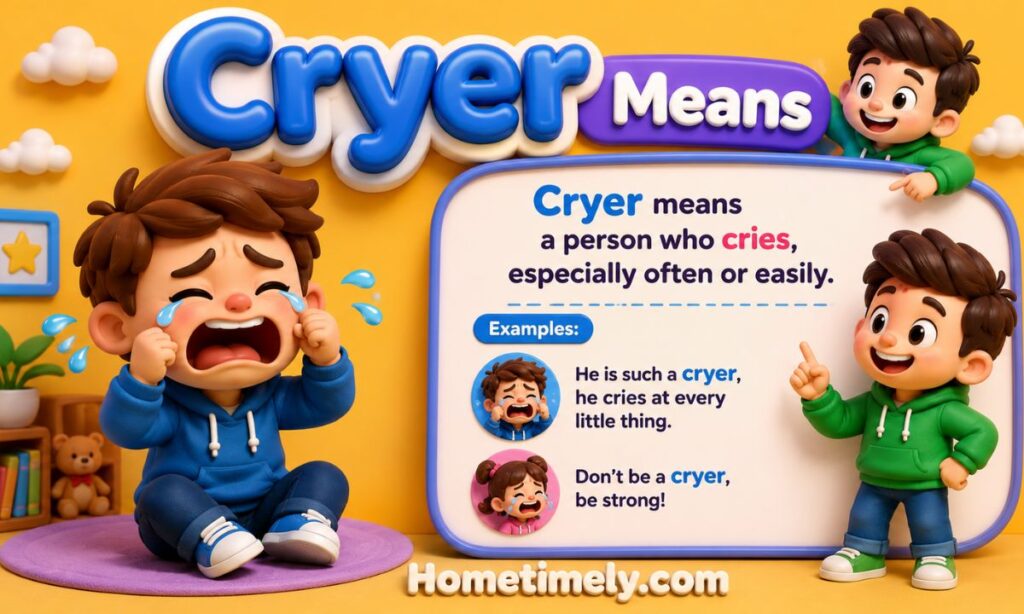
Even though “cryer” is not the standard spelling, it does still show up in a few specific contexts. Understanding these helps explain why the confusion refuses to fully disappear.
1. As a surname
“Cryer” exists as a legitimate family surname in English-speaking countries. Because surnames often preserve older or regional spelling variations, “Cryer” as a last name has nothing to do with grammar correctness. It simply reflects historical naming conventions.
2. As a spelling mistake
By far the most common reason “cryer” appears in writing is simple human error. Since the word is pronounced exactly like “crier,” many writers spell it the way it sounds rather than following the standard English spelling rule.
3. Rare or informal usage
Occasionally, “cryer” appears in casual, informal writing, character dialogue in fiction, or stylistic branding choices. In these cases, the spelling is usually intentional rather than accidental, though it still falls outside standard grammar rules.
Also Read This : TYSM Meaning in Text: Definition, Examples & Best Replies
The Core Difference Between Cryer vs Crier
To make the distinction as clear as possible, here is a direct side-by-side comparison.
| Feature | Crier | Cryer |
| Standard spelling | Yes | No |
| Dictionary recognized | Yes (Merriam-Webster, Oxford, Cambridge) | No |
| Common meaning | Someone who cries; a public announcer | Rarely used; mainly a surname |
| Used in formal writing | Yes | No |
| Used in historical texts | Occasionally, alongside crier | Yes, in older manuscripts |
| Grammar rule followed | Yes (y → i before -er) | No |
Crier
Crier follows the standard English spelling rule and is the version accepted in dictionaries, style guides, and professional writing. Whether the context is emotional (“she’s a crier”) or historical (“the town crier”), crier is always the safe and correct choice.
Cryer
Cryer breaks from the standard spelling pattern. While it was more common centuries ago when English spelling was far less standardized, it now functions mainly as a surname or an easily made typing mistake. If you see “cryer” used to mean someone who cries or announces news, most editors would flag it for correction.
Why This Confusion Happens
The mix-up between these two words is not random. It stems from a very specific quirk in how English spelling works compared to how English sounds.
The spelling pattern issue
English speakers naturally want to spell words the way they sound. Since “crier” and “cryer” are pronounced identically, it feels intuitive to keep the “y” from the base word “cry” and simply add “-er,” producing “cryer.”
However, English spelling is not purely phonetic. Many words follow visual and historical spelling conventions rather than sound alone. In this case, the rule dictating that a final “y” changes to “i” before certain suffixes overrides the instinct to spell purely by ear.
This same clash between sound and spelling appears in other tricky word pairs, though not always with the same outcome:
- Drier vs dryer: Both spellings survived, but they now carry different meanings. “Drier” typically describes something more dry, while “dryer” refers to a machine.
- Flier vs flyer: Both remain common today and are largely interchangeable, unlike crier and cryer.
Crier and cryer, however, did not follow that same path. Instead, “crier” won out completely, while “cryer” faded into near-obsolescence for this particular meaning.
Cryer or crier for crying
When specifically describing someone who cries, whether occasionally or often, the correct word is always crier, never “cryer.”
Correct examples:
- “He’s not usually a crier, but that ending made him tear up.”
- “She became a quiet crier as she got older.”
- “The baby was a loud crier throughout the entire flight.”
Incorrect example:
- “He’s not usually a cryer, but that ending made him tear up.” ❌
No matter how natural “cryer” might feel based on pronunciation, standard English grammar consistently favors “crier” for this emotional meaning.
Where You Will Actually See “Crier”
Beyond casual conversation, the word “crier” appears in several specific settings, both historical and modern.
Courtrooms
Some court systems still use the term “court crier” to describe an officer who formally announces the opening of court proceedings, calls witnesses, or maintains order during a session. While the role has evolved, the term persists in certain legal traditions.
Auctions
Historically, auctioneers were sometimes referred to as criers, since their job involves loudly announcing bids and prices to a crowd. Though “auctioneer” is now the far more common modern term, “crier” still appears in historical descriptions of the profession.
Historical reenactments
Renaissance fairs, historical festivals, and heritage tourism events frequently feature costumed performers acting as town criers. These reenactments help preserve the tradition and educate visitors about how news traveled before mass media existed.
Literature and storytelling
Writers exploring historical fiction, fantasy worlds, or period dramas often include a crier character to authentically represent how information spread within a story’s setting. This usage keeps the word alive in creative writing well beyond its everyday, literal use.
Common Mistakes People Make
Even after learning the correct spelling, a few related mistakes tend to trip people up.
Using cryer for an announcer
One of the most frequent errors is writing “cryer” when referring to someone who announces news publicly. Since this meaning has existed for centuries and is strongly tied to formal and historical writing, using the nonstandard spelling here looks especially out of place.
Incorrect: “The cryer announced the festival dates.” Correct: “The crier announced the festival dates.”
Thinking it means an emotional person
Some writers assume “crier” only applies to public announcers, forgetting that it equally describes someone who cries easily. Both meanings are valid and standard.
Treating both words as interchangeable
Because they sound alike, some assume “crier” and “cryer” are simply two acceptable spellings of the same word, similar to “flier” and “flyer.” This is not the case. Only “crier” is standard, while “cryer” is nonstandard outside of surnames or intentional stylistic choices.
Easy Way to Remember the Difference
If you want a simple mental shortcut, try this:
- You cry, so you become a crier, not a “cryer.”
- Think of other “-y” verbs that follow the same pattern: carry → carrier, worry → worrier, marry → marrier (less common, but grammatically valid).
- Ask yourself: would a spell-checker or editor flag this? If the answer is yes, the word is likely “cryer,” and you should switch it to “crier.”
Repeating this pattern a few times when writing or proofreading will make the correct spelling second nature.
Modern Equivalent of a Crier
While the traditional town crier no longer serves a practical purpose in most societies, the core function of publicly sharing important information has simply shifted to other roles and formats.
Modern equivalents of a crier include:
- News anchors and broadcasters delivering daily updates
- Public announcement systems in airports, stations, and stadiums
- Social media accounts and news alerts that push information instantly
- Auctioneers who still verbally call out bids in real time
- Radio hosts and podcasters sharing news and updates aloud
The town crier’s job of loudly and clearly sharing information with a crowd has essentially been absorbed by technology, though the human instinct to gather and listen to important announcements remains the same.
Why “Crier” Survived in English
Language naturally favors consistency, and “crier” simply fit better within established English spelling patterns than “cryer” did. Once dictionaries and early grammar guides began standardizing spelling during the 18th and 19th centuries, “crier” was selected as the preferred form, likely because it aligned with the same “y to i” rule used across many other agent nouns.
As formal education spread and spelling became more standardized in schools and publishing, “crier” solidified its position, while “cryer” gradually faded from everyday use, surviving mainly as a surname and in older historical documents.
This mirrors a broader pattern in English, where competing spellings often existed for centuries before one form was formally adopted while the other slowly disappeared from common use.
Conclusion
The debate between cryer and crier comes down to one simple, memorable rule: crier is correct, and cryer is not, at least when referring to someone who cries or someone who makes public announcements. The confusion is understandable, given that both words sound identical and English spelling does not always match pronunciation perfectly.
Whenever you are unsure, remember that the “y” in “cry” changes to “i” before adding “-er,” giving you “crier.” Whether you are writing about an emotional moment, a historical town crier, or a modern courtroom officer, this spelling will always be the safe, standard, and dictionary-approved choice. Keep this simple rule in mind, and you will never have to hesitate over this tricky word pair again.

Michael Brook is the creator and author behind Healthy Leeks, a platform focused on grammar, writing skills, and English language learning. Passionate about clear communication and effective writing, Michael Brook shares practical grammar tips, easy-to-follow language guides, and educational content to help readers improve their English with confidence.


