You’re scrolling through a chat and someone replies with “tysm.” No context, no explanation, just four letters. Is it a typo? A new slang term? Something you’re supposed to already know?
TYSM is one of the most common abbreviations in modern texting, and once you know what it means, you’ll start spotting it everywhere — in DMs, comment sections, group chats, and even some workplace messages. This guide breaks down exactly what TYSM means, where it comes from, how to use it naturally, and what to say instead when you want your gratitude to feel a little more personal.
TYSM Meaning Explained Clearly
TYSM stands for “Thank You So Much.” It’s an acronym, meaning each letter represents the first letter of a word in the phrase it replaces.
| Letter | Stands For |
| T | Thank |
| Y | You |
| S | So |
| M | Much |
It’s used to express gratitude quickly, especially in situations where typing out a full sentence feels unnecessary. TYSM carries a slightly stronger tone than a plain “thanks” or “ty,” since it includes the emphasis word “so” — similar to how “thank you so much” feels warmer in speech than a flat “thanks.”
What Does TYSM Mean in Texting?
In texting specifically, TYSM functions as a fast, casual way to acknowledge a favor, compliment, or piece of help. It’s part of a much larger family of texting abbreviations built for speed: think LOL, BRB, IDK, and OMG. TYSM fits into this same shorthand culture, just focused on gratitude instead of laughter or urgency.
A few quick characteristics of TYSM in texting:
- It’s informal — best suited for friends, peers, and casual relationships
- It conveys appreciation faster than typing the full phrase
- It often appears with emojis, exclamation marks, or repeated letters (like “tysmm” or “tysmmm”) for extra emphasis
- It rarely appears in formal writing, official documents, or professional emails
If a friend sends you notes you missed in class, helps you move apartments, or compliments your outfit, replying “tysm!” is a completely normal, expected response in most casual digital spaces.
TYSM Meaning in Chat and Online Communication
Beyond one-on-one texting, TYSM shows up constantly across broader online communication — comment sections, livestream chats, customer service replies, and gaming platforms. The core meaning never changes, but the tone can shift slightly depending on where it’s used.
In chat environments specifically, TYSM often serves a few practical purposes:
- Quick acknowledgment — responding to dozens of comments or messages without typing the same sentence over and over
- Maintaining a friendly tone — keeping interactions warm even when replies are brief
- Signaling genuine appreciation — especially when paired with emojis like 🥹, ❤️, or 😊
- Saving time in fast-moving conversations — group chats, livestreams, and Discord servers where messages scroll quickly
Because online communication tends to be less formal than written letters or emails, TYSM fits naturally into the rhythm of chat-based platforms, where brevity is valued just as much as politeness.
TYSM Meaning in 2025 vs 2026
TYSM’s core definition hasn’t shifted between 2025 and 2026 — it still means “Thank You So Much.” What has changed slightly is how widely and confidently it’s used.
| Aspect | 2025 | 2026 |
| Recognition | Widely understood among younger users | Recognized across nearly all age groups |
| Common platforms | Instagram, TikTok, SMS | Instagram, TikTok, Discord, workplace chat tools |
| Formality | Almost entirely casual | Occasionally appears in semi-formal team chats |
| Pairing with emojis | Common | Even more common, with layered emoji combinations |
| Variations | TYSM, TYSMM | TYSM, TYSMM, TYSMMM, TYSMH |
The general trend is that TYSM has moved from being a niche, youth-driven abbreviation to a near-universal piece of digital shorthand. It still isn’t appropriate for formal writing, but it’s become common enough that most internet users — regardless of age — recognize it instantly.
Where TYSM Is Used Most Today
TYSM thrives in environments built around speed, brevity, and casual tone. It’s far less common in spaces that prioritize formality or permanence, like printed documents or legal writing.
Common Platforms
- Instagram: Frequently used in comments and captions, especially by creators thanking followers for likes, shares, or kind words
- TikTok: Common in replies to comments, especially when creators are responding to large volumes of feedback
- WhatsApp and SMS: Used between friends and family for quick, everyday thanks
- Discord: Common in gaming and community servers, often paired with custom emojis
- Twitter/X: Used in quote tweets, replies, and threads to acknowledge support or shoutouts
- Workplace chat tools (Slack, Teams): Occasionally used in casual internal channels, though rarely in formal announcements or client-facing messages
Who Uses TYSM the Most
TYSM is most strongly associated with Gen Z and younger millennials, largely because these groups grew up communicating primarily through texting and social media rather than phone calls or letters. That said, its use has expanded well beyond any single age group.
- Teenagers and young adults use it constantly across texting and social apps as a default, low-effort way to say thanks
- Content creators and influencers rely on it to respond to large volumes of comments efficiently while still sounding warm
- Online communities (gaming, fandoms, forums) use it as a quick, friendly acknowledgment
- Some professionals use it in casual internal communication, though almost never in client-facing or formal contexts
Popular TYSM Variations and What They Signal
TYSM rarely appears in its plainest form alone. Small variations change the emotional weight of the message.
| Variation | What It Signals |
| tysm | Standard, friendly thanks |
| TYSM | Slightly more emphatic or enthusiastic |
| tysmm / tysmmm | Extra appreciation, often playful |
| tysm! | Genuine, upbeat gratitude |
| tysm 🥹 | Emotional, touched, or deeply grateful |
| tysm ❤️ | Warm, affectionate thanks |
| tysmh | “Thank you so much, haha” — lighthearted, joking tone |
These small tweaks matter more than people often realize. Adding extra letters or an emoji can shift a message from a casual reflex to something that feels genuinely heartfelt.
Tysm meaning from a girl

When a girl sends “tysm,” the core definition stays exactly the same — “Thank You So Much” — but the tone often leans warmer or more personal, especially depending on the relationship and accompanying emojis. A few patterns to note:
- Paired with ❤️, 🥹, or 😊, it usually signals genuine warmth or affection rather than a purely transactional thank-you
- In friendship contexts, it’s typically just an enthusiastic, friendly acknowledgment
- In flirtatious or romantic contexts, “tysm” combined with extra punctuation or heart emojis can carry a slightly more intimate undertone
- Without any emojis or punctuation, it usually reads as polite but neutral — closer to a quick, casual thanks than anything deeper
Context always matters more than the abbreviation itself. The same four letters can read as a passing pleasantry or a genuinely touched response depending on what surrounds them.
TYSM Examples in Real Conversations
Seeing TYSM used in realistic scenarios makes its tone easier to understand than a definition alone.
Friendly Text
Friend 1: “I left your jacket by your door, you forgot it at my place!” Friend 2: “omg tysm, I was looking everywhere for that 😭”
Group Chat
Person A: “I booked the restaurant for Friday, 7pm works for everyone right?” Person B: “tysm for sorting that out!” Person C: “yes perfect, tysm 🙌”
Instagram Comment
Follower: “Your outfit in this post is amazing!” Creator: “tysm 🥹❤️”
Quick Acknowledgment
Coworker: “Sent over the file you needed.” You: “tysm, appreciate it!”
Tysm reply in short form
Sometimes you need to respond to a “tysm” message rather than send one yourself. Short, natural replies include:
- “Np!” (No problem)
- “Anytime!”
- “Ofc 😊” (Of course)
- “You got it!”
- “No worries at all”
- “Happy to help”
These replies match the same casual, low-effort energy as TYSM itself, keeping the exchange light and conversational rather than overly formal.
Is TYSM Polite or Rude?
TYSM is polite, not rude. It’s a sincere, if brief, way of expressing thanks. The confusion sometimes happens because abbreviations can feel impersonal compared to a full sentence, especially to people less familiar with texting culture.
A few points that clear up the confusion:
- TYSM is never inherently dismissive — it’s simply a shortened form of a polite phrase
- Tone depends heavily on context, punctuation, and emojis, not the abbreviation itself
- A flat “tysm” with no punctuation can occasionally feel a little plain, but it isn’t rude
- In casual digital spaces, abbreviated thanks are the norm, not an exception
The short answer: TYSM is appropriate and polite in casual settings. It only risks feeling off when used in spaces that expect more formal or detailed communication, like professional emails or sensitive conversations.
Why TYSM Can Feel Flat Sometimes
Despite being polite, TYSM doesn’t always land with the same warmth as a fuller expression of gratitude. There are a few reasons for this.
Why Abbreviations Lose Warmth
Shortened phrases strip away some of the natural rhythm and emphasis that spoken language carries. “Thank you so much” said out loud can include tone, pacing, and emotion that “tysm” simply can’t replicate through text alone.
How Emojis Change the Meaning
Emojis often do the emotional work that the abbreviation itself can’t. A bare “tysm” can feel neutral or even slightly rushed, while “tysm 🥹” or “tysm ❤️” immediately signals warmth, sincerity, or even emotional impact.
Common Misinterpretations of TYSM
- Mistaking brevity for indifference: A short reply doesn’t mean someone isn’t grateful — it often just reflects fast-paced texting habits
- Confusing it with “ty” or “tysmh”: “Ty” is a more minimal thanks, while “tysmh” adds a joking “haha” tone
- Reading no punctuation as coldness: Many people simply don’t use punctuation in casual texting at all, regardless of how they feel
Tysm meaning from a boy
When a boy sends “tysm,” the meaning is identical — “Thank You So Much” — but tone interpretation can again depend heavily on context rather than gender alone. A few general patterns:
- In friend groups, it’s typically a simple, casual acknowledgment with no deeper meaning
- In professional or semi-formal chats, it usually signals straightforward appreciation
- Paired with emojis or exclamation marks, it can come across as more enthusiastic or genuinely touched
- A plain “tysm” with no extra context is usually just efficient, friendly communication — not a sign of disinterest
As with TYSM from anyone, the words around it (or the absence of them) tend to matter more than who’s sending the message.
Best Alternatives to TYSM
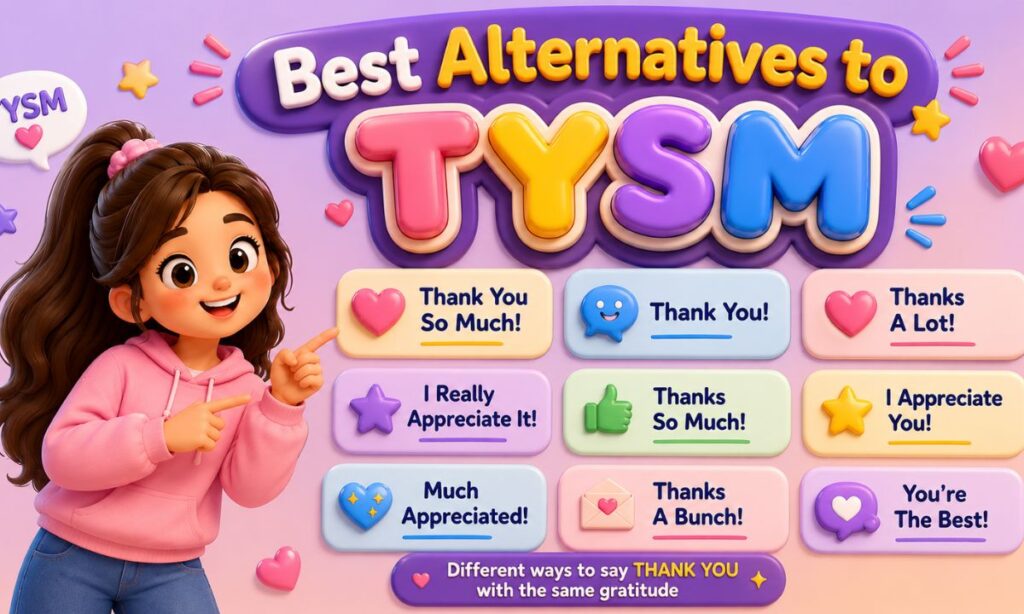
TYSM works well in casual digital spaces, but it isn’t always the right fit. Here are alternatives organized by tone and context.
Professional or Formal Alternatives
- “Thank you so much for your time.”
- “I sincerely appreciate your help with this.”
- “Thank you for your continued support.”
- “I’m grateful for your assistance.”
Casual and Friendly Alternatives
- “Thanks a ton!”
- “Appreciate you!”
- “You’re the best, thanks!”
- “Thanks so much, seriously!”
Deep or Heartfelt Gratitude
- “I genuinely don’t know what I would have done without you.”
- “This means more to me than you know.”
- “Thank you from the bottom of my heart.”
- “I’ll never forget how much this helped me.”
How to Choose the Right Thank-You Expression
Picking between TYSM, a casual phrase, or a heartfelt message comes down to three quick questions.
Who Are You Talking To?
A close friend, a coworker, a client, and a stranger online all warrant slightly different tones. TYSM works well for friends and casual acquaintances but can feel too relaxed for clients or formal professional contacts.
What’s the Context?
A quick favor (like sending a file) calls for something brief, like TYSM or “thanks!” A bigger gesture — financial help, emotional support, a major favor — usually deserves a fuller, more specific thank-you.
How Deep Is Your Gratitude?
If you’re genuinely moved by someone’s kindness, a short abbreviation might undersell how you actually feel. In those moments, taking the extra few seconds to type a complete sentence (or even a short paragraph) tends to land better than four letters ever could.
TYSM vs Other Internet Thank You Acronyms
TYSM belongs to a wider family of thank-you shorthand. Here’s how it compares to similar abbreviations.
| Acronym | Full Meaning | Tone |
| TY | Thank You | Minimal, quick |
| TYSM | Thank You So Much | Warmer, more emphatic |
| TYVM | Thank You Very Much | Slightly more formal-leaning |
| TYSVM | Thank You So Very Much | Extra emphatic, layered gratitude |
| THX | Thanks | Casual, brief |
| TSM | Thanks So Much | Similar to TYSM, slightly less common |
| TAL | Thanks A Lot | Can be sincere or sarcastic depending on tone |
TYSM sits comfortably in the middle of this spectrum — more expressive than a bare “ty” or “thx,” but still firmly casual compared to fuller written-out thank-yous.
Also Read This : Goodmorning or Good Morning: Which Is Correct?
TYSM Across Cultures and Languages
While “TYSM” as a specific set of letters is an English-language construct, the underlying concept — quick, casual digital gratitude — exists across many languages and cultures. Different language communities have developed their own shorthand for expressing thanks quickly in texting and online chat.
TYSM Meaning in Different Languages
- Spanish: Casual texters often use “grax” or “muchas grax” as a quick equivalent
- French: “Mrc” or “mrci bcp” serves a similar shorthand function for “merci beaucoup”
- Hindi/Hinglish: Phrases like “bahut shukriya” are sometimes shortened informally in texting, though full abbreviations are less standardized
- Malayalam and other regional languages: Localized informal thank-you phrases appear in texting, often blended with English slang like TYSM itself in bilingual conversations
The exact letters change, but the underlying behavior — compressing a polite, warm phrase into something fast and casual — is a global pattern in digital communication, not something unique to English speakers.
Case Study: TYSM in Real Digital Conversations
To understand how TYSM actually functions day to day, it helps to look at a few realistic scenarios across different settings.
Social Media Example
A small content creator posts a tutorial video and receives dozens of supportive comments. Rather than writing a full sentence under each one, they reply “tysm 🥹” repeatedly. Followers don’t read this as lazy or impersonal — they recognize it as the standard, expected way creators acknowledge appreciation at scale. The brevity is normalized by the platform’s culture, not seen as a lack of effort.
Workplace Chat Example
In a relaxed internal Slack channel, a team member shares a useful resource with a colleague. The colleague replies “tysm, this is super helpful!” In this semi-formal but still casual setting, TYSM reads as efficient and friendly. The same reply in a formal email to a client, however, would likely feel out of place — a fuller “Thank you so much for sharing this” would suit that context better.
Emotional Chat Example
A friend offers emotional support during a difficult week. The recipient replies “tysm for being here for me 🥹❤️.” Here, the abbreviation is paired with emotional emojis that carry most of the sincerity, showing how TYSM can still convey real depth when combined with the right supporting cues, even though the words themselves are brief.
Common TYSM Mistakes to Avoid
- Using it in formal emails or professional documents — it almost always reads as too casual
- Sending it without any context in serious conversations — heavier emotional moments usually need more than four letters
- Confusing it with similar acronyms like “tysvm” or “tyvm,” which carry slightly different emphasis
- Assuming a bare “tysm” is cold or dismissive — context and platform norms matter more than the abbreviation itself
- Overusing it to the point it loses meaning — if every message ends in “tysm,” it can start to feel automatic rather than genuine
Quotes on Gratitude in Digital Conversations
Even in a world of acronyms and quick replies, the underlying idea behind expressions like TYSM connects to a much older truth about gratitude: that acknowledging others matters, no matter how briefly it’s expressed. As communication researchers and etiquette writers have long noted, the format of a thank-you matters far less than the consistency and sincerity behind it. A short “tysm” sent regularly and genuinely often builds more goodwill over time than a single elaborate thank-you note sent once and rarely repeated.
Reference Cambridge Dictionary Definitions
While “TYSM” itself is internet slang rather than a formally standardized dictionary entry, major reference sources that track digital language and abbreviations consistently define it as shorthand for “thank you so much,” used informally in texting and online communication. Style and language resources that document modern slang, including academic and editorial language guides, treat TYSM as part of the broader category of texting abbreviations alongside terms like LOL, BRB, and OMG — informal, widely recognized, but not appropriate for formal written English.
Conclusion
TYSM is a simple, friendly piece of digital shorthand that means “Thank You So Much.” It’s polite, efficient, and perfectly suited to the fast pace of texting, social media, and casual chat. Whether it comes from a friend, a coworker, or a stranger online, the core meaning stays the same — even as tone shifts depending on emojis, punctuation, and context.
Use it freely in casual conversations, but reach for fuller phrases when the moment calls for something deeper or more formal. Understanding when TYSM fits — and when it doesn’t — is

Michael Brook is the creator and author behind Healthy Leeks, a platform focused on grammar, writing skills, and English language learning. Passionate about clear communication and effective writing, Michael Brook shares practical grammar tips, easy-to-follow language guides, and educational content to help readers improve their English with confidence.