Trying to figure out whether it’s “favs” or “faves”? You’ve probably seen both spread across social media, playlists, and casual texts, and honestly, both look right at first glance. The truth is simple: both spellings exist, both mean “favorites,” and the one you choose depends on tone, platform, and audience. This guide breaks down everything you need to know so you never second-guess yourself again.
Favs
Favs is the shortened, no-extra-letter version of “favorites.” It’s compact, quick to type, and shows up a lot in hashtags, app buttons, and fast-paced digital spaces where speed matters more than style.
Faves
Faves is the slightly longer, more natural-sounding version. It mirrors how the word is actually pronounced, which is why many writers and style guides lean toward it in everyday sentences.
Favs or Faves – Quick Answer
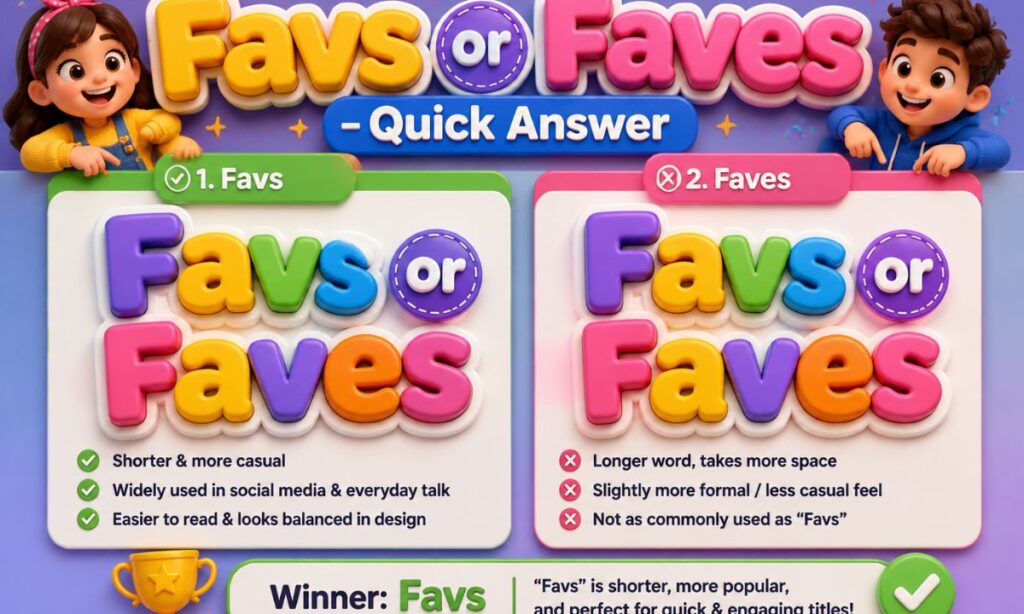
Here’s the short version if you’re in a hurry: both spellings are correct, and neither one is “wrong.” They’re informal abbreviations of “favorites” (or “favourites” in British English), not official dictionary words with strict rules.
Simple rule:
- Use faves when writing full sentences, since it reads more naturally.
- Use favs for tags, buttons, hashtags, or short labels where brevity matters.
- Avoid both in formal writing — stick with “favorites” instead.
Examples:
- “These are my faves from the new album.” ✅
- “Tap the star to save as favs.” ✅
- “Our favs include the blue and grey options.” ✅ (also acceptable, just less common in prose)
Short Form of Favorite or Favourite (Fav, Fave, Favs, Faves)
All four versions — fav, fave, favs, faves — come from the same root word: favorite (American English) or favourite (British English). They’re simply shortened for speed and casual tone.
Common Short Forms:
| Short Form | Type | Common Use |
| Fav | Singular | Buttons, tags, usernames |
| Fave | Singular | Sentences, captions |
| Favs | Plural | Hashtags, lists |
| Faves | Plural | Sentences, social posts |
Examples:
- “This song is my fave right now.”
- “Add it to your favs before you forget.”
- “She shared her top 5 faves of the year.”
- “Click the heart icon to save as fav.”
Which One Should You Use?
If you’re writing a sentence someone will actually read out loud in their head, faves usually feels smoother. If you’re labeling a button, tag, or short UI element, favs works just fine. There’s no strict rule — just a general pattern based on readability.
Related Search Queries Explained:
Many people search terms like “favs meaning,” “is it faves or favs,” “fav or fave,” and “my favs or faves.” All of these point to the same core confusion: informal English doesn’t always follow one fixed spelling, and both versions are widely accepted across platforms.
The Origin of Favs or Faves
The base word: Favorite / Favourite
The word favorite comes from Latin through French, originally tied to the idea of “favor” or “preference.” Over centuries, it became a standard English word used to describe something preferred above others.
How the short forms developed
As texting and social media became part of daily life, people naturally started shortening longer words. Favorite got trimmed down first to fav, then to fave as a way to better match how the word sounds when spoken.
Why two spellings exist
Since neither form is an official dictionary standard, spelling came down to personal preference and phonetics. Some writers dropped the “e” for speed, while others kept it to preserve the natural pronunciation. Both habits stuck, and that’s why we still see the split today.
When Should You Use Favs?
Favs works best in short, casual, and fast-paced contexts. Here’s when it fits naturally:
- Hashtags – “#MyFavs2026”
- App buttons – “Save to Favs”
- Usernames or handles – “TravelFavs”
- Quick captions – “New favs alert!”
Favs feels compact and functional, which is exactly why apps, websites, and social platforms often default to this version for interface labels.
British English vs American English Spelling
American English
American English typically uses favorite as the full word, and both fav and favs appear commonly online, especially on platforms with strong American user bases.
British English
British English uses favourite with the extra “u,” but interestingly, the informal short forms — fave and faves — tend to be slightly more common than favs, especially in UK media and casual writing.
Comparison Table
| Feature | American English | British English |
| Full word | Favorite | Favourite |
| Common short singular | Fav / Fave | Fave |
| Common short plural | Favs | Faves |
| Formal usage | Favorite | Favourite |
Which Spelling Should You Use?
Use faves if:
- You’re writing a full sentence
- You want a warmer, more natural tone
- You’re posting on Instagram, blogs, or captions
Use favs if:
- You’re creating a hashtag or tag
- You need a short label for a button or app feature
- You’re writing something quick and casual, like a text
Avoid both if:
- You’re writing a formal email, report, or academic paper
- Your audience is unfamiliar with casual internet abbreviations
- Clarity matters more than brevity
Audience-based advice
For younger, social-media-savvy audiences, either spelling works fine. For older or more formal audiences, it’s safer to stick with the full word “favorites” to avoid confusion.
Examples of Favs in Sentences
- “These sneakers are definitely one of my favs.”
- “Check out this list of reader favs from last month.”
- “Save your favs so you don’t lose track of them.”
- “Our team favs include three new product designs.”
Examples of Faves in Sentences
- “That restaurant has become one of our faves.”
- “Here are my top five faves from the show.”
- “She always posts her weekly faves on Fridays.”
- “This playlist is full of old faves and new discoveries.”
Common Mistakes with Favs or Faves
1. Using them in formal writing
Slang words like favs or faves can make professional documents, resumes, or business emails feel careless. Stick with “favorites” in those situations.
2. Mixing tone
Switching between formal and casual language in the same piece of writing can confuse readers and weaken your message. Keep the tone consistent throughout.
3. Incorrect apostrophes
A common error is writing “fav’s” or “fave’s” to show plural form. Plural words don’t need an apostrophe — it’s favs or faves, not fav’s or fave’s.
4. Overusing slang
Even in casual writing, too much informal language can reduce clarity. Use favs or faves naturally, not in every single sentence.
Favs vs Faves Meaning, Usage, and Common Questions
Meaning of Favs and Faves
Both words simply mean “favorites” — items, people, or things someone prefers most. Neither carries a different definition; the difference is purely stylistic.
Common Usage Questions
People often wonder if one spelling is “more correct” than the other. In reality, both are informal and accepted, though faves tends to appear more often in natural sentences, while favs shows up more in tags and short labels.
Common Mistake (Apostrophe Issue)
As mentioned above, avoid adding an apostrophe before the “s.” These are simple plural forms, not possessive nouns.
Extra Clarifications from Search Queries
Searches like “favs or faves grammar,” “which is correct fav or fave,” and “faves meaning slang” all point to the same answer: context and tone decide the better choice, not a fixed grammar rule.
Favs or Faves in Everyday Examples
Emails
Casual, friendly emails might include lines like, “Thanks for sharing your faves with me!” — but formal business emails should avoid slang entirely.
News & Media
Entertainment sections and lifestyle articles often use faves in headlines, such as “Fan Faves Return This Season,” since it fits a light, engaging tone.
Social Media
Platforms like Instagram and TikTok frequently feature captions like “New faves this week” or hashtags like “#WeekendFavs,” depending on the creator’s style.
Apps & Websites
Buttons and labels almost always use favs, such as “Add to Favs” or “View My Favs,” since shorter text fits better in small UI spaces.
Formal Writing
In resumes, essays, or professional reports, neither favs nor faves should appear. Use the complete word “favorites” instead.
Also Read This : Refer or Reffer: Which Spelling Is Correct?
Favs or Faves – Google Trends & Usage Data
What Google Trends shows
Search interest for both terms remains steady, with spikes often tied to social media trends, year-end “favorites” lists, and product review content.
By region
American audiences show slightly higher search volume for “favs,” while British and Commonwealth audiences tend to search “faves” more frequently, aligning with regional writing habits.
Context matters
Search data confirms what usage patterns already show: neither spelling dominates completely. Instead, popularity shifts based on platform, purpose, and audience expectations.
Comparison Table: Keyword Variations
| Term | Type | Best Used For |
| Favorite | Full word | Formal writing |
| Favourite | Full word (UK) | Formal writing (UK) |
| Fav | Short singular | Tags, buttons |
| Fave | Short singular | Sentences, captions |
| Favs | Short plural | Hashtags, labels |
| Faves | Short plural | Sentences, social posts |
For ESL Learners
If English isn’t your first language, here’s a simple way to remember the difference: think of faves as the “spoken” version, since it matches how the word sounds. Favs is more of a “written shortcut,” commonly seen on buttons and tags rather than in natural speech. When in doubt, using the full word “favorites” is always a safe and clear choice.
Conclusion
At the end of the day, favs or faves both mean the same thing — favorites — and neither spelling is officially wrong. Choose faves for natural sentences and favs for tags, buttons, or quick labels, and save “favorites” for anything formal. Once you understand the context, picking the right one becomes second nature.

Michael Brook is the creator and author behind Healthy Leeks, a platform focused on grammar, writing skills, and English language learning. Passionate about clear communication and effective writing, Michael Brook shares practical grammar tips, easy-to-follow language guides, and educational content to help readers improve their English with confidence.