If you’ve ever typed “tripple” and then stared at it, wondering if that extra letter belongs there, you’re dealing with one of English’s sneakiest little spelling traps. It looks like it should have a double consonant, the same way “apple” or “ripple” do — but it doesn’t. This guide breaks down exactly why, where the word comes from, how it’s used across different types of writing, and how to make sure you never type the wrong version again.
Triple
“Triple” is the correct, standard English spelling. It means three times as much, made up of three parts, or occurring three times. It functions as an adjective, a noun, and a verb, which makes it one of the more versatile number-based words in the language.
Tripple
“Tripple” is, in nearly every case, simply a misspelling of “triple.” It isn’t recognized by major dictionaries as a standard English word. The one narrow exception is a specialized, largely historical term describing a particular horse gait — but unless you’re deep in equestrian terminology, this isn’t the word you’re looking for.
Triple or Tripple: Quick Answer
- Correct spelling: triple (one “p”)
- Incorrect in standard use: tripple (two “p”s)
- Rare exception: “tripple” as a term for a horse’s gait, found in some dictionaries but almost never used in everyday writing
- Easy memory trick: “tri” means three — the word stays short and simple, with no extra letter needed
If you’re writing about anything multiplied by three — money, portions, scores, layers, or speed — “triple” is the spelling you want, every single time.
The Origin of Triple or Tripple
“Triple” has a long, well-documented history in English. It traces back to the Latin word “triplus,” meaning threefold, which itself came from “tri-” (three) combined with “-plus” (fold). From there, it passed into Medieval Latin as “triplare,” meaning “to triple” or “to multiply by three,” before moving into Old French as “triple.” English absorbed the word from Old French in the 14th century, keeping both the spelling and the core meaning of “threefold” intact.
By the 15th century, “triple” was already being used as a noun in English texts, and its meaning has stayed remarkably consistent for over 600 years. Whether you’re reading a medieval manuscript or a modern news article, “triple” has always pointed back to the number three.
“Tripple,” on the other hand, doesn’t share this same lineage. It isn’t a variant spelling that evolved alongside “triple” — it has a completely separate, much narrower origin. In specific dictionaries, “tripple” is listed as a term describing a particular gait in horses, where both legs on one side move together before both legs on the other side follow. This usage is believed to come from Dutch words related to skipping or light-footed movement, and it shows up almost exclusively in older or regional equestrian writing.
So when people write “tripple” thinking it’s simply the plural-looking version of “triple,” they’re not drawing on any real linguistic history — they’re just following a visual pattern from other double-consonant English words, which brings us to why the confusion happens in the first place.
It also helps to compare “triple” with its numeric siblings: “double,” “quadruple,” and “quintuple.” Each of these words follows the same general Latin-derived structure — a number prefix combined with a “-ple” or similar suffix meaning “fold.” None of them double their final consonant either. “Double” comes from the Latin “duplus,” “quadruple” from “quadruplus,” and “quintuple” from “quintuplus.” Seeing the whole family together makes it clear that “triple” isn’t behaving oddly — it’s simply following the exact same pattern as every other number-based “-ple” word in English.
This kind of etymological consistency is actually a helpful memory tool. If you already know that “double” only has one “b,” you can apply that same logic to “triple” having only one “p,” since both words are built from the same underlying Latin structure.
British English vs American English Spelling
Unlike words such as “colour/color” or “travelling/traveling,” “triple” doesn’t have a regional spelling variation. Both American and British English use the exact same one-“p” spelling.
Comparison Table
| Region | Correct Spelling | Regional Variation? |
| American English (US) | triple | None |
| British English (UK) | triple | None |
| Canadian English | triple | None |
| Australian English | triple | None |
| South African English | triple (tripple only in horse-gait context) | Rare technical exception |
This consistency makes “triple” one of the easier words to get right once you know the rule, since you don’t need to adjust your spelling based on your audience’s location the way you would with many other English words.
Which Spelling Should You Use?
In virtually every piece of writing you’ll ever produce — emails, essays, articles, business reports, texts, or social captions — “triple” is the word you need.
Use triple when you mean:
- Three times the amount, size, or quantity (“triple the budget”)
- Made up of three parts or layers (“a triple-layer cake”)
- Occurring three times in a row (“a triple win”)
- To multiply something by three, as a verb (“we plan to triple our revenue”)
Only reach for tripple if you are specifically writing about the historical, specialized horse gait — and even then, expect most readers to assume it’s a typo unless the surrounding context makes the equestrian meaning obvious.
A simple test: if your sentence has anything to do with numbers, quantities, sports scores, food portions, or business growth, you want “triple.” If it doesn’t fit any of those categories, you almost certainly still want “triple” — the horse-gait usage is rare enough that most writers will go their entire careers without needing it.
Here’s a fast three-step check you can run whenever you’re unsure:
- Does the sentence involve multiplying by three, three parts, or three occurrences? If yes, use “triple.”
- Are you specifically writing about horse gaits or equestrian terminology? If yes, and only in that narrow context, “tripple” may technically apply — though many style guides would still recommend rephrasing for clarity.
- Still not sure? Default to “triple.” It’s correct in the overwhelming majority of real-world writing situations, and no major dictionary lists “tripple” as a standard alternative spelling.
For content writers, students, and professionals alike, this simple decision process removes almost all the guesswork. In fact, you could go your entire life writing professionally and never need the word “tripple” even once.
How to Spell Triple (Common User Queries)
People search for help with this word in a lot of different ways. Here are the most common questions, answered directly:
Is it “triple” or “tripple”? It’s “triple,” with a single “p.”
Why doesn’t triple double its consonant like other words? The doubling rule in English generally applies when a suffix is added directly after a short, stressed vowel and a single consonant — like “stop” becoming “stopping.” In “triple,” the “-le” ending already completes the syllable structure, so the consonant doesn’t need to double. Words like “simple,” “sample,” and “supple” follow this exact same pattern.
Is “tripple” ever correct? Only in a narrow, specialized context describing a specific horse gait. In everyday writing, it’s considered a spelling error.
Does spell-check catch “tripple”? Most modern spell-checkers and grammar tools will flag “tripple” and suggest “triple” instead, since it isn’t recognized as standard English.
What part of speech is “triple”? It can function as an adjective (“a triple win”), a noun (“he hit a triple”), or a verb (“sales tripled this year”).
How do I remember the spelling permanently? Think of the root “tri-,” meaning three. Just like “triangle” and “tricycle” don’t double their consonants, neither does “triple.”
Common Mistakes with Triple or Tripple
Even careful writers slip up on this word from time to time. Here’s why it happens and how to catch it:
- Pattern-matching with similar-looking words. Words like “apple,” “ripple,” “supple,” and “topple” all use double consonants, which makes “tripple” feel visually correct even though it isn’t.
- Typing quickly without proofreading. Because “triple” and “tripple” sound identical when spoken, the error is easy to miss when you’re typing fast in emails, texts, or social posts.
- Confusing “triple” with “treble.” These two words are related in meaning but are not interchangeable. “Treble” is most often used in British English for financial or musical contexts (a “treble clef,” or “the prize money trebled”), while “triple” is the more universal, general-purpose term.
- Assuming a suffix always doubles the final consonant. Learners who’ve recently studied rules like “stop → stopping” sometimes overapply that logic to every short word, forgetting that words ending in “-le” follow a different pattern entirely.
- Relying on autocorrect instead of proofreading. Not every keyboard or writing app flags “tripple” instantly, especially in apps with lighter spell-checking, which lets the mistake slip through unnoticed.
A quick way to catch this error before publishing: count the letters. T-R-I-P-L-E has six letters. If what you typed has seven, you’ve added an extra “p” that doesn’t belong.
- Overcorrecting after learning a different doubling rule. Writers who’ve recently studied words like “hop → hopping” or “run → running” sometimes start doubling consonants everywhere out of caution, even in words like “triple” where the rule doesn’t apply.
- Trusting muscle memory over active proofreading. Once someone has typed “tripple” a few times without correction, their fingers can start to “remember” the wrong spelling, making it feel more natural than it should.
- Skimming past short, familiar words during editing. Just like with other commonly confused word pairs, writers often focus their proofreading energy on longer or more complex words, assuming shorter, everyday words like “triple” can’t possibly be spelled wrong.
If you want a foolproof method for catching this mistake permanently, try reading your sentence aloud and pausing on the word “triple” specifically. Say each syllable slowly: “trip-le.” Notice that there’s no reason for a doubled consonant to sit between those two syllables — that pause alone is often enough to catch the error before it goes to print.
Triple in Different Contexts
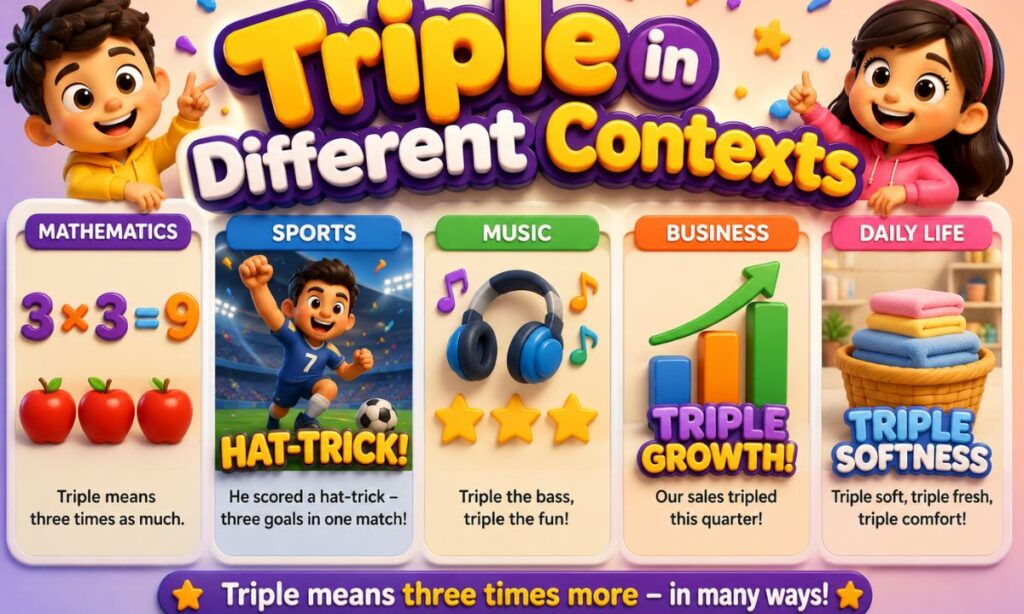
“Triple” shows up across an unusually wide range of fields, which is part of why getting the spelling right matters so much — it’s a word you’re likely to use often, no matter what you write about.
- Sports: A “triple” in baseball is a hit that allows the batter to safely reach third base. In track and field, the “triple jump” combines a hop, a step, and a jump into one continuous motion.
- Business and finance: Companies often talk about wanting to “triple revenue,” “triple output,” or achieve “triple-digit growth.”
- Food and beverage: Menus frequently advertise a “triple shot of espresso,” a “triple cheeseburger,” or a “triple-layer cake.”
- Mathematics: In basic arithmetic, to “triple” a number means to multiply it by three.
- Medicine: A “triple bypass” refers to heart surgery that reroutes blood flow around three blocked arteries.
- Entertainment and writing: The “Rule of Three” — grouping ideas, jokes, or examples into sets of three — is a well-known storytelling and public-speaking technique often described using the word “triple.”
- Technology: Smartphone marketing often highlights a “triple camera” system, referring to three separate lenses.
- Music and audio: A “triple album” refers to a musical release spread across three discs or volumes.
- Real estate: A “triplex” is a building divided into three separate living units, and the term shares the same Latin root as “triple.”
- Gaming: Word and puzzle games often reward players with a “triple word score” or “triple letter score” for landing tiles on special board spaces.
- Travel and telecom: Providers frequently advertise “triple play” bundles, combining television, internet, and phone service into one package.
This breadth of usage is exactly why getting the spelling right matters so much. Unlike a rare technical term you might use once a year, “triple” is a word that shows up in ordinary conversation, professional writing, marketing copy, and casual social posts alike — which means the opportunities to misspell it (and the opportunities for readers to notice) are constant.
Triple or Tripple in Everyday Examples
Emails
“Please triple-check the attached figures before we send this to the client.”
“Following the merger, we expect to triple our customer base within two years.”
News Writing
“The company reported triple-digit growth for the third consecutive quarter.”
“Local officials confirmed that traffic accidents have nearly tripled since the new intersection opened.”
Social Media
“Triple threat: singer, dancer, actress — she does it all. 🔥”
“Triple scoop, extra sprinkles, zero regrets. 🍦”
Formal Writing
“The proposed policy aims to triple funding for renewable energy research over the next decade.”
“Historical records indicate that the population tripled between 1850 and 1900.”
Across every one of these examples, notice that the spelling never changes based on tone or formality — it’s always “triple,” whether you’re texting a friend or drafting a formal report.
Two more contexts worth highlighting are customer service and academic writing, since both come up constantly in real-world communication:
Customer service: “We sincerely apologize for the inconvenience and are offering triple loyalty points on your next purchase.”
Academic writing: “The study found that participant engagement nearly tripled after the intervention was introduced, suggesting a strong correlation between the two variables.”
In both cases, “triple” integrates naturally into the sentence without drawing attention to itself — which is exactly the goal of correct spelling. The moment a reader notices a spelling error like “tripple,” their attention shifts away from your message and toward the mistake itself, which is worth avoiding in any context where credibility matters.
Triple or Tripple: Google Trends & Usage Data
Search and usage data consistently show “triple” as the overwhelmingly dominant spelling, which lines up with its status as a standard, dictionary-recognized English word used across business, sports, food, and everyday conversation.
“Tripple” does appear in search data, but almost entirely as a misspelling query — people typing it into a search bar because they’re unsure which version is correct, not because they intend to use the horse-gait meaning. This pattern shows up clearly:
- Search engines commonly prompt “Did you mean: triple?” when users type “tripple.”
- Historical usage in published books and articles shows “triple” appearing consistently for centuries, while “tripple” shows only scattered, minor appearances — mostly in older or regional texts.
- Spell-check and grammar tools almost universally flag “tripple” as incorrect, reinforcing just how rarely it’s intentionally used.
For anyone creating content, this data points to a clear conclusion: readers searching “triple or tripple” want confirmation of the correct spelling, not information about equestrian terminology, which is exactly the kind of intent this kind of guide is built to satisfy.
It’s also worth noting how search volume for “triple” spikes around specific events and seasons. Interest in the word tends to rise during major sporting events, particularly baseball season and track and field competitions, where the “triple” (a three-base hit) and the “triple jump” both draw significant attention. Similarly, searches around business and finance often reference “triple-digit growth” during earnings season, when companies report their quarterly results. This pattern reinforces just how embedded “triple” is across completely unrelated fields — sports, finance, food, and everyday conversation all rely on the same, single correctly spelled word.
Common Phrases That Use “Triple”
English has developed a long list of set phrases and collocations built around “triple.” Recognizing them can help reinforce the correct spelling through repetition:
- Triple threat
- Triple jump
- Triple play
- Triple bypass
- Triple-decker (sandwich or bus)
- Triple crown
- Triple-check
- Triple digit(s)
- Triple word score (in word games)
- Double or triple (as in stakes or bets)
Each of these phrases uses “triple” as a fixed part of the expression — none of them ever appear with the double-“p” spelling in standard, edited English.
A few of these phrases deserve a closer look, since they show up so often in everyday communication:
- Triple threat: Used to describe someone skilled in three related areas, most commonly in entertainment (“As a singer, dancer, and actress, she’s a true triple threat”).
- Triple-check: A step beyond the more common “double-check,” often used when accuracy is especially critical (“Please triple-check the contract before we sign”).
- Triple crown: Refers to winning three major, related titles or competitions in a single category, used across horse racing, wrestling, and other sports.
- Triple-decker: Describes anything built in three stacked layers, most commonly sandwiches or buses (“He ordered the triple-decker club sandwich”).
Recognizing these set phrases helps reinforce correct spelling through repetition and familiarity, since seeing “triple” consistently in the same fixed expressions makes the correct version feel natural over time.
Comparison Table: Triple vs Tripple
| Feature | Triple | Tripple |
| Standard spelling | Yes | No |
| Recognized by major dictionaries | Yes | Only as a rare, specialized term |
| Common meaning | Three times, threefold | Not applicable in general use |
| Rare technical meaning | N/A | A specific horse gait |
| Used in business/sports/food writing | Yes, frequently | No |
| Regional spelling differences | None | None |
| Flagged by spell-checkers | No | Usually yes |
Also Read This : 31st or 31th: Which Is Correct? Meaning, Rules, and Examples
Triple vs Tripple (Meaning, Usage & Confusion)
The core confusion between these two words comes down to visual pattern-matching rather than any real grammatical overlap. English contains dozens of common words that double their final consonant before certain endings — “apple,” “little,” “bottle,” “kettle” — and because these words look structurally similar to “triple,” writers sometimes assume the same doubling rule should apply.
It doesn’t. “Triple” ends in the suffix “-ple,” which behaves differently from suffixes like “-ing” or “-ed” that typically trigger consonant doubling in short, stressed words. Words such as “simple,” “sample,” “supple,” and “staple” all follow the same single-consonant pattern as “triple,” which is a useful way to remember the rule: if a word ends in “-ple” and follows this family, it almost never doubles its consonant.
It’s also worth distinguishing “triple” clearly from “treble,” since the two are sometimes used interchangeably but aren’t identical in modern usage. “Treble” appears more often in British English, particularly in music (“treble clef”) and in certain financial or betting contexts (“the prize trebled”). “Triple” is the more universal, general-purpose word across both American and British English, and it’s the safer default choice in most everyday and professional writing.
Understanding this distinction — between a genuine spelling rule, a rare technical term, and a related-but-different word — is really the whole key to resolving the “triple vs tripple” question permanently.
It can also help to know a few common synonyms for “triple,” since recognizing related vocabulary reinforces the correct spelling and gives you more precise word choices depending on context:
| Synonym | Best Used For |
| Threefold | Formal or academic writing (“a threefold increase”) |
| Treble | British English, finance, or music contexts |
| Triplicate | Legal or administrative writing (“submit the form in triplicate”) |
| Trio / Threesome | Describing a group of three people or items |
| Triplex | Real estate or structural descriptions |
Each of these words carries the same core “three” meaning as “triple,” but they’re suited to slightly different contexts. Knowing when to reach for “threefold” instead of “triple,” for example, can make formal or academic writing feel more precise and polished.
Conclusion
The spelling debate between “triple” and “tripple” has a clear, simple answer: “triple” is correct in virtually every situation you’ll ever write in, while “tripple” survives only as a rare, specialized term for a horse’s gait that almost never appears outside equestrian writing. The confusion happens because English is full of double-consonant words that look similar, but “triple” simply doesn’t follow that pattern — its “-ple” ending keeps the spelling short and consistent, just like “simple” and “sample.”
The next time you pause before typing this word, remember the root: “tri” means three, and the word itself stays exactly as short and clean as that root suggests. Stick with “triple,” and you’ll never have to second-guess this spelling again.

Michael Brook is the creator and author behind Healthy Leeks, a platform focused on grammar, writing skills, and English language learning. Passionate about clear communication and effective writing, Michael Brook shares practical grammar tips, easy-to-follow language guides, and educational content to help readers improve their English with confidence.