You are typing a quick email to your manager. You pause mid-sentence, finger hovering over the keyboard. Is it message or messege? The two versions look almost identical at a glance, and when you are typing fast, the wrong one slips in before you even notice.
This confusion is far more common than most people admit. It trips up students, professionals, non-native English speakers, and even fluent writers who rely too heavily on muscle memory. The good news is that the answer is completely clear — and once you understand why the confusion happens and what the word actually means, you will never second-guess yourself again.
This guide covers the correct spelling, the full meaning of message, its origins, its literal and figurative uses, real-world examples across every context, regional spelling differences, grammar rules, and practical tips to keep you spelling it right every time.
Quick Answer: Messege or Message?
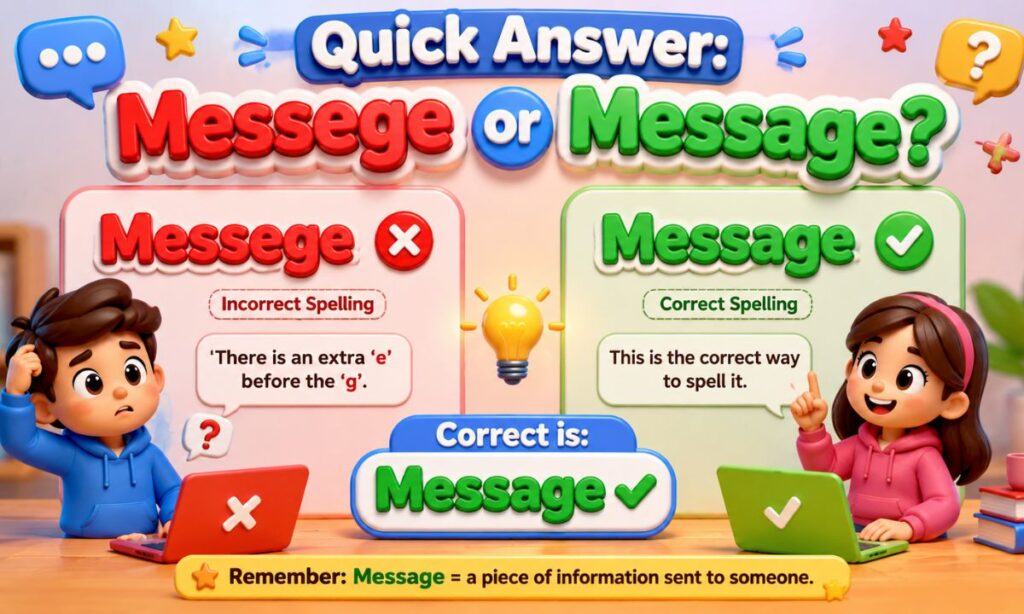
Message is the correct spelling. Messege does not exist in the English language.
There is no dictionary, style guide, grammar authority, or usage standard anywhere in the English-speaking world that recognizes messege as a valid word. It is simply a misspelling — common, understandable, but incorrect.
| Version | Correct? | Recognized in dictionaries? |
| message | ✓ Yes | Yes — all major dictionaries |
| messege | ✗ No | Never |
If you have ever typed messege, you are in excellent company. It is one of the most searched-for spelling confusions in English. But the answer is firm: always use message.
Why People Confuse Messege and Message
Understanding why this error happens is the fastest route to stopping it. There are several overlapping reasons.
1. Phonetic mismatch The word message is pronounced roughly as mess-ij in everyday speech. The middle vowel — that soft, almost throwaway syllable — does not sound like a clear “a.” It sounds closer to “e.” So when people spell the word phonetically, following the sound rather than the convention, they write messege instead of message.
This is the same reason words like separate (often misspelled seperate) or definitely (often misspelled definately) cause trouble. English spelling preserves historical forms that no longer match modern pronunciation.
2. Typing speed and muscle memory In the age of rapid digital communication — WhatsApp, Slack, email, social media — most people type quickly and automatically. The brain recalls how a word feels to type, not always how it is spelled. A single wrong vowel in the middle of a familiar word can sail past your conscious attention entirely.
3. Autocorrect confusion Here is a trap that surprises many people. When you type messege, your phone or device sometimes autocorrects it — but not always to message. It can change it to massage (the physical therapy treatment), which creates a completely different and often embarrassing word in your text. Autocorrect is helpful, but it is not a substitute for knowing the correct spelling yourself.
4. Brain auto-fill while reading Psychologists have long noted that the human brain tends to auto-complete familiar words when reading. If you proofread your own writing immediately after typing, your brain often sees the correct word even when the wrong one is on the page. This is why proofreading tips almost universally recommend reading your work after a short break, or reading it aloud.
5. Frequency and overexposure Ironically, because message is such a heavily used word — you send and receive messages dozens of times a day — you have more chances to accidentally misspell it. High-frequency words are paradoxically more vulnerable to typos precisely because we type them so automatically.
Word Origin: Where Does Message Come From?
Knowing a word’s history makes it far easier to remember how it is spelled. Message has a well-documented etymology that explains exactly why it looks the way it does.
The word entered Middle English around c. 1300, borrowed from Old French message, meaning “message, news, tidings, or embassy.” Old French in turn took it from Medieval Latin missaticum, which derived from Latin missus — the past participle of mittere, meaning “to send, to release, to let go.”
The same Latin root mittere gives English a large family of related words:
- Mission — a sending forth with purpose
- Missile — something sent through the air
- Emit — to send out
- Submit — to send under authority
- Transmit — to send across
- Commit — to send together; to entrust
- Permit — to send through; to allow
- Dismiss — to send away
Recognizing this family of words helps anchor message in your vocabulary network. Every one of these words traces back to the idea of sending — and so does message. A message, at its etymological core, is simply something that is sent.
The spelling message reflects that Latin ancestry. It is not governed by modern English phonetic rules. Like many borrowed words, it preserves the form of its origin language rather than spelling itself the way it sounds today. That is the root cause of the confusion — and also the reason there is nothing surprising about the spelling once you know where it comes from.
The phrase to get the message (meaning “to understand”) entered common use around 1960. The verb use — to message someone, meaning to send an electronic communication — was recorded as early as 1992, coinciding with the rise of digital communication.
Understanding Message: Literal and Figurative Use
The word message is richer than most people give it credit for. It works in two distinct registers — the literal and the figurative — and understanding both broadens your ability to use it precisely.
Literal Usage
In its literal sense, a message is a communication sent from one person or entity to another. It can take many forms:
- A spoken voicemail left for someone who did not pick up
- A written note slipped under a door
- A text sent over a messaging app
- An email to a colleague
- An official letter from a government body
- A notification from an app or platform
- A diplomatic communiqué between governments
In all of these cases, the word functions as a noun: there is a sender, there is content, and there is a recipient. The form of delivery varies — spoken, written, digital, visual — but the underlying concept is the same: one party communicating something to another.
Message also functions as a verb in modern usage: “I’ll message you the details.” “She messaged him as soon as she landed.” This verbal use is now completely standard in everyday English and widely accepted in professional informal writing, though in very formal documents the noun form is still preferred.
Figurative or Metaphorical Usage
Beyond literal communication, message carries a rich figurative dimension. When used figuratively, it refers to the underlying meaning, theme, or moral of something — a film, a speech, a campaign, a work of art, a public gesture.
This figurative use has been established in English since at least the 1820s. It draws on the original sense of a message as something sent with intent and purpose: when we talk about the message of something, we mean what it is trying to communicate beneath the surface.
- “The message of the film was that small acts of kindness change lives.”
- “The campaign sent a powerful message to lawmakers.”
- “She received the message loud and clear — her proposal was not welcome.”
- “The closing ceremony carried a message of unity for the entire world.”
This figurative meaning is what we invoke when we talk about sending the right message, getting the message across, or reading between the lines of a message. It assumes that communication has layers — and that the deeper layer matters most.
Regional Differences: US vs UK
One of the most practical questions about any spelling is whether it changes between American and British English. With message, the answer is refreshingly straightforward.
There is no difference. The spelling is identical in all major varieties of English.
| Region | Correct Spelling |
| American English | message |
| British English | message |
| Australian English | message |
| Canadian English | message |
| South African English | message |
| Indian English | message |
Whether you are writing for a US audience, a UK publication, an Australian university, or an international business, the correct spelling is always message. This is one of those rare English words where regional variation simply does not apply.
The same consistency holds for the plural (messages), the verb forms (messaged, messaging, messages), and related forms like messenger and messaging.
Common Mistakes to Avoid
Beyond messege itself, there are a few related spelling and usage errors worth watching for.
1. message → messege The core mistake. Always check the middle of the word: it is -ssa-, not -sse-.
2. message → massage These are entirely different words. Massage refers to the physical manipulation of muscles and soft tissue for therapeutic purposes. Mixing them up — especially in a professional email — produces an unintended and sometimes embarrassing result. Double-check which word you mean before sending.
| Word | Meaning | Example |
| message | Communication sent to someone | “Please leave a message.” |
| massage | Physical therapy for muscles | “She booked a massage.” |
| messege | Not a word — always incorrect | — |
3. messaging → messeging If messege is wrong, so is messeging. The correct form is messaging — double S, then A, then G.
4. msg → message Using the abbreviation msg is fine in casual digital contexts between people who know each other. In any professional, academic, or formal setting, write the full word message.
5. Relying on autocorrect to catch it As noted above, autocorrect does not always fix messege to message. It sometimes suggests massage instead. Always verify the result of any autocorrection when writing something important.
Messege or Message in English
In English — regardless of dialect, region, context, or register — the only accepted spelling is message. This applies to:
- Formal and informal writing
- Digital communication (texts, emails, social media)
- Academic papers and essays
- Legal and official documents
- Creative writing and fiction
- Journalism and published media
The form messege is universally treated as an error. No grammar guide, major dictionary, or usage authority endorses it under any circumstances. It is not an accepted variant spelling. It is not a regional alternative. It is not a historical form. It is simply a misspelling.
Also Read This : Coachs or Coaches? Understanding the Differences
How to Spell Message: Like “Mess” + “Age”
This is one of the most reliable and widely recommended memory tricks for this word — and it works because both component parts are real, familiar English words.
Break the word down like this:
mess + age = message
Both mess (a disordered state) and age (a period of time, or the process of growing older) are words you almost certainly already know how to spell. Put them together and you get message — with the double S coming from mess and the -age ending coming from, well, age.
This mental shortcut does several things at once:
- It reminds you that the word has double S (from mess)
- It reminds you that the ending is -age, not -ege
- It gives you a visual anchor that is easy to retrieve under pressure
Other words that share the same -age ending pattern:
- passage — the same pattern: pass + age
- carriage — carr + iage
- village — vill + age
- language — langu + age
- luggage — lugg + age
- package — pack + age
Notice: none of these words end in -ege. The -age ending is a consistent pattern in English nouns of this type, which is exactly why messege looks wrong to trained eyes even at a glance.
An additional memory rhyme that circulates widely:
“A message has age.”
Short, memorable, and accurate. It keeps the correct ending in mind every time.
Real-Life Examples of Message Usage
Seeing the correct word in natural context across different situations is one of the most effective ways to lock in correct spelling. Here is how message appears in real-life settings.
Texting and Messaging Apps
- “I sent you a message on WhatsApp — did you get it?”
- “Your message has been delivered.”
- “She left a voice message explaining the delay.”
- “Can you check the message thread from yesterday?”
- “I got your message — I’ll call you back this afternoon.”
These are the everyday, casual uses that most people encounter dozens of times daily. The word is never spelled differently because you are texting rather than writing formally — the spelling is fixed regardless of the medium.
Workplace Communication
- “Please see the message I forwarded from the client this morning.”
- “The CEO sent a company-wide message about the policy update.”
- “I wanted to message you before the meeting to flag a concern.”
- “Your message was received, and we are reviewing your proposal.”
- “The marketing team’s message to customers was clear and consistent.”
- “She drafted a message to the board outlining the quarterly results.”
In professional settings, the stakes of correct spelling are higher. A misspelling in an email to a client or a report submitted to senior leadership signals carelessness — even if the underlying content is excellent. Spelling message correctly is one of the smallest but most visible signs of writing professionalism.
Education and Academic Writing
- “The essay explored the message encoded in the poem’s final stanza.”
- “Students were asked to analyze the author’s central message.”
- “The professor left a message on the department noticeboard about the change of room.”
- “Her research paper examined how political messages are framed in social media.”
- “Submit a written message to the academic committee if you wish to appeal the decision.”
In academic writing, message most often appears in its figurative sense — referring to the thematic argument or communicative intent of a text, speech, or cultural artifact. Both uses (literal and figurative) are standard in academic English.
Social Media and Pop Culture
- “That campaign’s message really resonated with younger audiences.”
- “The film sent a powerful message about environmental responsibility.”
- “I slid into her DMs — sent a message and waited.”
- “Check your message requests — I think I sent it to the wrong inbox.”
- “The brand’s message has stayed consistent across every platform.”
Social media has made the word message more ubiquitous than ever. Direct messages, DMs, message requests, inbox messages — the word appears constantly across platforms, always spelled the same way.
Usage Trends and Insights

The word message has grown dramatically in frequency over the past three decades, driven almost entirely by the rise of digital communication.
When the verb form — to message someone — emerged around 1992, it was niche technical language. By the early 2000s, it was common. By the 2010s, it was universal. Today, message as a verb is completely standard in casual and professional digital communication: “I’ll message you,” “She messaged the team,” “Message me when you land.”
Google Ngram Viewer data confirms that the frequency of message in published English-language text has increased sharply since the 1990s, correlating directly with the growth of email, SMS, and social media platforms.
Interestingly, the misspelling messege has followed a similar trajectory — appearing more often in online searches precisely because more people are writing the word message more often, and more of them are second-guessing their spelling.
Related words and phrases that have grown in usage during this period include:
- messaging (as a noun: “instant messaging,” “messaging apps”)
- text message / text messaging
- direct message / DM
- voice message
- message thread
- message notification
All of these forms use the correctly spelled root word message — no variants, no exceptions.
Tips to Always Spell Message Correctly
If you want to eliminate this error from your writing permanently, here are practical, proven strategies.
1. Use the “mess + age” method Split the word visually: mess + age = message. Do this a few times consciously and the correct pattern will stick.
2. Remember the double S rule The word always has two S’s before the A. If you are about to type me-s-e-g-e, stop — you are missing the second S and the A is in the wrong place. The sequence is: M-E-S-S-A-G-E.
3. Memorize the -age ending The word ends in -age, rhyming with stage, cage, page, and age itself. It never ends in -ege.
4. Slow down on important messages Ironically, the word that most often gets misspelled is often the very word being used to communicate something important. For emails, formal documents, or academic submissions, type slowly and deliberately.
5. Proofread with a time gap After writing, wait at least a few minutes before rereading. A fresh set of eyes — even your own — catches errors that your brain glosses over immediately after writing.
6. Use spellcheck as a backup, not a crutch Spellcheck will usually catch messege, but it may suggest massage instead of message. Always verify the suggested correction before accepting it.
7. Read it aloud When you read text aloud, you process it more slowly and deliberately than when you read silently. This makes it easier to spot spelling errors.
8. Practice in writing If this word consistently trips you up, write a sentence using it correctly five times in a row. Repetition retrains muscle memory. Within a few sessions, the correct spelling becomes automatic.
Reference — Cambridge Dictionary Definitions
For authority and clarity, here is how the Cambridge Dictionary defines the relevant terms:
Message (noun): “A piece of information that you send to someone or leave for someone when you cannot speak to them directly.” Example: “Could you give him a message for me?”
Message (verb, informal): “To send someone a message using a phone or computer.” Example: “She messaged me to say she’d be late.”
Messege: Not listed. Not recognized. Not a word.
The Cambridge Dictionary also defines the word messenger — derived from the same root — as “a person who carries a message,” reinforcing the connection between the word and its Latin origin in sending.
Merriam-Webster similarly defines message as “a communication in writing, in speech, or by signals,” and traces its origin through “Middle English, from Anglo-French, from Medieval Latin missaticum.”
Both major reference authorities confirm: the correct spelling is always message.
Conclusion
The question of message vs messege has one clear, non-negotiable answer: message is correct, and messege is always wrong.
The confusion is completely understandable — pronunciation does not match spelling, typing speed creates errors, and autocorrect is not always reliable. But none of that changes the fact that there is only one accepted form of this word in English, and it has been the same since the word entered the language around 1300.
Once you know that message breaks down into the familiar parts mess + age, once you understand that the Latin root mittere (to send) explains the spelling, and once you have seen the word used correctly across dozens of real sentences, it becomes impossible to forget.
The correct spelling is M-E-S-S-A-G-E. Always has been. Always will be.
Every text you send, every email you write, every professional document you prepare benefits from getting this detail right. Spelling message correctly will not win you a prize — but misspelling it can cost you credibility, and that is a cost not worth paying.
Write it correctly. Use it confidently. And the next time you pause mid-sentence wondering which version is right, you will know exactly what to do.

Michael Brook is the creator and author behind Healthy Leeks, a platform focused on grammar, writing skills, and English language learning. Passionate about clear communication and effective writing, Michael Brook shares practical grammar tips, easy-to-follow language guides, and educational content to help readers improve their English with confidence.


