You are typing fast. You finish a long sentence and close it with — “finaly.” It looks right. It sounds right. But something feels off. You pause, stare at the screen, and wonder: is it “finaly” or “finally”?
This is one of the most common spelling slip-ups in everyday English writing. Students make it. Bloggers make it. Even professionals who write daily make it. The good news is that once you understand exactly why the confusion happens and what the correct rule is, you will never make this mistake again.
This guide covers everything — the correct spelling, the grammar structure behind the word, real sentence examples, the difference between “final” and “finally,” synonyms, common mistakes, and a full practice session at the end. By the time you finish reading, “finally” will be permanently locked into your memory with both L’s firmly in place.
The Correct Answer Explained Clearly
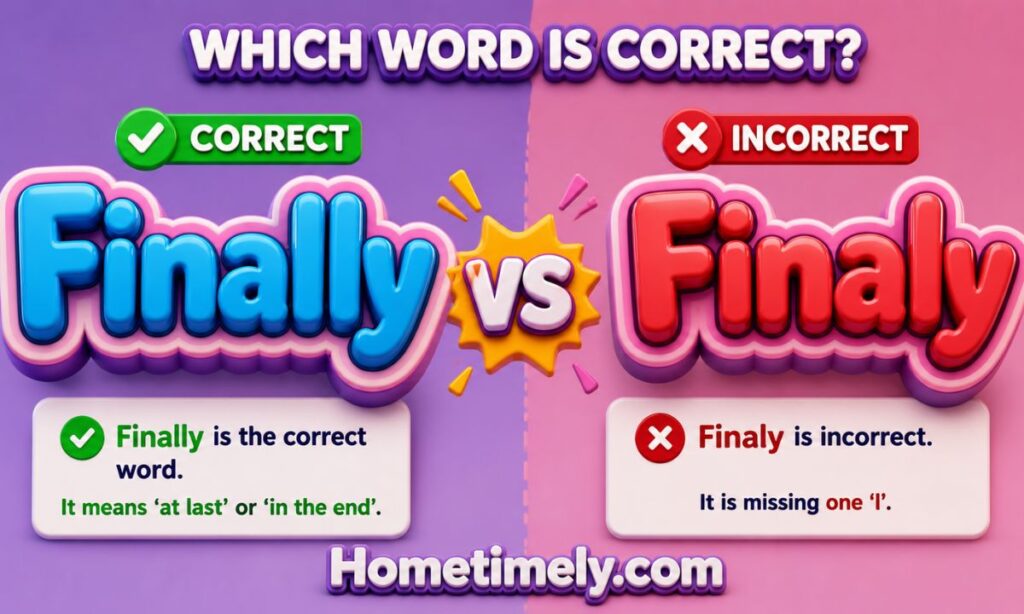
Let us start with the direct, no-confusion answer:
Finally ✅ — correct spelling, always used in modern English.
Finaly ❌ — incorrect spelling, always a mistake, never acceptable in any form of writing.
There is no grey area here. “Finaly” is not a British variant. It is not an informal shortcut. It is not an older spelling. It is simply a misspelling — one missing letter that weakens your writing the moment a careful reader spots it.
The rule behind the correct spelling is clean and logical:
final (adjective) + -ly (suffix) = finally (adverb)
The base word “final” ends with the letter L. The suffix “-ly” begins with the letter L. When you join them, both L’s stay. You do not drop one. You do not merge them. The result is always finally — with two L’s, back to back.
| Form | Spelling | Role | Example |
| final | f-i-n-a-l | Adjective | “This is the final round.” |
| finally | f-i-n-a-l-l-y | Adverb | “We finally reached the top.” |
| finaly | f-i-n-a-l-y | ❌ Misspelling | Never use this. |
What “Finally” Actually Means in English
“Finally” is an adverb. It describes when or how something happens. According to the Collins English Dictionary, “finally” carries three core meanings:
1. After a long time or delay This is the most common use. It signals that something happened after waiting, difficulty, or extended effort. It carries a sense of relief or satisfaction.
- “After months of preparation, the project was finally complete.”
- “The results finally arrived three weeks later than expected.”
2. At the end of a sequence Here, “finally” acts as a transition word — signaling that the last item in a list or series of events is being introduced.
- “First we ate, then we rested, and finally we packed up and left.”
- “The report covers background, findings, and finally, recommendations.”
3. Conclusively or decisively In more formal or legal language, “finally” can mean something is settled completely — with no room for further revision or appeal.
- “The matter was finally decided by the court.”
- “The terms were finally agreed upon after three rounds of negotiation.”
Each meaning is distinct, but the spelling never changes. Whether you are expressing relief, closing a list, or signaling a conclusion, you always write finally.
Why “Finaly” Is Incorrect and Commonly Misspelled
“Finaly” is a misspelling. It is not recognized in any standard English dictionary — not Merriam-Webster, not Oxford, not Cambridge, not Collins. There is no regional variation, no informal permission, and no historical precedent that makes “finaly” acceptable.
So where does this mistake come from? Several factors work together to produce it:
The base word “final” has only one L. Writers who are thinking about the root word — which they spell correctly — may simply attach “-y” instead of “-ly,” producing “finaly” instead of “finally.”
Fast typing outpaces careful thinking. In a rush, the fingers sometimes skip the second L without the brain noticing. The word still looks plausible at a glance, so the eye misses it during a quick read-through.
Phonetic spelling habits. When “finally” is spoken naturally, especially in casual or rapid speech, the double-L sound is not dramatically emphasized. Writers who spell by sound rather than by rule may hear only one L and write only one.
Autocorrect inconsistency. While most modern spell-checkers catch “finaly,” some basic or older tools — particularly on mobile keyboards — do not always flag it. Writers who rely entirely on autocorrect may never receive the correction they need.
Understanding why this error happens is the first step toward eliminating it permanently.
Grammar Structure Behind “Finally”
To understand “finally” deeply, you need to understand how adverbs are formed in English.
Most English adverbs are built by adding the suffix “-ly” to an adjective. This transforms a describing word (adjective) into a word that modifies verbs, adjectives, or other adverbs.
Examples of this pattern:
| Adjective | Adverb |
| quick | quickly |
| slow | slowly |
| careful | carefully |
| clear | clearly |
| final | finally |
| real | really |
| usual | usually |
| actual | actually |
Notice the pattern in the last four rows. Adjectives ending in “-al” produce adverbs ending in “-ally” — not just “-aly.” This is because the suffix “-ly” attaches to the full adjective, letter by letter:
- final → final + ly = finally
- real → real + ly = really
- usual → usual + ly = usually
- actual → actual + ly = actually
This is a consistent grammatical rule. Every adjective ending in “-al” produces an adverb ending in “-ally.” So the double-L in “finally” is not unusual or arbitrary — it is the natural, rule-following outcome of standard English adverb formation.
Remembering this rule also protects you from making similar errors in related words like “generally,” “formally,” “literally,” “naturally,” and “professionally.”
How “Finally” Is Used in Real Sentences
Seeing the word in context is one of the best ways to internalize correct spelling and usage. Here are examples across different registers and purposes:
Expressing relief after a long wait:
- “After six hours of travel, we finally arrived at the hotel.”
- “She finally got the job offer she had been waiting for all year.”
- “I finally understood what the instructor had been explaining for weeks.”
Introducing the last item in a sequence:
- “First, gather all your materials. Next, read the instructions carefully. Finally, assemble the pieces step by step.”
- “The plan includes budget review, team briefing, and finally, client presentation.”
Signaling a conclusion in writing or speech:
- “Finally, I want to thank everyone who contributed to making this event possible.”
- “Finally, it is worth noting that these results may not apply universally.”
Expressing finality or decisiveness:
- “The disagreement was finally resolved after a lengthy mediation.”
- “Parliament finally passed the bill after three failed attempts.”
Casual conversation and informal writing:
- “Finally! You are here. I thought you had forgotten.”
- “We finally got the internet fixed — only took two weeks.”
Difference Between Final vs Finally
Writers sometimes confuse not just the spelling of “finally” but its relationship to “final.” These are two different words with different grammatical roles, and mixing them up produces errors beyond just spelling.
Final is an adjective. It describes or modifies a noun. It tells you what kind of something it is — specifically, that it is the last one.
- “This is the final warning.”
- “She submitted her final report.”
- “The final score was 3-1.”
Finally is an adverb. It modifies a verb, an adjective, or a clause. It tells you when or how something happened — specifically, that it happened at the end or after a long wait.
- “She finally submitted her report.”
- “The score was finally confirmed.”
- “He finally gave the final answer.”
You cannot swap them. “This is the finally warning” is grammatically broken. “She submitted her final report finally” is redundant but possible — and shows that the two words serve entirely different functions even when used near each other.
| Final | Finally | |
| Part of speech | Adjective | Adverb |
| Modifies | Nouns | Verbs, adjectives, clauses |
| Meaning | Last / concluding | At last / in the end |
| Example | “final exam” | “finally finished” |
| Can stand alone as exclamation | No | Yes (“Finally!”) |
British and American English Usage of “Finally”
Unlike many English words — “colour/color,” “organise/organize,” “centre/center” — “finally” does not have regional spelling variants. Both British English and American English spell the word identically:
British English: finally ✅ American English: finally ✅ Australian English: finally ✅ Canadian English: finally ✅
There is no version of this word that uses a single L in any recognized variety of English, anywhere in the world. This makes the rule particularly simple to follow: regardless of where you are writing, regardless of your audience, the answer is always the same double-L spelling.
This consistency is actually relatively unusual in English. Many learners have been confused by real regional differences (like “fulfil” vs “fulfill”) and may assume “finaly” represents a similar valid variant. It does not. It is simply a mistake — in every dialect, on every continent.
Why People Make the Mistake “Finaly”
Beyond the general reasons already explored, there are specific psychological and habitual patterns behind this particular mistake:
1. Visual similarity to “final” The brain sees “final” and does not immediately register that adding “-ly” requires preserving both L’s. It treats “final” as a complete unit and adds “-y” the way you might add “-s” to make a plural.
2. The “-ly” suffix feels complete on its own “-ly” is the most recognizable adverb marker in English. When writers think “adverb of final,” they think “final + ly = finaly.” They do not break down the suffix letter by letter.
3. Influence from related but differently structured words Words like “finely” (from “fine” + “-ly”) have only one L. If “finely” has one L, why not “finaly”? The answer lies in the base word — “fine” ends in E, which is dropped before “-ly,” leaving one L. “Final” ends in AL, which stays complete, giving two L’s.
4. Typing speed and muscle memory errors In fast digital writing — texts, emails, social media — fingers move faster than conscious thought. “Finaly” is a standard fast-typing error in the same category as “teh” for “the” or “recieve” for “receive.”
5. Insufficient proofreading Many writers do not proofread carefully, especially in informal contexts. A single missing letter is easy to miss in a full paragraph of text, particularly when reading quickly.
Synonyms and Alternatives to “Finally”
Understanding “finally” includes knowing which words can replace it depending on context. Not all synonyms work in every situation — each carries a slightly different shade of meaning.
| Synonym | Best Used When | Example |
| Eventually | Emphasizing something took time | “She eventually agreed.” |
| At last | Expressing strong relief or impatience | “At last, the rain stopped.” |
| In the end | Summarizing an outcome | “In the end, it worked out.” |
| Ultimately | Signaling a final result | “Ultimately, the plan failed.” |
| Lastly | Introducing the last item in a list | “Lastly, please sign the form.” |
| In conclusion | Closing a formal argument | “In conclusion, the data supports…” |
| After all | Suggesting something happened despite doubt | “It worked out after all.” |
Key distinctions to know:
- Use “finally” when emphasizing relief after a long wait or difficulty — it is the most emotionally expressive option.
- Use “lastly” strictly for listing the final item in a series — it does not carry emotional weight.
- Use “ultimately” for formal conclusions about outcomes or results.
- Use “at last” when you want to emphasize impatience or frustration that is now resolved.
According to the Cambridge Grammar guide, “finally” and “at last” are close in meaning but differ in tone — “finally” is more neutral, while “at last” signals greater emotional involvement.
Also Read This : Taught vs Tought: Correct Spelling, Meaning, and Usage (Complete Guide)
Common Usage Mistakes with “Finally”
Spelling is not the only way writers get “finally” wrong. Here are other common errors:
1. Using “finally” too early in a sequence Wrong: “Finally, let me introduce the topic. First, I want to talk about history…” Right: Save “finally” for the genuinely last point.
2. Confusing “finally” with “lastly” “Lastly” works for lists. “Finally” works for events and conclusions. Mixing them in the wrong context sounds odd.
3. Overusing “finally” for emphasis When every other paragraph starts with “finally,” the word loses its signal value. Use it with intention.
4. Misplacing “finally” in the sentence According to Oxford, “finally” most naturally appears between the subject and the main verb (mid-position):
- Natural: “She finally understood.”
- Possible but heavy: “Finally, she understood.”
- Uncommon: “She understood finally.”
5. Writing “finaly” — the core misspelling This remains the most frequent and most damaging error. Always double-check before publishing or sending.
Why This Small Word Actually Matters
It might seem like a single missing L is a minor issue — something any reader will understand and forgive. In many informal situations, that is true. But spelling accuracy carries weight in contexts where it counts.
In professional writing: Misspellings reduce credibility. A cover letter, business proposal, or client report with “finaly” signals carelessness.
In academic work: Essays, dissertations, and research papers are evaluated partly on the quality of written expression. Spelling errors affect grades and impressions.
In digital content: Search engines and plagiarism-detection tools process text at a character level. Misspelled words can affect keyword matching and readability scores.
In everyday communication: Teachers, managers, editors, and peers notice spelling errors even when they say nothing. Correct spelling is a silent signal of competence.
In language learning: For ESL learners especially, building correct habits from the start prevents deeply ingrained errors that become harder to correct later.
One extra letter — one additional L — is a small investment for a large return in clarity, credibility, and confidence.
Practice Session: Finaly vs Finally
The best way to lock in any spelling rule is to practice it actively. Work through the exercises below without looking back at the article. Then check your answers honestly.
Fill in the Blanks
Complete each sentence by choosing the correct spelling from the brackets:
- After three hours of waiting, the train _______ arrived. [finaly / finally]
- She worked hard all year and _______ passed the exam. [finaly / finally]
- First came the appetizers, then the main course, and _______ dessert. [finaly / finally]
- _______, I would like to thank all of you for your patience. [Finaly / Finally]
- The issue was _______ resolved after weeks of discussions. [finaly / finally]
- He _______ admitted that he had made a mistake. [finaly / finally]
- We packed, cleaned, locked up, and _______ headed to the airport. [finaly / finally]
- _______ able to rest, she felt her shoulders drop with relief. [Finaly / Finally]
Answer
- finally
- finally
- finally
- Finally
- finally
- finally
- finally
- Finally
Multiple Choice: Finaly vs Finally
Choose the sentence that uses the correct spelling:
Question 1
- A. “We finaly agreed on the terms.”
- B. “We finally agreed on the terms.” ✅
Question 2
- A. “Finally, let us move to the last section.” ✅
- B. “Finaly, let us move to the last section.”
Question 3
- A. “She finaly finished the novel she had been writing for two years.”
- B. “She finally finished the novel she had been writing for two years.” ✅
Question 4
- A. “After many setbacks, the team finaly won the championship.”
- B. “After many setbacks, the team finally won the championship.” ✅
Question 5
- A. “The contract was finaly signed on Friday.”
- B. “The contract was finally signed on Friday.” ✅
Answer
All answers are option B, except Question 2 where the answer is option A. In every case, finally with two L’s is correct. Finaly with one L is never the right choice.
Correction: Finaly vs Finally
Each sentence below contains the misspelling “finaly.” Rewrite it correctly.
- “The doctor finaly gave us the test results.”
- “Finaly, the long project was complete.”
- “We finaly understood what had gone wrong.”
- “The committee finaly reached a decision.”
- “He finaly returned her calls after two weeks.”
Answer
- “The doctor finally gave us the test results.”
- “Finally, the long project was complete.”
- “We finally understood what had gone wrong.”
- “The committee finally reached a decision.”
- “He finally returned her calls after two weeks.”
Real Life Writing Example
Here is how “finally” appears in real, natural writing across different formats:
Email closing: “I have attached the updated report for your review. Please let me know if you have any questions. Finally, thank you for your continued patience throughout this process.”
Academic essay conclusion: “This study examined three variables over a six-month period. The data consistently supported the hypothesis. Finally, further research is needed to explore long-term patterns across a broader demographic.”
Casual social media post: “After months of planning, the renovation is finally done! So proud of how it turned out. Now we can actually use our kitchen again. 🎉”
News article: “After three failed attempts, the bill was finally signed into law on Thursday afternoon.”
Story writing: “She had searched for years. Cities, records, dead ends. Then one morning, a handwritten letter arrived in her mailbox. She finally had her answer.”
In every case — formal, informal, academic, creative — the word is spelled finally, and it carries meaningful weight in the sentence.
When Should You Use “Finally”?
Knowing the correct spelling matters. Knowing when to deploy the word makes your writing stronger. Use “finally” in these key situations:
To express relief or satisfaction after waiting: When something took longer than expected and is now complete, “finally” captures that emotional release.
- “After six months of delays, the report is finally ready.”
To sequence the last event in a series: When you are walking a reader through steps or events and want to signal the end of the chain.
- “We discussed the budget, reviewed the timeline, and finally approved the proposal.”
To introduce a concluding point in an argument or speech: In essays, presentations, and formal communication, “finally” signals that you are wrapping up.
- “Finally, I want to address the question of cost.”
As a standalone exclamation: When something long-awaited has happened, “Finally!” on its own perfectly expresses the feeling.
- “Finally! The package has arrived.”
When not to use it: Avoid “finally” when the sequence is short and no time or difficulty was involved. Saying “I woke up, showered, and finally had breakfast” sounds unnatural if breakfast happened immediately. Reserve “finally” for moments where time, effort, or patience genuinely preceded the event.
“Finally” in Everyday Conversation
“Finally” is not just a formal or academic word. It lives comfortably in everyday speech and casual writing. Here is how it sounds across different everyday situations:
Running late: “Sorry I’m late — I finally got a parking spot after going around three times.”
Technology frustration: “My laptop finally updated. It only took four hours and three restarts.”
Personal achievement: “I finally finished that book I started in January.”
Good news sharing: “We finally got approved for the apartment!”
Mild sarcasm: “Oh, you finally remembered to take out the bins. What a miracle.”
Encouragement: “You have been working so hard — this promotion is finally happening for you.”
The emotional range of “finally” — from genuine joy to dry humor to heartfelt relief — is part of what makes it such a useful and frequently used word. And in every single one of these cases, the spelling is the same: f-i-n-a-l-l-y.
Usage: Finaly vs Finally
A quick-reference guide for when and how to use “finally” correctly in writing:
| Situation | Use “finally”? | Example |
| After a long wait | ✅ Yes | “We finally landed.” |
| Closing a list | ✅ Yes | “Finally, add the salt.” |
| Concluding an essay | ✅ Yes | “Finally, the data shows…” |
| Expressing relief | ✅ Yes | “Finally! It is over.” |
| Short sequences with no delay | ⚠️ Careful | May sound dramatic |
| Any spelling with one L | ❌ Never | “Finaly” is always wrong |
Answer
The correct and only accepted spelling in every situation above is finally. The single-L version “finaly” is never appropriate, regardless of how the sentence is constructed, what register you are writing in, or which variety of English you use.
Professional Rule to Remember
If you take one thing away from this entire guide, make it this:
final + ly = finally Keep every letter from “final.” Add every letter from “ly.” Never drop the second L.
Write it down. Say it out loud a few times. Type it five times in a row right now: finally, finally, finally, finally, finally.
Then remember:
- “Finaly” does not exist in any dictionary.
- “Finaly” is never correct in British, American, Australian, or any other English.
- “Finaly” is not a casual shortcut — it is simply a mistake.
- Tools like Grammarly, Microsoft Word, and Google Docs will flag “finaly” as an error every time.
Write with both L’s. Write with confidence. Write finally.
Conclusion
The difference between “finaly” and “finally” comes down to one letter — but that one letter follows a clear, logical rule. The adjective “final” keeps all its letters when the suffix “-ly” is added, producing the double-L adverb “finally.” There are no exceptions, no regional variations, and no contexts where the single-L version is acceptable.
“Finally” is a powerful, versatile word that signals completion, relief, sequence, and conclusion across every type of writing. Spelling it correctly is a small action with a meaningful impact — on your credibility, your clarity, and your confidence as a writer. From this point forward, the rule is simple: when in doubt, remember final + ly = finally, and you will never write “finaly” again.

Michael Brook is the creator and author behind Healthy Leeks, a platform focused on grammar, writing skills, and English language learning. Passionate about clear communication and effective writing, Michael Brook shares practical grammar tips, easy-to-follow language guides, and educational content to help readers improve their English with confidence.


