One extra letter “o” is all it takes to turn a sentence about failure into a sentence about setting something free and that’s exactly the trap “loosing” and “losing” set for millions of writers every day. You’ve probably seen both spellings used online, in emails, and even in published content, which only adds to the confusion. Is it “loosing weight” or “losing weight”? “Loosing your mind” or “losing your mind”? “Loosing the game” or “losing the game”?
The truth is that only one of these spellings applies to almost every situation you’ll ever write about, while the other is so rare that many native English speakers go years without ever needing it. This guide breaks down exactly when to use “losing,” when “loosing” actually applies, and why this mix-up happens so often in the first place. By the end, you’ll never have to pause and guess again.
Loosing
“Loosing” is the present participle of the verb “loose,” meaning to release, unfasten, or set something free. It’s a real word, but it’s used far less often than most people assume — mainly in contexts like archery, sailing, or older literary writing.
Losing
“Losing” is the present participle of the verb “lose,” meaning to fail to keep, misplace, or be defeated. This is the word almost everyone means to use when discussing failure, absence, or reduction of any kind — whether it’s losing weight, losing a game, or losing focus.
Loosing or Losing: Quick Answer

If you’re unsure which spelling to use, here’s the short version:
- Losing is correct in almost every everyday situation — failure, defeat, misplacing something, or reduction.
- Loosing is correct only when you mean releasing, untying, or setting something free.
Main Difference:
The core difference comes down to root verbs. “Losing” comes from “lose” (to fail to keep something). “Loosing” comes from “loose” (to release or unfasten something). They look almost identical, but their meanings point in completely different directions.
Examples:
- I keep losing my phone charger. (misplacing)
- The team is losing the match. (failing to win)
- The falconer began loosing the bird from its perch. (releasing)
- The archer was loosing arrow after arrow. (letting fly)
Definitions with Examples
Losing (Definition)
“Losing” describes the ongoing action of failing to keep, hold, or win something. It applies to physical objects, competitions, emotions, health, time, money, and countless everyday situations. It’s the present participle of “lose,” and it’s overwhelmingly the more common of the two spellings in modern English.
Examples:
- She’s losing confidence after the setback.
- The company is losing customers due to slow service.
- He’s losing hair faster than expected.
- We’re losing daylight, so let’s hurry.
“Loosing,” on the other hand, describes the act of releasing something from restraint. It’s the present participle of “loose,” and outside of specific contexts like archery, sailing, and formal or historical writing, it rarely appears in modern English.
Examples:
- The sailors were loosing the ropes from the dock.
- The hunter is loosing the hounds.
- The soldiers were loosing arrows toward the horizon.
- He is slowly loosing his grip on the rope. (Note: this specific phrase is often misused — see the usage tip below.)
Simple Meaning
Think of it this way: if the sentence is about something disappearing, failing, or being defeated, you want “losing.” If the sentence is about something being untied, released, or set loose, you want “loosing.” Ninety-nine times out of a hundred, the word you’re reaching for is “losing.”
Synonyms of Losing
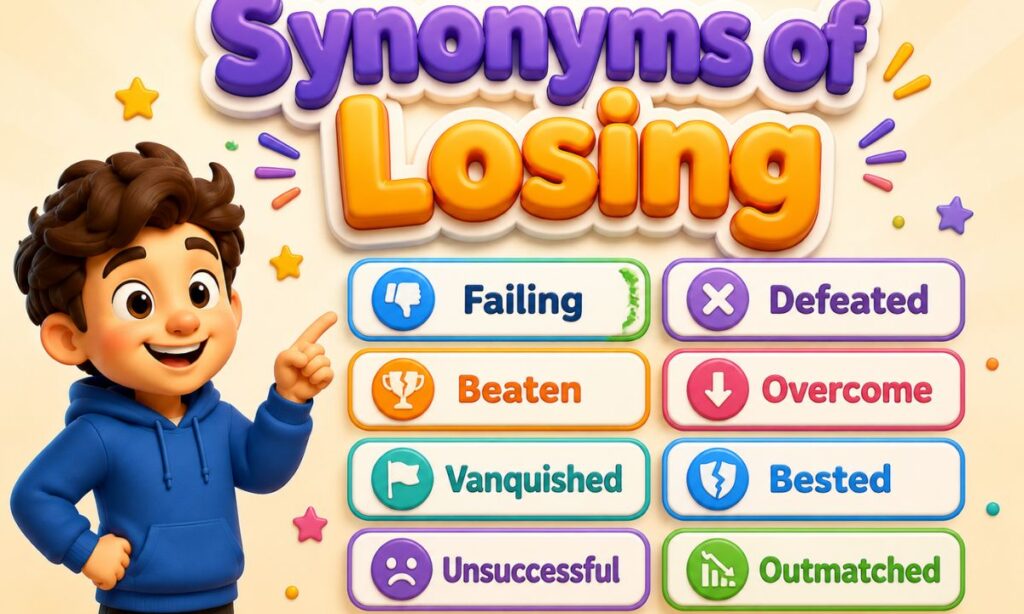
Since “losing” covers so much emotional and situational ground, it has many useful synonyms depending on context:
- Misplacing (losing an object)
- Failing (losing a competition)
- Forfeiting (losing a game or match)
- Dropping (losing points, rank, or value)
- Shedding (losing weight or hair)
- Fading (losing hope or interest)
“Loosing,” by contrast, has a much narrower set of synonyms, since its meaning is more specific: releasing, unfastening, untying, freeing, and unleashing.
The Origin of the Words
Both words trace back to Old English, but they come from two entirely different roots. “Lose” derives from the Old English word losian, meaning “to perish” or “to fail to keep.” Over centuries, its spelling and pronunciation shifted, eventually settling into the modern “lose,” pronounced with a “z” sound, rhyming with “choose.”
“Loose,” meanwhile, comes from the Middle English loos, itself derived from Old Norse lauss, meaning “free” or “unbound.” It kept its double “o” spelling and its “s” sound, rhyming with “moose.” Despite their similar appearance today, these two words developed along completely separate paths, which is exactly why their meanings never overlap despite how alike they look on the page.
Lose → Losing
When “lose” takes the “-ing” ending to form its present participle, the silent “e” is dropped and replaced with “-ing,” giving us “losing.” This follows the standard English spelling rule: verbs ending in a silent “e” drop that “e” before adding “-ing” (write → writing, hope → hoping, lose → losing). “Loose,” by contrast, does not drop any letters since it doesn’t end in a silent “e” the same way — it simply adds “-ing” to form “loosing.”
British English vs American English Usage 🇬🇧🇺🇸
The distinction between “losing” and “loosing” doesn’t change between British and American English. Both varieties treat “lose” and “loose” as entirely separate words with entirely separate spellings, and neither dialect accepts “loosing” as an alternative spelling of “losing.”
Key Point:
Regardless of region, “losing” is the correct choice for describing failure, defeat, or misplacement. “Loosing” remains rare in both British and American writing, appearing mainly in specialized, nautical, or literary contexts rather than everyday communication.
Usage Table:
| Feature | British English | American English |
| Correct spelling for failure/defeat | Losing | Losing |
| Correct spelling for release/unfastening | Loosing | Loosing |
| Everyday frequency of “loosing” | Rare | Rare |
| Common context for “loosing” | Sailing, literature, archery | Sailing, literature, archery |
| Acceptable interchangeable spelling | No | No |
Easy Trick to Remember the Difference
Here’s a memory trick that sticks: focus on the single “s” in both “losing” and “loss.” If a sentence involves loss of any kind, use “losing.” Now focus on the double “o” in both “loosing” and “loose.” If a sentence involves something becoming loose or being released, use “loosing.” Matching the extra letters to their meaning makes the choice almost automatic after a little practice.
Which Spelling Should You Use?
Use “Losing” When:
- You’re talking about failing to win a game, match, or competition.
- You’re describing misplacing an object.
- You’re referring to a reduction, such as losing weight or losing hair.
- You’re describing an emotional state, such as losing hope, confidence, or patience.
- You’re referring to losing time, money, or opportunities.
Use “Loosing” When:
- You’re describing releasing an animal, arrow, or object from restraint.
- You’re writing about sailing, archery, or historical/literary contexts.
- You’re describing untying or unfastening something physical.
Memory Trick (Easy)
If you can replace the word with “releasing” and the sentence still makes sense, use “loosing.” If replacing it with “releasing” sounds wrong, use “losing” instead. This single substitution test resolves almost every case of confusion instantly.
Usage Tip (Very Important)
One especially tricky case involves phrases like “loosing his grip” versus “losing his grip.” Even though “loosing” technically means releasing, the standard and correct phrase in modern English is “losing his grip” — because the sentence describes someone failing to maintain control, not deliberately releasing something. This is one of the most commonly misused examples online, so it deserves special attention.
Examples:
- Correct: He is losing his grip on the situation. (failing to maintain control)
- Correct: The climber is losing his grip on the rock face. (failing to hold on)
- Less common but valid: The falconer is loosing his grip deliberately to release the bird. (intentional release)
In nearly every real-world context, “losing his grip” is the phrase you want, since it almost always describes an unintentional loss of control rather than a deliberate release.
Also Read This : https://hometimely.com/cognisant-or-cognizant/
Common Mistakes: Loosing or Losing
1. Using “Loosing” Instead of “Losing”
By far the most common mistake is writing “loosing” when the intended meaning is failure or defeat, such as “We are loosing the match” instead of the correct “We are losing the match.” This error appears constantly in social media posts, emails, and even professional content.
2. Confusing “Lose” and “Loose”
Many writers mix up the base verbs themselves before they even reach the “-ing” form. Remember: “lose” is a verb meaning to fail to keep something, while “loose” is most often an adjective meaning not tightly fixed, though it can also function as a verb meaning to release.
3. Spelling Based on Sound
Because “lose” is pronounced with a “z” sound that seems to call for a second “o,” writers often add one out of habit, since it visually resembles words like “choose” or “loose.” This purely visual instinct is one of the biggest reasons the mistake persists.
4. Fast Typing Errors
When typing quickly on social media or in casual messages, writers often type “loosing” simply because their fingers move faster than their attention to spelling. While autocorrect sometimes catches this, it doesn’t always flag “loosing” as wrong since it is, technically, a real word — just the wrong one for the context.
Loosing or Losing in Everyday Examples
Daily Life
- I keep losing my keys every morning.
- She’s losing patience with the slow traffic.
- He’s losing weight after changing his diet.
Social Media
- “Feeling like I’m losing my mind during finals week 😩”
- “Our team is losing followers this month — time to fix our strategy.”
- “Losing motivation is normal, don’t give up!”
School
- The student is losing points for late submissions.
- She’s losing focus during long lectures.
- The debate team is losing confidence before the final round.
Work
- The company is losing revenue due to rising costs.
- He’s losing clients because of slow response times.
- The team is losing momentum on the project timeline.
Usage Trends & Popularity
Search and usage data consistently show that “losing” appears far more often than “loosing” across nearly every type of writing — from casual social posts to formal business reports. This makes sense, since “losing” applies to such a wide range of everyday topics: sports, health, relationships, finances, and emotions. “Loosing,” by comparison, is largely confined to specialized writing, such as historical fiction, sailing manuals, or descriptions of archery.
Trend Summary:
Grammar tracking tools have noted a steady rise in searches asking whether “loosing” or “losing” is correct, particularly around phrases like “losing weight,” “losing hair,” and “losing my mind.” This suggests the mistake isn’t disappearing — if anything, faster typing and social media shorthand are making it more common, which is exactly why understanding the distinction remains valuable for anyone who writes online.
Comparison Table
| Word | Root Verb | Meaning | Example Sentence |
| Losing | Lose | Failing to keep, win, or hold onto something | She is losing the race. |
| Loosing | Loose | Releasing, unfastening, or setting free | The archer is loosing an arrow. |
Common User Queries
People frequently search for very specific phrases when trying to resolve this confusion, including:
- Is it “losing weight” or “loosing weight”? (Always “losing weight,” since it refers to reduction.)
- Is it “losing my mind” or “loosing my mind”? (Always “losing my mind,” describing an emotional or mental state.)
- Is it “losing hair” or “loosing hair”? (Always “losing hair,” describing gradual reduction.)
- Is “loosing” ever correct? (Yes, but only for release-related meanings, such as loosing an arrow or loosing a knot.)
- Why do people confuse these words so often? (Because “lose,” “loose,” and “loosing” look and sound similar, despite having entirely different roots and meanings.)
Anyone who wants to dig deeper into related word pairs can also check a trusted
Grammar
Incorporate or Encorporate: Which Spelling Is Correct? to reinforce the distinction with additional examples.
Conclusion
The difference between “loosing” and “losing” ultimately comes down to their root verbs: “lose” for failure, defeat, or misplacement, and “loose” for release or unfastening. Because “losing” applies to such a broad range of everyday situations — sports, health, emotions, relationships, and finances — it’s the word you’ll need in the vast majority of your writing. “Loosing” remains valid, but its use is limited almost entirely to specialized or literary contexts involving physical release.
The easiest way to avoid this mistake going forward is to run a quick mental check before you hit publish: does the sentence describe something being lost, failed, or reduced? Then it’s “losing.” Does it describe something being untied, released, or set free? Then it’s “loosing.” With that one question in mind, you’ll spell it correctly every single time, whether you’re writing a quick social post, a school assignment, or a professional report that needs to look polished and credible.

Michael Brook is the creator and author behind Healthy Leeks, a platform focused on grammar, writing skills, and English language learning. Passionate about clear communication and effective writing, Michael Brook shares practical grammar tips, easy-to-follow language guides, and educational content to help readers improve their English with confidence.


