You’re typing a message, and your fingers pause right before you hit send. “What kind of movies do you like?” Wait — should that be “kinds”? You stare at the sentence for a second too long, then just send it anyway and hope nobody notices.
Here’s the good news: this mix-up trips up native speakers just as often as English learners, and the fix is simpler than you’d think. Once you understand the one rule behind it, you’ll never second-guess yourself again.
Quick Answer
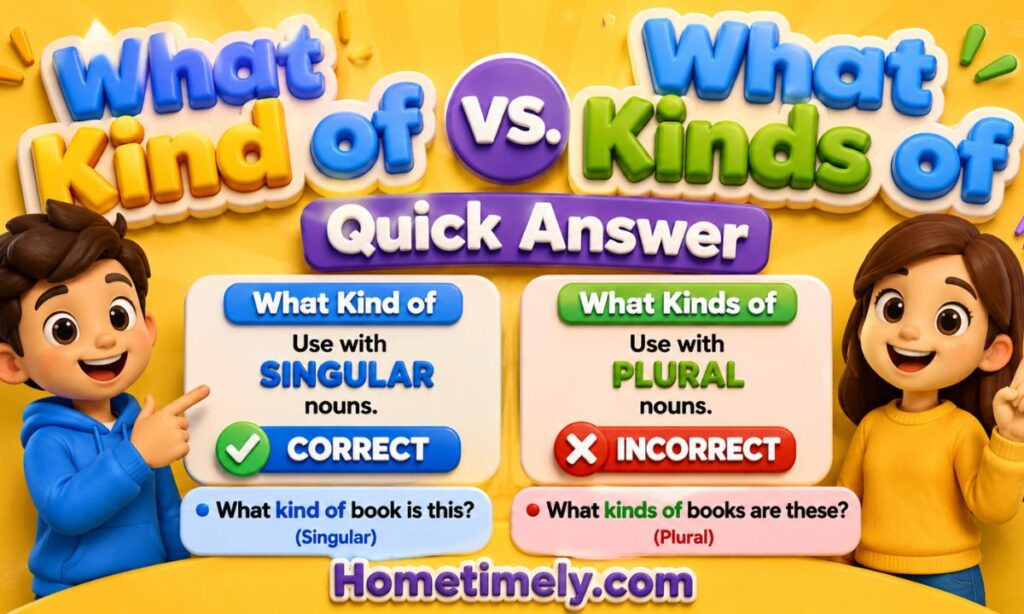
Use “what kind of” when you’re asking about one type or category, and use “what kinds of” when you’re asking about more than one.
The word right after “of” is your clue. If it’s singular or uncountable, go with “kind of.” If it’s plural, go with “kinds of.”
- What kind of car do you drive? (one category)
- What kinds of cars do you like? (multiple categories)
That’s the whole rule in a nutshell. But there’s more nuance worth knowing, especially if you want your writing to sound polished in every situation — from texting a friend to writing a formal report.
Meaning of “What Kind of”
“What kind of” is used when you’re asking about a single type, category, or classification of something. It typically pairs with a singular noun, though it can also pair with uncountable (mass) nouns like music, advice, or furniture.
When you ask “what kind of,” you’re narrowing the focus. You want one clear answer, not a list.
Examples:
- What kind of phone do you use? (expecting one answer: iPhone, Samsung, etc.)
- What kind of music do you enjoy?
- What kind of job are you looking for?
- What kind of dog is that?
Notice that in each case, the speaker expects a focused, specific response. They’re not fishing for a variety pack of answers — they want to know the one category that applies.
Meaning of “What Kinds of”
“What kinds of” is used when you’re asking about multiple types, varieties, or categories. It’s almost always followed by a plural countable noun, and it signals that you expect — or are open to — more than one answer.
Examples:
- What kinds of books do you read? (fiction, biography, mystery — several types)
- What kinds of exercise do you do?
- What kinds of skills does this job require?
- What kinds of problems is the team facing?
This phrase invites a broader, more exploratory response. It tells the listener you’re interested in range and diversity, not just a single label.
Key Difference Explained Simply
The entire distinction comes down to number — specifically, how many categories or types you expect in the answer.
| Question | What It’s Really Asking |
| What kind of shoes do you wear? | One general style — sneakers, boots, etc. |
| What kinds of shoes do you own? | A collection — sneakers, boots, sandals, heels |
Think of “kind” as a container that holds one type, and “kinds” as a container that holds several. The noun that follows should match that container. If the noun is singular, it goes with “kind of.” If it’s plural, it goes with “kinds of.”
It really is that straightforward — the confusion usually comes from the fact that, in casual conversation, people bend the rule all the time (more on that below).
Singular vs. Plural: The Simple Grammar Rule
Here’s the grammar logic laid out step by step:
- “Kind” is singular. It should agree with a singular or uncountable noun.
- “Kinds” is plural. It should agree with a plural countable noun.
- Check the noun right after “of.” That noun tells you which form to use.
The test: Try swapping in “type” or “types.”
- “What type of car do you drive?” → sounds natural → use kind of
- “What types of cars do you like?” → sounds natural → use kinds of
If “type” fits, use “kind of.” If “types” fits better, use “kinds of.” This little substitution trick works almost every time and takes the guesswork out of the decision.
What About Uncountable Nouns?
Uncountable nouns — like water, furniture, advice, information, or love — don’t have a plural form, so they almost always pair with “kind of,” even when you’re really asking about a range of possibilities.
- What kind of advice did she give you?
- What kind of furniture fits this room?
You wouldn’t say “what kinds of furniture” unless you’re specifically referring to different categories of furniture (like chairs, tables, and shelves treated as distinct groups) rather than furniture as a general concept.
What About Collective Nouns?
Collective nouns — team, family, group, class — are grammatically singular even though they refer to multiple people. That means they typically pair with “kind of.”
- What kind of team are you building? (the team as a single unit)
If you shift the focus to the individuals within that group, plural thinking can creep into the meaning, but the grammar itself usually stays singular unless you’re comparing several groups.
Comparison Table: What Kind of vs What Kinds of
| Feature | What Kind of | What Kinds of |
| Grammatical number | Singular | Plural |
| Noun that follows | Singular or uncountable | Plural countable |
| Expected answer | One category | Multiple categories |
| Common with | food, music, advice, furniture | books, movies, jobs, skills |
| Formality | Works in both casual and formal English | Preferred in formal or academic writing when multiple types are meant |
| Substitution test | “Which type of…?” | “Which types of…?” |
| Example | What kind of coffee do you drink? | What kinds of coffee does this shop sell? |
This table is a handy reference if you ever find yourself unsure mid-sentence. Bookmark it, screenshot it, or just remember the golden rule: singular noun, singular phrase; plural noun, plural phrase.
Real-Life Example Scenarios
Seeing these phrases in everyday context makes the rule stick much faster than memorizing a definition. Here’s how the distinction plays out across different situations.
In Casual Conversation
- What kind of movie do you want to watch tonight? (one genre — action, comedy, etc.)
- What kinds of movies do you usually enjoy? (a broader taste — comedy, horror, drama)
In the Workplace
- What kind of experience do you have in marketing? (a focused answer, like “digital marketing”)
- What kinds of skills are needed for this role? (a list — communication, analytics, leadership)
In Academic Settings
- What kind of degree are you pursuing? (bachelor’s, master’s — one answer)
- What kinds of courses does this program offer? (math, history, economics — several)
In Customer Service or Retail
- What kind of warranty comes with this product?
- What kinds of payment methods do you accept?
In Journalism and Interviews
- What kind of statement did the company release?
- What kinds of reactions has the public had?
Across every one of these contexts, the underlying logic never changes: singular expectation, singular phrase; plural expectation, plural phrase.
Common Mistakes and How to Avoid Them
Even confident English speakers slip up here. Below are the most frequent errors and simple fixes for each one.
Mistake 1: Using “kind of” with a plural noun
- ❌ What kind of books do you like?
- ✅ What kinds of books do you like?
Since books is plural, the phrase should match. This is by far the most common error, especially in fast, informal speech.
Mistake 2: Using “kinds of” with a singular or uncountable noun
- ❌ What kinds of advice did you get?
- ✅ What kind of advice did you get?
Advice is uncountable, so it should pair with the singular form unless you’re explicitly comparing categories of advice.
Mistake 3: Mismatching demonstratives
- ❌ These kind of books
- ✅ These kinds of books
- ❌ This kinds of book
- ✅ This kind of book
The demonstrative pronoun (this/these) needs to agree with kind/kinds just as much as the noun does.
Mistake 4: Ignoring context in favor of habit
Some speakers default to “what kind of” no matter what, simply because it feels more natural to say. In relaxed conversation, this rarely causes real confusion. In writing — especially professional, academic, or exam contexts — it’s worth slowing down and applying the rule properly.
Here’s a quick reference for spotting and fixing these slip-ups:
| Mistake | Why It’s Wrong | Correction |
| What kind of shoes do you own? | “Shoes” is plural | What kinds of shoes do you own? |
| What kinds of milk is in the fridge? | “Milk” is uncountable | What kind of milk is in the fridge? |
| These kind of problems | Demonstrative mismatch | These kinds of problems |
| What kinds of homework did you get? | “Homework” is uncountable | What kind of homework did you get? |
Helpful Memory Trick
If the grammar terms ever slip your mind mid-conversation, try this shortcut:
Kind = one. Kinds = many.
Or use the substitution test: swap in “type” or “types” and see which one sounds right.
- “Which type of…?” → kind of
- “Which types of…?” → kinds of
Another trick: picture a box. “Kind of” is a box holding one item. “Kinds of” is a box holding several items at once. Whichever box matches what you’re picturing in your head is the phrase you want.
Also Read This : Loosing vs. Losing: What’s the Difference? (With Examples)
American vs British English Differences
Here’s some reassuring news: there’s no real grammatical difference between American and British English when it comes to “kind of” versus “kinds of.” Both varieties follow the identical singular-plural rule.
That said, there are a couple of minor stylistic tendencies worth noting:
- British English speakers sometimes use “sort of” more frequently than “kind of” in casual conversation, though both phrases follow the same grammar logic.
- American English tends to use “kind of” as a filler word (meaning “somewhat”) slightly more often in everyday speech — for example, “I’m kind of tired” — but this informal usage doesn’t affect the grammatical rule for questions.
So whether you’re writing for a US or UK audience, the core rule stays the same: match the phrase to the number of the noun that follows it.
Related Phrases and Synonyms
English offers several alternatives to “kind of” and “kinds of” that follow the exact same singular-plural logic. Mixing these into your writing can add variety and keep your language from sounding repetitive.
- What type of / What types of — functionally identical to kind/kinds
- What sort of / What sorts of — more common in British English
- What category of / What categories of — often used in formal or academic writing
- What variety of / What varieties of — useful when discussing products, plants, or specific classifications
Examples:
- What type of insurance do you need? (singular)
- What types of insurance are available? (plural)
- What sort of person is she? (singular)
- What varieties of apples grow here? (plural)
All of these follow the same underlying rule as “kind” and “kinds,” so once you’ve mastered one pair, you’ve essentially mastered them all.
Why This Distinction Matters
You might be wondering whether a single “s” is really worth this much attention. It is, and here’s why.
Clarity. Using the correct form tells your listener or reader exactly how many answers you’re expecting. Ask “what kind of car” and someone will likely name one model. Ask “what kinds of cars” and they might list several — which could completely change the outcome of a conversation, an interview, or a survey question.
Professionalism. In resumes, emails, reports, and presentations, small grammar details shape how credible you appear. A hiring manager or client may not consciously notice correct grammar, but they will notice when something feels slightly off.
Confidence. Once you internalize this rule, you stop hesitating mid-sentence. That fluency translates into smoother conversations, cleaner writing, and a more natural command of English overall.
Precision in specific fields. Journalists, teachers, researchers, and customer service professionals rely on precise phrasing to get useful, targeted responses. The right question format leads to the right kind of answer — pun intended.
Practice Sentences
Test yourself with the sentences below. Decide whether each one needs “kind of” or “kinds of,” then check your answers against the key that follows.
- What ______ music do you listen to when you study?
- What ______ vegetables are in this soup?
- What ______ car is best for a big family?
- What ______ advice would you give a new employee?
- What ______ shoes should I wear for hiking?
- What ______ weather do you expect this weekend?
- What ______ hobbies do you have?
- What ______ cheese goes well with red wine?
Answer key:
- Kind of (music is uncountable)
- Kinds of (vegetables is plural)
- Kind of (one category expected)
- Kind of (advice is uncountable)
- Kind of (one general style, though “kinds” works if comparing several options)
- Kind of (weather is uncountable)
- Kinds of (hobbies is plural)
- Kind of (one type of cheese, generally)
If most of these felt intuitive, you’ve already got a solid grip on the rule. The more you practice spotting singular versus plural nouns, the faster this distinction becomes second nature.
Conclusion
At the end of the day, this isn’t about memorizing a rigid rule — it’s about paying attention to the noun right after “of” and letting it guide your choice. Singular noun, singular phrase. Plural noun, plural phrase. Keep that one idea in your back pocket, and you’ll never freeze mid-sentence over “kind” versus “kinds” again.

Michael Brook is the creator and author behind Healthy Leeks, a platform focused on grammar, writing skills, and English language learning. Passionate about clear communication and effective writing, Michael Brook shares practical grammar tips, easy-to-follow language guides, and educational content to help readers improve their English with confidence.