
If you have ever paused mid-sentence wondering whether to write “cheer” or “chear,” you are certainly not alone. This tiny spelling dilemma has tripped up students, bloggers, ESL learners, and even seasoned writers. The two words look almost identical, sound exactly the same when spoken aloud, and yet only one of them belongs in modern English writing.
This complete usage guide breaks down the cheer vs chear difference in clear, practical terms. You will understand the correct spelling, the historical background behind the confusion, how to use the word in different contexts, and how to avoid common mistakes that hurt your writing credibility. By the end, you will never second-guess yourself again.
What Is the Difference Between Cheer and Chear?
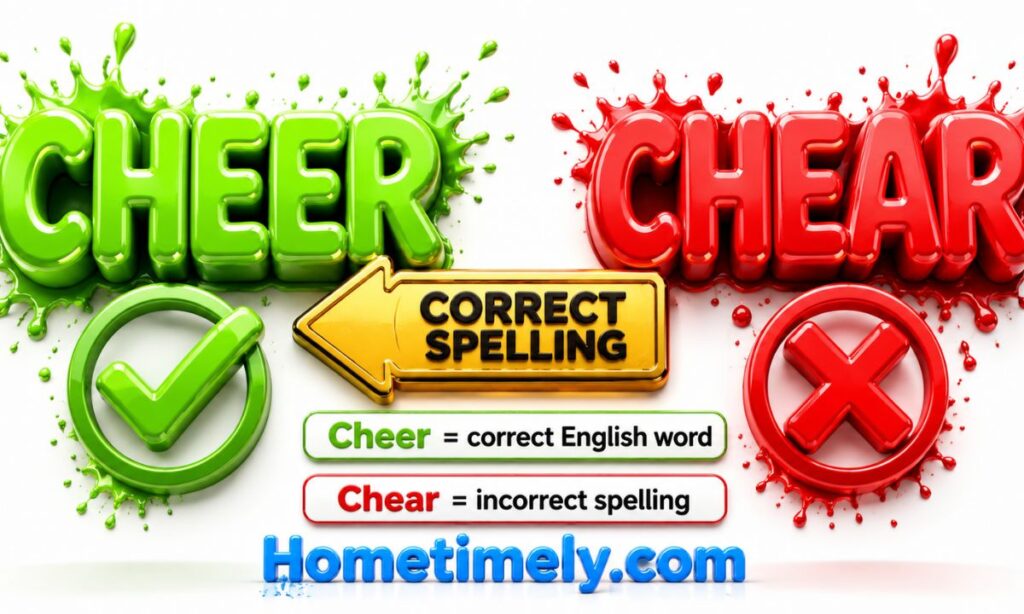
Here is the straightforward answer every writer needs:
Cheer is the correct, standard, modern English spelling. It functions as both a noun and a verb. As a noun, it refers to a feeling of joy, warmth, or approval. As a verb, it means to shout encouragement, express happiness, or uplift someone emotionally.
Chear is an obsolete, archaic spelling that was used in Old and Early Modern English texts before spelling became standardized. It does not appear in any current major dictionary as a valid modern word. If you use “chear” today, readers will assume it is a typo — not a stylistic choice.
This is not a regional variation like “colour” vs “color.” It is not a matter of British English vs American English. It is simply a question of correct spelling versus an outdated form that modern English discarded centuries ago.
Professional Comparison Table
| Feature | Cheer | Chear |
| Correct Modern Spelling | ✅ Yes | ❌ No |
| Found in Modern Dictionaries | ✅ Yes | ❌ No |
| Used in Professional Writing | ✅ Yes | ❌ No |
| Functions as Noun | ✅ Yes | ❌ No |
| Functions as Verb | ✅ Yes | ❌ No |
| Historical Usage | ✅ Yes (Middle English) | ✅ Yes (archaic variant) |
| Accepted Today | ✅ Always | ❌ Never |
| Pronunciation | /tʃɪər/ | /tʃɪər/ (identical) |
Key Insight
Both words share the same pronunciation — /tʃɪər/ — which is precisely why so many people struggle with the spelling. Your ears cannot tell the difference. Your writing must. Always choose “cheer” in every modern context, formal or informal, digital or print.
Cheer Definition (Precise Explanation)
According to the Cambridge Dictionary, cheer is defined as:
- Verb: “To give a loud shout of approval or encouragement.”
- Noun: “A loud shout of approval or encouragement.”
But the word carries a much richer semantic range than that single definition suggests. At its core, cheer expresses positive emotional energy — whether that manifests as a spontaneous shout at a sports event, a quiet sense of holiday warmth, or a deliberate act of supporting a friend through a hard moment.
The word entered Middle English around 1200 CE, borrowed from Anglo-French chere, which itself derived from Old French chiere meaning “face” or “expression.” From Late Latin cara (head, face), and possibly from Greek kara, the word originally described a person’s outward expression or countenance — not necessarily a happy one. Over several centuries, it narrowed to mean specifically positive emotional states and the outward expressions of joy and support.
Cheer Meaning in Different Contexts
Emotional Context
In emotional language, “cheer” refers to an inner state of positivity, happiness, or optimism. When someone radiates good cheer, they project warmth and hopefulness to those around them. This is especially common in descriptions of character: “Despite the setbacks, she entered the room with remarkable cheer.”
You will often encounter phrases like “full of cheer,” “holiday cheer,” or “good cheer” in emotional and literary contexts. These expressions tap into the warmth dimension of the word — cheer as a sustained mood rather than a single vocal outburst.
Social Context
Socially, “cheer” functions as a connector between people. It appears in group settings — sporting events, celebrations, rallies, and gatherings — where collective emotional energy is expressed outwardly. A crowd cheers. A team cheers each other on. Friends cheer someone up after bad news.
In British English especially, “cheers” has also become a common informal greeting and expression of thanks, used in casual conversation and at the end of emails in the same way an American might write “thanks” or “take care.”
Situational Context
Situationally, cheer appears across vastly different scenarios:
- A packed stadium erupting after a goal is scored
- A parent cheering their child at a school play
- Someone sending a message to cheer up a grieving friend
- Holiday decorations described as spreading festive cheer
- A toast at a wedding: “Cheers to the happy couple!”
Each situation uses the same word but draws on a slightly different shade of its meaning — vocal encouragement, emotional uplift, or celebratory warmth.
Cheer as a Noun
As a noun, “cheer” refers to a shout of approval, a sense of happiness, or an atmosphere of positive feeling. It can be countable or uncountable depending on context.
- Countable: “The crowd let out a cheer.” (one specific shout)
- Uncountable: “The room was full of holiday cheer.” (a general atmosphere)
Examples
- The final goal was met with a thunderous cheer from the home crowd.
- There was a quiet sense of cheer in the office after the good news broke.
- Three cheers for the volunteers who worked through the night!
- He brought warmth and cheer wherever he went.
- Her arrival brought a wave of cheer to the hospital ward.
Cheer as a Verb
As a verb, “cheer” describes the act of shouting encouragement, lifting someone’s spirits, or expressing vocal approval. It is a regular verb: cheer → cheered → cheering.
- Intransitive: “The audience cheered.” (no object needed)
- Transitive: “She cheered the runners as they passed.” (takes an object)
- Phrasal: “He tried to cheer her up.” (cheer + up = make someone happier)
Examples
- The fans cheered wildly as the team took the field.
- I called her to cheer her up after a difficult week.
- Everyone cheered when the announcement was made.
- The coach cheered his players on from the sideline.
- Good news always cheers me up instantly.
Cheerful Expression in Communication
The word “cheer” has spawned a family of related words that are equally important to know:
- Cheerful — describing a person or atmosphere that radiates happiness (“She gave a cheerful wave goodbye.”)
- Cheerfully — the adverb form (“He cheerfully agreed to help.”)
- Cheerfulness — the noun form of the quality (“Her cheerfulness was infectious.”)
- Cheerless — the opposite, meaning bleak or joyless (“It was a cold, cheerless morning.”)
- Cheerleader — someone who leads organized cheering, or metaphorically someone who strongly supports another
- Cheery — an informal synonym for cheerful (“a cheery greeting”)
Understanding this word family helps you use “cheer” more naturally across different sentence structures and writing styles. Notice that none of these derivatives use the “chear” spelling — every single one builds on the correct double-E form.
How to Spell Cheer in English (With Confidence)
If you want to remember the correct spelling forever, the key is understanding the vowel pattern. English uses a predictable double-E pattern in many common words to produce the long /iː/ sound.
Correct Cheer Spelling
C – H – E – E – R
Think of similar words that follow the exact same double-E pattern:
| Word | Pattern | Pronunciation |
| cheer | -eer | /tʃɪər/ |
| peer | -eer | /pɪər/ |
| steer | -eer | /stɪər/ |
| beer | -eer | /bɪər/ |
| deer | -eer | /dɪər/ |
| career | -eer | /kəˈrɪər/ |
| volunteer | -eer | /ˌvɒlənˈtɪər/ |
Every word in this family uses the double-E spelling. “Chear” breaks this consistent pattern and has no equivalent in modern vocabulary.
Why the Double “E” Matters
The double “E” in “cheer” is not arbitrary. It serves a phonetic function — it signals that the vowel should be pronounced with a long, sustained /iː/ sound rather than a short or modified vowel.
In English spelling conventions, a single “E” after a consonant (as in “chear”) would be unusual and inconsistent with how English forms this sound. The established pattern is “ee” — and cheer follows it perfectly. Spelling it as “chear” introduces a vowel combination (E-A) that in English typically produces a different sound entirely (as in “bear,” “pear,” or “wear” — which rhyme with “air,” not “ear”).
This is one reason spell-checkers immediately flag “chear” — it violates the internal phonetic logic of English spelling. The word simply does not look right because it is not right.
Cheer Pronunciation
The pronunciation of “cheer” is: /tʃɪər/
Breaking it down phonetically:
- tʃ — the “ch” sound, as in “chair” or “church”
- ɪər — the “ear” sound, as in “ear,” “near,” or “fear”
So it sounds like: ch + ear = cheer
Both British and American English pronounce it identically. There is no regional variant in pronunciation — only in some informal derivatives. This uniform pronunciation is precisely why the cheer vs chear confusion exists: when spoken aloud, you cannot distinguish one from the other. Context and writing are the only places where the difference becomes visible.
Why People Misspell “Cheer”
Several overlapping factors explain why “chear” keeps appearing in written English even today:
- Identical pronunciation — There is zero auditory difference between “cheer” and “chear.” Writers who rely on how a word sounds when guessing its spelling are likely to guess wrong.
- The EA vowel pattern — English uses “ea” to produce the /iː/ sound in many words: “read,” “lead,” “bead,” “meal,” “deal.” Writers may unconsciously apply this pattern to “cheer.”
- Autocorrect limitations — Some basic autocorrect systems focus on recognizable common errors and do not always catch “chear” because it looks phonetically plausible.
- Lack of visual memory — Writers who have not internalized the “eer” pattern may produce “ear” (which is also a real word) and add a “ch” before it — resulting in “chear.”
- Speed typing — In casual digital communication, the fingers often outrun the brain, producing transpositions or pattern substitutions.
Chear Meaning: Historical Background and Modern Reality
What Does Chear Mean?
In its historical context, “chear” carried essentially the same meaning as modern “cheer” — it referred to a person’s facial expression, mood, disposition, or state of spirits. The word “cheer” itself traces back through Anglo-French and Old French to the Latin cara, meaning “face.” In Middle English, spelling had not yet been standardized, so a single word might appear in multiple forms across different manuscripts and regions.
Chear: Obsolete Form Explained
Before the 18th century, English spelling was essentially a matter of personal choice and regional convention. Printers, scribes, and writers spelled words as they heard them or as their local tradition dictated. “Chear” was simply one of several competing variants. Other variants included “chere,” “cheere,” and “chere” — all representing the same word.
The standardization of English spelling, accelerated by the publication of Samuel Johnson’s dictionary in 1755 and later by Noah Webster’s American dictionary in 1828, eliminated most of these variants. “Cheer” won out as the accepted form. “Chear” did not disappear immediately — it lingered in print for some decades — but by the 19th century it had become definitively archaic.
Examples of Historical Usage
In Early Modern English texts, you would find passages such as:
- “Be of good chear” — a biblical phrasing from early English translations
- “With merry chear they feasted…” — from 16th-century narrative poetry
- “Her countenaunce and chear did change…” — from Edmund Spenser’s era writings
These uses were entirely normal and correct for their time. But that time is four centuries gone. No modern editor, teacher, or publisher would accept “chear” in a contemporary text.
Does Chear Exist in Modern English?
Technically, it is recorded in historical dictionaries and etymological references as an obsolete variant. The Online Etymology Dictionary lists “chear” simply as an “obsolete spelling of cheer (n.).”
Practically, it does not exist. No major modern dictionary — not Merriam-Webster, not Oxford, not Collins, not Cambridge — recognizes “chear” as a current, valid English word. It does not appear as an accepted alternative spelling. It does not appear as a dialect form. It is simply gone from living English.
If you write “chear” in a professional document, academic essay, social media post, or business email, the word will be treated as a spelling error. There is no context in which it is acceptable today.
Is Chear a Real Word?
Historically: yes. In Early Modern and Middle English, “chear” was a real and accepted spelling.
In modern English: no. It is not recognized by any current authority on English language usage. Using it today does not demonstrate knowledge of archaic English — it simply looks like a mistake.
The test is simple: open any reputable modern dictionary and search for “chear.” You will not find it listed as a valid entry. That is your answer.
Detailed Differences
Spelling Difference
| Cheer | Chear | |
| Vowel Pattern | EE (double-E, consistent) | EA (archaic vowel pair) |
| Dictionary Status | Current, valid entry | Obsolete/not listed |
| Spell-Check Result | Accepted | Flagged as error |
Meaning Difference
Both words historically conveyed the same meaning — joy, encouragement, positive emotional expression. In practical terms today, only “cheer” carries any meaning because “chear” is not used. If you wrote “chear” in a sentence, a modern reader would assume you meant “cheer” and made a typo.
Usage Difference
“Cheer” is used everywhere — formal writing, casual speech, social media, literature, journalism, academic work, and everyday conversation. “Chear” is used nowhere in contemporary writing, except perhaps in intentional historical fiction where archaic language is stylistically appropriate and clearly framed as such.
Language Evolution Perspective
Languages evolve. Spelling evolves. “Chear” is a linguistic fossil — evidence of how English used to work before standardization. Studying it is interesting from a historical linguistics perspective, but using it is as out of place as writing “hath” instead of “has” or “dost” instead of “do” in a modern email.
Cheer vs Chear Pronunciation
As covered earlier, both are pronounced identically: /tʃɪər/. This phonetic identity is the root of all confusion. In spoken English, you can never be wrong between the two — in written English, you can always be wrong. Choose “cheer” and you will always be right.
Why This Causes Confusion
The cheer vs chear confusion is particularly stubborn for three connected reasons.
First, the pronunciation offers no clue. Most spelling confusion in English involves words that at least sound somewhat different — “affect” vs “effect,” for instance, have subtle phonetic distinctions. Cheer and chear have none whatsoever.
Second, English has a competing vowel pattern (EA = /iː/) that appears in dozens of common words. Writers who have internalized “read,” “bead,” and “deal” may unconsciously apply the same EA pattern to “cheer.”
Third, the archaic form “chear” was genuinely correct for centuries. If you have encountered it in old texts and assumed it was simply an older but still-valid spelling — like “colour” for “color” — that assumption is understandable but wrong. Unlike British vs American spelling variations, “chear” is not a legitimate regional or stylistic alternative.
Also Read This : Half Day vs Half-Day: Which Is Correct and How to Use Each Form
Cheers Meaning and Usage
“Cheers” is the plural form of the noun “cheer” and the third-person present tense of the verb. But it has also developed a rich standalone life as an interjection — a word used expressively on its own.
As an interjection, “cheers” serves multiple social functions:
- A toast: Said while raising glasses before drinking — “Cheers, everyone!”
- An expression of thanks: Common in British English — “Thanks for your help.” / “Cheers!”
- A farewell: Used casually to say goodbye — “See you tomorrow. Cheers!”
- General goodwill: Closing an informal email — “Let me know what you think. Cheers.”
The use of “cheers” as a drinking toast became established in British English around 1919, derived from the earlier vocal senses of the word. Today it is genuinely versatile — one of those rare words that functions as a greeting, a farewell, a thank-you, and a toast all at once.
Fun Facts About These Words
- The word “cheer” originally meant face — not happiness. It took centuries to shift to its current positive meaning.
- <cite index=”10-1″>”Cheer” arrived in English as a loanword from Anglo-French, which itself derived from Medieval Latin cara and probably Greek kara.</cite>
- <cite index=”14-1″>The use of “cheers” as a salute or toast when drinking is recorded in British English from 1919.</cite>
- The word “cheerio” — a British parting expression — comes from the same root.
- <cite index=”8-1″>The sense of “cheer up” used intransitively is attested as far back as the 1670s.</cite>
- Native American languages as far as Canada adopted the old English greeting “What cheer?” after the Puritan settlers used it.
Examples of Cheers Usage
- As a toast: “Raise your glasses — cheers to the graduate!”
- As thanks: “You fixed it? Cheers, I really appreciate that.”
- As farewell: “Great meeting you. Cheers!“
- In writing: “Let me know if you need anything else. Cheers, James.”
- As exclamation: “Cheers from the whole team!”
Is It Cheers or Chears?
It is always cheers — never “chears.” Just as “chear” is not an accepted spelling of “cheer,” “chears” is not an accepted spelling of “cheers.” The plural, verbal, and interjection forms all add an “s” to the correct base word: cheer → cheers. There is no version of this word family that uses the “ea” vowel combination in modern English.
Difference Between Cheer and Cheers
Writers sometimes wonder whether to use “cheer” or “cheers” in a given sentence. Here is the practical distinction:
| Cheer | Cheers | |
| Noun (singular) | “a cheer rose from the crowd” | — |
| Noun (plural) | “many cheers were heard” | “the cheers were deafening” |
| Verb (base) | “they cheer every goal” | — |
| Verb (3rd person) | — | “she cheers loudly” |
| Interjection | — | “Cheers!” |
| Toast | — | “Cheers!” |
| Informal thanks/farewell | — | “Cheers!” |
The standalone interjection “Cheers!” always uses the plural form. You would not say “Cheer!” when raising a glass — the plural form is the socially established convention for that specific use.
How to Use Cheer in a Sentence (Professional Examples)
Basic Usage
These sentences demonstrate clear, everyday use of “cheer” in both its noun and verb forms:
- “A cheer went up from the crowd when the team scored.”
- “She smiled to cheer up the nervous students before the exam.”
- “The news of the promotion brought real cheer to her day.”
- “Fans cheered loudly throughout the entire match.”
- “Good coffee and warm company are enough to cheer anyone.”
Advanced Usage
These examples show “cheer” in more nuanced, layered contexts:
- “Despite the cold and the long delay, the volunteers worked with remarkable cheer, never letting frustration show on their faces.”
- “He spoke in a tone carefully designed to cheer without minimizing the difficulty of what lay ahead.”
- “The hospital ward, usually so quiet, filled with cheer when the children’s choir performed.”
- “Her book radiated the kind of quiet cheer that makes readers feel understood rather than lectured.”
Cheer Up: Meaning and Usage
“Cheer up” is one of the most common phrasal verb forms. It means:
- Intransitive (used without an object): to become happier or more positive — “She eventually cheered up after a long walk.”
- Transitive (used with an object): to make someone feel happier — “I brought flowers to cheer her up.”
Common situations where “cheer up” naturally fits:
- Comforting a friend after disappointment
- Lifting someone’s mood during illness
- Helping someone shake off stress or anxiety
- Sending a card or gift with the intention of improving someone’s spirits
Common Mistakes and How to Avoid Them
Using “Chear” Instead of “Cheer”
Wrong: “The fans gave a loud chear when the goal went in.” Right: “The fans gave a loud cheer when the goal went in.”
This is the most fundamental mistake. Whenever you write this word, default to the double-E spelling without exception.
Writing “Chears” Instead of “Cheers”
Wrong: “Three chears for the birthday girl!” Right: “Three cheers for the birthday girl!”
The same spelling rule applies to all forms. “Chears” is not a word. “Cheers” is the only correct plural and interjection form.
Mixing Archaic and Modern Spelling
Wrong: “She looked at him with a merry chear in her eyes, then cheered loudly.” Right: “She looked at him with a merry cheer in her eyes, then cheered loudly.”
Inconsistency is particularly jarring. Even writers who know that “chear” is archaic sometimes use it for stylistic texture without realizing how disruptive it appears in modern prose.
The Impact of Spelling Accuracy
Spelling accuracy is not just about following rules — it directly affects how your writing is perceived and how much trust your readers place in you.
Incorrect Example
“She walked onto the stage to a roar of chears from the audience. The coach had worked hard to chear the team through a brutal season.”
Even a reader who does not immediately notice the error will feel a vague unease. Something seems off. That friction weakens the impact of the writing.
Correct Example
“She walked onto the stage to a roar of cheers from the audience. The coach had worked hard to cheer the team through a brutal season.”
Clean, confident, credible. The reader focuses on the story, not the spelling.
Analysis
The difference between these two examples is two letters — a single vowel swap. But that swap signals to readers whether or not the writer can be trusted to handle language carefully. In professional contexts, that trust matters enormously.
Tips to Remember the Correct Spelling
Memory Trick
Think of it this way: cheer contains the word “ear” — and when a crowd cheers, you hear it with your ears. The sound you hear is in the spelling you use.
ch + ear = cheer ✅
Never: ch + ear rearranged = chear ❌
Visual Association
Picture a crowd of people at a stadium, all facing forward, cupping their hands around their mouths and shouting. Above them floats the word in big letters: CHEER — with the double-E standing tall like two people side by side, cheering together.
Alternatively, line it up with its rhyming family: beer, deer, peer, steer, veer — all double-E. Cheer fits right in. “Chear” does not fit any of them.
Proofreading Strategy
Before publishing any piece of writing:
- Use Ctrl+F (or Command+F) to search your document for “chear” and “chears”
- Run a spell-check using Grammarly, Microsoft Word, or Google Docs
- Read the document aloud — your eye may skip over spelling errors that your ear catches as awkward
- If in doubt, type the word into Cambridge Dictionary or Merriam-Webster and check the entry
More Practice Exercises (Sharpen Your Skills)
Fill in the Blank
Complete each sentence with the correct word (cheer / cheers / cheered / cheering):
- The crowd _______ when the final whistle blew.
- She brought flowers to _______ up her friend.
- Three _______ for the coach who led us to victory!
- The room filled with _______ and laughter.
- The team’s arrival was met with loud _______.
Answers: 1. cheered, 2. cheer, 3. cheers, 4. cheer, 5. cheers
Correct the Mistake
Each sentence contains an error. Find it and fix it.
- “The audience gave a loud chear after the performance.”
- “She tried to chear him up after the loss.”
- “We all chear for our favorite team on weekends.”
- “The crowd cheared wildly when the announcement was made.”
Corrections:
- chear → cheer
- chear → cheer
- chear → cheer
- cheared → cheered
Choose the Correct Sentence
Pick the sentence that uses correct spelling:
A. “The players were cheared by the fans.” B. “The players were cheered by the fans.” ✅ C. “Three chears for the winning team!” D. “She cheard up quickly.” ❌
True or False
- “Chear” is an accepted spelling in modern English dictionaries. — False
- “Cheer” can function as both a noun and a verb. — True
- “Cheers” can be used as an informal way to say thank you. — True
- “Chear” and “cheer” have different pronunciations. — False
- The double-E in “cheer” follows a common English vowel pattern. — True
Sentence Creation Challenge
Write original sentences using each of the following forms correctly:
- cheer (as a noun)
- cheer (as a verb)
- cheers (as an interjection)
- cheered (past tense)
- cheering (present participle)
Example: “A single cheer broke the silence” / “She cheered loudly” / “Cheers, and safe travels!” / “They cheered until their voices gave out” / “The cheering crowd lifted the players’ spirits.”
Quick Challenge (Speed Test)
Answer without thinking too long:
- Correct spelling of the word that means joy or encouragement → cheer
- Plural or interjection form → cheers
- Past tense → cheered
- “Thank you” in British informal → cheers
- Obsolete, non-modern variant → chear (do not use it)
Mini Reminder
Every time you write this word family, remember one rule:
Double-E, always. No exceptions in modern English.
cheer ✅ — cheers ✅ — cheered ✅ — cheering ✅ — cheerful ✅ chear ❌ — chears ❌ — cheared ❌ — chearing ❌
Key Takeaways
After working through this complete guide, here is what you need to carry forward:
- Cheer is the only correct modern spelling. Use it in every context — formal, informal, digital, and print.
- Chear is an obsolete variant from Early Modern English. It carries no validity in contemporary writing and will be read as a spelling error.
- Both words share an identical pronunciation (/tʃɪər/), which is why the confusion persists — but identical sound does not make identical spelling acceptable.
- Cheer works as a noun (a shout of joy, a warm atmosphere) and as a verb (to encourage, to uplift someone).
- Cheers serves as the plural noun, third-person singular verb form, and as a versatile interjection meaning “toast,” “thank you,” or “goodbye.”
- Chear and chears have no place in any modern sentence under any circumstances.
- The memory key: ch + ear = cheer. The double-E follows the same pattern as peer, beer, deer, steer, and career.
- Spelling accuracy matters. Clean, correct writing builds credibility and trust with every reader.
Reference Cambridge Dictionary Definitions
- Cheer (verb): “To give a loud shout of approval or encouragement.” (Cambridge Advanced Learner’s Dictionary & Thesaurus)
- Cheer (noun): “A loud shout of approval or encouragement.” (Cambridge Advanced Learner’s Dictionary & Thesaurus)
- Cheers (interjection): “A friendly expression said just before you drink an alcoholic drink; also used informally to mean ‘thank you’ or ‘goodbye.'” (Cambridge Advanced Learner’s Dictionary & Thesaurus)
- Chear: Not listed as a current entry. Recorded in etymological references only as an obsolete spelling of “cheer.”
Mastering the cheer vs chear difference is one of those small victories that makes a real difference in how confidently and clearly you write. Now that you know the full story — the etymology, the correct spelling, the usage rules, the historical context, and the common traps — you can write “cheer” every single time with complete assurance. And that, truly, is something worth cheering about.
Final Thoughts
The difference between cheer and chear is simple. Cheer is the only correct modern spelling. Always use it in your writing, whether formal or casual.
Chear is just an old, outdated form that no longer belongs in modern English. If you write chear today, readers will see it as a mistake. Stick with cheer every time, and your writing will always look confident and professional.

Michael Brook is the creator and author behind Healthy Leeks, a platform focused on grammar, writing skills, and English language learning. Passionate about clear communication and effective writing, Michael Brook shares practical grammar tips, easy-to-follow language guides, and educational content to help readers improve their English with confidence.