You’re writing an email, crafting a social media caption, or finishing up an essay — and suddenly your fingers stop. Is it moment or momment? Both look plausible for a split second, but only one is correct. And once you learn the difference, you will never second-guess yourself again.
This guide gives you everything: the correct spelling, the full definition, the word’s rich history, how to use it in sentences, its place in idioms and different fields, and why the misspelling momment keeps catching people off guard. Whether you’re a student, a professional writer, or someone trying to sharpen their everyday English, this article is built for you.
Why the Confusion: Moment vs Momment
At first glance, the confusion seems almost silly — it’s just one extra letter. But language mistakes rarely feel silly when you’re the one making them, and this one is more common than most people realize.
The core issue is pronunciation. When you say the word “moment” at a natural conversational speed, the first syllable — “mo” — tends to sound slightly stretched, as if there’s extra weight behind the initial m. To some writers, especially those spelling phonetically, that emphasis suggests a doubled consonant. They write momment because that’s how the sound seems to translate on the page.
Add to that the fact that English does use double consonants in many similar-looking words — comment, common, commit, commerce — and the confusion becomes even more understandable. The eye and the ear together create a false pattern, and momment is the result.
It happens more often in quick typing, casual writing, and among English learners who are still building their instinct for spelling rules. None of that makes the error acceptable in formal writing, but it does make it very human.
Momment: The Common Misspelling Explained
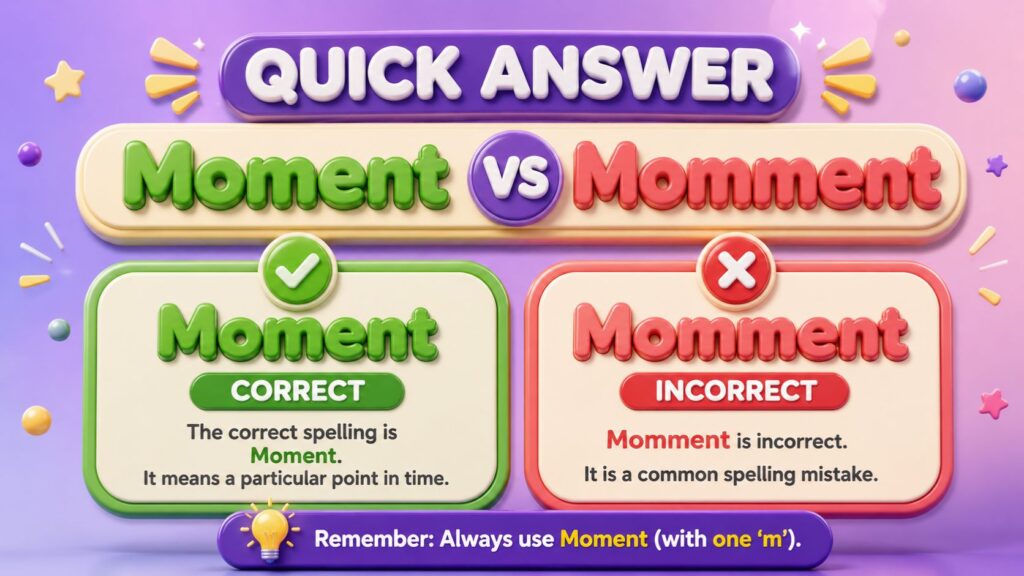
Let’s be absolutely direct: momment is not a word.
It does not appear in Merriam-Webster, Cambridge, Oxford, Collins, or any other recognized English dictionary. There is no dialect variant, no regional usage, no historical form that justifies writing momment. It is a straightforward spelling error — nothing more, nothing less.
The mistake almost always follows one of two paths:
- Phonetic spelling — The writer hears “MOH-ment” and assumes the emphasis means the m should be doubled, following the same logic as words like summer or hammer.
- Typing speed — Fast typists sometimes double a letter accidentally, especially one that opens a word. The finger just hits the key twice.
In both cases, the solution is the same: always write moment with a single m.
It’s also worth noting that no major style guide — AP Style, Chicago Manual of Style, MLA, or APA — would accept momment in any form of written work. Autocorrect on most devices will flag it immediately. If yours doesn’t, treat that as a reason to proofread, not as a pass.
The Correct Word: Moment
The correct spelling is moment — one m, followed by o, m, e, n, t. Six letters. No doubling.
Moment: Definition and Usage
Moment is primarily a noun in English, and it carries more than one layer of meaning:
1. A very short period of time This is the most common everyday use. When someone says “just a moment,” they mean a very brief wait — seconds, perhaps a minute at most.
“Could you hold on for a moment while I find your file?”
2. A specific point in time A moment can pinpoint an exact instant — not a duration, but a precise location on the timeline.
“The moment she walked in, the entire room went quiet.”
3. A significant or notable event This use is broader and more emotional. A “defining moment,” a “historic moment,” or a “moment to remember” describes an event with real weight — something that changes things, marks a shift, or stays in the memory.
“Winning the championship was the greatest moment of his career.”
4. Importance or consequence (formal/literary) In older and more formal writing, moment can mean significance or weight, as in “a matter of great moment.”
“The committee discussed issues of considerable moment.”
5. A technical/scientific quantity In physics, mathematics, and engineering, moment describes a specific measurable quantity, usually related to force, rotation, or statistical distribution.
Moment: Etymology
Understanding where a word comes from often makes the spelling and meaning click together in a lasting way.
Moment entered English during the Middle English period, around the 14th century. It came from the Latin word momentum, which itself was built from movere — the Latin verb meaning “to move.” The original Latin sense covered motion, a brief movement, and by extension, a brief instant of time.
The Oxford English Dictionary records moment in English texts as early as before 1382, in the Wycliffite Bible translation. Over the following centuries, the word broadened from its Latin roots to take on its modern range of meanings — from the literal (a brief span of time) to the figurative (a significant event) to the technical (a measurable quantity in physics).
Its cousins in other languages still show the family resemblance: French moment, Spanish momento, Italian momento, Portuguese momento — all descended from the same Latin root.
How to Spell Moment Correctly
Spelling moment correctly is straightforward once you remove the confusion:
- It has one m at the start — not two.
- The pattern is: M-O-M-E-N-T
- It follows a simple two-syllable rhythm: MO-ment
Here are a few memory tricks that work well:
Trick 1: Think of “movement.” Moment comes from the Latin movere (to move) — the same root as movement. If you remember that link, you remember the spelling: move → moment. No doubled letters in move, and none in moment.
Trick 2: Count the letters. M-O-M-E-N-T. Six letters. The m appears twice in the word, but they are the first and third letters — not sitting side by side.
Trick 3: Compare with comment. Comment has a double m because it comes from a different Latin root (com + mentum). Moment has a different origin and a different structure. When in doubt, remember: comment doubles, moment does not.
Trick 4: Use the word in a sentence before typing it. “In a moment” — say it, feel the rhythm (two syllables, not three), then write it. If it sounds like two syllables, it has six letters. Three syllables would suggest three parts; moment only has two.
Examples of Moment in Sentences
Seeing a word used in real, varied sentences is one of the best ways to internalize both its spelling and its meaning. Here are examples across different contexts:
Everyday speech:
- “Give me a moment to think this through.”
- “She was happy, just for that one brief moment.”
- “I’ll be ready in a moment.”
Describing a significant event:
- “Crossing the finish line was the defining moment of her athletic career.”
- “That conversation was a turning point — a real moment of clarity.”
- “History books will remember this as a pivotal moment in the peace process.”
Figurative and emotional use:
- “He had a moment of doubt just before signing the contract.”
- “She cherished every moment spent with her grandmother.”
- “The moment passed, and with it, any chance of a second beginning.”
Formal or literary use:
- “The ambassador addressed matters of great moment at the summit.”
- “It was, in that particular moment, the only thing that seemed real.”
Technical context:
- “The engineer calculated the bending moment before approving the structural design.”
Moment in Idioms and Expressions
Moment is woven into dozens of common English expressions. These phrases are so widely used that knowing them — and spelling the word correctly in each one — adds real fluency to your writing.
“Just a moment” — A polite request for a short pause. One of the most common phrases in customer service and professional conversation.
“At the moment” — Meaning right now, currently. “She’s not available at the moment, but she’ll call you back.”
“In the heat of the moment” — Describes an action or statement made impulsively, driven by intense emotion. “He said things he regretted in the heat of the moment.”
“On the spur of the moment” — Describes a decision made suddenly, without planning. “We decided on the spur of the moment to drive to the coast.”
“The moment of truth” — The critical instant when a decision must be made or the result of something is revealed. “The final exam was her moment of truth.”
“A defining moment” — An experience or event that fundamentally shapes who someone is or changes the direction of something. “Losing his job turned out to be a defining moment — it pushed him toward his real passion.”
“Man/Woman of the moment” — The most admired, celebrated, or important person right now. “After the winning goal, he was undeniably the man of the moment.”
“Live in the moment” — To focus fully on the present rather than worrying about the past or future. This phrase has wide use in wellness, mindfulness, and motivational writing.
“Have a moment” — Informally, to experience a brief lapse in concentration. “Sorry, I just had a moment — where were we?”
The Emotional and Cultural Meaning of Moments
Language is never just about definitions. Words carry emotional and cultural weight, and moment is a perfect example.
In everyday life, people use moment to describe the most meaningful experiences of their lives — a first kiss, the birth of a child, a graduation, a conversation that changed everything. The word carries a kind of reverence. Saying “that was a moment” signals that something mattered, that time slowed down, that life registered the event as significant.
Psychologists and mindfulness researchers have pointed to the concept of present-moment awareness — the practice of fully inhabiting the current instant rather than being pulled into past regrets or future anxieties. The word moment is central to this entire branch of well-being research and practice.
Culturally, the phrase “living in the moment” has become a philosophical stance as much as a linguistic expression. From motivational posters to meditation apps to song lyrics, moment has evolved into shorthand for presence, intentionality, and the recognition that experience is fleeting.
In literature and film, moments are the units that make up emotional storytelling. Screenwriters and novelists are often taught that a great scene pivots on a single defining moment — one beat where something shifts, something is understood, or something is lost forever.
Moment in Different Fields
One of the most interesting things about moment is how far beyond everyday language it extends. The word carries specific, technical meanings in several professional and academic fields.
Physics and Engineering In physics, a moment refers to a mathematical quantity related to force applied at a distance from a reference point. The moment of inertia describes how resistant an object is to rotational acceleration — a concept essential in mechanical engineering, aerospace design, and structural analysis. The bending moment in civil engineering describes the internal stress that develops in a beam when force is applied. These are precise, measurable quantities, and the word moment is the standard technical term for them.
Mathematics and Statistics In statistics, a moment is a specific quantitative measure of the shape of a probability distribution. The first moment is the mean (average), the second central moment is the variance, the third relates to skewness, and the fourth to kurtosis. These statistical moments are fundamental to data analysis, probability theory, and fields that rely on them — finance, research, machine learning, and economics.
Music and the Arts Musicians often talk about the “moment” in a performance — that instant when everything aligns and the music becomes more than the sum of its notes. Theatre directors speak of “the moment” in a scene when an audience visibly responds. Photographers try to capture “the decisive moment,” a concept famously described by photographer Henri Cartier-Bresson as the precise instant when visual composition and emotional content converge perfectly.
Psychology and Therapy Therapists working in mindfulness-based cognitive therapy (MBCT) and acceptance and commitment therapy (ACT) use “the present moment” as a therapeutic anchor. The ability to stay with a moment — to observe it without judgment — is considered a core skill in managing anxiety, depression, and stress.
Common Grammar Questions About Moment
Writers often have practical questions about how to use moment correctly in grammar. Here are the most frequent ones:
Is moment a noun or an adjective? Moment is primarily a noun. However, it appears in compound adjectives like “momentary,” “momentous,” and “the-moment” in phrases like “the man of the moment.” The adjective form of moment is momentary (lasting only a moment) or momentous (of great importance).
What is the plural of moment? The plural is simply moments. “There were many moments in that trip that I’ll carry with me forever.”
Can moment be used as a verb? No. Moment is not used as a verb in standard English. You cannot “moment” something. The associated verbs are in phrases: “seize the moment,” “enjoy the moment,” or “mark the moment.”
What are common collocations with moment? Moment pairs naturally with many adjectives and verbs. Some of the most widely used:
| Adjective + Moment | Verb + Moment |
| defining moment | seize the moment |
| pivotal moment | cherish the moment |
| brief moment | mark the moment |
| historic moment | capture the moment |
| awkward moment | live in the moment |
| perfect moment | enjoy the moment |
| tender moment | remember the moment |
Writing and Grammar Tips
Using moment well goes beyond spelling. Here are practical tips to help you write with the word more effectively:
- Avoid overuse. In some writing, moment appears so frequently it loses impact. Vary with synonyms — instant, second, point in time — to keep the prose from feeling repetitive.
- Be specific when using “defining moment.” It’s a powerful phrase, but it’s been used so often it can sound hollow. When you use it, follow it with detail that earns the label.
- Don’t confuse momentary and momentous. These two adjectives have nearly opposite emotional weight. Momentary means brief and fleeting. Momentous means hugely significant. Mixing them up changes meaning dramatically.
- Use “at the moment” carefully in formal writing. In academic or professional writing, “at present” or “currently” is often cleaner and more precise.
- Proofread for the double-m error. If you type quickly, run a search for “momment” in any important document before submitting or publishing. It takes two seconds and catches an error that would otherwise undermine your credibility.
- In creative writing, treat moments as beats. Every strong scene turns on a moment — a decision, a revelation, a shift in understanding. When revising, ask yourself where the moment is, and build toward it.
Famous Quotes About Moments
Writers, thinkers, and public figures have long used moment to capture something essential about the human experience. These quotes also serve as a reminder of the word’s emotional range and versatility:
“Life is not measured by the number of breaths we take, but by the moments that take our breath away.” — Commonly attributed to various sources; widely used in motivational contexts.
“Sometimes you will never know the value of a moment until it becomes a memory.” — Dr. Seuss
“Be happy in the moment, that’s enough. Each moment is all we need, not more.” — Mother Teresa
“The present moment always will have been.” — A philosophical observation about how even fleeting moments become permanent in the past tense.
“It was a defining moment in many ways.” — Cambridge Dictionary example sentence, showing how naturally the word appears in formal journalism and commentary.
These quotes show that moment is not just a grammar topic — it’s a word that carries genuine human weight.
Synonyms of Moment
When writing long-form content, repeating moment too often can weaken the prose. Here are the most useful synonyms, with notes on how each differs in tone and application.
Instant
Instant is the closest synonym to moment in everyday use. It emphasizes brevity even more strongly — an instant is shorter, sharper. Use it when you want to stress immediacy.
“The lights went out in an instant.” “I recognized her the instant she walked in.”
Instant is slightly more dramatic than moment. Where moment can be warm and reflective, instant tends to feel sudden and precise.
Minute
In informal speech, minute is often used interchangeably with moment to mean a short period of time. But in careful writing, minute (as a synonym for moment) can feel slightly more casual.
“Wait a minute — let me think about that.” “She was gone for just a minute.”
Note: When minute refers to the actual unit of time (sixty seconds), it is not interchangeable with moment. Context makes the distinction clear.
Occasion
Occasion shares the “significant event” meaning of moment, but it tends to imply something more formal, planned, or ceremonial. You attend an occasion; you experience a moment.
“The graduation was a proud occasion for the whole family.” “On this occasion, the committee will hear from both sides.”
Use occasion when the event has a social or ceremonial dimension. Use moment when the emphasis is on the experience itself.
Event
Event overlaps with moment in the sense of “a significant occurrence,” but it carries a different scale. An event is usually larger, more structured, and more public. A moment can be entirely private.
“The concert was the event of the summer.” “Sitting with her father in the hospital was a moment she would never forget.”
Use event for something organized and external. Use moment for something felt and experienced.
Also Read This : Parents’ vs Parent’s: Differences and Correct Usage
Summary Table: Moment vs Momment
| Feature | Moment | Momment |
| Correct spelling | ✅ Yes | ❌ No |
| Found in dictionaries | ✅ Yes (all major) | ❌ No |
| Accepted in formal writing | ✅ Yes | ❌ No |
| Accepted in informal writing | ✅ Yes | ❌ No |
| Number of syllables | 2 (MO-ment) | — |
| Word origin | Latin momentum | Spelling error |
| Part of speech | Noun (primarily) | — |
| Has a plural form | ✅ Yes (moments) | ❌ No |
| Used in idioms | ✅ Yes (many) | ❌ No |
| Technical/scientific use | ✅ Yes | ❌ No |
Key Takeaways
Before you close this article, here is the essential summary — everything you need to remember:
- Moment is the one and only correct spelling. Use it always, in every context.
- Momment (with a double m) is a misspelling. It does not exist in any English dictionary.
- The mistake happens because of phonetic spelling habits and the influence of similar-looking words like comment and common.
- Moment comes from the Latin momentum, meaning motion and brief duration.
- The word has both everyday meanings (a short period of time, a significant event) and technical meanings (physics, mathematics, engineering).
- Common idioms like “in the heat of the moment,” “on the spur of the moment,” and “the moment of truth” are widely used in professional and creative writing.
- Useful synonyms include instant, minute, occasion, and event — each with its own subtle distinction.
- To avoid the spelling error: remember the word has two syllables, one opening m, and traces back to a root that has no doubled letters.
Reference: Cambridge Dictionary Definitions
For authoritative reference, here is how Cambridge Dictionary defines moment across its key meanings:
| Definition | Cambridge Dictionary Entry |
| Primary meaning | A very short period of time |
| Secondary meaning | A point in time |
| Third meaning | Now; the present time |
| Formal/literary | Of great importance or consequence |
Cambridge also lists the following idioms under the moment entry:
- At the moment — currently, right now
- For the moment — temporarily, for now
- Of the moment — the most important or successful at a particular time
- On the spur of the moment — done suddenly, without planning
- In the heat of the moment — done impulsively, driven by emotion
- Just a moment — a polite request for a brief pause
These definitions confirm what every style guide, grammar reference, and dictionary agrees on: the word is moment, spelled M-O-M-E-N-T, and there is no such word as momment in the English language.
Conclusion
The difference between moment and momment is one letter — but that one letter is the difference between correct English and a spelling error. Moment is a word with more than 700 years of history, a Latin heritage, and a place in everything from everyday conversation to formal physics. Momment is simply a mistake, one that autocorrect flags and editors correct.
Now you know not just how to spell it, but why people get it wrong, what the word truly means, and how to use it with confidence in any kind of writing. The next time you pause mid-sentence wondering which version to write, there will be no hesitation: it’s moment, always and only moment.

Michael Brook is the creator and author behind Healthy Leeks, a platform focused on grammar, writing skills, and English language learning. Passionate about clear communication and effective writing, Michael Brook shares practical grammar tips, easy-to-follow language guides, and educational content to help readers improve their English with confidence.