You’re scrolling through Instagram comments, someone drops “AWL” on a cute puppy video, and you pause. What did they just say? Was it a typo? Is it short for something? If that sounds familiar, you’re in good company. AWL is one of those modern slang terms that shows up everywhere but gets explained almost nowhere — and when it does get explained, different sources say wildly different things.
That’s exactly why this guide exists. By the time you finish reading, you’ll know what AWL means, where it came from, how it’s used across different platforms and situations, and how to respond to it without looking lost. Whether you’re a parent trying to decode your teenager’s texts, a social media user keeping up with Gen Z, or just someone who hates being confused — this is for you.
🌟 AWL Meaning in Text: What It Actually Means
AWL doesn’t have one single, locked-in meaning. That’s the honest answer, and it’s also what makes it interesting. In digital communication, AWL shifts meaning depending on context, tone, and who’s using it. But there are three core definitions that account for the vast majority of its usage:
| Meaning | Full Form | Context | Tone |
| AWL | Always With Love | Sign-offs, DMs, social media | Warm, affectionate |
| AWL | A Whole Lot | Emphasis in casual texting | Expressive, casual |
| AWL | Aww / Aww Love | Emotional reaction to cute or heartfelt content | Soft, emotional |
The most widely recognized slang meaning in digital spaces is “Always With Love.” It’s used as a warm sign-off or an affectionate stamp on a message, similar to how someone might write “XOXO” or “with love” — except faster and more casual. You’ll see it in DMs, Snapchat streaks, Instagram captions, and late-night texts between close friends.
The second meaning — “A Whole Lot” — leans more toward emphasis. Think of it as a spoken-language shortcut. Instead of saying “I miss you so much,” someone might write “I miss you AWL.” The phrase gives the message extra emotional weight without requiring extra words.
The third meaning, “Aww” or “Aww Love,” is more of a phonetic expression — a stylized, stretched-out version of the classic “aww” reaction you’d have to something adorable or touching. It’s less of an acronym and more of an emotional sound written out in a new way.
Outside of slang, AWL also carries formal and technical meanings: in education, it refers to the Academic Word List, a curated set of vocabulary important for academic writing. In professional settings, it can stand for Absent With Leave (approved absence). In German industrial programming, it means Anweisungsliste, an instruction-list language for programmable logic controllers. But unless you’re in one of those specific fields, you’re almost certainly seeing the slang version.
Why the extra L?
This is one of the most common questions people have when they first encounter AWL. If it’s just “aww,” why add the L?
The “L” does a few things at once. Phonetically, it mirrors how many people actually say “aww” with a slight drawl — especially in Southern American English and other dialects where the vowel naturally elongates into an “awl” sound. Over time, internet users started spelling what they heard, and AWL stuck.
There’s also an aesthetic element. The extra letter makes the word feel more intentional, more styled — less like an accidental extra key press and more like a deliberate choice. In the same way people type “noooo” instead of “no” to convey more emotion, AWL communicates more intensity than a plain “aw.” It’s the visual equivalent of holding a note a little longer.
🕰️ Origins and Evolution of AWL
AWL didn’t come with a launch date or a founding moment. Like most internet slang, it grew organically across platforms, passed from one user to another until it had enough reach to be searched.
The earliest documented uses as a soft, affectionate expression appeared around 2011–2013 on Tumblr and early teen chatrooms. Back then, young people were already experimenting with emotional spelling — stretching out words, adding letters, and tweaking spellings to make reactions feel bigger and more personal than plain text allowed.
By 2015–2018, AWL had migrated to Twitter and Instagram DMs. As social media use exploded, brief but warm sign-offs became popular. “Always With Love” fit perfectly: it expressed genuine feeling without the awkwardness of a long goodbye.
From 2019 onwards, TikTok turbocharged its spread. Short-form video culture rewards emotional authenticity and quick, expressive captions. AWL appeared in comment sections, video descriptions, and creator sign-offs — and because TikTok crosses age groups, languages, and geographic borders, the term went genuinely global.
The “A Whole Lot” interpretation likely developed in parallel, shaped by regional American dialects where “whole” sounds close to “awl” when spoken casually. As SMS texting had character limits in its early days, users naturally compressed common phrases. “A Whole Lot” became AWL because it was phonetically accurate and fast to type.
Today, AWL operates in a linguistic gray zone — somewhere between a proper acronym, a phonetic expression, and evolving slang that means slightly different things to slightly different people. That flexibility is both its charm and its occasional source of confusion.
💬 AWL in Real Conversations: Practical Examples
Seeing AWL in context is the fastest way to understand it. Below are real-world-style examples across different emotional registers.
Affectionate Examples
- “Had the best birthday ever because of you. AWL 💛” (Used as a warm sign-off expressing genuine love and gratitude.)
- “Your friendship means AWL to me, seriously.” (Here AWL = “a whole lot” — adding emotional weight to the statement.)
- “Mom just made my favorite dinner. AWL her so much 🥺” (A soft, emotional reaction blending affection with the “aww love” sense.)
Sympathy Examples
- “I heard what happened. AWL — you’re going to get through this. 💙” (Warm, compassionate opener in a difficult conversation.)
- “She’s been going through AWL lately. Wishing her the best.” (Means “a whole lot” — emphasizing how much someone has endured.)
- “AWL, I didn’t know you were dealing with all of that. You should’ve told me.” (Empathetic reaction, similar to “aww, that’s so much.”)
Flirty Examples
- “You looked AWL today ngl 😏” (Combines flirty energy with “a whole lot” — implying they looked amazing.)
- “Goodnight. AWL ❤️” (Sweet, romantic sign-off packed with warmth and closeness.)
- “I think about you AWL more than I should tbh.” (Playfully affectionate confession.)
Playful Examples
- “That pizza was AWL. No notes. 🍕🔥” (Enthusiastic, fun use of “a whole lot” to mean absolutely amazing.)
- “AWL this drama in the group chat lmaoo 💀” (Used ironically to mean “so much” — playful and amused.)
- “Your dog is literally AWL. I can’t. 🐶” (Classic “aww love” reaction to something unbearably cute.)
Sarcastic Examples
- “Oh wow, thanks for the AWL of help you gave me back there 🙄” (Dripping with sarcasm — the “a whole lot” meaning flipped to mean “absolutely none.”)
- “You remembered my birthday. AWL. Really, I’m so touched.” (Flat, deadpan — context makes the sarcasm obvious.)
- “We’ve been friends for years and this is AWL you had to say.” (Disappointed sarcasm — “this is a whole lot” meaning “this is all” sarcastically.)
Awl Meaning in Text — The Funny Side
Like most internet slang, AWL has developed its own comedic life online. Memes and jokes usually lean into the fact that “awl” is also a real English word — a small pointed tool used for piercing holes in leather. That double meaning creates irresistible pun territory.
You’ll find jokes like:
- “She said AWL to my texts and I can’t tell if she loves me or wants to craft leather goods.”
- “Bro responded AWL and I had to Google whether he was being sweet or threatening to stab something.”
- “Plot twist: he’s not a romantic, he’s just really into cobbling.”
Beyond the tool pun, AWL also gets used in absurdist humor online — particularly in TikTok comment sections where commenters compete to be the funniest reaction to a video. Dropping “AWL 🥹” on a video of someone tripping over their own feet, or responding to someone’s dramatic breakup story with “AWL that’s wild” (using both the emotional and the “a whole lot” sense simultaneously) — that kind of layered usage is what makes it endlessly entertaining in the right context.
The humor mostly comes from the term’s flexibility. Because AWL can mean so many different things, skilled communicators can weaponize that ambiguity for comedic effect.
Awl Meaning Slang TikTok
TikTok deserves its own section here because it genuinely accelerated AWL’s adoption and gave it new dimensions of meaning.
On TikTok, AWL shows up most often in three places:
Comment sections — Usually as a reaction to emotional, cute, or heartwarming content. Someone posts a video of their grandmother seeing snow for the first time, and hundreds of comments say “AWL 🥹” — a pure, instinctive emotional reaction.
Video captions — Creators use it as a sign-off or summary phrase: “POV: you’re awl over me ❤️” or “Made this for awl my night-shift workers out there.” Here it slides between “always with love” and “all.”
Trends and audio — TikTok trends often involve playing with language. AWL has appeared in caption challenges, text-overlay trends, and comment-section games where users compete to drop the most emotionally resonant reaction.
The Gen Z-led language culture on TikTok also encouraged phonetic spelling and emotional exaggeration — which is exactly where AWL thrives. Instead of “aww,” you type AWL. Instead of “I love you all,” you might write “AWL of you 💛.” The line between deliberate expression and playful spelling blurs, and that’s the point.
📲 AWL Usage Across Different Platforms
Texting and Social Media
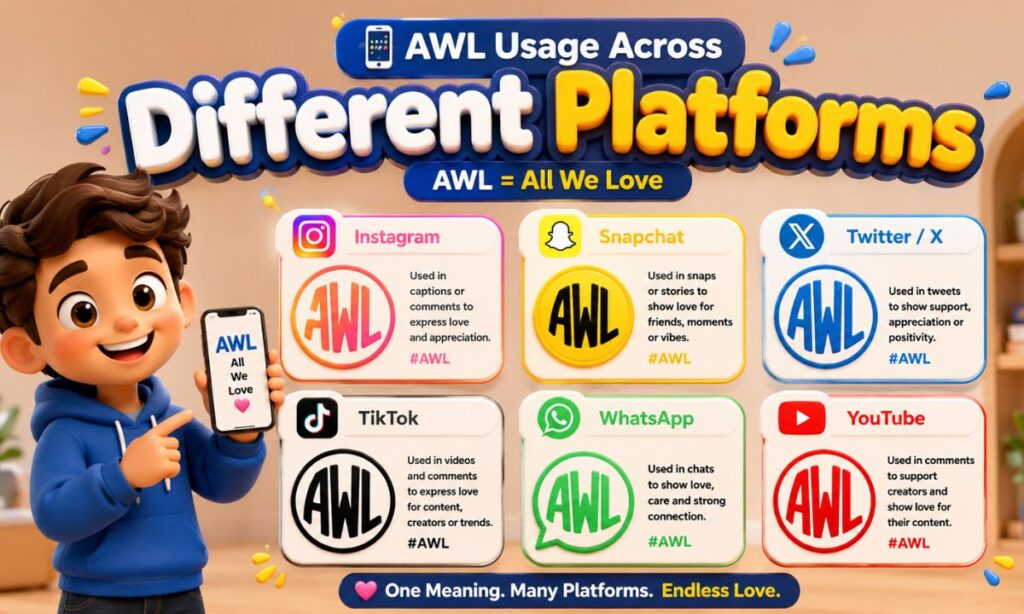
In text messages and across platforms like WhatsApp, Instagram, and Snapchat, AWL fits naturally into informal, emotionally expressive conversations. It works as a sign-off (“Talk later, AWL ❤️”), a reaction (“AWL this is the sweetest thing”), or an emphasis word (“I miss you AWL”).
On Instagram, it tends to appear in captions and comments — especially on posts about relationships, family, pets, or emotional milestones. On Snapchat, it often features in streaks and night-time messages, functioning as a warm low-effort way to maintain closeness.
Online Gaming
In gaming communities, AWL occasionally surfaces with the older meaning of “Absent Without Leave” (or its AWOL cousin). If a teammate disappears mid-match, someone might type “he’s AWL” as a quick, slightly sarcastic note. It’s less emotionally loaded in gaming contexts and more matter-of-fact.
There’s also crossover with casual gaming communities — especially mobile gaming spaces where players also maintain social relationships and use everyday slang.
Real-Life Conversations
AWL is mostly a textual phenomenon, but it occasionally bleeds into real-life speech among younger users. In the same way people now say “LOL” out loud, you’ll sometimes hear “awl” spoken naturally as an emotional reaction — especially among teenagers who’ve internalized slang to the point where it lives in their spoken vocabulary too.
🚫 Common Misunderstandings About AWL
Misunderstanding 1: AWL means AWOL
AWOL — Absent Without Leave — is a military and formal employment term meaning someone has disappeared without authorization. AWL is a different thing entirely in casual digital communication. The two look similar enough to cause confusion, but mixing them up in the wrong context can lead to awkward moments. If someone texts “I’ve been AWL 😔,” they almost certainly mean “a whole lot [going on]” or are using it affectionately — not admitting to unauthorized absence.
Misunderstanding 2: AWL is always sweet
AWL carries warm, affectionate energy in most contexts — but not all. As the sarcastic examples above show, tone and context can completely flip its meaning. A flat “AWL. Really appreciate that.” in the middle of a tense conversation reads very differently from the same phrase in a love message. Never assume AWL is positive based on the word alone; read the surrounding message first.
Misunderstanding 3: AWL is professional
It isn’t. AWL belongs firmly in the casual, personal communication category. Using it in a work email, a client message, or a formal document risks coming across as unprofessional or confusing. Even in friendly workplace chats, it’s worth gauging how well you know the other person before dropping internet slang into the thread.
🪄 Similar Terms and Related Expressions
Common Variations of “Aww”
| Term | Meaning | Emotional Intensity |
| Aw | Mild affection or sympathy | Low |
| Aww | Classic soft reaction | Medium |
| Awww | Prolonged, stronger version | Medium-High |
| Awwww | Very drawn out, extra emphasis | High |
| AWL | Stylized, typed-out version | High (with flair) |
| Awwh | Softer, sighing variation | Medium |
Related Cute or Emotional Slang
- ILY — I Love You. Direct affection, common in close relationships.
- ILYSM — I Love You So Much. An amplified version.
- BML — Bless My Life. Reaction to something sweet or joyful.
- ISTG — I Swear To God. Used for emphasis, can be emotional.
- OML — Oh My Lord. Surprise, admiration, or disbelief.
- UWU — An emoticon expressing warmth, cuteness, or affection.
- SLAY — Positive exclamation used to celebrate someone.
- FR — For Real. Used to validate or emphasize emotion.
Also Read This : Coachs or Coaches? Understanding the Differences
📨 How to Respond to AWL
Your response to AWL should match the tone it was sent in. Here’s a breakdown by context:
Sweet Responses
- “AWL back at you 💛”
- “That genuinely made my day, thank you.”
- “You’re the sweetest person I know, for real.”
Flirty Responses
- “Only for you 😏❤️”
- “Keep talking like that and I’ll never stop smiling.”
- “You’re dangerously cute, you know that?”
Playful Responses
- “Awl right, awl right, calm down 😂”
- “Did you just try to awl me into submission? It worked.”
- “Stop being cute, I’m trying to be normal rn.”
Sympathetic Responses
- “AWL, I’m so sorry. I’m here if you need anything.”
- “That’s a lot to carry. I’m proud of you for keeping going.”
- “Sending you all the love. For real.”
Neutral Responses
- “Thanks 🙂”
- “Appreciate that!”
- “Right back at you.”
Quick Response Flow
When you receive AWL and you’re not sure which meaning is intended, use this simple process:
- Read the surrounding message. What emotion does the overall text carry?
- Check for emojis. Hearts and soft emojis (🥹💛🥺) signal affection. Fire or laughing emojis signal playfulness.
- Consider your relationship. A crush uses AWL differently than a group chat.
- Match the energy. Warm reply for warm AWL. Playful reply for playful AWL.
🌍 Cultural and Regional Variations
United States
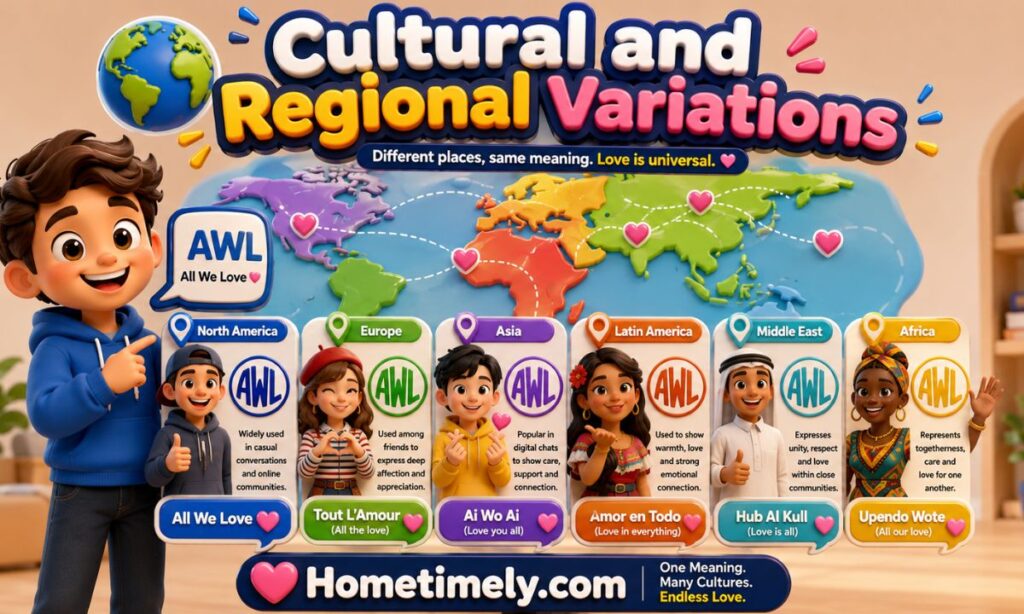
In the US, AWL is most common among teens and young adults, predominantly on Snapchat, TikTok, and Instagram. Both the “Always With Love” and “A Whole Lot” interpretations circulate widely. The phonetic connection to certain American dialects (where “whole” sounds like “awl”) also gives the term natural staying power.
United Kingdom
British users encounter AWL but tend to be more likely to read it sarcastically or question it as American slang. The traditional British equivalent for warm sign-offs leans toward “all my love” written out, or more classic emoji-based affection. That said, younger UK users on TikTok and Instagram have adopted AWL in much the same way as their American counterparts.
Southeast Asia
In countries like the Philippines, South Korea, and Japan, AWL slots naturally into cultures that already embrace cute emotional expression — what’s known as kawaii in Japan or aegyo in Korea. The soft, expressive nature of AWL fits well with these aesthetics. K-pop fan communities in particular use AWL frequently in comment sections and fan group chats.
Older Audiences
For people over 40 who didn’t grow up with mobile internet slang, AWL is likely either unfamiliar or confusing. The most probable interpretation from this demographic would be the literal English word “awl” (the pointed tool), or confusion with AWOL. If you’re communicating with an older audience, spelling things out is always the safer choice.
⚠️ Is AWL Ever Offensive?
In most cases, AWL is harmless — even kind. But there are situations where it can land badly.
When AWL can feel rude
Used dismissively in a serious conversation. If someone is sharing something genuinely painful and you respond with a breezy “AWL 😊” and nothing more, it can feel like you’re minimizing their experience. AWL is a soft, casual expression — it needs more context in heavy moments.
Used sarcastically with someone unfamiliar with the tone. Sarcasm is always risky over text. If the other person doesn’t know you well enough to read your tone, a sarcastic “AWL, so helpful 👏” can read as genuine — or as passive-aggressive — depending on what they’re expecting.
Used in professional contexts. In a work email or formal message, AWL looks out of place at best and unprofessional at worst. It can undermine credibility, especially in communications with clients, senior colleagues, or anyone who values formal tone.
Sent to someone unfamiliar with slang. To someone who doesn’t use internet slang, AWL is simply confusing. It can make the sender seem careless or communicate that they’re not putting in real effort — even if that’s not the intention.
The general rule: if you’re not certain both parties share the same understanding of the word and its tone, lean on something clearer.
Reference: Cambridge Dictionary Definitions
While Cambridge Dictionary does not define AWL as internet slang, it does define two terms that give useful context to its evolution:
The entry for “awl” as a noun describes it as a small, pointed tool used for making holes in leather or wood — the traditional meaning that modern slang has repurposed phonetically.
The entry for “aww” captures the emotional sound — used to express affection, sympathy, or mild disappointment — which lies at the heart of what AWL communicates in digital conversation.
This gap between the formal dictionary and actual usage is a perfect example of how internet language outpaces traditional reference tools. AWL lives in the space where spoken sound, emotional shorthand, and digital culture converge — a place dictionaries are only beginning to catch up with.
Conclusion
AWL is a tiny three-letter term that carries a surprisingly big range of meaning. At its core, it’s an expression of warmth — whether that warmth comes through “Always With Love,” “A Whole Lot,” or a stylized version of “aww.” It lives in DMs, comment sections, Snapchat streaks, and TikTok captions, moving fluidly between affectionate, playful, and occasionally sarcastic registers depending on context.
What makes AWL worth understanding isn’t just the definition — it’s what it represents. Terms like this show how digital communication has developed its own emotional vocabulary, one that prioritizes speed, expressiveness, and human connection over grammar-book precision. AWL isn’t sloppy writing. It’s the language of people who want their messages to feel like something.
The next time you see AWL in a text, take a second to read the room — the emojis, the relationship, the conversation’s overall energy. Nine times out of ten, someone is just trying to tell you they care. And that’s worth knowing.

Michael Brook is the creator and author behind Healthy Leeks, a platform focused on grammar, writing skills, and English language learning. Passionate about clear communication and effective writing, Michael Brook shares practical grammar tips, easy-to-follow language guides, and educational content to help readers improve their English with confidence.