If you’ve ever typed “openned” and watched your spell-checker underline it in red, you’re not alone. This tiny word trips up native speakers and English learners alike, mostly because English spelling rules aren’t always consistent.
The good news is that the correct answer is simple, and once you understand the one rule behind it, you’ll never second-guess yourself again.
Quick Answer
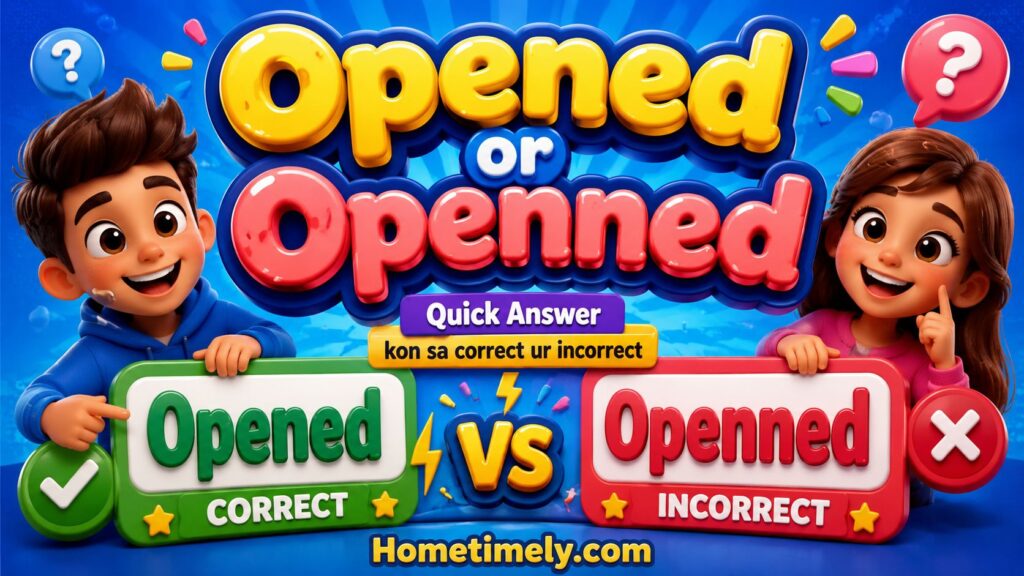
Opened is the correct spelling. Openned is a misspelling and is not recognized in any standard dictionary.
“Opened” is the past tense and past participle of the verb “open.” It follows the regular pattern of adding “-ed” to a base verb, without doubling the final consonant.
| Spelling | Status | Example |
| Opened | ✅ Correct | She opened the door. |
| Openned | ❌ Incorrect | She openned the door. |
Meaning of “Opened”
“Opened” describes an action that has already happened. It’s the past tense of “open,” a verb that means to make something accessible, to start an event, or to begin operating.
It can refer to:
- Physical actions – opening a door, box, or window
- Starting something – opening a meeting, a business, or a conversation
- Becoming available – a shop, road, or website that has opened for use
Examples:
- She opened the door quietly.
- The new bakery opened last Monday.
- He opened his laptop and started working.
In each case, “opened” signals that the action is complete, not ongoing.
Why People Mistakenly Write “Openned”
The confusion isn’t random — it comes from a real pattern in English grammar. Many verbs double their final consonant before adding “-ed,” such as:
- stop → stopped
- plan → planned
- drop → dropped
Because these words look similar to “open,” people assume the same rule applies. But it doesn’t, and here’s why.
The consonant-doubling rule only applies when the final syllable of a verb is stressed. In words like “stop” and “plan,” the stress falls on that last syllable, so the consonant doubles to keep the short vowel sound.
In “open,” the stress falls on the first syllable: OP-en, not o-PEN. Since the final syllable isn’t stressed, the “n” does not double. That’s the entire reason “opened” is correct while “openned” is not.
Simple Rule to Remember
Here’s an easy way to lock this in:
- Find where the stress falls in the verb.
- If the stress is on the last syllable, double the final consonant (stop → stopped).
- If the stress is on an earlier syllable, just add “-ed” (open → opened).
A quick memory trick: think of words that follow the same pattern as “open” — happened, listened, visited, entered. All of these keep a single consonant because the stress sits earlier in the word, just like “open” does.
Comparison Table: Openned vs Opened
| Feature | Openned | Opened |
| Correct spelling | No | Yes |
| Found in dictionaries | No | Yes |
| Follows English grammar rules | No | Yes |
| Used in professional writing | Never | Always |
| Grammatically valid past tense of “open” | No | Yes |
Opened vs. Openned: Side-by-Side Comparison
To make the difference even clearer, here’s how each version looks in real sentences:
| Incorrect (Openned) | Correct (Opened) |
| I openned the email this morning. | I opened the email this morning. |
| She openned the store early. | She opened the store early. |
| They openned a new branch downtown. | They opened a new branch downtown. |
| He openned the window for fresh air. | He opened the window for fresh air. |
Notice that “openned” never appears in any published dictionary, style guide, or grammar resource it exists only as a typing error.
Examples in Sentences
Seeing “opened” used correctly across different contexts helps the spelling stick in memory.
- She opened the door and stepped inside.
- The museum opened its new exhibit yesterday.
- He opened a savings account last week.
- The teacher opened the lesson with a question.
- They opened the gifts together on Christmas morning.
- The company opened a second office in Chicago.
- I opened my eyes to bright sunlight.
- The restaurant opened for lunch at noon.
Each sentence shows “opened” functioning as a simple past-tense verb describing a completed action.
Common Mistakes to Avoid
Beyond the double “n” error, a few related mistakes are worth watching for:
- Openned – the most common misspelling, caused by over-applying the doubling rule.
- Opend – a mistake made by dropping the “e” before adding “-ed.”
- Openeded – a rare but real typo where “-ed” gets added twice.
- Confusing “opened” with “open” – using the base form when the past tense is required, such as saying “She open the door yesterday” instead of “She opened the door yesterday.”
A simple proofreading habit reading your sentence aloud often catches these errors before you hit send.
American vs British English Differences
Unlike words such as “colour/color” or “travelled/traveled,” where American and British English genuinely differ, “opened” is spelled the same way in both varieties. There’s no regional variation here, so you never need to adjust the spelling based on your audience’s location.
| Region | Spelling |
| American English | Opened |
| British English | Opened |
| Australian English | Opened |
| Canadian English | Opened |
This makes “opened” one of the more reliable words in English once you learn it, it works everywhere.
Easy Grammar Rule to Remember
Here’s a condensed version you can save for future reference:
- Open is a regular verb.
- Regular verbs form their past tense by adding “-ed” to the base form.
- Doubling a final consonant only happens when the verb ends in a single vowel followed by a single consonant and the stress falls on that final syllable.
- “Open” ends in “-en,” and its stress falls on the first syllable, so no doubling occurs.
- Formula: open + ed = opened
Keep this rule in mind and you’ll automatically get similar words right too, including “happened,” “listened,” and “fastened.”
Related Forms of “Open”
Understanding how “open” changes across different tenses reinforces why the single “n” spelling is consistent throughout.
| Form | Word | Example |
| Base form | Open | I open the door every morning. |
| Third person singular | Opens | She opens the shop at 8 a.m. |
| Past tense | Opened | He opened the box yesterday. |
| Past participle | Opened | The store has opened for business. |
| Present participle | Opening | They are opening a new branch soon. |
| Adjective | Open | The door is wide open. |
Every single one of these forms uses one “n,” which is another strong signal that “openned” has no place in standard English.
Synonyms for “Opened”
Depending on context, you can vary your writing by swapping “opened” for a more specific verb. This also helps avoid repetition in essays, articles, and professional writing.
- Unlocked – She unlocked the door before entering.
- Launched – The company launched its new product line.
- Started – He started the meeting with an update.
- Revealed – The curtain revealed the stage.
- Unsealed – She unsealed the envelope carefully.
- Inaugurated – The mayor inaugurated the new bridge.
- Uncovered – He uncovered the hidden box.
Using synonyms thoughtfully can make your writing feel more polished, as long as the replacement fits the sentence’s meaning.
Mini Spelling Test (Try Yourself)
Test your understanding with these quick fill-in-the-blank sentences. Choose the correct spelling for each one.
- She _______ the window to let in fresh air. (opened / openned)
- The new café _______ last weekend. (opened / openned)
- He _______ his laptop before the call. (opened / openned)
- They _______ a savings account together. (opened / openned)
- The store _______ early for the holiday sale. (opened / openned)
Answer: All five blanks should be filled with “opened.” If you got them all right, you’ve mastered the rule.
Also Read This : What Kind of vs. What Kinds of: What’s the Difference? (With Examples)
Why Correct Spelling Matters
Small spelling errors can quietly undermine otherwise strong writing. In emails, resumes, essays, and business documents, a mistake like “openned” can distract readers or create an impression of carelessness, even when the rest of the content is well thought out.
Correct spelling supports:
- Clarity – readers understand your message without pausing to decode it.
- Credibility – accurate writing signals attention to detail, especially in academic or professional settings.
- Confidence – knowing the rule means you never have to second-guess a common word again.
Once you understand why “opened” is correct because the stress in “open” falls on the first syllable the rule becomes easy to apply to similar words, making your writing sharper overall.
Conclusion
The correct spelling is “opened,” while “openned” is simply a misspelling that doesn’t exist in standard English. The mix-up happens because English sometimes doubles a final consonant before “-ed,” but that rule only applies when the last syllable is stressed which isn’t the case in “open.” Remember the formula open + ed = opened, and you’ll spell it correctly every time, in any English-speaking context.

Michael Brook is the creator and author behind Healthy Leeks, a platform focused on grammar, writing skills, and English language learning. Passionate about clear communication and effective writing, Michael Brook shares practical grammar tips, easy-to-follow language guides, and educational content to help readers improve their English with confidence.


