Ever typed “resell value” into a sentence and then paused, wondering if it should actually be “resale value”? You’re not alone. These two words look almost identical, sound similar, and both come from the same root but they play completely different grammatical roles. Mixing them up is one of the most common small errors in business writing, product listings, and everyday conversation.
This guide breaks down exactly what separates resale from resell, shows you real examples from industries like real estate, fashion, and online business, and gives you simple tricks so you never confuse them again.
Resale or Resell: Quick Answer ✅
Here’s the short version before we go deeper:
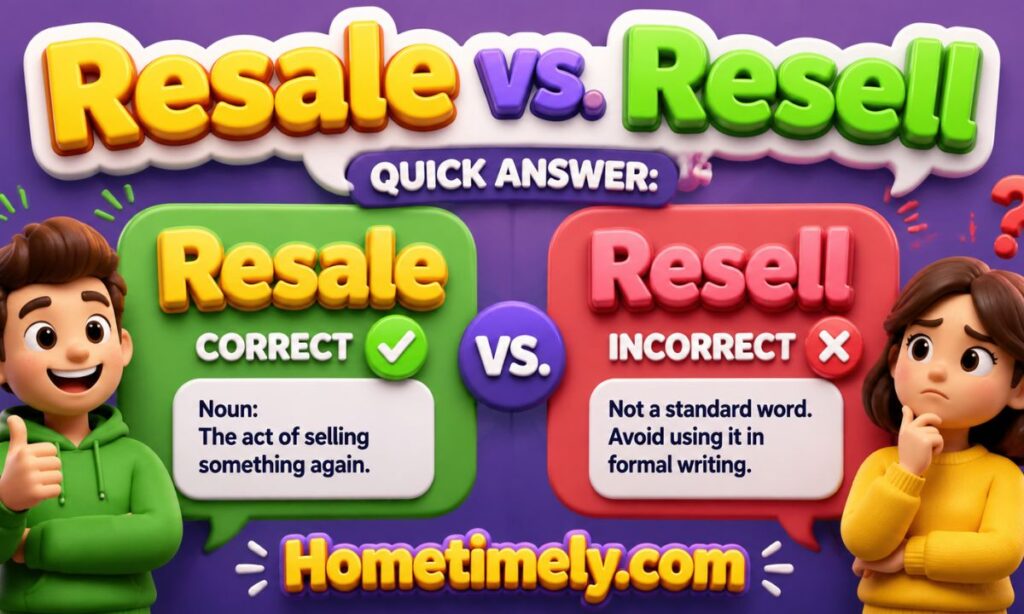
- Resale is a noun (sometimes an adjective). It refers to the act, event, market, or value connected to selling something a second time.
- Resell is a verb. It describes the action of selling something you previously bought.
| Word | Part of Speech | Meaning | Example |
| Resale | Noun / Adjective | The sale, market, or value of a previously owned item | “The resale value is impressive.” |
| Resell | Verb | To sell something again after buying it | “I plan to resell my laptop.” |
If you remember nothing else, remember this: resale pairs with “sale,” and resell pairs with “sell.”
What Does Resale Mean?
Resale refers to the act, transaction, or marketplace where something is sold for a second time after its original purchase. It functions primarily as a noun, though it frequently shows up as an adjective describing another noun.
As a noun, resale describes:
- A second sale of a product
- The overall market or industry built around selling used goods
- The value an item retains when sold again
Examples:
- The luxury watch resale industry has grown rapidly.
- She found a vintage dress at a local resale shop.
- The resale of tickets is restricted by the venue.
Notice that in each sentence, resale behaves like a “thing” — an event, a place, or a category — rather than an action someone is performing.
Common Phrases Using Resale
Certain word combinations with “resale” appear constantly in everyday and business English:
- Resale value
- Resale market
- Resale shop
- Resale price
- Resale rights
- Resale certificate
- Resale platform
Each of these treats resale as a noun or adjective attached to another noun — never as something a person actively “does” in the sentence.
What Does Resell Mean?
Resell means to sell something again after you’ve already purchased or acquired it. Unlike resale, resell is strictly a verb. It describes an action taking place, not a category or market.
Examples:
- The company buys electronics wholesale and resells them at retail prices.
- I want to resell my old textbooks before the semester ends.
- Some collectors resell rare sneakers for a significant profit.
A person derived from this verb is called a “reseller” — someone whose job or side hustle involves buying items with the intention of selling them again.
Resale vs Resell: The Key Difference
The simplest way to separate these words is through grammar, not meaning. Both relate to selling something a second time, but they answer different questions.
- Resale answers “what is it?” — a market, an event, a value, a category.
- Resell answers “what is happening?” — an action being performed by someone.
A quick substitution trick works well here:
- If you can replace the word with “sale”, use resale. (“The car has great resale value” → “The car has great sale value” — awkward, but the noun logic holds.)
- If you can replace the word with “sell”, use resell. (“I plan to resell my car” → “I plan to sell my car” — makes complete sense.)
Because resale is a noun/adjective and resell is a verb, they are not interchangeable, even though native speakers sometimes swap them by mistake in casual speech.
Resale Value vs Resell Value
This comparison is one of the most searched questions related to these two words, and the answer is straightforward: only “resale value” is correct.
“Value” is a noun, and nouns need another noun (or adjective) to describe them — not a verb. Since resell is a verb, it cannot logically modify “value.” Resale, being a noun/adjective, fits naturally.
- ✅ The car has excellent resale value.
- ❌ The car has excellent resell value.
This rule holds true across every industry — cars, real estate, electronics, and collectibles all use “resale value,” never “resell value.”
Resale and Resell in Online Business
E-commerce has made both words extremely common, and understanding when to use each one matters for product descriptions, business plans, and marketing copy.
- A resale business is the overall model or company that purchases products and later sells them again.
- To resell is the action those business owners take every day — sourcing items and reselling them to customers.
Examples:
- They run a small resale business specializing in refurbished phones.
- The store buys inventory from wholesalers and resells it online at a markup.
- Reselling platforms like consignment apps have made starting a resale side hustle easier than ever.
You’ll also encounter the term “resell rights,” which refers to a license allowing someone to sell another person’s digital product and keep the profit — common in the world of online courses, templates, and software.
When Should You Use “Resale”?
Use resale when you’re referring to:
- A market or industry (“the sneaker resale market”)
- A category of shop or platform (“a resale app”)
- The value or price something retains (“strong resale value”)
- An event or instance of selling again (“the resale of the property”)
When Should You Use “Resell”?
Use resell when you’re describing:
- An action someone is performing (“I will resell my bike”)
- A future or planned sale (“we plan to resell the equipment”)
- A repeated business activity (“they resell imported goods”)
- Instructions or advice (“don’t resell counterfeit items”)
Resale and Resell in Real Estate
Real estate is one of the clearest places to see this distinction in action.
- A resale home is a property that has already had at least one previous owner, as opposed to new construction.
- To resell a house means to sell it again after having purchased it, often after renovations or a period of ownership.
Examples:
- The resale market for suburban homes remains competitive.
- Investors renovate properties before they resell them for a profit.
- This resale home comes with an updated kitchen and finished basement.
Resale and Resell in Ticket Sales
Ticket marketplaces rely heavily on both words, and getting them right matters for anyone writing about live events.
- Resale describes the marketplace or transaction category. (“Ticket resale has become a billion-dollar industry.”)
- Resell describes the act performed by an individual seller. (“She plans to resell her concert tickets since she can no longer attend.”)
Many events explicitly prohibit the resale of tickets above face value, and scalpers who violate these rules resell them anyway on secondary marketplaces.
Resale and Resell in Fashion
The secondhand fashion movement has pushed both terms into mainstream vocabulary, especially with sustainability trends.
- Resale refers to the broader secondhand fashion economy — resale shops, resale apps, resale value of designer items.
- Resell refers to what an individual seller does with their own closet items.
Examples:
- Designer handbags often hold strong resale value years after purchase.
- She decided to resell her wardrobe on a secondhand fashion app.
- The resale fashion industry is expected to keep growing as shoppers prioritize sustainability.
Resale vs. Resell: Examples in Sentences
Here’s a side-by-side list to reinforce the distinction across different contexts:
| Sentence | Correct Word | Why |
| The ___ value of this phone is impressive. | Resale | Modifies a noun |
| I plan to ___ my old furniture. | Resell | Describes an action |
| The ___ shop downtown has great deals. | Resale | Describes a type of shop |
| They ___ imported goods for a profit. | Resell | Verb describing an activity |
| Ticket ___ is banned at this venue. | Resale | Refers to the transaction/event |
| She will her car next year. | Resell | Future action |
Why People Confuse Resale and Resell
The confusion isn’t random it happens for a few clear reasons:
- Both words share the same root (“sell”) and the same prefix (“re,” meaning “again”).
- They sound nearly identical when spoken quickly.
- English speakers often use nouns and verbs interchangeably in casual conversation, which blurs the grammatical line.
- Auto-correct and spellcheck tools rarely flag either word, since both are legitimate spellings.
Common Mistakes with Resale and Resell
Even confident writers slip up occasionally. Watch out for these frequent errors:
- ❌ I will resale my shoes tomorrow. → ✅ I will resell my shoes tomorrow.
- ❌ The resell value of the car is high. → ✅ The resale value of the car is high.
- ❌ She resale old books online. → ✅ She resells old books online.
- ❌ This house has great resell potential. → ✅ This house has great resale potential.
A good habit is to read the sentence aloud and ask: “Is this describing a thing, or is someone doing something?” That single question resolves almost every mix-up.
Also Read This : Visiter or Visitor: Which One Is Correct? (Answered in 30 Seconds)
Memory Tricks to Remember the Difference
If you need a fast mental shortcut, try one of these:
- Resale rhymes with “sale.” Sales happen at stores, markets, and events — all nouns. Resale works the same way.
- Resell rhymes with “sell.” Selling is something a person actively does — a verb. Resell works the same way.
- Picture a “For Resale” sign at a shop (a noun label) versus someone saying “I’ll resell it” (an action they’re announcing).
British vs American English
Unlike many word pairs that split between British and American spelling, resale and resell are used identically across both dialects. There is no regional variation in spelling or grammar — the noun/verb distinction applies everywhere English is spoken, whether in the UK, the US, Canada, Australia, or beyond. The only variation tends to be in which industries use the terms most often, with automotive and property content favoring “resale value” almost universally.
Frequently Used Expressions
To wrap up the practical side, here are some of the most common set phrases built around each word:
With Resale:
- Resale value
- Resale market
- Resale shop
- Resale certificate
- Resale rights
- For resale only
With Resell:
- Resell online
- Resell for profit
- Reselling business
- Resell rights (note: this specific phrase pairs “resell” as a verb form describing a licensing action, distinct from “resale rights” as a legal category)
- Buy to resell
User Queries 🔍
People searching this topic online typically want to know:
- Is it “resale value” or “resell value”?
- What’s the difference between a resale shop and reselling?
- Can “resale” ever be used as a verb?
- Is “resell” the same as “flipping”?
- Do British and American English use these words differently?
The answers to all of these trace back to the same core rule: resale is a noun/adjective, resell is a verb, and context determines which one fits.
Conclusion 📌
Resale and resell may share the same root word, but they serve very different jobs in a sentence. Resale describes a market, an event, a value, or a category — it’s the “thing.” Resell describes the action of selling something you’ve already bought it’s the “doing.” Once you internalize this noun-versus-verb distinction, you’ll never second-guess phrases like “resale value” or “I plan to resell my car” again.
Whether you’re writing a product listing, discussing real estate, flipping sneakers, or just trying to clean out your closet, using the right word makes your writing sound clearer, more professional, and more polished. Keep the simple substitution trick in mind sale for resale, sell for resell and you’ll get it right every time.

Michael Brook is the creator and author behind Healthy Leeks, a platform focused on grammar, writing skills, and English language learning. Passionate about clear communication and effective writing, Michael Brook shares practical grammar tips, easy-to-follow language guides, and educational content to help readers improve their English with confidence.


