Back-to-school season always brings the same small debate: is it “kindergartner” or “kindergartener”? Parents typing a proud social media caption, teachers preparing classroom signs, and writers drafting school newsletters all pause at the same spot. The word looks slightly different depending on where you see it, and neither spelling ever gets flagged by spellcheck.
Here’s the good news you’re not making a mistake either way. This guide explains exactly where both spellings come from, which one is technically more common, and how to choose confidently depending on your audience.
Kindergartner or Kindergartener: Quick Answer
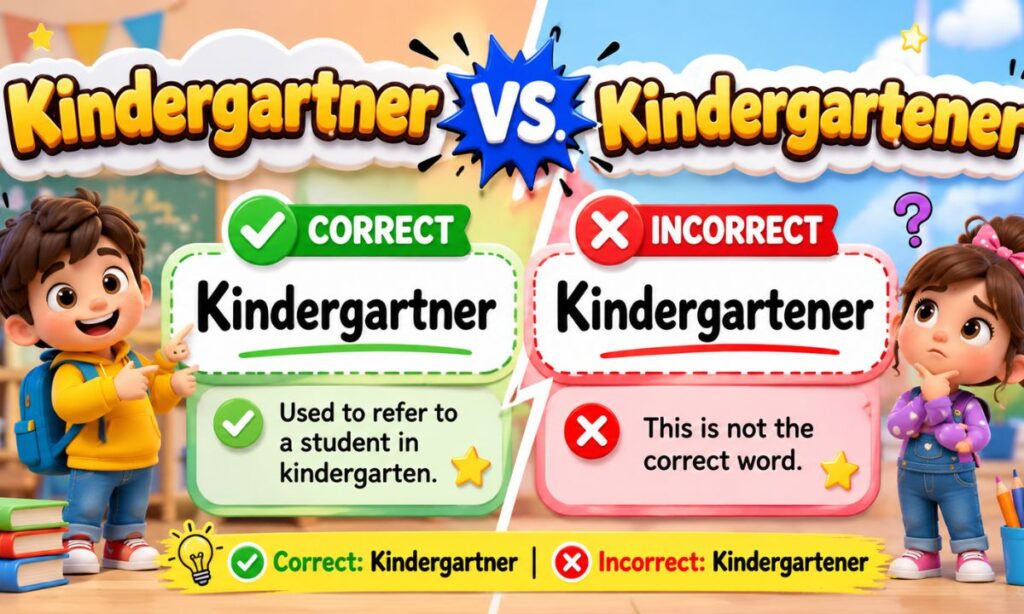
Both kindergartner and kindergartener are correct spellings of the same word, referring to a child attending kindergarten, typically around five years old.
- Kindergartner — the shorter, more traditional spelling, slightly more common in dictionaries and formal American English.
- Kindergartener — the longer variant with an extra “e,” widely used in casual writing, parenting blogs, and everyday speech.
Neither spelling is “wrong.” The difference comes down to style and regional habit, not grammar rules.
The Origin of Kindergartner or Kindergartener
To understand why two spellings exist, it helps to look at where the word came from.
- Kindergarten is a German word meaning “children’s garden.” It was introduced by educator Friedrich Fröbel in the 19th century to describe an approach to early childhood learning centered on play and exploration.
- When English speakers needed a word for a child attending kindergarten, they applied the familiar “-er” pattern used for people-nouns, such as teacher, writer, and painter.
- Applying that pattern directly to “kindergarten” produces kindergartener.
- Over time, many English speakers dropped the middle syllable for easier pronunciation, producing the shorter kindergartner.
Both forms evolved naturally from the same root, which is exactly why dictionaries list them as accepted alternates rather than treating one as an error.
British English vs American English Spelling
Unlike classic British-versus-American spelling pairs (color/colour, organize/organise), this isn’t really a regional split.
- Both kindergartner and kindergartener are American English forms.
- British English rarely uses either word. Instead, British schools typically refer to a child in “reception” or “nursery,” since the term “kindergarten” itself is far less common in UK education systems.
- Canada and Australia use both spellings occasionally, though their early education systems often rely on different terminology altogether.
So if you’re writing for a British audience, neither spelling may be the most natural choice but for American English content, both are fully acceptable.
Which Spelling Should You Use?
Use whichever spelling matches your audience and writing context, then stay consistent throughout your document. Here’s a simple breakdown:
| Situation | Recommended Spelling |
| Formal or academic writing | Kindergartner |
| Traditional dictionaries and style guides | Kindergartner |
| Everyday conversation and parenting blogs | Kindergartener |
| School newsletters and casual educational content | Either (stay consistent) |
| Marketing or SEO content | Consider search volume for your audience |
The most important rule isn’t which word you pick — it’s picking one and sticking with it throughout the same piece of writing.
What Does “Kindergartner” Mean?
A kindergartner is a child enrolled in their first year of formal schooling, usually kindergarten, typically around five or six years old. It functions as a standard noun.
Examples:
- My daughter is a kindergartner this year.
- The kindergartners lined up for their first day of school.
- Reading aloud is especially important for a kindergartner’s development.
This spelling drops the extra “e” found in “kindergarten,” similar to how some English words simplify for smoother pronunciation.
What Does “Kindergartener” Mean?
Kindergartener carries the exact same meaning as kindergartner a child attending kindergarten but keeps the full “-ener” ending, staying closer to the original word “kindergarten.”
Examples:
- Every kindergartener received a welcome pack on their first day.
- She’s such a proud kindergartener, showing off her new backpack.
- The kindergarteners sang a song for their families.
Some writers find this version more intuitive since it visually mirrors “kindergarten” more closely, even though it isn’t the shorter or more traditional option.
Common Mistakes with Kindergartner or Kindergartener
Because both spellings are valid, most “mistakes” aren’t really grammar errors — they’re inconsistency errors. Watch for these instead:
- Switching spellings mid-document. Using “kindergartner” in one paragraph and “kindergartener” in the next looks unpolished, even though both are correct individually.
- Misspelling the plural form. It’s kindergartners or kindergarteners — never “kindergartner’s” when referring to more than one child (that apostrophe form implies possession, not plural).
- Confusing it with “kindergarten.” Kindergarten refers to the school or grade level itself; kindergartner/kindergartener refers to the child attending it.
- Assuming one spelling is officially “incorrect.” Major dictionaries, including Merriam-Webster and the American Heritage Dictionary, list both as standard entries.
Kindergartner or Kindergartener in Everyday Examples
Here’s how both spellings show up naturally across different contexts:
Kindergartner:
- I can’t believe my son is already a kindergartner.
- The teacher praised her kindergartners for their patience.
- Being a kindergartner comes with a lot of new responsibilities, like tying your own shoes.
Kindergartener:
- The kindergartener proudly held up her drawing.
- Every kindergartener in the class got a certificate.
- Starting as a kindergartener is a big milestone for any child.
Notice that the sentences work identically well with either spelling the meaning never changes, only the word’s visual form.
Also Read This : https://www.merriam-webster.com/dictionary/kindergartner
Easy Trick to Remember the Correct Word
If you want a simple way to decide which spelling to use, try this:
- Think “shorter and traditional” → kindergartner. It drops a syllable, similar to how “camera” is sometimes pronounced “camra.”
- Think “matches the root word” → kindergartener. It keeps the full spelling of “kindergarten” intact, plus “-er.”
- When unsure, check your style guide. If you’re writing for a school, publication, or brand, follow whatever their existing materials use.
- If you want the safest, most universally accepted option, choose “kindergartner.” It’s the version most consistently listed first in major dictionaries.
Kindergartner or Kindergartener: Google Trends & Usage Data
Search interest and dictionary data both suggest a slight, consistent lean toward one spelling over the other:
- Dictionary entries, including Merriam-Webster, typically list kindergartner as the primary spelling, with kindergartener noted as an accepted variant.
- Long-term usage tracking (such as Google Ngram data comparing printed text over decades) shows kindergartner used somewhat more frequently overall, though both spellings follow similar trends over time.
- Kindergartener tends to appear more often in casual, conversational writing — parenting blogs, social media captions, and informal school communications.
- Kindergartner appears more frequently in formal or traditional educational writing.
The takeaway: kindergartner holds a modest edge as the “default” spelling, but kindergartener is common enough that it never reads as incorrect.
Comparison Table: Kindergartner vs Kindergartener
| Feature | Kindergartner | Kindergartener |
| Meaning | A child attending kindergarten | A child attending kindergarten |
| Origin | Shortened form, drops a syllable | Closer to the original word “kindergarten” |
| Formality | Slightly more formal/traditional | Slightly more casual/conversational |
| Dictionary preference | Usually listed first | Usually listed as a variant |
| Common in | Academic writing, formal documents | Parenting blogs, everyday speech |
| Correctness | ✅ Correct | ✅ Correct |
| Regional use | American English | American English |
Conclusion
Kindergartner and kindergartener are two accepted spellings for the same word, and choosing between them is a matter of style rather than correctness. Kindergartner tends to appear more often in dictionaries and formal writing, while kindergartener feels natural in everyday, conversational contexts.
Whichever version you choose, the most important habit is staying consistent throughout your writing. Once you understand where the two spellings come from, you can use either one with complete confidence because both are, quite simply, correct.

Michael Brook is the creator and author behind Healthy Leeks, a platform focused on grammar, writing skills, and English language learning. Passionate about clear communication and effective writing, Michael Brook shares practical grammar tips, easy-to-follow language guides, and educational content to help readers improve their English with confidence.


