
“How are you fairing?” or “How are you faring?” If you’ve paused before typing this question, you’re dealing with one of English’s trickiest homophone pairs. These two words sound identical but mean completely different things and mixing them up is one of the most common small mistakes writers make. Here’s exactly how to tell them apart, for good.
Quick Answer: Fairing or Faring?
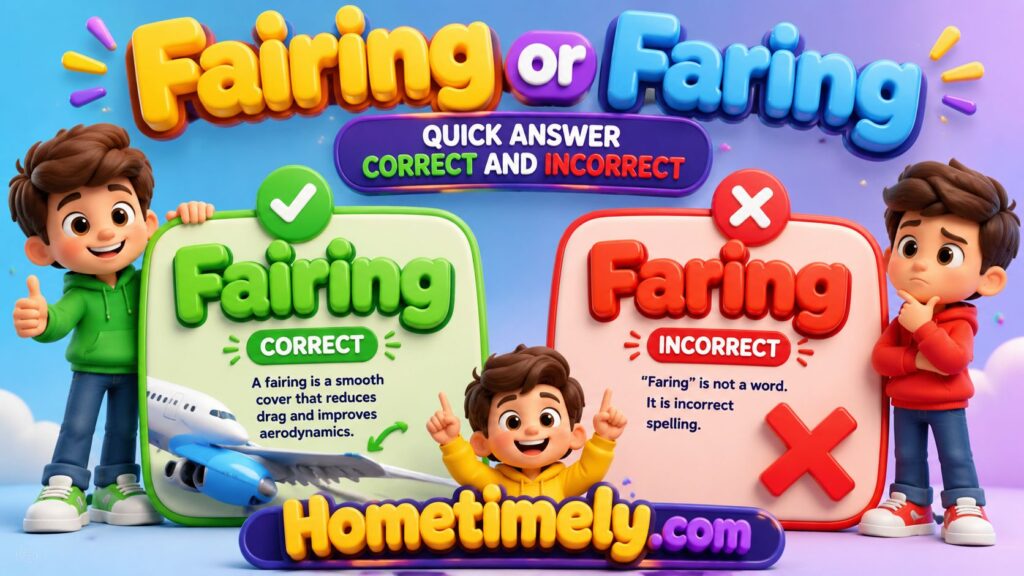
Faring is the word you want when talking about how someone is doing, managing, or progressing. Fairing refers to a physical structure on a vehicle, aircraft, or spacecraft that reduces drag.
| Word | Part of Speech | Meaning |
| Faring | Verb (present participle of “fare”) | Doing, managing, progressing |
| Fairing | Noun | Aerodynamic covering on a vehicle |
So the correct phrase is always “How are you faring?” never “How are you fairing?”
Meaning of “Fairing”
Fairing is a noun used in engineering, aviation, and automotive design. It describes a shell or structure attached to a vehicle to smooth airflow, reduce drag, and improve overall performance.
You’ll typically hear this word in contexts like:
- Motorcycles – the plastic shell covering the front of a sport bike
- Aircraft – panels that streamline the body of a plane
- Rockets and spacecraft – the nose cone that protects a payload during launch
- Boats – structures that reduce water or wind resistance
Example: The motorcycle’s fairing cracked after the minor collision.
Meaning of “Faring”
Faring comes from the verb “fare,” which means to get along, progress, or experience a particular outcome. Adding “-ing” turns it into a present participle, commonly used in questions and statements about someone’s condition or performance.
You’ll see “faring” in contexts like:
- Checking in on someone’s well-being: How are you faring after the surgery?
- Describing performance: The team is faring well this season.
- Talking about progress: She’s faring better in her new job than expected.
Example: He is faring reasonably well despite the setback.
Key Differences Between Fairing and Faring
| Feature | Fairing | Faring |
| Word type | Noun | Verb (present participle) |
| Root word | Fair (to smooth) | Fare (to go/manage) |
| Used for | Vehicles, aircraft, rockets | People, teams, situations |
| Common phrase | “New fairing installed” | “How are you faring?” |
| Field | Engineering/technical | Everyday/conversational |
The simplest way to separate them: fairing is a thing, faring is an action.
Common Mistakes People Make
The most frequent error is using “fairing” when asking about someone’s well-being.
- ❌ How are you fairing?
- ✅ How are you faring?
Other common slip-ups include:
- Mixing the words in casual writing – “She is fairing well in college” instead of “faring.”
- Assuming spell-check will catch it – both words are spelled correctly on their own, so spell-checkers won’t flag the wrong choice.
- Using “fairing” in a performance context – “The company is fairing better this quarter” should be “faring.”
- Misspelling “faring” as “fareing” – this isn’t a real word; the correct form drops the silent “e” before adding “-ing.”
Because these mistakes don’t trigger red underlines, careful proofreading matters more than usual here.
Memory Tricks to Never Confuse Them Again
A few simple associations make this pair much easier to remember:
- Faring = fare → Think of a “farewell” or a taxi “fare.” Both relate to a journey or a person’s path, just like faring relates to how someone’s personal journey is going.
- Fairing = fair + ing → A fairing makes a vehicle’s surface “fair,” meaning smooth and even, which reduces drag.
- “Are” is inside “faring” → Notice that “faring” contains the letters for “are,” which matches the question “How are you faring?”
- Fairing sounds technical → If the sentence involves a machine, vehicle, or aircraft, it’s almost always fairing.
Pick whichever trick sticks best, and you’ll stop hesitating over this pair for good.
American vs British English Differences
There is no spelling difference between American and British English for either word. Both “fairing” and “faring” are used identically across regions.
| Region | Fairing | Faring |
| American English | Fairing | Faring |
| British English | Fairing | Faring |
| Australian English | Fairing | Faring |
The only variation is stylistic. British writing sometimes favors “How are you faring?” in slightly more formal contexts, while American English often defaults to the more casual “How are you doing?” Both phrasings are correct; it’s simply a matter of tone.
Easy Trick to Remember the Difference
If you only remember one rule from this entire guide, make it this one:
If it involves a person’s condition, use faring. If it involves a vehicle’s structure, use fairing.
Run a quick mental test before you commit to either spelling:
- Ask yourself: is the sentence about a person, team, or situation? → Use faring.
- Ask yourself: is the sentence about a motorcycle, aircraft, or rocket part? → Use fairing.
This two-question check works for almost every sentence you’ll ever write with these words.
Also Read This : What Kind of vs. What Kinds of: What’s the Difference? (With Examples)
When to Use Fairing in Technical Writing
In engineering, aviation, and automotive writing, “fairing” is a precise technical term, and there’s no substitute for it. Use it when describing:
- Vehicle design – “The car’s fairing reduces aerodynamic drag at high speeds.”
- Motorcycle components – “He replaced the cracked fairing after the accident.”
- Aerospace structures — “The rocket’s fairing separated cleanly after launch.”
- Marine engineering – “The boat’s hull fairing smooths water flow.”
Because this word carries a specific technical meaning, it’s important not to substitute it with a more general term like “cover” or “shell” in professional or scientific writing, where precision matters.
Fairing and Faring in Example Sentences
Seeing both words side by side in similar sentence structures makes the distinction easier to internalize.
Fairing:
- The mechanic ordered a replacement fairing for the motorcycle.
- Engineers tested the fairing’s shape in a wind tunnel.
- The spacecraft’s fairing protected the satellite during launch.
- A damaged fairing can affect a vehicle’s fuel efficiency.
Faring:
- How is your brother faring after the move?
- The business is faring surprisingly well this year.
- She’s faring better than expected after the surgery.
- The new employee is faring nicely in his first month.
Notice how “faring” always connects to a living subject or an ongoing situation, while “fairing” always connects to a physical object.
When to Use Faring in Conversation or Writing
“Faring” fits naturally into everyday speech, check-ins, and reflective writing. It’s especially common when:
- Asking about someone’s recovery or health
- Discussing a team’s or company’s performance
- Checking on a friend’s progress after a big change, like a move or new job
- Writing narrative or reflective content about how a character is coping
Example: After weeks apart, she finally asked how he was faring on his own.
This word carries a warm, conversational tone, which is part of why it shows up so often in personal messages and check-in emails.
Why These Words Get Confused So Often
Fairing and faring are true homophones they sound exactly alike but come from entirely different word roots and serve entirely different grammatical roles. A few reasons this mix-up is so common:
- Identical pronunciation removes any audible clue about which spelling is correct.
- Spell-check won’t help, since both words exist and are spelled correctly on their own.
- Fairing is a rarer, more technical word, so many people default to it simply because “faring” looks less familiar.
- Both words end in “-ing,” which visually reinforces the idea that they might be interchangeable, even though their meanings have nothing in common.
Recognizing why the confusion happens is often the fastest way to stop making the mistake yourself.
Quick Practice Quiz
Test yourself with these five sentences. Choose “fairing” or “faring” for each blank.
- How is your mom _______ since the operation?
- The motorcycle’s _______ needs to be repainted.
- The startup is _______ better than analysts predicted.
- The rocket’s _______ deployed successfully after liftoff.
- He’s _______ well despite the tough semester.
Answers: 1. faring 2. fairing 3. faring 4. fairing 5. faring
If you got all five right, this pair should no longer give you trouble.
Conclusion
Fairing and faring may sound identical, but their meanings couldn’t be more different. Faring describes how someone or something is doing, while fairing refers to a physical, aerodynamic structure on a vehicle.
Whenever you’re asking about a person’s well-being or progress, faring is the correct choice always. Save fairing for motorcycles, aircraft, and rockets, and you’ll never confuse this pair again.

Michael Brook is the creator and author behind Healthy Leeks, a platform focused on grammar, writing skills, and English language learning. Passionate about clear communication and effective writing, Michael Brook shares practical grammar tips, easy-to-follow language guides, and educational content to help readers improve their English with confidence.


