You sit down to write a quick caption or email, type “time flys so fast,” and pause. Does that look right? It doesn’t, and you’re not the only one who’s stopped mid-sentence over this exact phrase. Here’s the clear answer, plus the simple grammar rule behind it, so you never have to second-guess it again.
My Quick Answer
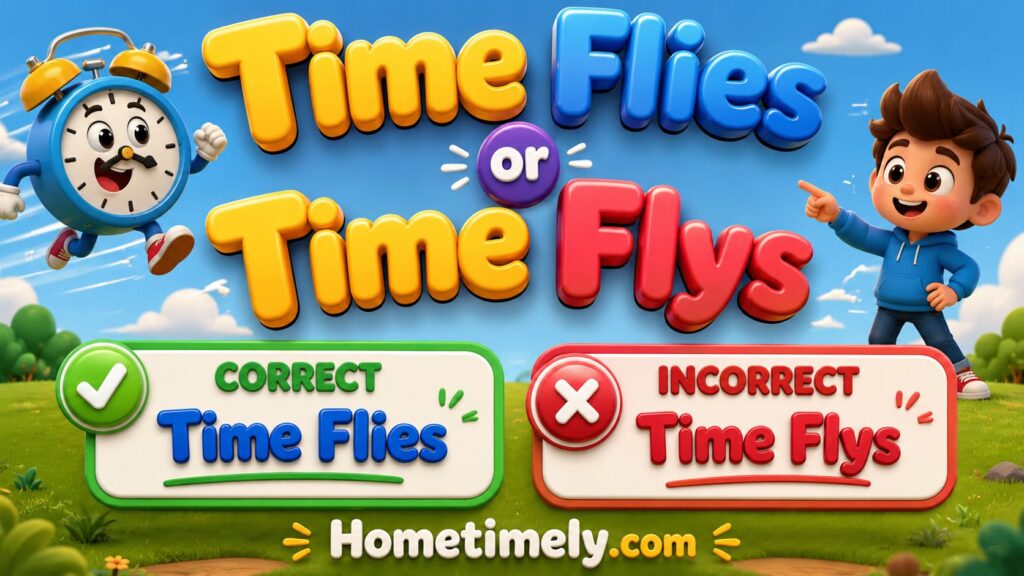
Time flies is correct. Time flys is always a mistake.
There’s no context, casual, formal, academic, or professional, where “flys” is an acceptable substitute for “flies” in this phrase. It isn’t a British versus American English difference either. Both varieties of English agree on the same spelling.
- Correct: Time flies when you’re having fun.
- Incorrect: Time flys when you’re having fun.
If you remember one thing from this article, let it be this: whenever “fly” follows a singular subject like time, he, she, or it, the correct form is always flies, never “flys.”
Why I Found It’s “Time Flies”
When I looked into why this mistake is so common, it came down to a simple mix-up between two different grammar patterns.
Most English speakers learn early on that adding “s” makes a word plural or turns a verb into its third-person form: cats, runs, plays. That instinct works fine most of the time. But fly doesn’t follow the regular “just add s” pattern, because it ends in a consonant followed by the letter y.
Instead of becoming “flys,” the verb fly transforms into flies in the third-person singular present tense. This happens because time, like he, she, and it, is treated as a singular subject, so the verb must match it in its singular form.
That one exception is the whole story behind the confusion. People assume every verb ending in y just takes an s, but English spelling rules say otherwise.
The Consonant + Y Rule I Learned
Here’s the actual spelling rule that explains why “flies” is correct, broken down step by step:
- Look at how the base verb ends. Fly ends in a consonant (l) + y.
- When a verb ends in a consonant followed by y, English grammar requires you to change the y to i before adding the ending.
- For third-person singular present tense, add -es instead of just -s.
- Put it together: f-l-y → f-l-i + es = flies.
This is different from verbs that end in a vowel + y, like play or stay. Those simply add -s, no changes needed: plays, stays. The rule only kicks in when a consonant comes right before the y.
Because time behaves grammatically like a singular noun (he, she, it, time), the verb that follows it must also take this singular, -ies ending. That’s why we say “time flies,” not “time fly” or “time flys.”
What “Time Flies” Means
Beyond the spelling, it helps to understand what the phrase is actually communicating.
“Time flies” is an idiom, meaning its message isn’t about literal flight. It describes the feeling that time is passing quickly, especially during moments that are enjoyable, busy, or absorbing.
- You might say it after a great weekend that felt like it lasted five minutes.
- You might say it while realizing an entire year has gone by since a big life event.
- You might say it mid-conversation, surprised that an hour has already passed.
The phrase captures a shared human experience: our perception of time speeding up when we’re engaged, and slowing down when we’re bored or waiting. It has nothing to do with clocks moving faster. It’s about how time feels.
Why “Time Flies” Is the Correct Phrase
Putting the grammar and meaning together, here’s why “time flies” is the only correct version:
- Grammatically, time is treated as a third-person singular subject, so it requires the -ies verb form, matching patterns like “she tries” or “he cries.”
- Historically, the phrase has roots in the Latin expression tempus fugit, which translates to “time flees” or “time escapes.” English writers adapted this idea centuries ago, and the modern form settled into “time flies.”
- Consistently, both British and American English use the exact same spelling, unlike words such as color/colour or organize/organise. There’s no regional variation to worry about here.
- Dictionary-wise, “flys” isn’t recognized as a standard English word in this context at all, which is why spell-checkers and grammar tools flag it every time.
All of these point to the same conclusion: “time flies” isn’t a stylistic preference. It’s the only grammatically correct form.
Common Mistakes I’ve Found and How to Avoid Them
After seeing this error pop up again and again, a few patterns stand out:
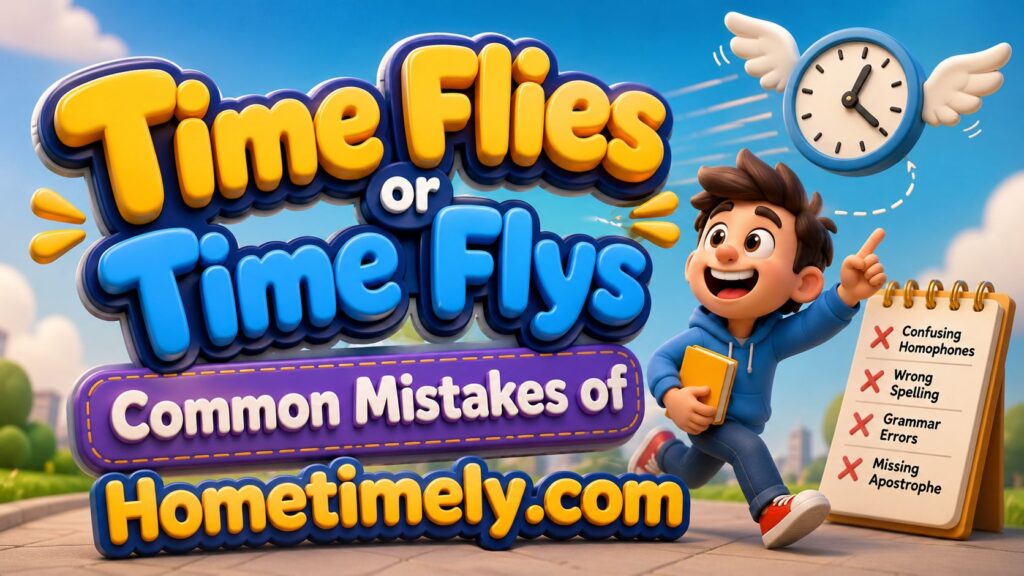
- Mistake: Writing “flys” because it looks like a simple plural, the way “toys” or “days” would work. Fix: Remember that “fly” isn’t just becoming plural here, it’s conjugating as a verb, and verbs ending in consonant + y follow the -ies rule.
- Mistake: Assuming autocorrect will always catch it. Fix: Many casual typing apps and social media platforms don’t flag “flys,” so don’t rely on autocorrect alone.
- Mistake: Overcomplicating the rule by trying to memorize the phrase instead of the underlying pattern. Fix: Learn the consonant + y rule once, and it applies automatically to every similar verb, not just “fly.”
- Mistake: Confusing “flies” the verb with “flies” the plural noun (as in, insects). Fix: Context makes the difference clear. “Time flies” uses the verb form; “There are flies in the kitchen” uses the noun form. Both are spelled identically, but they mean very different things.
Real-World Examples I’ve Collected
Seeing the phrase in natural, everyday sentences makes it easier to internalize the correct spelling.
Casual conversation:
- Time flies when you’re on vacation.
- I can’t believe it’s already December, time flies!
- Time flies when you’re catching up with old friends.
Professional and email use:
- Time flies so quickly this quarter; let’s schedule a check-in soon.
- Apologies for the delayed response, time flies during busy seasons.
- Looking back at this project, time flies when the team is in sync.
Social media captions:
- Can’t believe it’s already fall, time flies.
- One year at this job today. Time flies!
- Throwback to last summer, time really does fly.
Notice that in every example, the spelling stays exactly the same: f-l-i-e-s, regardless of tone or setting.
Time Flies vs Time Flys: My Summary Table
Here’s a simple reference table you can save for quick spelling checks.
| Feature | Time Flies (Correct) | Time Flys (Incorrect) |
| Grammatical status | Standard, correct verb form | Misspelling, not a real word |
| Verb rule applied | Consonant + y → change y to ies | Rule ignored |
| Used in American English | Yes | No |
| Used in British English | Yes | No |
| Recognized by dictionaries | Yes | No |
| Appropriate for formal writing | Yes | No |
| Appropriate for casual writing | Yes | No |
| Origin | Rooted in Latin “tempus fugit” | No linguistic basis |
Other Common Variations I Found
While researching this phrase, a few related versions and misspellings came up often:
- Time flies by – correct, an extended version of the same idiom.
- Time flys by – incorrect, same mistake applied to the longer phrase.
- Time fly – incorrect, missing the required verb agreement entirely.
- Time flies when you’re having fun – the most common full version of the idiom, always spelled with “flies.”
- Time flie’s – incorrect, mistakenly adding an apostrophe as if forming a possessive, which doesn’t apply here at all.
No matter which variation you’re using, the core word “flies” never changes its spelling.
Also Read This : It’s Called vs It Called: Correct Meaning, Usage & Examples
Memory Tips I Use to Remember the Rule
If the grammar explanation feels like a lot to hold onto in the moment, these quick tricks help:
- Match it to similar words. Try becomes tries, cry becomes cries, dry becomes dries. Fly follows the same family: fly becomes flies.
- Say it with “he” or “she.” If you wouldn’t write “he flys away,” you shouldn’t write “time flys” either. Both use the same singular verb rule.
- Picture the Latin root. Tempus fugit reminds you that this phrase has old, established roots, not a modern casual spelling.
- Check the y. If a verb ends in a consonant right before the y, expect it to become -ies, not just add an s.
Other Words That Follow the Same Rule
This consonant + y pattern isn’t unique to “fly.” Once you notice it, you’ll spot it in plenty of everyday verbs:
- Try → Tries, not “trys”
- Cry → Cries, not “crys”
- Dry → Dries, not “drys”
- Carry → Carries, not “carrys”
- Reply → Replies, not “replys”
- Study → Studies, not “studys”
Each of these follows the exact same logic as “time flies”: consonant before the y, so the y changes to i, and -es is added for the singular verb form.
Synonyms and Alternatives to “Time Flies”
If you want to express the same idea without repeating the same idiom, several alternatives work well depending on tone:
- Time passes quickly
- The hours slipped by
- Time got away from me
- Before I knew it, the day was gone
- Time seemed to fly by
- The moments flew past
These alternatives keep your writing varied while still capturing that same feeling of time moving faster than expected.
Explore More Grammar Guides
Mixing up verb endings is one of the most common sources of everyday spelling mistakes, especially with irregular or consonant-plus-y verbs. If this guide helped, it’s worth building a habit of checking similar tricky pairs whenever you’re unsure, phrases and words like putting vs puting, or tries vs trys, follow their own small but consistent rules. The more of these patterns you learn, the fewer second-guesses you’ll have while writing.
conclusion
Getting “time flies” right comes down to one dependable rule: when a verb ends in a consonant plus y, that y changes to ies for singular subjects like time, he, she, or it. Once that clicks, “flies” stops being something you have to think about and becomes automatic, the same way “tries” or “cries” already feels natural.
So the next time you’re wrapping up an email, writing a caption, or just chatting with a friend about how fast the year has gone, you can type it with confidence: time flies, never time flys. It’s a small detail, but getting it right keeps your writing polished and clear.

Michael Brook is the creator and author behind Healthy Leeks, a platform focused on grammar, writing skills, and English language learning. Passionate about clear communication and effective writing, Michael Brook shares practical grammar tips, easy-to-follow language guides, and educational content to help readers improve their English with confidence.